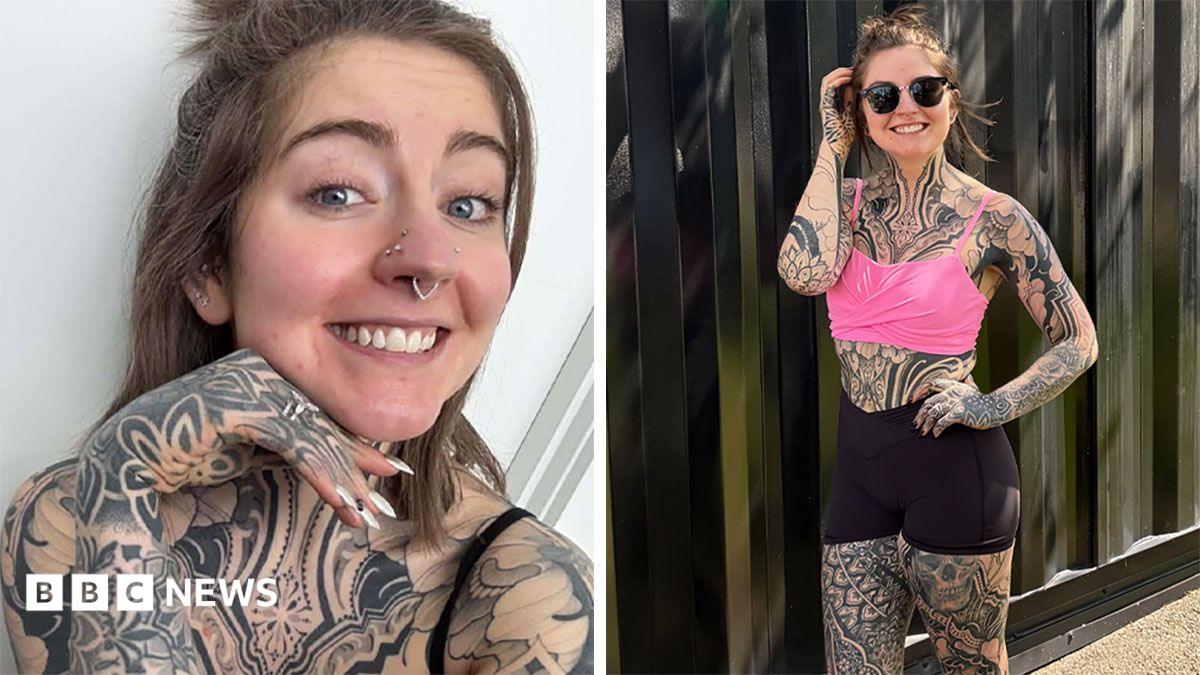
Image source, Alyssa GrocuttImage caption, Dr Alyssa Grocutt explored perceptions of tattoos in the workplace for her PhD
Tattoos have been in the cultural mainstream for years. Even the prime minister has got one (a bee, on his bicep).
And there are no signs the trend is starting to fade. More people than ever are going under the needle as a form of self-expression: 40% of British 25-49 year-olds have at least one tattoo, according to a 2024 YouGov poll.
The most popular body part to be inked? The upper arm, says YouGov.
But has that acceptance carried over into the workplace?
Sociologist Dr Michael Rees says a big gulf in social acceptability remains between visible and non-visible tattoos, particularly those on hands, neck and face as opposed to the rest of the body.
"I don't think it's completely accepted, and I think there's probably limits to that."
While Rees himself has his hands and neck inked, he didn't get either done until he got his first permanent job as an academic.
"Even working in the career I work in, I was concerned that it may harm my job prospects.
"I think people getting tattooed in those areas are potentially restricting the careers that they go into."
This is borne out by 2022 YouGov research, which found that while about two-thirds of people consider visible tattoos on the face or neck unprofessional, a similar proportion would think other visible tattoos are professional.
Image source, Matthew ReesImage caption, Sociologist Dr Michael Rees has his hands and neck inked, but didn't get either done until he got his first permanent job as an academic
Dr Alyssa Grocutt, who is herself heavily tattooed, explored perceptions of tattoos in the workplace for her PhD at the University of Calgary in Canada, and found many stereotypes around tattooed people still exist today, both positive and negative.
Perhaps unsurprisingly, people with intimidating tattoos – in this study, a skull and a knife – were perceived as risky, while those with "friendly" tattoos of a rose and some leaves were perceived as more creative and artistic.
Overall, job applicants with visible tattoos are still slightly less likely to be hired than those without, she says.
But for entrepreneurs, or those working in creative industries, Grocutt suggests they may be viewed as an extension of someone's personal brand.
"Even 11 years ago, when I started getting tattooed, the hands, neck and face were called 'job stoppers', and a lot of artists wouldn't tattoo people in those areas," she says.
"I think it's shifting a bit or maybe tattoo artists don't want to be gatekeepers. There's more positive perceptions now, [but] you still get a lot more attention, and that's an adjustment to get used to."
For centuries, tattoos were firmly linked to criminal gangs and sailors and, more recently, counter-cultural movements such as punk and motorbike clubs.
But since the early 2000s, tattoos have been steadily "demystified" through a combination of celebrities and popular TV shows such as Tattoo Fixers and London Ink, says Rees.
"When I got my first tattoos in the late '90s... they were outside of the mainstream. But they are everywhere now."
Every tattooed person he interviewed in the 2000s for his research cited David Beckham as their inspiration; the footballer made a statement when he got his first inking in 1999. Now, celebs like Harry Styles and Ed Sheeran are covered in tattoos, with more than 50 each.
Tattoo artist Martha Smith thinks stigma has "changed massively", with tattoos no longer seen as associated with criminality or class discrimination.
And new trends are emerging too. Smith, who is based in Broadstairs, Kent, specialises in fine line and dot work tattoos. The hashtag #finelinetattoo has racked up 10.3m searches on Instagram, while #dotworktattoo boasts 4.8m searches.
"Probably until the early noughties, there was a very specific person who thought they could be tattooed. But in the 13 years I've been tattooing, clients have certainly become more diverse," Smith says, adding that she quite often tattoos NHS workers, social workers or teachers.
Image source, Martha SmithImage caption, Tattoo artist Martha Smith specialises in fine line and dot work tattoos and thinks stigma has "changed massively"
Catherine Hibbert, 44, waited almost 20 years to get her first tattoo. She now plans to get one every year of her forties.
"I was a bit nervous when I went for my first one," she says. "I was scared of it being painful, or that I was making the wrong decision.
But as soon as the tattoo template was on, Hibbert says she "instantly loved it".
"I guess it's an adrenaline rush, but I'm on a high for days after."
Her forearm tattoo comprises geometric shapes symbolising different members and aspects of her family.
"They've all got meaning, and I like the fact that I can design them myself," says Hibbert, who works in an art gallery.
Image source, Catherine HibbertImage caption, "I guess it's an adrenaline rush, but I'm on a high for days after," says Catherine Hibbert, who plans to get a tattoo every year of her forties
Smith thinks tattooists themselves now come from a much broader artistic background.
"You now often go to a tattooist because of their artwork. This massively opens up the kind of person that would want a tattoo and what a tattoo can mean. It also is a more affordable way of becoming an art collector."
"Everybody loves my arm tattoo," she says. "I think it's because it's quite unusual from what lots of people expect a tattoo to look like… this is very delicate."
Of all the factors behind tattoos' popularity, authenticity is the one Rees thinks trumps them all – because, he says, it is something we really value culturally.
"A lot of my respondents thought that was something that a tattoo gave them, a commitment to a band or to a person, to [addiction] recovery, just to kind of [being] who they really were."
Of course, the elephant in the room is regret. Tattoos are permanent, and critics suggest that as these generations age they may no longer like the inkings they chose decades previously.
"They're like a story, so it's memories and it's stories about me and my life."
Bottomless tattoo events cheapen industry, say artists
'Just joking' added to England World Cup win tattoo