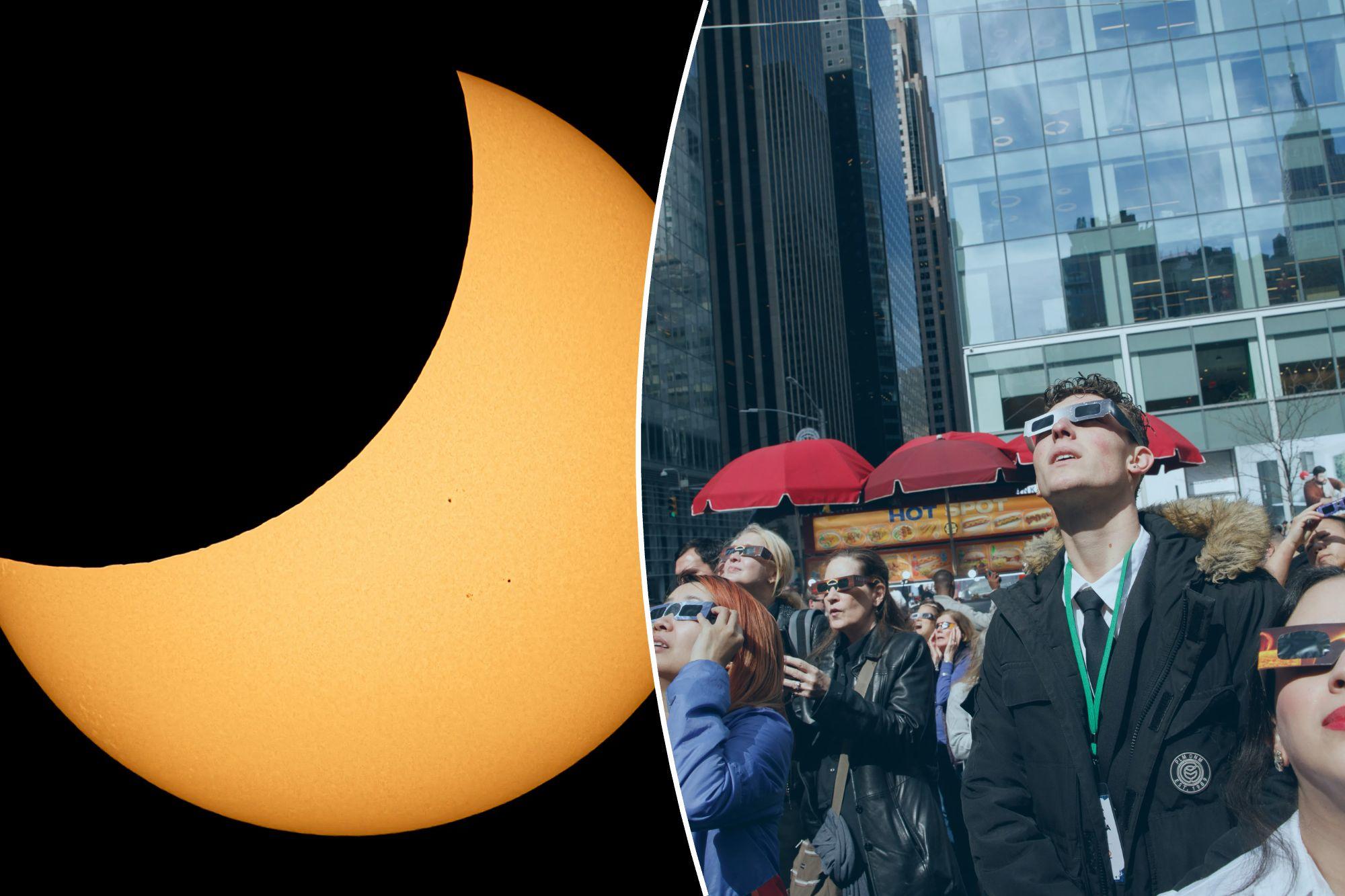
A partial solar eclipse will be visible on August 12 in parts of North America, including NY. Thiago - stock.adobe.com See more of our coverage in your search results.
Add The New York Post on Google Stargazers are over the moon.
On August 8, the skies will be shrouded in a moon shadow due to a solar eclipse that will be visible in Europe, Canada and parts of the Northern US.
This celestial spectacle occurs when our lunar satellite passes between the sun and the Earth, causing a twilight-esque effect as it obscures the solar rays, according to the Weather Channel.
When this cosmic overlap is total, all that will be visible is the sun’s corona — its elusive outer atmosphere, according to Space.com.
A partial solar eclipse (pictured) will grace the skies in parts of Canada and the Northeast US. Mariusz – stock.adobe.com In this case, the 180-mile-wide path of totality will sweep across Spain, Greenland, Iceland, northern Spain and the Balearic Islands, marking Europe’s first total solar eclipse since 1999, Livescience reported.
Meanwhile, other parts of Europe and North America will have the opportunity to witness a partial eclipse, when the moon only blocks out part of our solar star, meaning we won’t get the dramatic darkening experienced during the total package.
The US’ last total eclipse was on April 8, 2024, when the totality swept over everywhere from Texas to New York City.
In New York, the partial will last for roughly an hour and a half, beginning at at 1:07pm, peaking at 1:54pm and ending at 2:38pm.
New Yorkers taking in an eclipse on April 8, 2024, in Bryant Park. Tamara Beckwith While we won’t get the full effect in the Empire State, watching the phenomenon sans proper eye protection can cause permanent retinal damage.
As such, skywatchers should only view the spectacle through certified eclipse glasses — be careful as there are a lot of fakes on the market — and not regular sunglasses as these won’t do the trick.
Bonafide totality specs are around 100,000 times darker than regular sun shades, allowing only a sliver of sunlight through.
Can’t get your hands on a pair in time? Not to fear. Stargazers can use a pinhole projector or even improvise with certain household items.
“I often just use a vegetable colander,” Jason Steffen, a physics and astronomy professor at the University of Nevada, Las Vegas, told National Geographic. “Each round hole in the colander will make an image of the moon and sun.”
Skywatchers who aren’t in Europe but want the full effect can catch the totality via NASA’s livestream starting at 1:15pm Eastern Time.
It can be streamed via Amazon Prime, Facebook, Instagram, NASA+, Twitch, X , and YouTube.