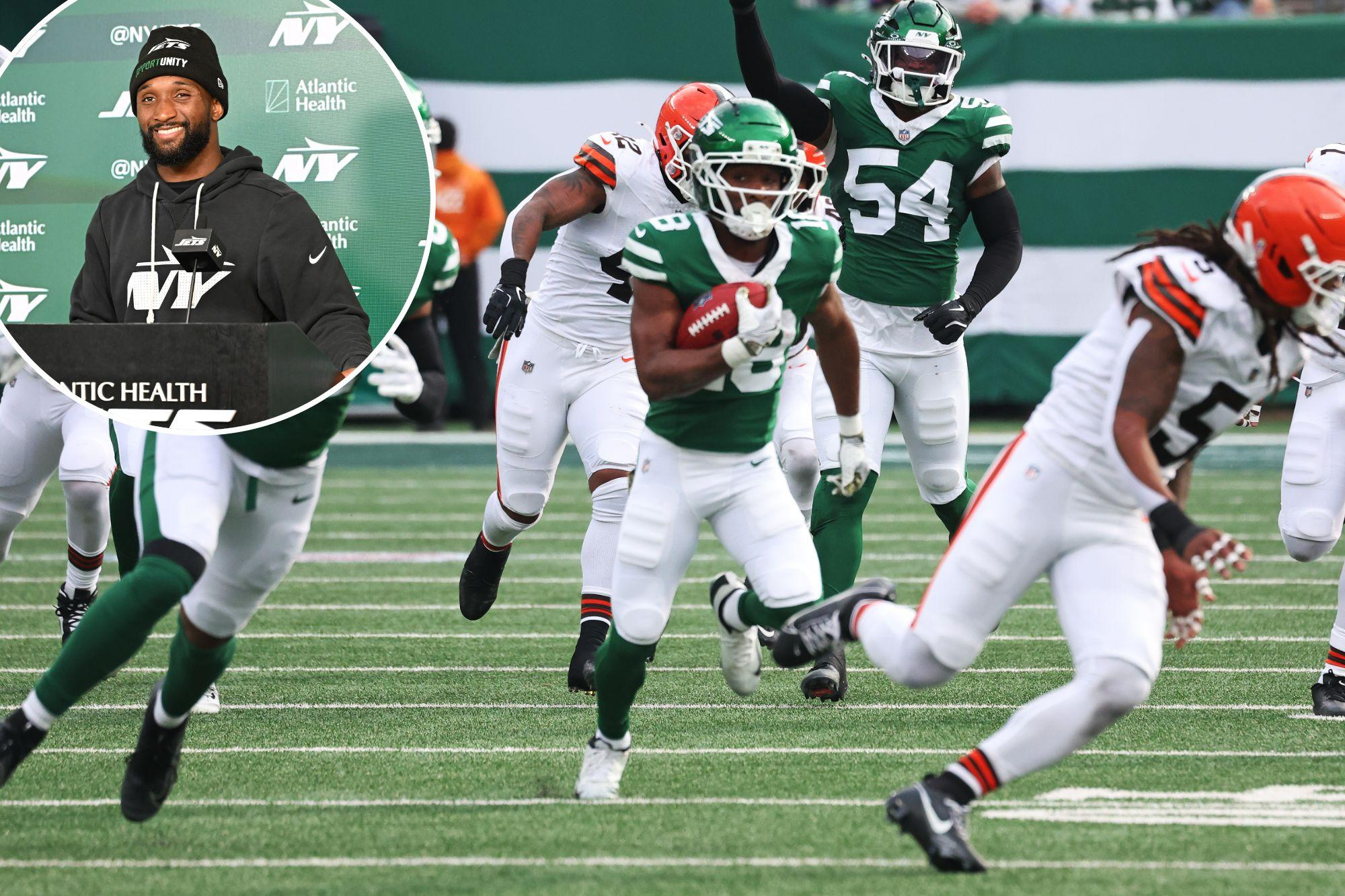
Add The New York Post on Google Jets kick return specialist Isaiah Williams fields some training camp Q&A from Post NFL columnist Steve Serby.
Take flight with the Jets Text with Brian Costello all season as he brings Sports+ subscribers the latest Jets intel from on the field and off.
Q: Do the doubters you’ve had all your life motivate you even now?
A: I would say back then it most definitely motivated me. I remember when I was in college, coming in as a big-time recruit as a quarterback at the University of Illinois, had a lot of expectations, and I remember I was just in so much social media and I just used to see everything. Like, I used to see, like, “Oh, he’s not this, he’s not that.” I used to, like, literally screen shot all the tweets, and at one point I made it my screen saver (smile). At the time, I would say it motivated me somewhat to prove them wrong, but I think at this point in my life, I don’t really look to prove anybody right or wrong. So no matter what people say or don’t say, it don’t really bother me. It don’t bother me if people say, “You’re the greatest thing since sliced bread,” or, “You’re the worst player I ever seen.” It don’t really bother me because I know why I do what I do now. It’s for the man up above, to give God the glory.
Q: But at one time it did bother you, right?
A: It most definitely did bother me, and it motivated me. But I quickly learned, for me, it wasn’t something that was consistent. ’Cause then if that’s what you live for, to prove somebody wrong, what’s gonna happen when everybody loves you? Are you gonna still have that same edge, are you still gonna have that same fire? For me in a way, most definitely in my college career, I think it motivated me, and then once I got to the other side of it, and people started telling me like, “Oh you’re good, you could do this,” I think I got a little comfortable. I kind of just try to block out all the outside noise.
Q: You said in your “Origins” video that you went through anxiety and depression. How long did that last and how bad was it?
A: It was pretty bad. It started around my freshman year at Illinois. I want to say it peaked around my sophomore year.
A: To the point where I was having like suicidal thoughts. I would never say I was really, like, suicidal, but it was times where I would tell myself, “I would rather not wake up and have to go do what I gotta do tomorrow.” I got to the point where I was nervous to talk to people. … I would go out to the field and somebody could be 5, 10 yards from me and I would throw the ball to the ground. It was almost like my body was paralyzed, like, I couldn’t really do what I knew I could do. But I was just believing all these lies, that I wasn’t good enough. It just got super bad, and I was trying everything. I’ve always kind of been a hard worker, so my mentality was like, “I know this is not me.” I never dealt with this stuff in my life, so it’s like, “Man, I’m gonna do whatever I can to get up out of this.” I tried everything — I tried meditation, I tried reading books, you name it. … I tried drinking. I ain’t never drink in my life until I got to college. I never even thought about. I wasn’t drinking too much, but I was trying to do anything to just ease the pain. And nothing was working. Everything just felt like a Band-Aid. … I ended up getting invited to church early on during my college career. The pastor was also our team chaplain, he invited a group of us over. He just gave me a bunch of Bibles. He was like, “Well you could take it and give it to a bunch of the guys.” And then for me, it was just sitting in the room for like a year. The Bible was just sitting there, I never read it, just sitting in the room. One day, like, someone was just telling me, “Just open it up, start reading.” And then I just started reading consistently, and slowly but surely started to change. People just started asking me questions like, “Hey, what do you believe in?” And then like started wanting to help me, like to guide me and teach me about the world out of nowhere, like, stuff like this had never happened. And slowly but surely, I believe my identity started to change. I stopped listening to the lies, and I stopped listening to what everybody else thought I was, and who God says I am. That’s when things started to change, when I stopped believing the lies.
Q: What was the worst lie you read about yourself?
A: Even sometimes to myself, just thoughts coming up like, “Not good enough.” … People saying like, “Oh you’re too short.” … Then you have a bad game you get it the worst, like, “We hate you. Kill yourself.” If that’s your motivation, you’re gonna feed into that stuff. That’s why I say at one point in my life that was my motivation. But now that’s no longer my motivation. That don’t give me no fuel no matter what nobody says about me ’cause I know who I am, I know my identity.
A: My motivation now is to glorify God in all that I do. I just got married closing on a year now.
A: Samantha. . . . Just wanting to start a family, and wanting to be the best leader, example that I could be for my family. I want to do things that we never seen growing up. When we do have kids, I want to raise them in the way of the Lord. I want to be a great example for them for them to look up to. And then, as far as on the football field, I want to be a great example for my brothers. I care about them bigger than football. I want us to be a great football team. I want to be a light,
Q: Would you buy a ticket to watch Isaiah Williams play football?
A: (Chuckle) ) Hundred percent. . . . As a kid, that’s something I always looked forward to, being an exciting football player, you know like when you make a move, make somebody miss and the crowd goes crazy, or you score a touchdown and the crowd goes crazy . . . excitement and explosive.
A: When I was in Detroit I had the perfect opportunity to learn under Kalif Raymond. The way that I practice, the way that I do everything, I attribute a lot of that to what I learned from him, what I learned from being around Amon-Ra St. Brown. I wouldn’t say I wanted to be a returner most definitely coming out of college . . . just seeing what you can do when you just buy into it. . . . During the season I’m always keeping up on guys, not to compete with them but just to see how are they making explosive plays. [Marvin] Mims with the Broncos, I watched him last offseason when I was in Cincinnati, he always got a high average. I was like man, what is he doing?
A: Punt return-wise . . . Guy from the Vikings [Myles Price], he was a rookie . . . of course the Tennessee Titans [Chimere Dike], he was All-Pro.
Q: What do you prefer, punt return or kickoff return?
A: (Smile) Either one. Whichever one I can get the ball in my hand (laugh). They’re two different skill sets though. Kick return more downfield, punt return more like . . . well both of ’em you kind of got to set it up. I like both of ’em.
Q: Don’t you have to be a little crazy to do punt return?
A: You do. Just having to track that ball for so long knowing that these guys running 21, 22 miles per hour at you full speed, like ,you can’t really see them ’cause you gotta worry about catching the ball first, and then once you catch the ball, you gotta be quick on your feet to be able to make a play, make somebody miss, or you’re gonna get lit up (chuckle). You gotta be a little crazy, but once you do it after a while you start to realize it’s really not that bad.
Q: Did you ever have fear when you first started?
A: A hundred percent (laugh). But I feel that goes back to when my identity changed and when I got rid of all that. It was just like, “You know what? Go have fun, go play free, it ain’t nothing to be afraid of.”
Q: What kind of impact do you think you can make as a wide receiver?
A: I believe I can make a huge impact. I believe I could be a game-changer. An explosive-type player that could make plays when need to be, whether that’s short, whether that’s intermediate, whether that’s catch-and-run.
A: Sometimes. ’Cause you got the ball in your hands every single play (laugh).
Q: Tell coach Aaron Glenn you could do the Wildcat.
Q: What are your thoughts on Coach Glenn?
A: I would say he’s a guy like when you walk in that room, everybody just respects and knows he’s about to say something that’s not only gonna make us better players but better men. Guys in the room, they know that.
Q: Special teams coordinator Chris Banjo?
A: He was just in our shoes not too long ago. So it’s a mixture of, like, (laugh) relatable, but also, like, “This is our coach,” and man, when I tell you both of them are just so detailed and on top of it, but like in a way they’re both kind of like non-traditional in a sense of, like, they both used to be players so they understand, so they relate more. With Banjo it’s crazy how much he can relate in the meeting room, but still the guys gravitate and respect everything he’s saying. It’s hard sometimes to have both, but he got both.
A: A leader. A guy that I feel comfortable not only going up to him as a player, but also like as a man. He’s a guy that I go to for advice, somebody that I trust to give me just honest feedback.
Q: You played in college with Tommy DeVito.
A: That’s probably one of the most coolest dudes I ever been around in my life.
Q: You trained with Olympians in the offseason.
A: I was in Arizona, training with Altis. A lot of it is about being explosive, being fast, being able to instead of like a 10-yard game, everybody wants touchdowns. That was just one thing that I really wanted to hone in on, working on my speed. I do believe it’s a skill that you could get better with.
Q: Tell me about your granny, Earsene.
A: Kind of was raised by Granny a little bit, ’cause my mom, while I was growing up, having me so young, she went off to college. She went to Missouri State, which is about four hours, and then she transferred to be closer to home [St. Louis]. My granny was the one that I could always count on. I love that lady.
A: Growing up as a kid, that was just the one person I looked up to. His work ethic, growing up watching his videos. I kept his routine, waking up at 4, working out, and working out again at 12. I think watching it as a kid in middle school, high school, I feel like it instilled that same work ethic in me, to the point where I was in high school, waking up at 4 or 5 before school, going outside, throwing into the net. I’m like, “You know what? I want to be like Kobe.” I remember when I was in middle school I asked my mom, “Just give me a bunch of Kobe shirts, Kobe jerseys,” like that’s all I wanted … Kobe shoes.
Get the insider’s view on Gang Green Sign up for Inside the Jets by Brian Costello, a weekly Sports+ exclusive.
Q: Did you have a similar mentality?
A: I’ll say it’s pretty similar. Just that I attack everything. Every time I touch the field, I want to give everything I got, and just empty myself every time I go out there, so I would say it’s pretty similar to the Mamba Mentality.
A: I love chicken wings, any type of wings, but I’m gonna go something untraditional. I’m gonna go meat loaf and mashed potatoes.
Q: Can this team surprise people?
A: Yeah. … [There’s] a lot of talent on this team. A lot of talent. I think also we got the leaders in the building to put it all together. Being able to put it all together and just the mentality, and I feel like we’re building that every single day.
If you are struggling with suicidal thoughts or are experiencing a mental health crisis, you can call or text 988 or chat at 988lifeline.org for free and confidential crisis counseling.