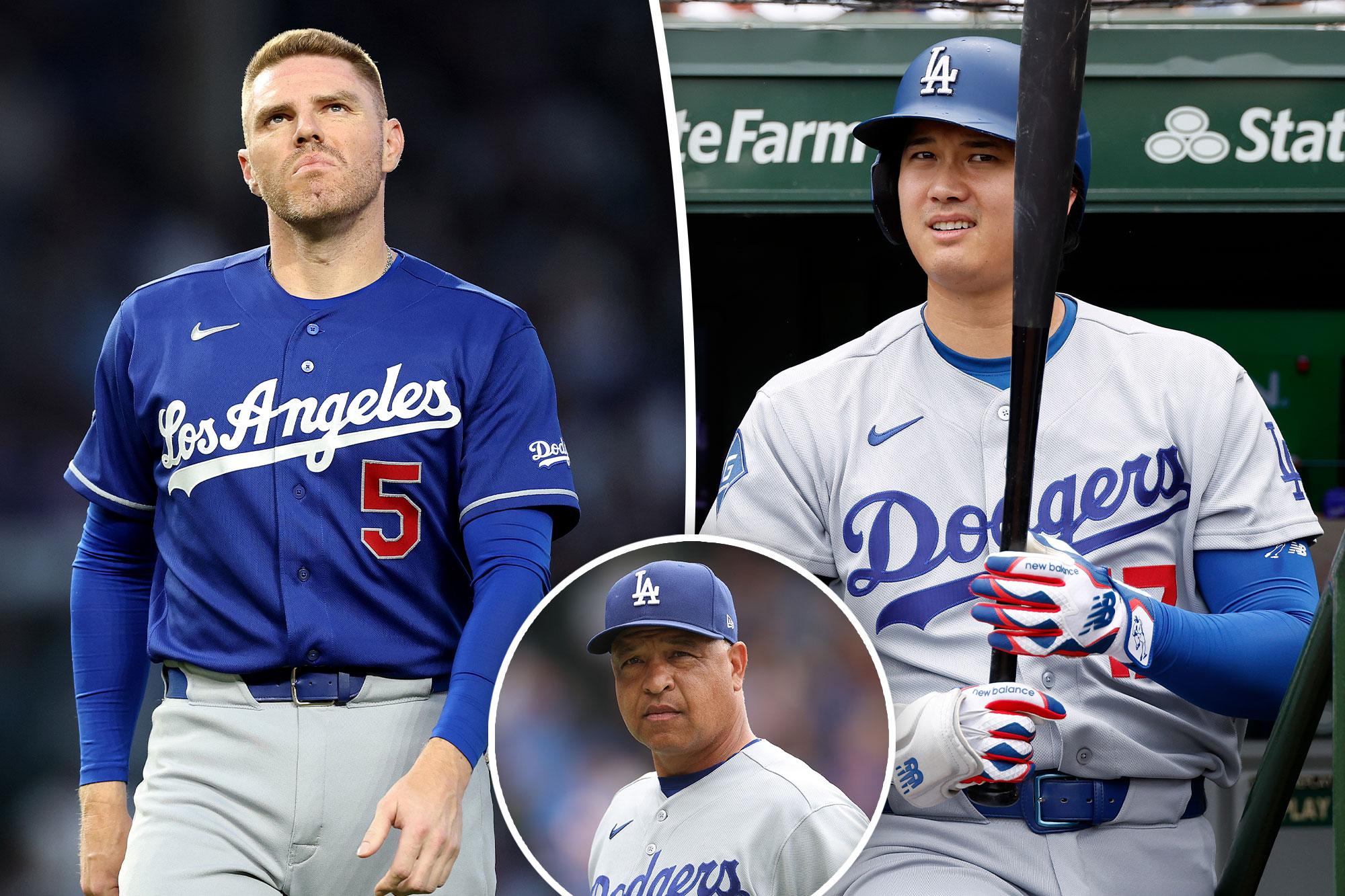
Add The California Post on Google Freddie Freeman was the one who tried hardest to calm the waters.
In the wake of a loss Wednesday at Wrigley Field, which extended the Dodgers’ season-long losing streak to six games after back-to-back sweeps by the Cubs and Red Sox, Freeman first downplayed the severity of a hand injury that had knocked him out of the game.
And, he made a point of repeatedly emphasizing, neither is the team despite its poor run of recent results.
“You’re not going to get an excuse from any of us,” he said. “We expect to win every time we come to the yard.”
“We’re going to be fine,” he promised. “It’s a 162-game schedule. We’re going to go through it at some points … We just got to play better.”
Indeed, the Dodgers have preached patience amid their current skid. But that doesn’t mean there aren’t also reasons to panic. Here’s a look at where things stand and why both reactions are valid now:
For much of the summer, the Dodgers seemed to be on a glide path to the playoffs. They’d built a double-digit game lead in the National League West. They’d separated themselves for a top-two seed in the NL, as well.
The Diamondbacks have inched back within eight games of the Dodgers in the NL West — still a significant gap, to be sure, but one close enough to put some renewed importance on this weekend’s three-game series in Phoenix.
More concerningly, the Dodgers now find themselves with the third-best record in the NL, a half-game behind the Braves for an all-important first-round playoff bye.
Manager Dave Roberts said he wasn’t paying much mind to that situation yet.
“A week ago it looked a lot different, and another week from now it could look even more different,” he said. “So, you just got to kind of put your head down and play baseball.”
Still, a stretch run once poised to be devoid of late-season meaning is quickly becoming uncomfortably interesting, leaving the Dodgers with work to do to optimize their positioning for the playoffs.
Exactly 13 months ago, the Dodgers endured their longest losing streak since 2017 by dropping seven in a row. That kicked off an extended second-half slump in which they went 22-32 from early July to early September before finally rediscovering their form down the stretch.
Not only is that history undaunting to the Dodgers — it is, in some ways, an almost welcome reminder of how much the two-time defending champions have been able to overcome before.
“I don’t think guys are putting too much weight on what happened last year,” Roberts said, before noting that “last year ended up pretty well.”
Indeed, if two bad months didn’t stop the Dodgers a season ago, then one bad week now doesn’t figure to, either.
“We win four in a row,” Freeman said, “and no one talks about the six in a row we lost.”
To bounce back with a winning streak, of course, the Dodgers will need more consistency from their lineup.
At times in the last week, they’ve shown promise — especially when Mookie Betts and Kyle Tucker have offered production from the middle of the order.
Too often, though, that pairing in particular has looked like a half-billion-dollar hole in the heart of the Dodgers’ lineup, with both of them on track for career-worst seasons.
Betts seemingly reached rock bottom on Tuesday, when an 0-for-12 skid left him hitting .167 over the last month. That erased all the confidence he’d built during a resurgent June. It also left him looking lost as he answered questions from his locker.
“Every day I show up and try to restore that hope-meter in order to keep myself going,” he said. “But this is really hard.”
Betts responded on Wednesday with a 4-for-4 game, while Tucker also recovered from a disappointing recent homestand by racking up five hits during his unceremonious return to Wrigley Field.
Problem is, neither veteran slugger has maintained such momentum for very long this season. And until they do, the Dodgers’ offense (which has seen Max Muncy, Tommy Edman and others scuffle lately) will remain susceptible to this week’s kind of drop-off.
There are reinforcements still on the way for the Dodgers, even beyond the still-uncertain status of Shohei Ohtani’s pitching.
Blake Snell is set to rejoin the starting rotation next week, having completed a minor-league rehab assignment. Tyler Glasnow is a few weeks behind him, after beginning his own minor-league rehab stint on Tuesday. Will Smith is continuing to ramp up activities, which will give the Dodgers’ lineup a boost once he eventually returns.
Even the Dodgers’ depth should be improved down the stretch, with Blake Treinen and Brock Stewart expected back soon from the IL, Kris Bubic having been added at the deadline in hopes of a late-August return, and Gavin Stone and Bobby Miller (remember them?) finally pitching in real games in Oklahoma City for the first time this year.
Reinforcements aren’t always everything. Just look at the Dodgers’ current bullpen.
The returns of Edwin Díaz and Evan Phillips were supposed to shore up the group lately. Instead, they’ve both shown signs of rust that have contributed to the unit’s growing midseason slump.
Since May 26, Dodgers relievers have a combined ERA of 5.00. And while several starters will likely eventually shift into bullpen roles — from Eric Lauer and Roki Sasaki, to Justin Wrobleski and (if he can straighten out his mechanics) the recently demoted Emmet Sheehan — the team is still lacking an exact hierarchy of late-game options.
None of the above questions are particularly new for the Dodgers.
In each of the last two years, they’ve dealt with rotation injuries, navigated inconsistencies in their lineup, figured out how to piece together 27 outs in October and gone on to win back-to-back World Series.
And this year, with Tarik Skubal in tow and almost every key piece from those past teams still around, they might be more talented than ever.
That’s why, despite the team’s current skid, Freeman tried to assuage each and every concern that was raised on Wednesday. Why, when describing the source of his undented optimism, all he had to do was motion back toward the locker room.
“It’s easier when you look around our clubhouse,” he said. “We just got a really good team.”
Thus, even at a rare moment in the year when external panic was starting to set in, he continued to preach patience, knowing one bad week had not put their dynasty under threat.