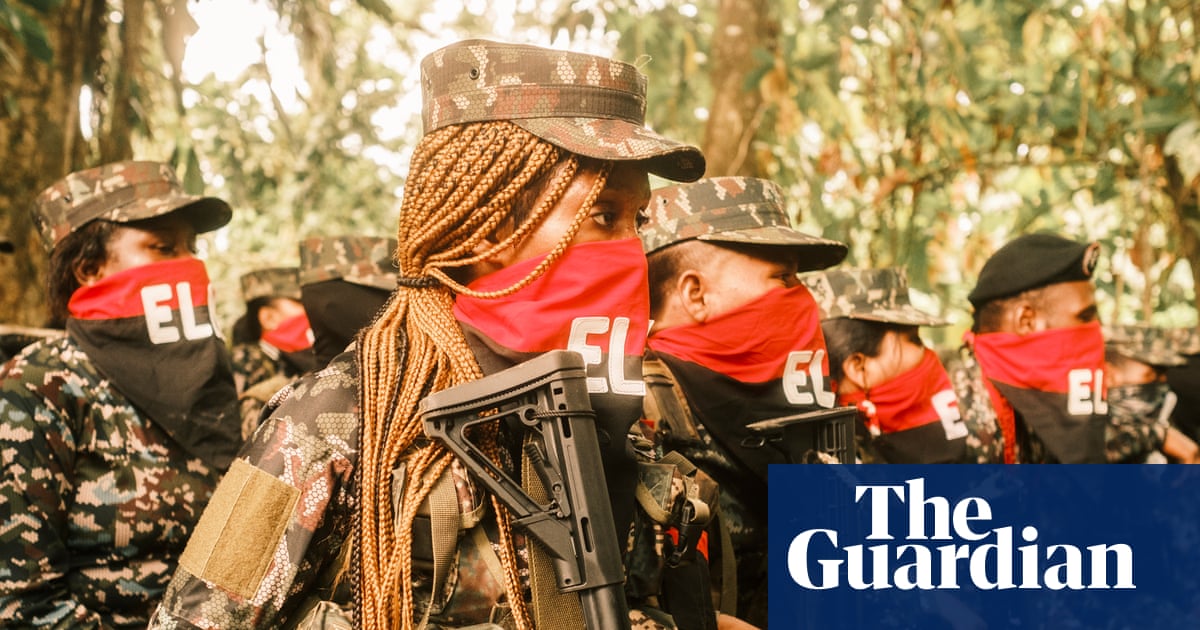
ELN members at a camp in southern Chocó, Colombia. Photograph: Santiago Mesa/The GuardianView image in fullscreenELN members at a camp in southern Chocó, Colombia. Photograph: Santiago Mesa/The GuardianColombia on the brink: ELN guerrilla group prepares for return to warAs Abelardo de la Espriella takes office as president vowing a new military offensive, the country’s last leftwing rebels are getting ready to fight back
As the boat approached the riverbank, camouflaged figures watched from the tree line.
Behind them, in the dim understory of the jungle, a commander of the National Liberation Army (ELN) sat with his rifle on his lap, amid the buzz and whine of insects and the thwacks of machetes on bamboo as his troops set up camp, hidden from enemy drones.
Colombia’s 62-year old armed conflict is on the brink of a new chapter, with the country’s new president, Abelardo de la Espriella, who takes office on Friday, vowing an end to peace talks and launch a new military offensive. Colombia’s last guerrilla group says it is ready for whatever might come.
“Where we can go on the offensive, we will,” said the commander of the group’s Western War Front, who goes by the moniker Yerson. “And if the ELN leadership says we have to carry out a military offensive at the national level, we will. Attacks in cities, in the countryside, wherever.”
View image in fullscreenMembers of the ELN’s Western War Front take part in military exercises in southern Chocó, Colombia. Photograph: Santiago Mesa/The GuardianView image in fullscreenA member of the ELN’s Western War Front walks across a wooden raft on the San Juan River in southern Chocó. Photograph: Santiago Mesa/The GuardianView image in fullscreenA member of the ELN’s Western War Front rests inside a shelter in southern Chocó. Photograph: Santiago Mesa/The GuardianYerson and his troops were deep in the Pacific department of Chocó, in an ELN stronghold accessible only after hours of river travel, where humid heat soaks through the cloud cover.
Occasional communities, each a line of wooden shacks on stilts, broke the dense forest on the banks. Giant mining barges were moored on the river, with diggers clawing up the riverbed to extract the particles of gold it contains.
The ELN and rival armed groups fight to control the San Juan River, its resources and its population. At one point in the journey, armed men from the Gulf Clan, a violent paramilitary group, stopped the Guardian’s boat to question the passengers, before promising to liberate the area from the ELN.
Yerson was unfazed. “All of the ELN territories are being invaded by bands of mercenaries,” he said. “They are very violent, but they are not disputing political power.”
View image in fullscreenCommander Yerson stands in front of an ELN flag at a camp in southern Chocó. Photograph: Santiago Mesa/The GuardianView image in fullscreenELN members listen as Commander Yerson reads the group’s regulations at a camp in southern Chocó. Photograph: Santiago Mesa/The GuardianView image in fullscreenAn ELN member poses for a photograph at a camp in southern Chocó. Photograph: Santiago Mesa/The GuardianColombia’s conflict began in the 1960s, rooted in extreme land inequality and exclusionary politics. Leftwing guerrillas emerged to challenge the state, battling government forces later allied with rightwing paramilitaries, forerunners of the Gulf Clan. Money from cocaine trafficking fuelled all sides. The conflict has killed hundreds of thousands of people and displaced millions.
Along with the Revolutionary Armed Forces of Colombia (Farc), the ELN was the most important of the guerrilla groups. Founded in 1964, it fused Marxism-Leninism with Che Guevara’s foco theory — the idea that a small armed band in a remote rural area can eventually topple the state — and Liberation theology, which framed the struggle against poverty and oppression as an expression of Christian faith.
National Liberation Army (ELN) train in the Colombian JungleIn their pursuit of revolution, the two groups have carried out killings and kidnappings, and forced the confinement and displacement of civilian populations.
The Farc demobilised in 2016 after striking a peace deal with the Colombian state, but the ELN says its members will only lay down arms after the country’s political and economic system has been transformed.
“The Farc surrendered in exchange for nothing,” said Yerson, adding that subsequent presidents have failed to fully implement the peace deal, while former Farc combatants have been killed.
View image in fullscreenA female member of the ELN’s Western War Front at a camp in southern Chocó. Photograph: Santiago Mesa/The GuardianView image in fullscreenAn ELN member at a camp in southern Chocó. Photograph: Santiago Mesa/The GuardianView image in fullscreenThe hands of a member of an ELN member who lost a finger after being bitten by a snake while living in the jungle. Photograph: Santiago Mesa/The GuardianGustavo Petro, a leftist who was a guerrilla with the defunct M-19 in the 1980s, was elected president in 2022 on a promise of “total peace”, vowing to make good on the Farcdeal and negotiate with all of Colombia’s remaining armed groups on the left and right.
But after a few years, almost all the talks – including those with the largest groups — the ELN, the Gulf Clan and Farc dissidents who refused to demobilise in 2016 — either stalled or collapsed.
Yerson rejected the idea that the election of Colombia’s first leftist president meant that the ELN’s goals could be achieved through the current political system.
“They handed out lands [to the poor]. They did a kind of pension reform. They were looking for ways to improve healthcare,” he said. “But in the end these are small things. They don’t help with the popular awakening.”
View image in fullscreenColombia’s president-elect, Abelardo de la Espriella, speaks at a security summit in Barranquilla. Photograph: Charlie Cordero/ReutersIn Yerson’s telling, Petro was allowed to take power by the “Colombian oligarchy”, which needed to pacify the people after an explosion of inequality protests in 2019 and 2021, but knew he “was never going to undertake fundamental reforms, that he could be controlled”.
Colombia’s political system “is not the democracy it claims to be”, he said. “That is where the trap is.”
Now the ELN faces a very different proposition in the form of De la Espriella, a Trump-admiring millionaire who rose to prominence as a criminal lawyer representing accused leaders of the AUC, a rightwing paramilitary group that fought the guerrillas and killed civilians accused of collaborating with them..
De la Espriella has given Colombia’s armed groups a month to submit to him or face the consequences, while promising to deepen security cooperation with the US and build mega-prisons inspired by the Salvadoran president, Nayib Bukele.
Security analysts, however, say armed groups have gathered strength and resources in recent years. The ELN has about 6,300 members between armed fighters and unarmed support, spread across Colombia and Venezuela.
View image in fullscreenCommander Yerson reads out the ELN’s regulations to at a camp in southern Chocó. Photograph: Santiago Mesa/The GuardianView image in fullscreenAn ELN member operates a drone during exercises at a camp in southern Chocó. Photograph: Santiago Mesa/The GuardianView image in fullscreenAn ELN member wearing camouflage used by the group’s snipers with a precision rifle at a camp in southern Chocó. Photograph: Santiago Mesa/The GuardianThe 60 or so fighters in the camp were evenly split between men and women, indigenous and Afro-Colombian members. “The majority [of the ELN] has always been the poor, the lowest down,” said Yerson. “Here, as Chocó is more Afro-Indigenous, that’s what we are.”
Each of them had a modern assault rifle, either an AK-47 or an AR-15, some with “Made in USA” stamped on the body. One also had a .50 calibre sniper rifle, the bullets of which can punch through vehicles, while another flew a drone.
The camp was deep in ELN territory, and they were relaxed. When someone took out a portable speaker and began to play vallenatos – popular Colombian folksongs – they left their rifles resting against trees or slung them over their backs and paired up to dance, suddenly looking like the young Colombians they are.
National Liberation Army (ELN) dance during a break from trainingVarious groups, including the UN and Human Rights Watch, have accused the ELN of recruiting minors — but Yerson said their rules only allow people over 16 to join.
It was impossible to verify details of his troops’ backgrounds, as they had been told not to talk. Yerson presented two women to be interviewed in his presence, but they struggled to speak, apparently afraid of saying the wrong thing.
Yerson himself described the ELN as “a life choice” for Colombia’s poor, who have few options. “Maybe that’s why they join, but once they are here they come to understand why we are fighting,” he said.
The ELN functions by taxing “every commercial entity” in the territory it controls, and in Chocó that means illegal gold mining and logging are their key sources of income, said Yerson. It also carries out kidnappings for ransom.
View image in fullscreenTwo ELN members rest on the forest floor at a camp in southern Chocó. Photograph: Santiago Mesa/The GuardianView image in fullscreenA female ELN member combs her hair at a camp in southern Chocó. Photograph: Santiago Mesa/The GuardianView image in fullscreenAn ELN member adjusts another’s beret before military exercises in southern Chocó. Photograph: Santiago Mesa/The Guardian“We are an embryonic state, and every state takes taxes,” he said. “If they can strangle us economically, we will cease to exist as a rebel organisation.”
Yerson claimed coca cultivation has disappeared in ELN territory in Chocó. He denied the group was involved in the drug trafficking, but acknowledged it taxes the business like any other.
The US, which has given its military a new role to take on “narcoterrorism” across the Americas, might not think much of that distinction.
“The question of guilt doesn’t matter to the US. What matters to them are interests,” said Yerson. “We are the only guerrilla group with political principles left standing in Colombia and the world. We will always be something they want to destroy.”
He says the ELN will not simply be on the defensive, but will strike back where it can. A car bomb attributed to the group exploded outside a police station near the border with Venezuela last week, injuring 12 police officers and three civilians, and drone attacks have become common.
View image in fullscreenELN members listen as Commander Yerson reads the group’s regulations at a camp in southern Chocó. Photograph: Santiago Mesa/The GuardianView image in fullscreenA fire burns at night at a camp in southern Chocó. Photograph: Santiago Mesa/The GuardianView image in fullscreenELN members in thick vegetation near a camp in southern Chocó. Photograph: Santiago Mesa/The Guardian“They have to be legitimate objectives. We don’t put car bombs where the civil population will die,” said Yerson, who pointed to the 2019 suicide car bombing of a police academy in Bogotá that killed 22 as a model. “The comrades could go and make kamikaze attacks of that impact.”
Despite the election of De la Espriella and other rightwing leaders across the continent, Yerson was adamant that the ELN was not losing the ideological battle.
Voters are being deceived, he said, before quoting the South American revolutionary leader Simón Bolívar: “An ignorant people is the blind instrument of its own destruction.
“The ideological battle is not being lost,” he repeated, as if irritated by the phrase. “We are on the right side of history.”
Asked whether Colombia was any closer to the ELN’s goals after decades of conflict, Yerson was unsure: “I don’t know. But I can tell you that the only way to win things for the people is through the struggle,” he said. “We’ve been in the struggle for 62 years, and there will be many more.”