The head of the World Health Organization warned that "we must urgently and massively scale up all our efforts" against the latest Ebola outbreak, with new cases doubling in some hotspots in the past week alone.
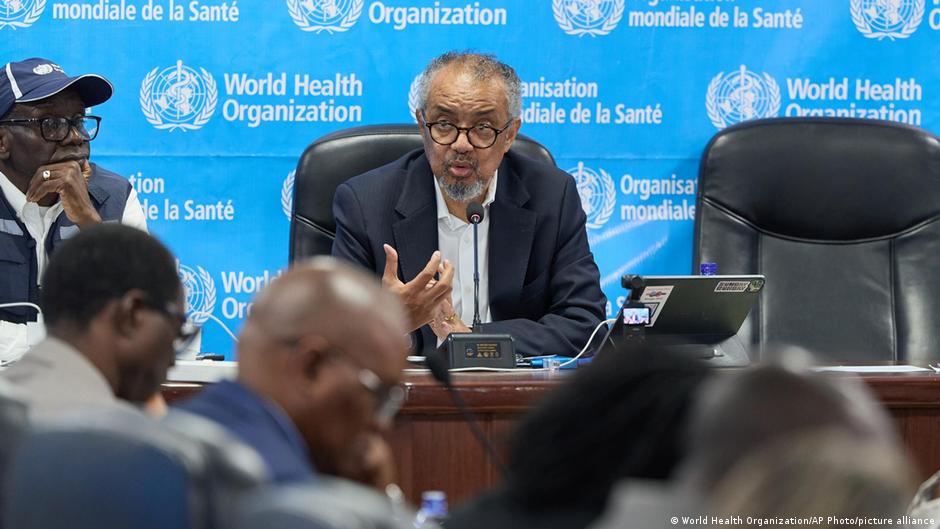
https://p.dw.com/p/5IMUgThe outbreak is 'spreading faster than our scale-up of the response,' Tedros saidImage: World Health Organization/AP Photo/picture allianceAdvertisementThe head of the World Health Organization visited Kinshasa, capital of the Democratic Republic of Congo (DRC), on Wednesday, warning that the Ebola outbreak in the east of the country was "spreading faster than our scale-up of the response."
The 17th Ebola outbreak in DRC's history is already the fastest-spreading and the second-most deadly outbreak on record.
WHO Director-General Tedros Adhanom Ghebreyesus has now visited twice this summer since the public health emergency, centered in the eastern Ituri province, was first declared in mid-March,.
His visit coincided with a health scare in the Maluku municipality in northeastern Kinshasa. A passenger on a crowded ship died with Ebola-like symptoms and authorities were rushing to isolate it and conduct checks.
DW correspondent Wendy Bashi reported that the boat was mainly transporting timber, but that roughly 200 people were also on board. The barge had come from Kisangani originally, far to the east in DRC. Bashi reported that the isolation measures were a precaution and that the deceased had not yet been tested for or diagnosed with Ebola.
WHO's Tedros said that he was holding meetings with health and humanitarian partners supporting the Ebola response in the DRC to "discuss the challenges we face." He noted new cases were "doubling in some hotspots over the past week alone."
"We all agree that we must urgently and massively scale up all our efforts across all pillars of the response and by all partners," he wrote in an online post. "That means reaching every affected community despited insecurity and displacement, strengthening coordination under the Government's leadership, ensuring health workers ahve the protection, training and support they need, and accelerating access to care, surveillance, and safe, dignified burials."
He also said it was crucial that communities be "at the center" of the response, saying the outbreak could only be stopped with their "trust, leadership and partnership."
According to the most recent data from Congo's Ministry of Health, it had confirmed 3,874 cases, including 1,751 deaths, as of Monday. At least 717 patients were in isolation while 749 patients have recovered.
The vast majority of cases, somewhere in the region of 90%, have been recorded in the eastern province of Ituri bordering Uganda. Only a handful of cases are on record outside DRC's borders.
As Tedros visited on Wednesday, the US State Department pledged another $242 million (roughly €210 million) in funding for a combination of immediate response, preparedness efforts and humanitarian assistance related to the outbreak.
The State Department also said its Travel Advisory status for the DRC, Uganda and South Sudan "remains at Level 4 — Do Not Travel."
DR Congo launches Ebola trial for high-risk contactsTo view this video please enable JavaScript, and consider upgrading to a web browser that supports HTML5 video
Medical charity Doctors Without Borders warned on Wednesday that the rare strain was still "spreading at an alarming and unprecedented rate" in a remote area of DRC with poor infrastructure.
"The response is expanding but is still not reaching communities quickly enough to break transmission chains," the group said.
Reports of many front line health workers going on strike, either in disputes over pay levels or non-payment, or a mixture of the two, have only worsened already inadequate access to healthcare.
Dr. Jean Kaseya, the head of the Africa Centers for Disease and Control, warned that "contact tracing is not working" and more and more cases were detected late, reducing the chances of survival.
The rare Ebolavirus strain in this outbreak, known as Bundibugyo, has no approved treatment or vaccine. Hurried trials of candidate vaccines and treatments have since begun.
Researchers believe the outbreak started in remote areas several months before it was identified and officially declared, with early deaths being misdiagnosed as conditions like peritonitis.
Local funeral practices, often involving open coffins and laying hands on corpses, helped the virus to spread.
Don't let the algorithm hide the news. If you rely on our team for trusted reporting, please take a moment to select us as your Preferred Source on Google, so you'll always see our verified news first.