Video El-Sayed challenges Mike Rogers after Michigan primary victory Senior national correspondent Rich Edson reports from Belleville, Michigan, as progressive candidate Abdul El-Sayed wins the Democratic Senate primary, narrowly defeating Haley Stevens. Rep. Jim Banks, R-Ind., discusses El-Sayed's alignment with the Democratic Socialists of America platform, including healthcare and border policies.
Tuesday night, the left won. The right won. The establishment won. The insurgents won.
100 DAYS UNTIL MIDTERMS AND DEMOCRATS ARE WINNING BECAUSE THEY ACTUALLY HAVE A MESSAGE
The political class will now perform its traditional postmortem: find the result it agrees with and declare a sweeping ideological mandate.
Tell me what you are going to do for me, and please do it before I lose interest.
The real divide was not left versus right. It was memorable versus forgettable.
'SQUAD' MEMBER'S COMEBACK BID THWARTED AS ESTABLISHMENT DEMS NOTCH VICTORY AGAINST SOCIALISTS
The winners had a sentence. The losers had a résumé.
Consider Abdul El-Sayed, who defeated Rep. Haley Stevens in Michigan’s Democratic Senate primary.
His message was: "Money out of politics. Money in your pocket. Medicare for All."
Eleven words. Three beats. A villain, a benefit and a policy. In that order.
DAVID MARCUS: IN BOOMING DETROIT, VOTERS SKEPTICAL OF SOCIALISM SNAKE OIL
Politicians like to imagine voters carefully comparing policy frameworks. Voters are usually wondering why everything costs so much and whether anyone in public life has noticed.
Stevens made the respectable case: experience, credentials and electability. All of that may have been true. It was also about her.
"I can win" is not a promise to voters. It is a candidate asking the public to participate in her career planning.
A résumé is evidence. It is not a reason. No one has ever left a rally humming, "She performs well in hypothetical general-election matchups."
DEM PRIMARY ERUPTS AS ESTABLISHMENT FAVORITE DISMISSES RIVAL AS ‘CELEBRITY CANDIDATE’
The same dynamic appeared in Missouri, although ideology changed costumes.
Former Squad member Cori Bush warned that billionaires and outside interests were trying to control her district.
Her opponent Wesley Bell answered with six words: "Progressives are supposed to make progress."
EX-'SQUAD' MEMBER FIGHTS FOR COMEBACK AS SOCIALIST WING RAMPS UP WAR ON DEM ESTABLISHMENT
Bell took a word Bush believed she owned — "progressive" — and handed it back with a new definition: not posture, purity or national attention, but results.
A villain alone is not enough. It is only the first half of the argument.
FOX NEWS POLL: VOTERS WANT MAJOR CHANGE AMID ECONOMIC AND POLITICAL DISCONTENT
They are doing this to you, and I will do this for you.
Too many candidates never reach the second clause. They mistake indignation for persuasion.
But anger is an accelerant, not a destination. It can start the car. It cannot tell you where you are going.
The closer an issue gets to the kitchen table, the less ideological it feels.
China was taking the jobs; he would bring them back.
Washington had lost control of the border; he would build the wall.
America had been diminished; he would make it great again.
FOX NEWS POLL: COOL YOUR SERVERS! VOTERS REJECT DATA CENTERS
One could object to every detail and still understand the whole thing before the elevator doors closed.
Republicans saw their own version in Michigan’s gubernatorial primary. John James spoke about restoration, work, security and a Michigan comeback. Perry Johnson emphasized a sweeping audit of state government.
Politicians adore process words because they sound responsible. Voters hear paperwork.
They are not dreaming of an interagency working group. They would like the electric bill to go down.
This may be why data centers became one of the night’s more revealing issues.
William Lawrence made opposition to unchecked data-center development central to his Michigan campaign. He took something vast and abstract — artificial intelligence infrastructure — and brought it home.
"Your family may pay more to power someone else’s data center" can move votes.
The closer an issue gets to the kitchen table, the less ideological it feels.
That is also why affordability has become the great unifying language of recent elections.
Politicians with little else in common have discovered that voters are preoccupied with the same rude facts: rent, groceries, child care, health care and the shrinking distance between a paycheck and a minor financial emergency.
But "affordability" is not, by itself, a message. It becomes persuasive only when people can picture it: the prescription they can fill, the rent increase they avoid, the utility bill they can manage.
Voters do not experience the economy as a set of indicators. They experience it as a series of small humiliations.
The grocery cart edited at checkout. The dinner out quietly canceled. The home that now seems permanently one promotion away. The medicine postponed.
The party that speaks most clearly to that experience will have an advantage. The one that answers with macroeconomic data will deserve what happens next.
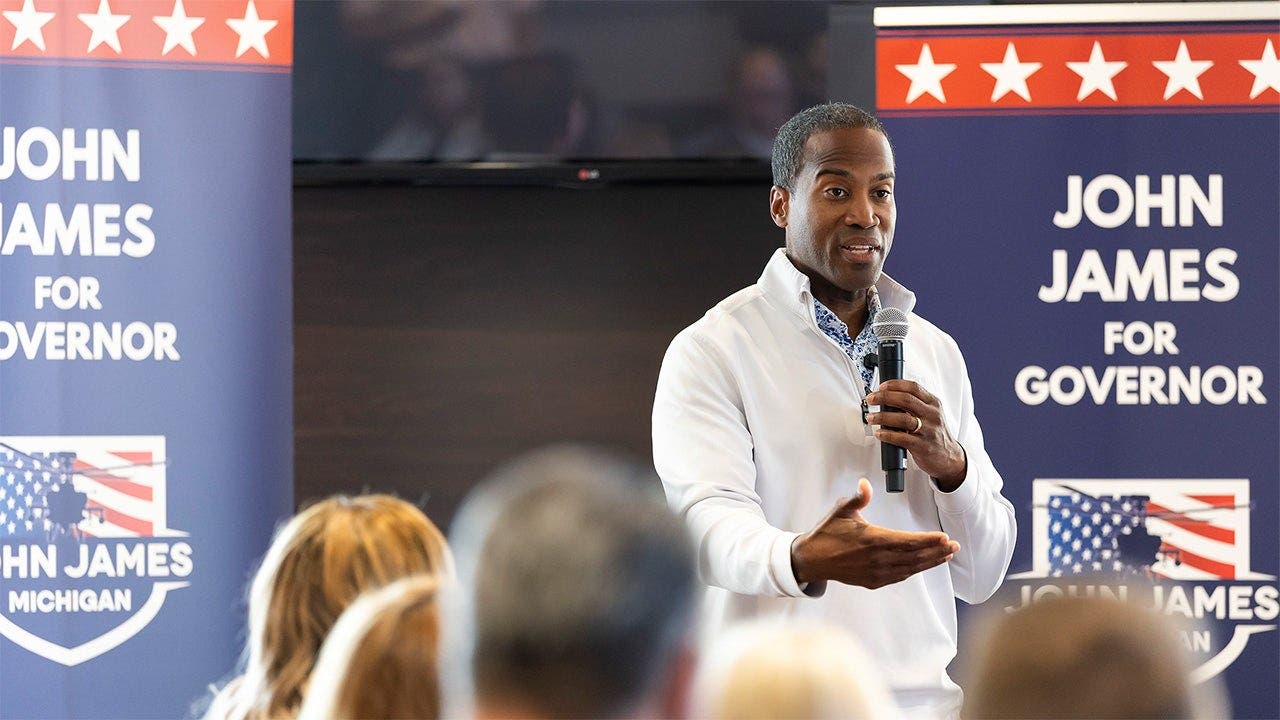
Republican gubernatorial candidate in Michigan, Rep. John James, R-Mich., speaks during a breakfast at Fireside Grill & Patio on Aug. 3, 2026 in Novi, Michigan. James defeated businessman Perry Johnson in the Republican primary on Tuesday, August 4. (Finn Gomez/Getty Images)
Tuesday’s results also suggest something we should not miss.
Americans can be anti-establishment and anti-mayhem at the same time.
They can want change and reassurance. A fighter and a grown-up. Someone who will break the right things and leave the rest of the house standing.
This confuses political professionals, who prefer voters to fit neatly into ideological boxes.
The quality that matters is not always moderation. It is translation.
Tuesday’s results also suggest something we should not miss. Americans can be anti-establishment and anti-mayhem at the same time.
Can a candidate turn an ideology into an outcome? A policy into a picture? A political argument into something people can see in their own lives?
Tuesday’s winners were not uniformly progressive, moderate, populist or establishment.
What they shared was the ability to place the voter inside the story.
The voter is expected to applaud this autobiographical achievement and infer a benefit.
The stronger appeal begins with an understood "you."
Every campaign should have to pass a second-person test.
Can voters hear themselves in it? Can they explain what changes if the candidate wins? Can they repeat the central idea in 10 seconds?
Both parties will now produce impressive documents announcing that voters endorsed whatever the authors believed on Monday.
But voters may have said something less ideological and more useful:
CLICK HERE FOR MORE FOX NEWS OPINION
Do not describe your ambition and call it our future.
Tell us what is wrong. Tell us what you will do. Tell us how life will be different.
Tuesday night was not a triumph of the left or the right.
It was a triumph of the personal over the procedural, the promise over the résumé and the memorable over the merely correct.
CLICK HERE TO DOWNLOAD THE FOX NEWS APP
CLICK HERE TO READ MORE FROM LEE CARTER
Lee Hartley Carter is a communications strategist and public opinion expert. She's the founder and CEO of Carter Intelligence Group and author of "Persuasion: Convincing Others When Facts Don't Seem to Matter" (TarcherPerigee, September 3, 2019). Follow her on X on @lh_carter.