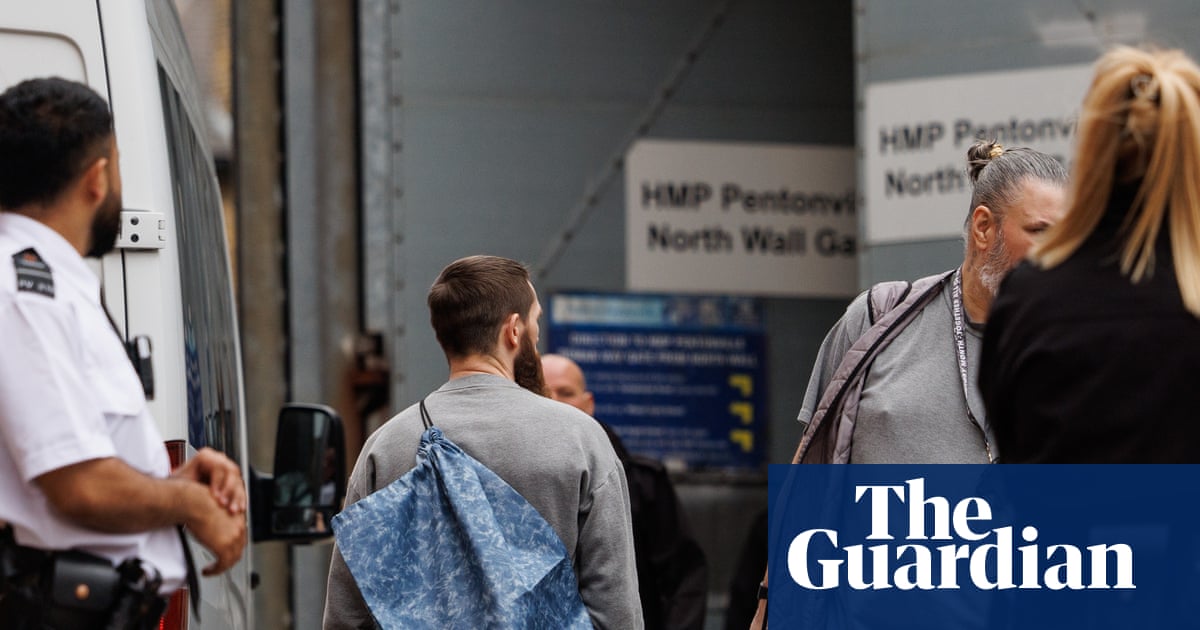
Prisoners being released from HMP Pentonville in London in 2024. The justice secretary said the government would not need further emergency release schemes. Photograph: Tolga Akmen/EPAView image in fullscreenPrisoners being released from HMP Pentonville in London in 2024. The justice secretary said the government would not need further emergency release schemes. Photograph: Tolga Akmen/EPAAbout 1,000 fewer prisoners to get early release as Burnham tightens rulesJustice secretary says ministers would have liked to block more but doing so would cause prison system to ‘break’
About 1,000 fewer prisoners will be released early after Andy Burnham’s intervention to exclude those convicted of rape, serious child sexual offences and grooming from the scheme.
The justice secretary, Alex Norris, said 5,000 prisoners would be released over 10 months from October in England and Wales, down from the government’s original plan for 6,000 from September.
The prime minister announced on Monday that prisoners convicted of rape, serious child sexual offences and grooming would be excluded from the scheme to ease overcrowding, after pressure from MPs, victims, campaigners and frontline prison officers.
Norris told Sky News that he would like to have gone further in blocking early release of some prisoners, but doing so would have caused the prison system to “break down”.
He added that the government would not need further emergency release schemes as sentencing changes would provide “long-term security” for prison capacity.
He said: “We’re out of where the previous government got to, which is this doom loop of getting to the end, having to do emergency release schemes where individuals were let out with none of the controls that we’re talking about.”
But he acknowledged that the proposals had “created harm” for grieving families such as the wife of PC Andrew Harper, Lissie, and added that he was sorry.
“I would express how angry I am too at being in a situation where we’re having to make significant changes that do have real impacts on people’s lives, so that we are able to have a functioning prison system,” he said.
Harper’s mother, Debbie Adlam, said her family was “paying the price” after learning her son’s killers remained eligible for early release under the government’s plans to ease prison overcrowding.
Some prisoners serving time for some sexual or violent offences will still be eligible for release at the halfway point of their sentence if they have not committed serious breaches of prison rules.
This applies to Jessie Cole and Albert Bowers, two of Harper’s killers, who were jailed for 13 years in 2020 for manslaughter. Henry Long, the main perpetrator, will not be subject to early release.
View image in fullscreenJessie Cole (left) and Albert Bowers, two of PC Andrew Harper’s killers, will be eligible for release. Photograph: Thames Valley police/PAHarper, a 28-year-old police officer, sustained fatal injuries while responding to a quad bike theft in Sulhamstead, Berkshire, in August 2019.
Speaking to BBC Newsnight, Adlam said: “It feels like we’re letting Andrew down again. We’ve been through the justice system, we thought we’d done as best as we could. Now we’re standing up to fight again with this evening’s announcement.”
Harper died after he was caught in a strap attached to the back of a car and dragged down a country road as three teenage suspects fled the scene of the burglary. Long, the driver of the vehicle, received a 16-year sentence. Cole and Bowers were passengers in the car.
While she accepted that Norris was sorry, she felt the decision was made “very quickly”, adding: “There surely has to be other answers.”
Adlam told BBC Breakfast that “Andrew deserves better than this and so do we”, and that it was important that the Prison Service kept the family informed of when and whether they would be released.
Burnham wrote in the Telegraph on Monday evening that the scheme had roots in previous governments’ “failure to add sufficient new places between 2010 and 2024”, when just 500 places were added and 23 prisons closed. He said he understood the “anger and anxiety” felt by victims’ families, which had informed his “significant changes”.
“I know I can look people in the eye and say to them there is nothing more I could have asked for without risking the prison system collapsing within months. Such an outcome would expose the public to enormous risk: police would be unable to make arrests; courts would be unable to send new offenders to prison; and our justice system would grind to a halt,” he wrote.
The prime minister has assured the public that offenders will face tighter community supervision, including new GPS monitoring for rapists to restrict their movements. He also promised a new package of support for victims, backed by £10m in new funding to provide trauma-informed contacts for victims, alongside a national helpline.
He added that as well as building 14,000 new prison places by 2013, he had asked the justice secretary to review the indefinite sentences handed out between 2005 and 2012, to consider more early release for women’s prisoners given the lower risk they pose, and to look into faster returns of foreign national offenders to their country of origin.
But the Conservatives have said victims “deserve better” than “learning their fate from press releases”. The Tory leader, Kemi Badenoch, said her party would build more prison places, rent cells abroad and deport foreign offenders to ease overcrowding.
She said: “This is only a partial climbdown. Killers, violent offenders, men who have terrorised their partners and more will all still walk out of prison in October.”