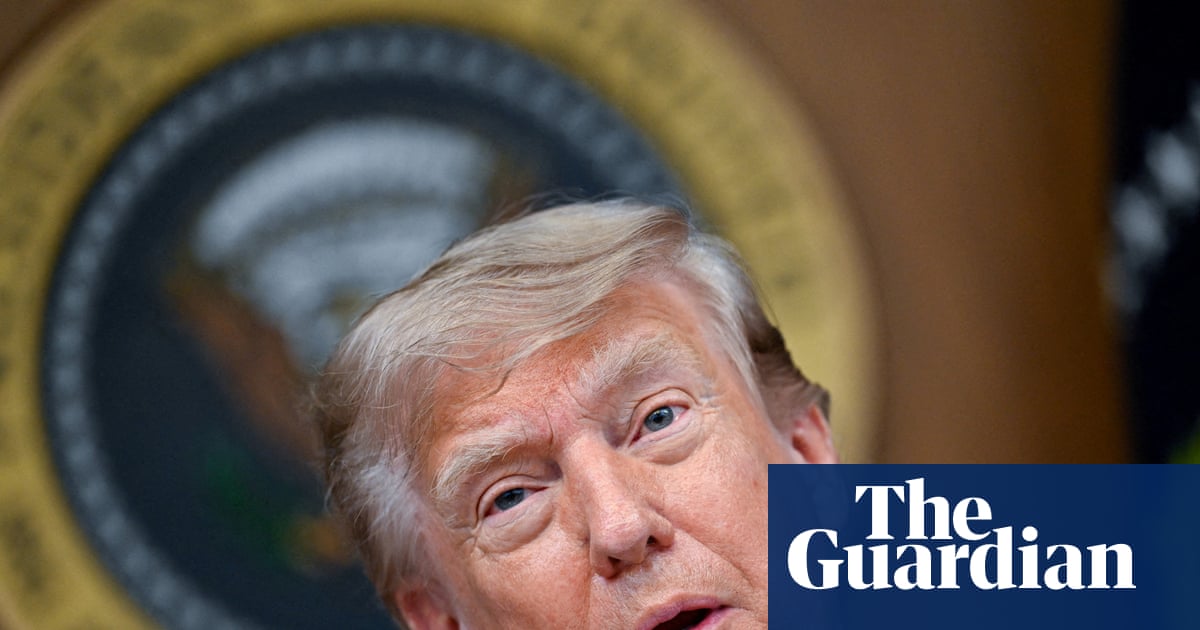
The National Foreign Trade Council has issued a veiled warning about how Donald Trump may respond to Australia’s proposed News Bargaining Incentive. Photograph: Daniel Heuer/ReutersView image in fullscreenThe National Foreign Trade Council has issued a veiled warning about how Donald Trump may respond to Australia’s proposed News Bargaining Incentive. Photograph: Daniel Heuer/ReutersTrump wants ‘fair treatment’ in fight over Labor’s levy on tech giants to pay for news, US trade group warnsNational Foreign Trade Council ‘disappointed’ at move to expand News Bargaining Incentive but Australian experts say government is not going far enough
Follow our Australia news live blog for latest updates
Get our breaking news email, free app or daily news podcast
A major US trade body has rubbished the Albanese government’s plan to make more big tech platforms pay for Australian journalism, issuing a veiled warning about how Donald Trump may respond to the “deteriorating trend”.
The National Foreign Trade Council said it was “disappointed” at the Australian government’s move to expand its News Bargaining Incentive (NBI) to take in Microsoft’s LinkedIn, amid trade tensions between Washington and Canberra including newly increased tariffs on Australian goods.
But competition experts in Australia say the government has not gone far enough in helping support news outlets whose content is being exploited by platforms such as Facebook and Google, and that the exclusion of AI platforms was a major flaw.
Read more“I hope they move on the AI issue and give us that clarity,” said the former ACCC chair Rod Sims.
“I’d like to see a bit of urgency. The potential lack of ambition, and not every [media outlet] getting a deal, certainly worries me.”
The proposed NBI, which the Albanese government seeks to legislate in coming months, would require tech giants to compensate media outlets for the news on their platforms, either through making commercial deals or paying a higher levy.
It initially included Google, TikTok and Meta; Monday’s announcement that the NBI would include professional networking sites – previously carved out from the plan – and increase the cost charge but reduce the cost base, was hailed by Labor as a fairer model.
But Tiffany Smith, the vice-president of global trade policy at the National Foreign Trade Council, criticised the move.
“We remain disappointed that Australia continues to push forward with a news bargaining incentive that now covers an even broader spectrum of US companies,” she told Guardian Australia.
The NFTC is a major American trade lobby, with members including affected companies Meta, Microsoft and Google; other tech companies such as Amazon, Apple and Samsung; and major firms like BP, Coca-Cola, Ford, Toyota, Shell and Visa.
“The Trump administration has made it clear that it is fully committed to the fair treatment of American companies abroad. We call on the Australian government to reconsider this measure, which adds to a broader deteriorating trend in the tax and investment climate in Australia,” Smith said.
But Sims, a former boss of the Australian Competition and Consumer Commission and a supporter of the NBI, said the government wasn’t doing enough to support news.
Under the plan, big tech platforms would have to make at least six individual deals with news publishers – up from a previous four – to avoid paying the levy, set at a higher rate.
The assistant treasurer, Daniel Mulino, who is leading the process, said on Monday that Australian media would expect to receive “$200 million to $250 million” in total under the arrangements.
Sims said he was pleased the NBI was progressing, and would scrap the carve out for professional networking sites, but said more money should be raised to support journalism – noting $250m was the figure raised under the former News Media Bargaining Code, legislated by the Coalition half a decade ago, and which only included Meta and Google.
Sims said the government should be aiming higher than that, more in the realm of $300m plus, with more companies included and inflation added.
“There’s a lack of ambition, and simple arithmetic here,” Sims said.
News Corp’s Australian chair, Michael Miller, claimed the government’s changes “gut the incentive for tech platforms to strike fair deals with Australian media”, saying the rules “need strengthening, not softening”.
“On an already uneven playing field, getting this wrong won’t just hurt Australian media. It will erode the quality and independence of news every Australian relies on,” he said.
The changes were also criticised by the Coalition and Greens, making the NBI’s pathway through parliament unclear when the legislation is introduced in coming weeks.
Sims was critical that AI platforms deriving value from Australian news would not be captured – even those incorporated into NBI-exposed companies, such as Google’s Gemini. He also worried that many outlets would miss out on benefit, with big tech companies only obliged to make six deals minimum.
“It just means not everybody will get a deal, in fact most won’t … some outlets in public interest journalism won’t get some. That’s a real concern,” he said.
Another former ACCC chair, Allan Fels, said it was positive the government was making progress, but worried the scheme didn’t go far enough to “extract more from the platforms” for Australian journalism.
A Microsoft spokesperson said the company “shares the Government’s objective of promoting a sustainable Australian news ecosystem” and said it would continue “constructive engagement with Government, publishers and industry stakeholders to support high-quality journalism, innovation and economic growth”.