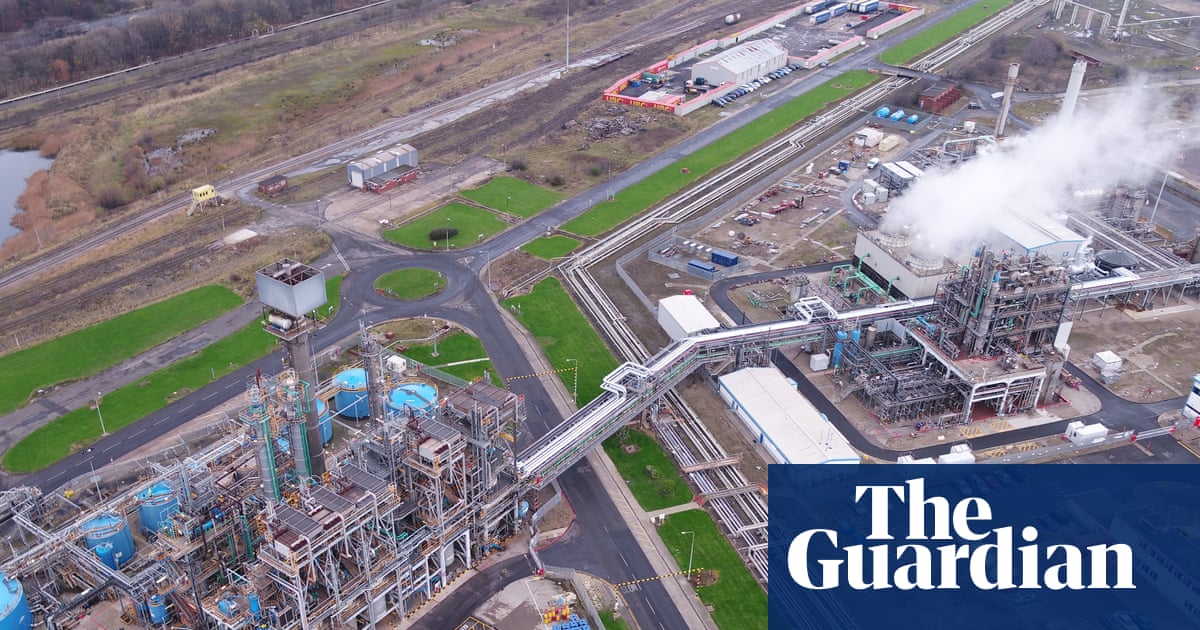
Huntsman Polyurethanes’ chemical plant is in Teesside, north-east England. Photograph: HandoutView image in fullscreenHuntsman Polyurethanes’ chemical plant is in Teesside, north-east England. Photograph: HandoutUK plastic manufacturer could face legal action over toxic emissionsExclusive: Environment Agency is considering whether to prosecute Huntsman Polyurethanes over emissions of carcinogenic benzene
A plastic manufacturer in the north of England is facing potential legal action over emissions of benzene, a carcinogenic chemical with no safe level, the Guardian can reveal.
The Environment Agency (EA) is considering taking legal action against Huntsman Polyurethanes in Teesside for a potential breach of licence, which is a criminal offence.
Campaigners say it has shone a light on the toxic nature of the global plastics industry and that workers and the local community have been put at risk.
Huntsman Polyurethanes, a petrochemical company that manufactures chemicals to produce plastic, sits within the sprawling Teesside chemical cluster in the seaside town of Redcar, North Yorkshire. The factory is part of Huntsman Corporation, a publicly traded global producer and marketer of chemical products which boasted revenues of $6bn in 2025.
In 2023, Huntsman decommissioned a process that was reducing its benzene air emissions and replaced it with an alternative method controlled by a third party.
However, EA documents show this new process “periodically paused”, with benzene consequently emitted directly to the air. The documents also show the EA was aware of this problem in 2023, but did not investigate until this year.
During this time, the benzene emissions from the site rose from 13 tonnes in 2022 to 17 tonnes in 2024, according to EA records.
Benzene, which is used to make some plastics, is carcinogenic to humans and causes leukaemia. According to the World Health Organization there is no safe level of exposure.
In an inspection report from March, the EA recorded several permit breaches in relation to the benzene emissions. The document states benzene is a carcinogen and it is “reasonably foreseeable that the deficiencies in the management system will cause multiple emissions, that when agglomerated, may result in a significant impact on the environment or human health until resolved through compliance”.
Failure to comply with an environmental permit is a criminal offence.
A Huntsman spokesperson said the benzene emissions were not illegal and were “fully compliant with our permit conditions”.
However, the EA told the Guardian: “We are considering further enforcement action with our legal team in relation to these permit breaches and have informed the UK Health Security Agency and the Health and Safety Executive so that they can assess any public or occupational health risks”.
Huntsman was instructed by the EA to carry out modelling to assess the impact of the benzene emissions in March 2026. The modelling found “significant” breaches of air quality standards in all scenarios considered. These standards are legally binding and are set to protect human health from toxic pollutants. In one scenario, the benzene emissions were predicted to exceed the 24-hour limit by 933%.
However, the EA told the Guardian an internal review of the modelling found the impacts to be “not insignificant but predicted environmental concentrations remain below the relevant environmental standards”.
“Our air quality experts have assessed environmental and human health impacts – their feedback indicates that these emissions do not pose a significant risk to local sites such as nearby schools,” the spokesperson added.
However, David Santillo, a senior scientist with the Greenpeace Research Laboratories at the University of Exeter, said these emissions are “very significant” and described the Environment Agency’s slow action as a “travesty”.
“The Environment Agency should be there to prevent this kind of thing, not just to document it and request more and more reports,” he said.
The EA said Huntsman “failed to act proactively” but it also “recognised that further follow-up sooner could have supported more timely implementation”. It added that its recent interventions have led to “significantly improved performance of the abatement system on site”.
Ally Lewis, professor of atmospheric chemistry at the University of York, said benzene is one of the most harmful air pollutants to human health and that the EA “seems to be allowing an obvious degradation in air quality and an increase in a pollutant that causes cancer on the basis that it’s fine as long as you stay below a somewhat arbitrary value”.
“If this is our national approach to managing risk and chemicals it seems remarkably laissez-faire and hands off,” he said.
Roel Vermeulen, professor of environmental epidemiology and exposome science at Utrecht University, said the modelling report flags a plausible problem that should be taken “very seriously”.
He said measurements of the benzene levels outside people’s homes and in other places in the community should “begin immediately” and this should be in parallel with reducing emissions.
A spokesperson from Huntsman said its own air monitoring data “indicates that concentrations beyond the site boundary are below applicable air quality standards”. It also said its “long-term personal monitoring programme highlights that there are no real-world instances of exceedance of exposure limits for personnel on site.” The company refused to share this data with the Guardian and has not shared it with the EA.
Campaigners say the benzene emissions from this factory point to a broader problem with the global plastic industry. A recent Greenpeace report said pollution from plastic waste is only one aspect of the “devastating impacts of plastics”, with the hazardous chemicals used in plastic production also “poisoning people and the natural world”.
International research has linked living close to plastic production facilities with negative health outcomes. The Boston College Global Observatory found that plastic production workers are at increased risk of a range of cancers, including leukaemia.
“You can’t manufacture plastics without creating pollution and the plastics then create pollution of their own. It’s a messy business right the way through,” Santillo said.
Carole Zagrovic, who worked as a community development specialist in Redcar for Friends of the Earth for around a decade in the early 2000s, said back then people in the area “talked about cancer like it’s the flu. They had become blase and hardened towards it,” she said.
Zagrovic said she was “appalled” that pollution like this was ongoing and said it seemed like nothing had changed despite her years of campaigning.
A spokesperson for Huntsman said: “Huntsman’s benzene emissions are fully compliant with our permit conditions, including our 2024 emissions, as governed by the Environment Agency.”
An EA spokesperson said: “We have been carrying out extensive regulatory work in response to concerns about emissions from this site, including inspections and compliance reporting which uncovered several breaches. We are considering further enforcement action in relation to these breaches and are working with the operator to ensure site improvements are rapidly delivered, due to our action, controls have been improved and emissions associated with process vent gases have reduced significantly since early February.”