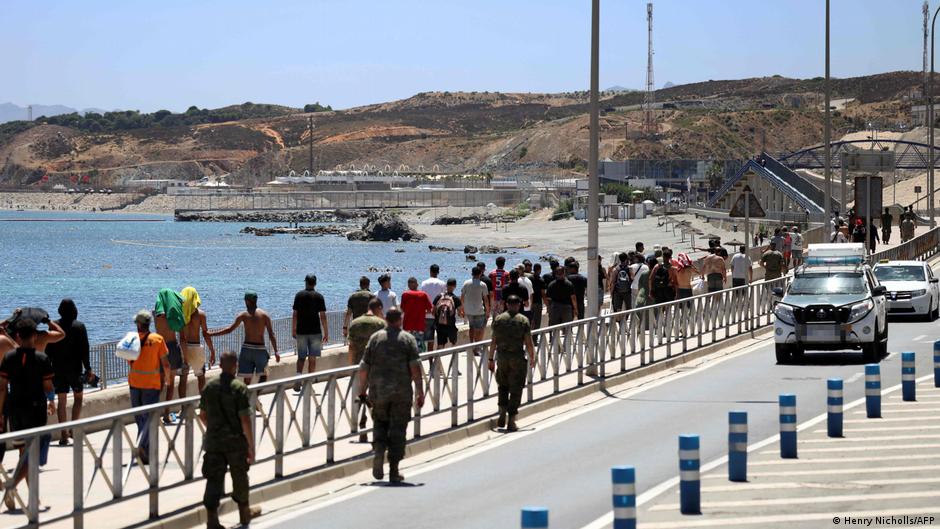
The European Commission has offered Morocco more support at the border to Ceuta and Melilla, and called for "united action" from the bloc on border security. Its interior ministers will discuss the issue on Tuesday.
https://p.dw.com/p/5ICmDMost of the people who rushed around the border checks last week have since returned to Morocco [FILE: August 2, 2026]Image: Henry Nicholls/AFPAdvertisementEuropean Commission President Ursula von der Leyen has told Spain's prime minister that border security is a "shared European responsibility" and suggested Brussels could provide more assistance to Morocco.
This comes as Spain tries to return the last of tens of thousands of people who swam around or otherwise breached the border to the North African exclave of Ceuta last week.
European Union interior ministers will convene for an emergency video meeting on Tueday to discuss potential responses. The scenes had led to friction betwen EU members and to Italy and France implementing temporary border controls, even though it's not possible to travel from Ceuta to the mainland without providing identification.
Von der Leyen wrote to Prime Minister Pedro Sanchez on Monday, which was soon seen by several news agencies, calling for "united action" on border security within the bloc.
"From this incident it is clear that we must do more to further strengthen our borders at critical points," she wrote.
"The protection of all our external borders is a shared European responsibility," von der Leyen said, calling for vigilant monitoring and the use of physical barriers where needed.
She commended Sanchez on his "swift handling" of the situation, with the vast majority of the roughly 50,000 people having already returned across the border to Morocco.
Ceuta's top government official Juan Jesus Vivas estimated that between 3,000 and 5,000 people remained in the city, with the Spanish governemnt's delegate offering a slightly lower estimate.
Von der Leyen also raised the prospect of intensified cooperation with and assistance for Morocco if necessary when it came to the Spanish coastal exclaves of Ceuta and Melilla.
"Morocco is an important strategic partner, particularly in our efforts to combat migrant smuggling and illegal migration," von der Leyen wrote. "In cooperation with Spain, especially on anything related to Ceuta and Melilla, we could enhance border management early-warning systems and improve our technical and financial support to Morocco.
The sudden large-scale rush across Ceuta's border starting on Thursday triggered sharp tensions among the EU's members states, with France announcing temporary border checks.
Migration-averse governments or ministers in Italy, Denmark and Finland even called for Spain to be suspended from the Schengen free-travel area, while right-wing opposition politicians around the bloc were often even more vocal.
Madrid responeded critically to what it called a "selfish" response from some partners, and called for emergency talks among European interior minister to chart a way forward.
Von der Leyen said Tuesday's talks would be a "first step," promising the issue would also feature in October's EU leaders' summit.
The EU has significantly tightened its migration rules in recent months, in steps that have led to a marked reduction in irregular migration into the bloc more generally.
It's also agreed on the option of sending failed asylum seekers to partner third countries deemed safe outside its borders, calling these destinations "return hubs." So far, though, no such deals have been set up even though legislation enabling them has been ushered in.
Migration expert Gerald Knaus, the director of the European Stability Initiative think tank, told DW it was clear that last week's developments were not based on "anything structural," given no meaningful changes either in Morocco's social situation or in Spain's migration policy.
Instead he said there "was a lot of false information" online wrongly spreading rumors like "Spain was opening its borders" and "there was an opportunity to get through."
He said the lower numbers of people swimming around the border checks earlier in the week fueled the fire and led to the vastly increased numbers by Thursday.
Knaus said the current situation was in no way comparable with the 2015 when thousands were arriving on a daily basis, many fleeing civil war in Syria.
"In this crisis, there were very, very few asylum seekers. Most of them were young Moroccan men. So, no, this is not a sudden increase in structural pressure from a big displacement crisis," he said.
But Knaus said that the political reaction throughout Europe and the way it generated similar panic and far-right calls to close the Schengen zone demonstrated that the difference in scale and the event being an outlier rather than a pattern didn't really matter.
"What we see is that politically, even two days of an event in North Africa create fear in Finland and Denmark and Germany," Knaus said. "And so clearly, all countries in Europe have an interest in helping the countries in the Mediterranean find a policy. And the policy has to be signaling clearly: Don't do this. Don't climb across the fence. Don't take to the boats. Don't swim across the sea. Because when you do, we will treat you humanely, but we will return you and if necessary, to a safe third country."
Knaus said that this message, if conveyed and shown to be true, would stop dangerous sea crossings almost completely and overnight. And he said that the new EU rules could make it possible to achieve.
However, he said he did not hold out much hope for the events in Ceuta leading to concerted action or cooperation among EU members.
"What is most likely is that there will be some grandstanding — that different governments will accuse each other. Spain will respond and will say it is not to blame and there will be bad feelings and no solution," Knaus predicted.
Don't let the algorithm hide the news. If you rely on our team for trusted reporting, please take a moment to select us as your Preferred Source on Google, so you'll always see our verified news first.