play Live Sign upShow navigation menuplay Live Click here to searchsearchSign upNews|Donald TrumpTrump says US has ‘understanding’ with Israel on Hamas disarmament dealIsrael has not yet agreed to plan for Hamas to surrender weapons in exchange for full Israeli withdrawal from Gaza.
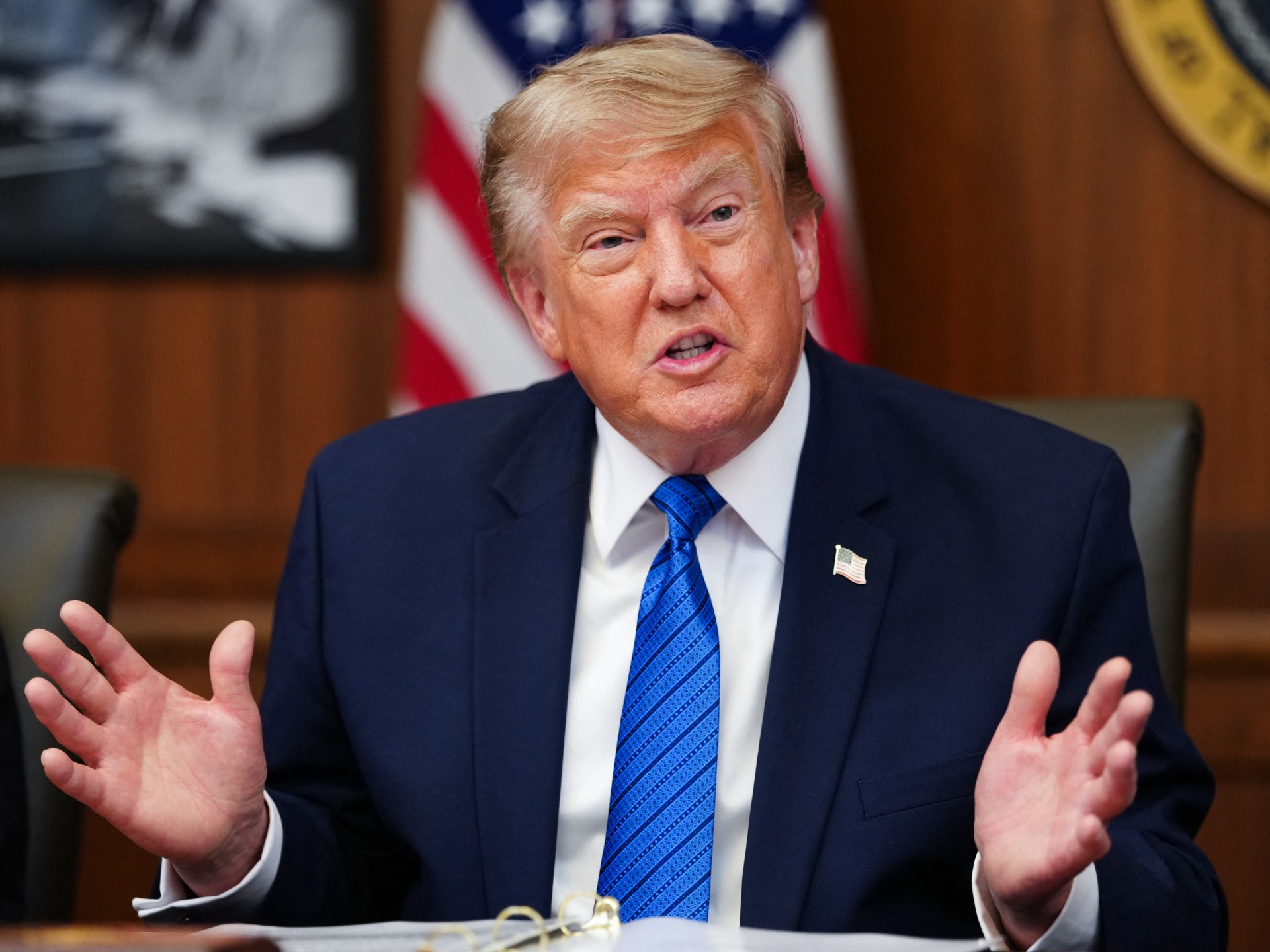
xwhatsapp-strokecopylinkgoogleAdd Al Jazeera on GoogleinfoUS President Donald Trump speaks during a Cabinet meeting at Camp David in Maryland [Aaron Schwartz/AFP]By Joseph StepanskyPublished On 31 Jul 202631 Jul 2026United States President Donald Trump has claimed that Israel is “very happy” about the newly announced deal with the Palestinian group Hamas, even though the country has yet to agree to its terms.
Friday’s statement came as Trump led a cabinet meeting at Maryland’s Camp David, a presidential retreat.
The US president explained that the deal may go through “ups and down” as the situation remains “complex”, but he presented a rosy picture overall.
“We do have an understanding with Israel. Israel’s very happy about it. Israel helped us with it,” Trump said of the agreement.
Hours earlier, Hamas had confirmed it agreed to the first step in a deal to bring Israel’s genocidal war in Gaza to a complete end.
Israel, however, has remained largely silent on the arrangement, which would include Hamas surrendering its weapons to a Palestinian committee in exchange for a full Israeli withdrawal from Gaza.
At least one Israeli official, far-right Minister Itamar Ben-Gvir, has called the plan “unacceptable to Israel”. He called its provisions “tantamount to agreeing to Hamas organising for the next massacre”.
In an interview with CNN, the Israeli ambassador to the United Nations, Danny Danon, nevertheless maintained that Trump would “absolutely not” be disappointed with Israel’s eventual response.
Still, he, too, questioned details of the agreement, saying Israel would only support a deal that assured that “Hamas will not have the capability to even touch this weapon again.”
Trump, meanwhile, painted a far more positive picture of Israeli sentiment as he spoke to reporters.
“It’s a great breakthrough. Nobody’s ever thought that would be possible to disarm Hamas,” he said.
The preliminary agreement, announced following a meeting of mediators from Egypt, Qatar, Turkiye and the US, could indeed represent a major turn in Israel’s genocidal war in Gaza, during which at least 73,341 Palestinians have been killed in the enclave.
Both sides signed a ceasefire agreement as part of a 20-point US-backed plan in October of last year. The future of its full implementation has been unclear amid near-daily Israeli violations. At least 1,214 Palestinians have been killed in Gaza since the ceasefire began.
A so-called International Board of Peace has been launched to oversee the deal, with Trump as its chair, and a political organisation called the National Committee for the Administration of Gaza has been appointed to eventually oversee daily administrative operations in the besieged enclave.
But wider questions over Israel’s eventual withdrawal from Gaza, the surrendering of Hamas’s weapons, the deployment of the International Stabilization Force (ISF), and a redevelopment plan for Gaza have remained unanswered.
The latest plan also remains on unsteady footing. Under the deal, Hamas is set to prepare an inventory of weapons over 14 days, with extensions possible.
The ISF and a new Palestinian police force would then oversee the transfer of those weapons to a Palestinian National Committee, which will be tasked with storing and monitoring the weapons.
Under the deal, Israeli forces would incrementally withdraw from Gaza during the process. The military has remained in Gaza since the October ceasefire agreement, occupying more than 70 percent of the enclave as it expanded Israel’s “Yellow Line” of control.
Reporting from Washington, DC, Al Jazeera correspondent Rosiland Jordan explained that there are no specific deadlines related to Hamas’s transfer of weapons and the withdrawal of Israeli forces.
That process would only begin after the “changing the security situation on the ground”, which itself involves several rounds of Israeli approval.
Earlier this week, the Israeli cabinet initially approved the entry of some ISF forces into Gaza. It will also vet the new police force.
“It has indicated that this change in the security posture or ‘demilitarisation’, as the Board of Peace has called it, will take some time,” Jordan said.
“It’s not going to be until that takes place that you really will see a blossoming, as it were, of a new type of political governance inside Gaza. They don’t want to put a deadline on it, but they say this is the process of how this will take place.”
Speaking to Al Jazeera, Harlan Ullman, the chairman of the Killowen Group advisory firm, cautioned that any agreement remains fragile. Success will be contingent on the response of Israeli Prime Minister Benjamin Netanyahu, who faces consequential elections in October.
“This is a very fragile agreement. It needs to be nurtured,” he said. “There are many, many aspects that can come apart, but I hope that Trump’s optimism is justified.”