A Patriot missile launcher in Warsaw, Poland, in 2023. Photograph: NurPhoto/Getty ImagesView image in fullscreenA Patriot missile launcher in Warsaw, Poland, in 2023. Photograph: NurPhoto/Getty ImagesTrump backtracks from promise to let Ukraine build Patriot missilesUS president tells reporters during Camp David cabinet meeting technology ‘a hard thing to give away’
Donald Trump has backed off a promise to let Ukraine manufacture its own Patriot air defense interceptors, telling reporters that handing over the underlying technology was “a hard thing to give away” during a cabinet meeting at Camp David.
The retreat, billed by the White House as “something different” for the cabinet to experience together, was the first such meeting at the presidential compound of Trump’s second term.
It also became the venue for the US president to unpick, in real time, a commitment he made to Volodymyr Zelenskyy just a few days earlier.
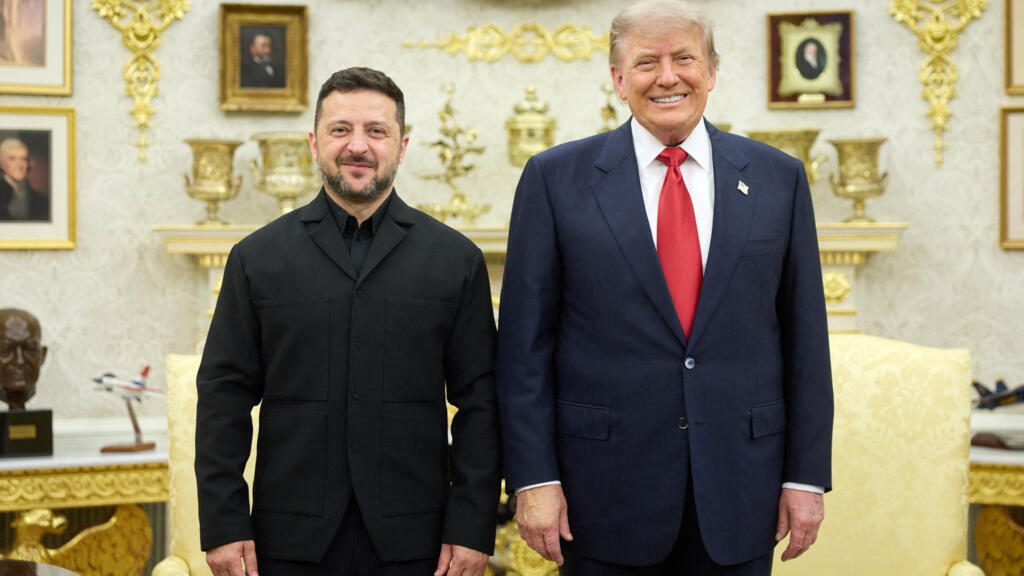
Asked whether he was ready to grant Kyiv a license to build Patriots domestically – something he had suggested at a Nato summit in Turkey just this month, and which the Ukrainian president described as a productive topic in their White House meeting on Tuesday – Trump was noncommittal.
“We have not agreed to that,” he said. “We’re talking about it, but it’s a hard thing to give away that kind of technology.”
Giving away the weapons carried its own risks, he added: “They can suddenly turn on you. You know that is possible.”
The interceptor travels at “8,600 miles an hour”, Trump explained, adding for context: “If you go 60, it gets to be a little fast.”
He went on to recall an occasion on which five missiles were fired “at Jordan” and were shot down in sequence – rendered by the president as “bing bing bing bing”.
“Nobody else has that capacity,” he said of the system, before concluding that Washington “will be building many plants” to produce Patriots and Tomahawk missiles domestically – just not, for now, in Ukraine.
The reversal is likely to unsettle Kyiv, which has spent the past year lobbying for both more interceptors and the means to produce its own, amid a global shortage that has been compounded by the volume of Patriot and Tomahawk stock expended in Washington’s confrontation with Iran.
Trump touched on that conflict too, telling reporters the US would be “hitting them very hard” if talks broke down, and dismissing Iran’s military as effectively hollowed out. “They have no navy … they have no anti-aircraft,” he complained, comparing the controversial five-month campaign favorably with US wars in Vietnam, Afghanistan and Korea, and arguing in each case that the war lasted “many years”, whereas his administration had achieved more, in less time. His stated goals for the campaign have repeatedly shifted.
An expert analysis of the Pentagon’s own arsenals tell a different story: the Center for Strategic and International Studies says two-thirds of the department’s Patriot interceptor have been used, perhaps prompting a $58.6bn army contract with Lockheed Martin to rebuild supplies, along with a recent White House request to Congress for tens of billions of dollars more in emergency funding.
The Camp David gathering came a day after Trump announced what he called a “historic” agreement for Hamas to disarm and for Israeli forces to withdraw from Gaza, a claim that has yet to be confirmed by Israel.
Pressed on the sequencing of the deal – whether disarmament or withdrawal would come first, the issue that has stalled negotiations for months – Trump declined to specify either way, saying only that Washington had “an understanding” with Israel and that the Israelis were “very happy about it”.
He was similarly light on detail when asked if the agreement would actually hold, despite a diplomatic backdrop that includes an outstanding international criminal court (ICC) arrest warrant for the Israeli prime minister, Benjamin Netanyahu, an unresolved international court of justice (ICJ) case accusing Israel of genocide in Gaza, arms restrictions imposed by several governments over the conduct of the war, and a governing coalition at home that has repeatedly rejected anything short of Hamas’s total disarmament before any withdrawal.
“The people are very complex and difficult,” said Trump. “In many cases wonderful, in many cases not so wonderful.”
An Israeli official has said that no withdrawal from the so-called Yellow Line will happen before Hamas fully disarms, while members of Netanyahu’s own coalition have voiced opposition to the plan, details Trump did not address.