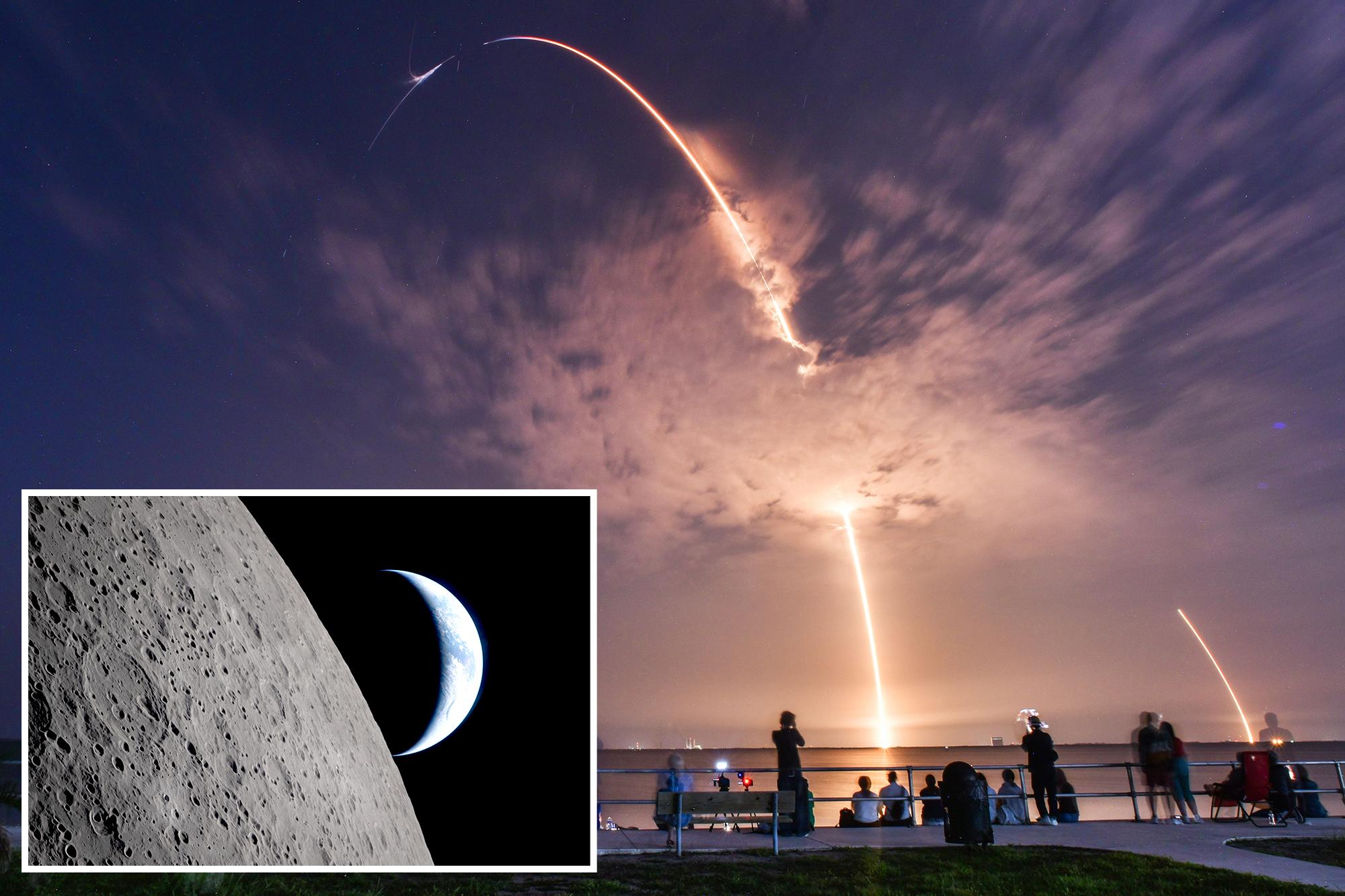
The upper stage of SpaceX's Falcon 9 will collide with the moon on August 5, affording astronomers an opportunity to study the real-time effects of a lunar impact. NASA via Getty Images See more of our coverage in your search results.
Add The New York Post on Google It’s one small crash for man.
Just months after the historic Artemis II Mission, humanity will witness yet another trip to the moon on August 5. But this time, the lunar landing is unplanned — our rocky satellite will be impacted by an errant component from a SpaceX craft.
As predicted months ago, the upper stage of the Falcon 9 rocket is a week away from colliding with the moon at more than seven times the speed of sound. The impact will add a new crater to its pockmarked surface and kick up a dust plume that will potentially be visible from Earth, USA Today reported.
Coincidentally, this collision course marks a return for the spacecraft, which was part of the launch that sent two landers — the Blue Ghost-1 by Texas-based firm Firefly and Japan’s Resilience — to the moon on Jan. 15, 2025, according to Space.com.
With its mission complete, the 8,800-pound uncrewed spacecraft part lacked the fuel to return to Earth or move into deep space. Instead it remained in orbital limbo until gravity slingshotted it toward the moon, where it is slated to crash on the near side the Einstein crater on August 5.
While permanently reshaping the moon’s surface is not ideal, the unplanned journey to the moon will afford scientists the rare opportunity to study the real-time effects of a lunar impact.
As part of a non-peer-reviewed study published in preprint server arxiv, University of Texas grad student William Jo used a special physics simulation to model the collision.
His team predicted that the debris column will have a central ejecta spike reaching between 47 miles and over 60 miles high.
Meanwhile, new research led by New Mexico planetary scientist Benjamin Fernando suggested that the impact crater would be around 66-to-98 feet wide — which is sizable but smaller than an asteroid-induced pockmark because the spacecraft is hollow
But will we be able to see the flash from the crash? It’s hard to say.
“Our calculations suggest the plume should be several orders of magnitude brighter than the dark-sky background for the first few minutes after impact,” Jo told Space.com. “So the plume should be visible, though I’d stress this is a single nominal case. The real one will look different, and the numbers are on the optimistic side.”
Meanwhile, Fernando’s team determined that the both the flash and debris plume will be “potentially observable” from terrestrial and space-based facilities.
The researchers noted that the degree of visibility is “imprecisely predicted at present,” although the study authors note it could be a tad faint for moongazers armed with regular telescopes.
“it will probably be at least worth taking a look,” said study co-author Bill Gray, an astronomer who writes the Project Pluto orbital tracking software. “Maybe we’ll see the flash. Maybe we’ll see rocks ejected from the crater. Maybe we’ll even see both.”
For many researchers, the event’s visibility is beside the point.
The fallout from a lunar impact will shed important light on dust and plume effects from such collisions, and potential hazards that moon-bound space junk poses to future lunar missions, among other factors.
“Watching this one gives us a rare chance to open up ejecta-plume science and calibrate those models against a real event, which matters for every future thing we deliver to the moon,” said Jo.
Thankfully, the collision doesn’t pose a threat to people, and won’t significantly reshape the lunar surface, Gray wrote on his website.
However, he noted that the upcoming event does highlight a “certain carelessness about how leftover space hardware (space junk) is disposed of.”
This study could be particularly important as SpaceX develops a much larger Starship Rocket for future missions to the moon.