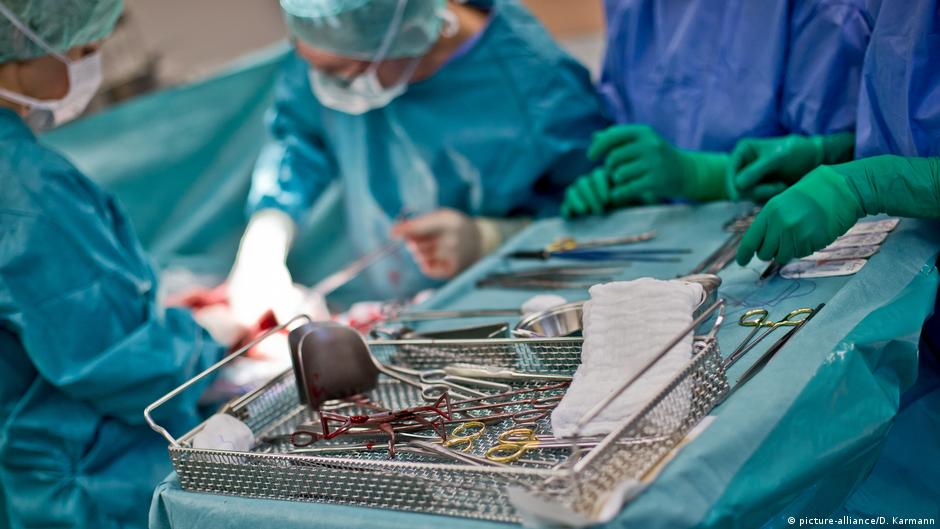
A months-long DW investigation into childbirth in Serbia revealed a striking pattern in women's negative experiences, the widespread use of practices not universally recommended by the WHO and a system under pressure.
https://p.dw.com/p/5I2UpA DW investigation shone a light on some women's negative experience of childbirth in SerbiaImage: picture-alliance/D. KarmannAdvertisement"People say that when you enter Betanija, you leave your dignity at the door. Is that normal?" one woman asked, recalling her experience at the maternity hospital in Novi Sad.
"In my village, they take better care of cows than the doctors took care of me," said another.
"I've never shown anyone my first photo with my baby because in that picture, I look half dead," said a third.
These three women have never met. They gave birth in different Serbian cities, in different years and under the care of different doctors. Yet there is a striking similarity in what they told DW about their experience of giving birth in Serbia.
Over the course of several months, DW spoke with over 20 women in Serbia whose testimonies reveal a similar pattern: inhumane treatment and the routine use of outdated procedures that often serve to compensate for the weaknesses of an overstretched healthcare system rather than respond to the needs of the mother and child.
In ideal circumstances, childbirth is a physiological process that follows its own rhythm. This is not, however, reflected in practices on many Serbian maternity wards.
Upon admission, women are routinely subjected to the same sequence of procedures: shaving, enemas and a first dose of oxytocin, a hormone used to induce or accelerate labor but one that can significantly increase both pain and the frequency of contractions.
The World Health Organization (WHO) only recommends these practices when there is a clear medical indication or when the woman herself requests them.
"It was so intense and aggressive," recalled Stefani S. from Novi Sad, describing the effects of her first oxytocin stimulation.
"I dilated very quickly, but the pushing contractions never started because they forced me open. Then one doctor after another came to examine me, and eventually one of them ruptured my waters. He didn't say a word. He didn't warn me. He just shoved his hand inside me," she told DW.
"They were forcing a labor that simply hadn't started," said Natasha S. from Ruma, who was also given oxytocin.
When labor continued to progress slowly, doctors resorted to the Kristeller maneuver — the application of manual fundal pressure to the upper part of the abdomen to physically push the baby out. The method is considered controversial by many professional associations because of the risk of injury to both mother and child.
"Afterwards, I had bruises under my breasts. She kept shouting, 'Push!' I was pushing blindly, blood vessels in my eyes burst from pushing the wrong way. Then I heard a doctor say: 'Bring me the vacuum extractor,'" Natasha told DW.
Natasha says that her baby developed a swelling on the head after the vacuum extraction. She says she spent the days that followed afraid that there would be more serious complications, including brain hemorrhage and cerebral palsy.
The pressure in hospitals to speed up labor often results in another intervention that has become almost routine in Serbia: episiotomy, a surgical incision made in the perineum to facilitate the baby's delivery.
Although the WHO does not recommend the "routine or liberal use of episiotomy" for women undergoing spontaneous vaginal birth, nearly every second woman in Serbia undergoes the procedure. Data collected by DW from maternity hospitals across the country shows that the episiotomy rate in some institutions exceeds 70%.
Episiotomy wounds can make recovery and newborn care more difficult. Many women who spoke to DW said that the procedure was carried out without explanation, without consent and in some cases without anesthesia.
For decades, episiotomies were routinely performed, especially on first-time mothers, because doctors believed they accelerated birth and prevented more severe tearing. Current medical guidelines no longer support such routine use, but old habits apparently die hard.
Biljana Stankovic, a psychologist who has spent years researching obstetric practices in Serbia, warns that some of these procedures are rooted not only in outdated medical assumptions but also in gender stereotypes.
In her research, she documented testimonies about the so-called "husband stitch" — an extra stitch allegedly used to restore the vagina "to its former size" after childbirth.
"The last time I heard about it was from a woman in Belgrade who said that […] her doctor commented: 'Here's a little bow for the husband,'" Stankovic says.
Many of the women interviewed by DW reported being called spoiled, weak, rude, disobedient or even selfish by medical staff during labor.
"At one point I said, 'Please tell me what's happening, it will make it easier.' And they just laughed, like: 'What is she talking about? Nothing will make it easier,'" recalled Stefani. "The man who delivered my baby barely spoke to me at all. He was annoyed because they had woken him up during the night shift."
That such experiences are not isolated incidents is reflected in the 2022 Report on the Treatment of Women in Gynecological and Obstetric Institutions in Serbia.
Its authors identified verbal abuse as one of the most common forms of mistreatment reported by women during childbirth.
One woman said that midwives threatened to "wake her up with slaps" if she fainted. Others described humiliating and sexualized remarks.
Experts point to a healthcare system under increasing strain.
Data obtained by DW shows that one third of all births in Serbia take place in just four major maternity hospitals in Belgrade and Novi Sad, while smaller facilities across the country continue to close.
"Because of the sheer number of births, women in large maternity wards are treated like they're on an assembly line — everything has to be finished within 24 to 48 hours so the bed can be freed up for the next patient," Jasmina Mihnjak, editor of the parenting platform "Svet za nas" (World for us), told DW.
Not everyone, however, believes that a lack of resources is the only explanation.
Data also shows that two-thirds of maternity wards in Serbia handle no more than three births per day. Under such circumstances, said one gynecologist who wanted to remain anonymous, women could be given more time for labor to progress naturally. Instead, "habit" and "routine" often prevail.
The new National Guideline for Good Clinical Practice: Physiological Vaginal Birth produced by the Serbian Health Ministry acknowledges many of the problems women have been highlighting for years and recommends different approaches.
"These testimonies from patients and pregnant women were shocking to us at first. But they also had positive effects on our profession," says Dr. Olivera Kontic, one of the guideline's authors.
Experts warn, however, that Serbia already has numerous guidelines and strategic documents that remain poorly implemented.
"There is no monitoring mechanism to show whether any of these recommendations are actually being applied," says psychologist Biljana Stankovic.
As a result, more women are turning to legal action, says Sanja Radivojevic of the Belgrade Centre for Human Rights. She argues that these cases involve clear violations of patient rights, abuse and infringements of constitutional protections of physical and psychological integrity.
"We had a case where a woman explicitly refused a vacuum extraction and said she understood the risks. They performed it anyway while four or five men held her down," Radivojevic says.
Yet not a single case of what is commonly referred to as obstetric violence has reached a final court judgment in Serbia. Radivojevic fears that if they ever do, prosecutors will side with the system and allow the cases to expire under statutes of limitation.
Meanwhile, many women leave maternity wards carrying more than a baby. For some, the fear and trauma outlast the birth itself.
The research for this article was conducted with the support of Journalismfund Europe.