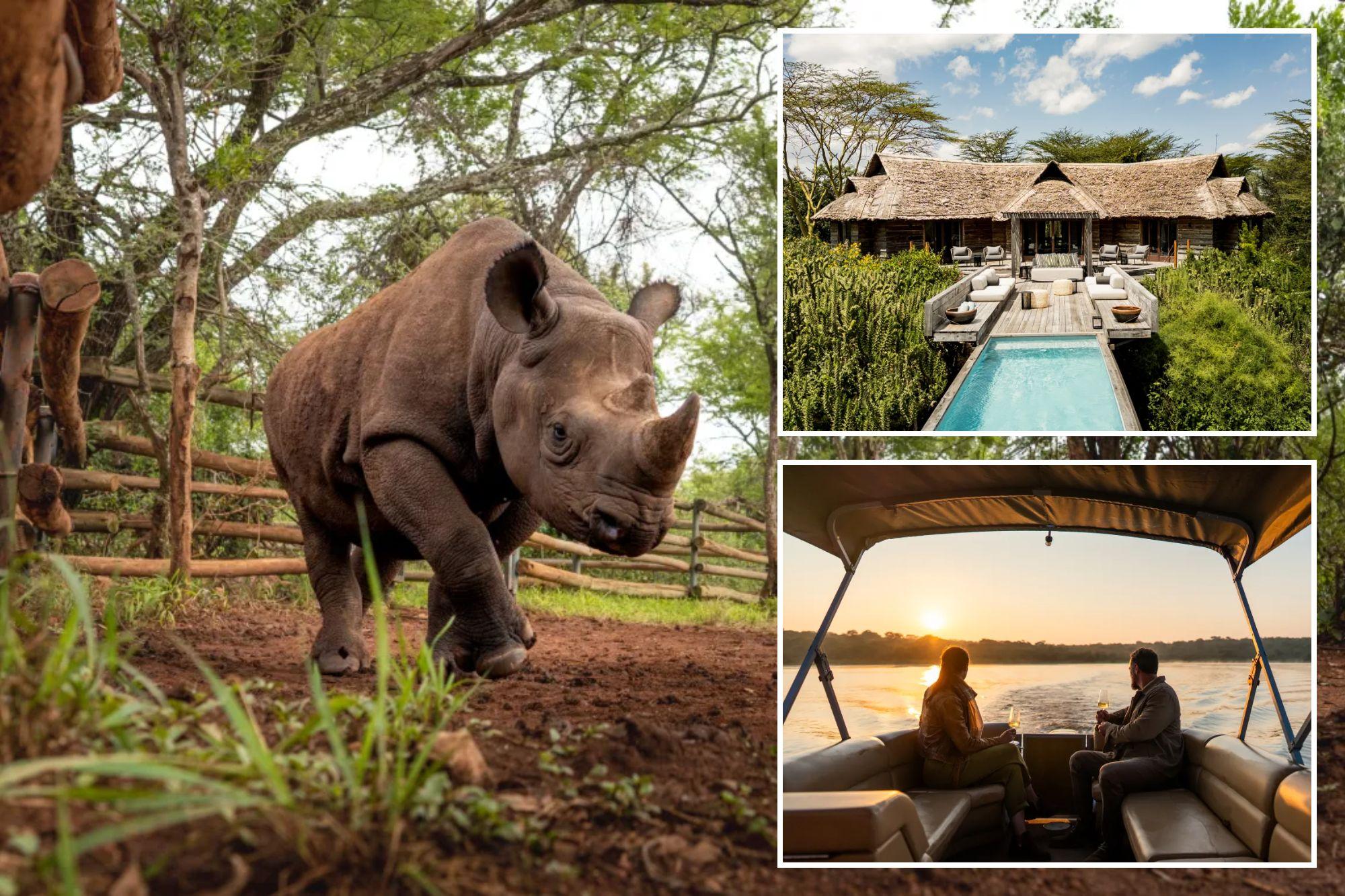
All horned up: Singita Grumeti in Tanzania works to re-up rhino numbers. Singita See more of our coverage in your search results.
Add The New York Post on Google The rhino stepped towards us, close enough to touch.
In the wilderness of central Kenya, the waist-high railing of my viewing platform felt laughably inadequate against an animal weighing well over a ton.
Kitui didn’t mind the barrier. For several minutes, the enormous black rhino stretched his long upper lip beneath the railing, sniffing curiously in our direction like a dog searching for treats.
Kitui is an unusual rhino. Bottle-raised in captivity, he has grown unusually comfortable around people. At Segera, a 50,000-acre wildlife conservancy and safari retreat in Kenya’s Laikipia Plateau, he’s known for wandering around the main lodge and keeping tabs on the guests.
Despite his easygoing demeanor, Kitui is also a reminder of just how fragile his species remains. Black rhinos are still critically endangered after decades of poaching pushed them to the brink of extinction. But across southern and East Africa, conservation organizations are doing something that would have seemed almost unthinkable 20 years ago: moving rhinos not because they’re running out of places to hide, but because they’re running out of space to hold a growing population.
The turnaround for Africa’s rhinos is remarkable. White rhino numbers have rebounded from just a few hundred animals a century ago to about 16,000 today, and black rhinos have risen from just 2,410 in 1995 to 6,788 today.
“We have proven that recovery is possible,” said Jo Shaw, CEO of Save the Rhino International. “African rhino conservation efforts are targeting not only the protection of rhinos in order to stop losses due to poaching but also prioritizing relocation and range expansion projects to actively create new populations and grow numbers.”
For the first time in a generation, the tide is turning, and success stories from across the continent offer hope for rhino conservation — with the timing especially advantageous for travelers. There has simply never been a better time to see rhinos on safari.
Last spring, Segera became the centerpiece of one of Kenya’s most ambitious wildlife conservation projects in decades, welcoming 21 black rhinos in a landmark operation led by the Kenya Wildlife Service and the Zeitz Foundation. It was the first step in a multi-year plan to create one of the world’s largest connected rhino sanctuaries by linking Segera with neighboring conservation areas across the Laikipia Plateau. Later this year, Segera will welcome the largest white rhino translocation ever in Kenya.
Owned by Jochen Zeitz, who founded the Zeitz Museum of Contemporary Art Africa in Cape Town, the retreat is known for its impressive art collection and villas that are a far cry from the typical safari tent. Lush landscaping envelopes each accommodation and luxe touches like private pools and butler service make calling this a “camp” feel almost unfair.
The rhino renaissance is happening across the continent. In Rwanda, NGO African Parks recently completed another huge rhino translocation, flying 70 white rhinos more than 2,000 miles from South Africa to Akagera National Park. The relocation coincides with the opening of Wilderness Magashi Peninsula, a high-end waterfront camp with only two villas, one two-bedroom suite, its own exclusive entrance into the park, and the opportunity to spot wildlife from both game-drive vehicles and boats.
Prior to his Venetian nuptials last year, Jeff Bezos reportedly rested up at Singita Grumeti. It’s located in a private concession adjacent to Tanzania’s Serengeti National Park, and its philanthropic arm, the Grumeti Fund, works to restore rhinos to the Serengeti-Mara ecosystem.
The fund completed the largest translocation of rhinos in Tanzanian history in 2019 and celebrated the concession’s first natural-born rhino calf in decades in 2020.
Despite recent conservation efforts elsewhere, the real holy grail of rhino sightings remains northern Namibia, where desert-adapted black rhinos roam free in one of the only places in Africa where they still exist outside national parks.
“Northern Namibia is rugged,” said Katie McDonough, travel advisor with Explore, Inc. “It’s definitely not something I’d recommend for everybody — but it’s a real adventure, and you’re approaching rhinos on foot.”
Whether you track them on foot in Namibia or from the comfort of a Singita plunge pool in Tanzania, the odds of seeing rhinos in the wild are only getting better.