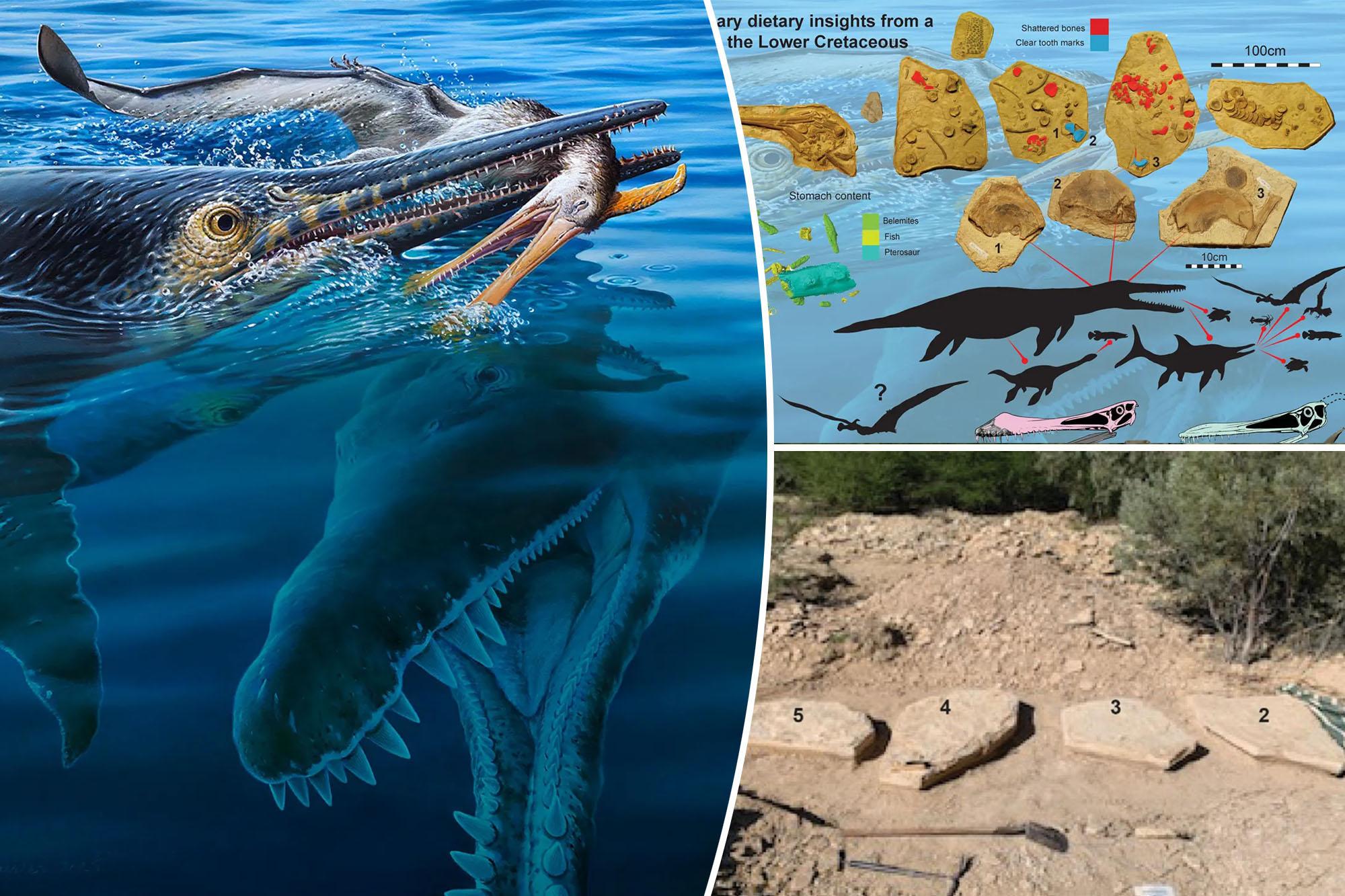
The Bag Of Bones pointed to a bizarre drama that played out beneath the waves 100 million years ago. Science Direct See more of our coverage in your search results.
Add The New York Post on Google Ah, the circle of death.
Specimens found in Australia highlighted a bizarre interspecies drama from the Cretaceous era, involving a flying dinosaur eaten by an over 20-foot marine reptile, which was in turn devoured by an even larger water monster. This fossilized food chain was highlighted in the journal Gondwana Research.
“It’s one of the clearest examples ever discovered of a three-tier predator interaction,” Dean Lomax, a paleontologist at the UK’s University of Manchester who was not directly involved in the research, said in a statement.
Signs of the bones in question had been discovered in 2019 by four fossil hunters digging in the Outback near Richmond. One hundred million years ago, this arid region was an inland water body known as the Eromanga Sea, which was a veritable monster soup.
The specimens, known as the “Bag Of Bones, were subsequently analyzed by lKronosaurus Korner fossil museum curator Kevin Petersen, whose team spent 600 hours organizing them into a quasi-complete ichthyosaur specimen measuring nearly 23 feet long.
A series of CT scans revealed that the stomach of the critter — a marine reptile that was essentially like a dolphin with razor sharp teeth, per Popular Science — contained the jaw of a flying dino known as a pterosaur.
This suggested that the aerial hunter had flown too close to the sea and gotten snapped up by the aquatic predator lurking beneath, marking the first ever evidence of this particular predator-prey interaction.
The ichthyosaur’s skeleton bore split vertebrae, missing ribs and crushing bite marks on other bones, said study co-author Matt White, a paleontologist at the University of New England.
“I was amazed by the size of the ichthyosaur, and shocked to see it littered with bite marks,” he said.
Dr. White believed there was one critter in the Eromanga Sea that was “capable of producing injuries of this magnitude”: the Kronosaurus queenslandicus.
Named after the powerful Titan of Greek mythology, this formidable pliosaur — a short-necked predator that resembled a crocodile with flippers — measured over 40 feet long and weighed 11 to 13 tons.
Kronosaurus also boasted a bite force of between 3,370—6,070 pounds, enough to take out a formidable predator such as an ichthyosaur.
Ultimately, the “Bag Of Bones” has shed important light on the circle of life — and death — that transpired beneath the Eromanga Sea.
“This discovery enriches our understanding of these ancient marine reptiles and illustrates the complex interactions that shaped their prehistoric aquatic environment,” said White.