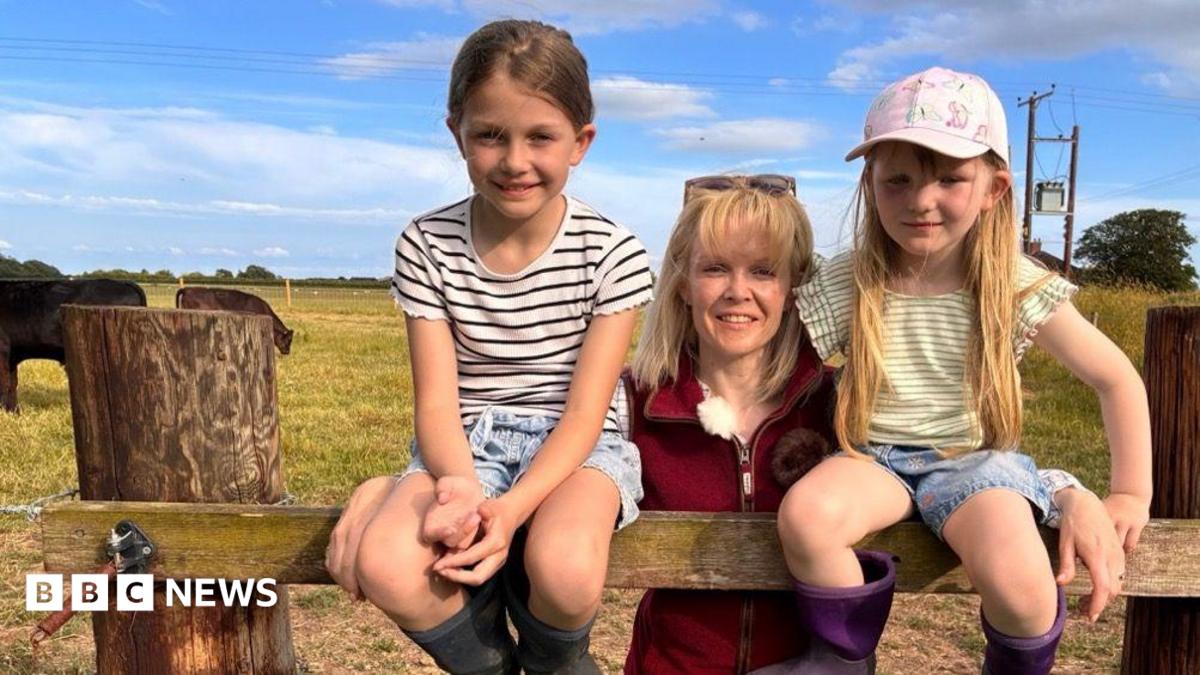
Image source, Linsey Smith/BBCImage caption, Heather Oldfield's daughters have ambitions to be farmers in the future
East Yorkshire and Lincolnshire rural affairs correspondentPublished15 minutes agoFor many, the smell of charcoal and sizzling meat is the scent of summer.
However, soaring costs mean a backyard barbecue may no longer be an affordable meal option.
The rising cost of burgers and fast food has been labelled "burgerflation".
According to data from the Consumer Price Index (CPI), the prices of beef, bread buns and bagged salad have risen sharply since last summer.
But does this mean farmers and food producers are earning more?
We spoke to some of those whose produce could find its way from the farm to your fork.
Heather Oldfield, cattle farmer, Boston, Lincolnshire
Image caption, The farm has 200 animals, but the amount buyers are paying for beef has fallen
Lincolnshire is known as the breadbasket of England due to its output of crops – and it also has a rich tradition of livestock farming.
Heather Oldfield, who farms cattle near Boston, says her family "want to feed people".
The family has 200 animals, which will be sold to Morrison's butchery. They will make many meat products, including burgers destined for barbecues.
The latest figures from the Agricultural Price Index (API), for April, show farmers like Oldfield were getting 8% less for their beef on average compared with the previous 12 months.
But shoppers were paying 9% more in May compared with a year before, according to the CPI.
"There's a lot of uncertainty," says Oldfield.
The mother-of-two says she must cover their costs to ensure the farm survives for her daughters, who want to be farmers.
Oldfield says: "How do we shore the business up into a place that's right for them to come into without saddling them with a lot of debt?"
A Defra spokesperson says the government is "backing our hard-working farmers, investing a record £11.8bn – more than any previous government".
Yet Oldfield is feeling the pressure. She also works full time for a plant breeder because the farm does not generate enough to pay the wages for both her and her husband.
Phil Clayton, baker, York, North Yorkshire
Image source, Linsey Smith/BBCImage caption, Thousands of loaves are baked each week at Phil Clayton's bakery
"I know I'm not going to be a millionaire running a bakery," says Phil Clayton.
We are speaking in the busy bakery he runs with his wife Tina. It is only 10am, but the operation has been in full swing for nine hours.
Clayton says it is "absolutely not true" that the bakery enjoys more profit due to price rises.
In May, families were paying 2% more for bread rolls than they were a year earlier, according to the CPI.
But in April, farmers were receiving 0.3% less for wheat, the main ingredient, according to API figures.
The 2% increase in prices for customers is smaller than the 3% rise seen across the whole CPI index.
Clayton says he does not regret increasing his prices by 10p to 20p.
"My responsibility is to make sure all of this lot get paid," he says, referring to his 30-strong team, which includes bakers, delivery drivers and Saturday staff employed in the cafe that adjoins the bakery.
Clayton points out the extra money shoppers pay at the tills goes towards increases in rent, wages, National Insurance, delivery fuel and the rising cost of flour – much of which originates from farms in the region.
Robert Archer, mill manager, Kirkbymoorside, North Yorkshire
Image source, Linsey Smith/BBCImage caption, The mill managed by Robert Archer buys more than 400 tonnes of locally grown organic wheat every year
Robert Archer says haulage costs have been "a big hit", forcing him to increase the price of the organic flour he mills in North Yorkshire.
"If we stayed at the same price we would be losing money and then we couldn't run the business," he says.
The mill buys more than 400 tonnes of wheat from farms in North Yorkshire and East Yorkshire each year. It generates enough flour to feed 20,000 people, he says.
The flour is sent to customers, including Phil Clayton's bakery in York.
Nelly Trevelyan, the mill's owner, says staying organic helps them to minimise percentage price rises because "we don't have nitrogen fertiliser cost increases [and] we don't use pesticides, so we haven't got those increases".
However, she says many people buy what they see as "cheap food" from "the industrial farming system" that uses more intensive methods.
Mathew Brankley, farmer, Snaith, East Yorkshire
Image source, Linsey Smith/BBCImage caption, The salad grown by Mathew Brankley is destined for the shelves of major supermarkets
Mathew Brankley believes food remains "relatively cheap" in the UK.
"I know that that might sound like a shock," he says. "But if you go to some places over in Europe and the States, the cost of a simple lettuce could be $2.99. In the UK, it's retailing at 80p to £1."
According to the API, vegetable growers were receiving 12.6% more for their produce in April compared to 12 months ago. But in May, shoppers were paying 8% more, according to the CPI.
Brankley insists he is no better off, explaining any extra money he is being paid for his crops is being "eaten up" by rises in the prices he pays for fuel and fertiliser.
"There's a lot of people that are taking a cut from what the customer pays in the supermarket before any of it gets back to the farmer," he says.
Despite the challenges, Brankley says he would not consider changing jobs.
"I wouldn't do anything else because I enjoy it so much."
A Defra spokesperson says: "We've already cut red diesel to its lowest rate in over 20 years [and] we are seeking views on suspending fertiliser tariffs to help farmers."
Listen to highlights from Hull and East Yorkshire or Lincolnshire on BBC Sounds, watch the latest episode of Look North.
Contact formContact formDownload the BBC News app from the App Store, external for iPhone and iPad or Google Play, external for Android devices
This burger was made from cow cells in a lab. Should it really be served in restaurants?