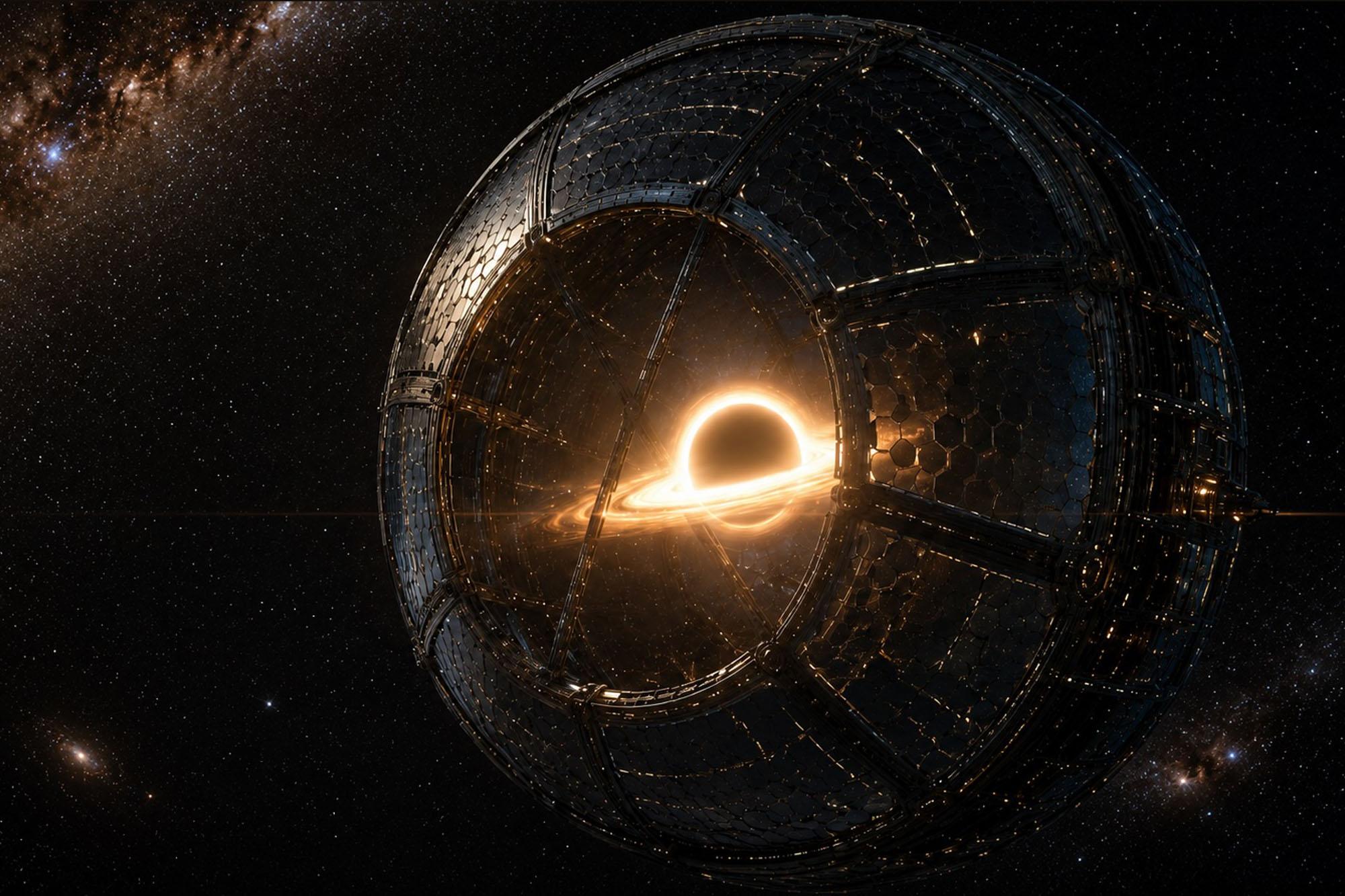
Alien civs could be using Dyson spheres to harness energy from black holes, researchers theorize. 91DPI - stock.adobe.com See more of our coverage in your search results.
Add The New York Post on Google They’re hole-ar powered.
If super-advanced alien civilizations exist, they would surely require insane amounts of energy to run. Now, international scientists are theorizing that these intelligent extraterrestrials could be harnessing the requisite power from black holes, per a study in Publications of the Astronomical Society of the Pacific.
“We’re aware it’s a very out-there theory,” paper lead author Olivia Curtis, of the Penn State Extraterrestrial Intelligence Center (PSETI) at Pennsylvania State University in the US, told ScienceAlert.
She was among the researchers who attended the “Dyson Minds 2025 Workshop,” organized by Penn State, MIT, and The Ultraintelligence Foundation, where astronomers, astrophysicists, AI experts, engineers, and industry experts explored whether extraterrestrials could build energy-harvesting structures around black holes to power their civs.
While this isn’t the first time this hypothesis had been proposed — Taiwanese researchers notably floated it in 2021 — this conference marked the first time experts from so many different fields gathered to discuss it.
The power siphon they proposed was a Dyson Sphere, a hypothetical engineering structure devised by theoretical physicist Freeman Dyson in the 1960s. Originally floated as a mechanism to harvest energy from a star, many experts believe that the ability to harness the Sun is a hallmark of an advanced stellar society.
But instead of star power, the researchers declared that they could use these spheres to amass power from super massive black holes — voids at the center of a galaxy that accrete (eat) everything in sight.
They also blast out jets filled with more energy than a million suns. In an April piece for The Conversation, UK radio astronomer Steve Prabu described these cosmic plasma beams as the “most energetic phenomena in the cosmos.”
While Curtis acknowledged that the theory was very “science fiction,” she deemed them less far-fetched when you consider proposals to install data centers in space.
“We’re imagining that if some form of life wanted to extract the largest energy gradient that they possibly could, they’d naturally find themselves at the center of their galaxy,” she said.
Of course, harnessing these colossal vortexes requires more than just erecting an intergalactic oil derrick. As the Taiwanese researchers postulated in their 2021 study, a Dyson Sphere would need to be a great enough distance away from the void to avoid being vaporized.
In fact, Curtis said that due to the luminosity, “you need to be about a parsec or about 3 light-years away from the black hole in order to actually have a satellite not immediately melt just due to the radiation.”
Fortunately, the researcher explained that these theoretical power vacuums wouldn’t be positioned past the event horizon, where it’s possible to get suctioned up by a black hole.
How does one account for the lag between spheres placed on either side of one?
Curtis explained, “They can either beam that information, in which case we might see like periodic bursts of information just from the fact that at some point those orbits are going to align and start pointing towards us.”
“It turns out that at these distance scales, if you want to transmit a zettabyte of information, it’s just faster to sling your hard drive at it instead of trying to beam the information yourself,” she added.
If aliens used these Dyson spheres to harness black hole power, this could be denoted via infrared signatures. In fact, Curtis’ research focuses on these signs, including the datasets from the Event Horizon Telescope Team, which snapped the black hole at the center of galaxy M87 in 2019 (our first ever), and the one in our own solar system, Sagittarius A*, in 2022.
Of course, many think there are plenty of holes in the Dyson sphere theory. Harvard scientist Avi Loeb, who notably theorized that interstellar comet 3I/ATLAS could be technological, told the Post that the “risks in the vicinity of an active black hole are far bigger than the benefits.”
He declared that “luminous quasars” — the radiant cores of galaxies powered by supermassive black holes — would “tear apart any technological infrastructure near the central black hole.”
“Also, the environment is highly hazardous for the construction workers of such infrastructure because of powerful X-rays and cosmic rays [that] would damage not only the bodies of biological workers but also the electronic wiring of any robots or AI systems,” he said. “All in all, I would stay away by many thousands of light years from supermassive black holes.”