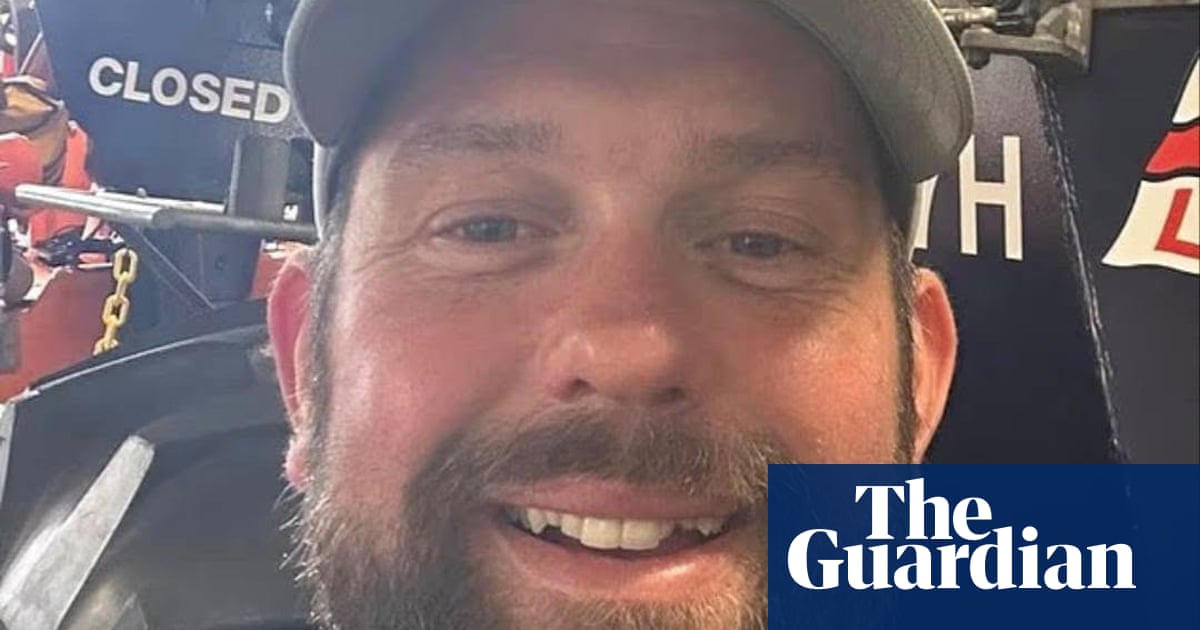
James Desborough. Police found notes suggesting he may kill again and planned to change his appearance before fleeing the UK. Photograph: FacebookView image in fullscreenJames Desborough. Police found notes suggesting he may kill again and planned to change his appearance before fleeing the UK. Photograph: Facebook‘A control freak’: murderer James Desborough convicted of two further killingsMan already serving life for killing his cellmate while awaiting trial also murdered and dismembered his friends Claudio Aquilino and Daniel Coleman
On a spring day last year, James Desborough marched up to Cornwall’s county hall in Truro and began bombarding the offices with dozens of eggs stolen from a supermarket.
It was a drug and drink-addled protest at his plight – homeless, jobless and generally angry at the world. He expected to be arrested and messaged a friend: “If I’m going to get nicked, might as well round the charges up.”
He certainly did that. In the weeks and months after the egg incident, Desborough committed three murders.
He killed two vulnerable friends, Claudio Aquilino and Daniel Coleman, whose dismembered and burnt bodies were found in woodland close to a shack where he sometimes lived off-grid in south Cornwall.
View image in fullscreenClaudio Aquilino, who was vulnerable and subjected to ‘cuckooing’ in the months before his death. Photograph: Devon and Cornwall police/PAThen while awaiting trial, he murdered Steven Kempster, his cellmate in Exeter prison, strangling him to death because he was annoyed with some of his habits.
Desborough, 40, is already serving a life sentence for the prison killing. After a jury at Winchester crown court convicted him of murdering his two friends, he may never be released, putting him on a par with serial killers such as Rose West who are expected to spend the rest of their lives behind bars.
Acquaintances have said Desborough was a control freak with a terrible temper – he has an old conviction for GBH – and was furious at what he saw as his bad luck in life. A civil engineer by profession and a father, he had fallen on hard times.
Quite what tipped him over into an explosion of violence is unclear. He used Aquilino’s and Coleman’s bank cards after he killed them, but police do not believe it was a simple matter of theft.
View image in fullscreenDaniel Coleman, who struggled with alcohol abuse and PTSD before Desborough murdered him. Photograph: Devon & Cornwall police/PAThe prosecutor in his trial, Ahmed Hossain KC, put it to Desborough that he might have killed them because he considered them worthless, deserving to die because of their troubled lifestyle and because they were “dinlos” – a local slang term for fools. Had he simply got annoyed with them and snapped? “I thought they were OK,” he replied in court. “They were good friends.”
The trial has certainly put the focus on a different Cornwall to the one most holidaymakers to the county love.
It highlighted not surfing beaches and historic landscapes, but the deep-rooted social issues that make life for many in the far south-west of England difficult. There are pockets of serious deprivation in Cornwall where people experience homelessness and addiction problems.
Desborough, Aquilino and Coleman were among those who – in the words of the defence barrister, Sean Brunton KC – had slipped through the cracks in society.
The three got to know each other when they lived in a hostel for homeless people in the seaside resort of Newquay.
View image in fullscreenJames Desborough at the Falmouth Stable pub on 3 June 2025, the last day Daniel Coleman was seen alive. Photograph: Devon & Cornwall policeIn the months before he died, Aquilino, 57, was taking hard drugs, suffering from depression and subjected to “cuckooing”, in which dealers take over the home of a vulnerable person.
Coleman, 43, abused alcohol and had cirrhosis. He had been kidnapped and stabbed at the age of 13, leaving him with post traumatic stress disorder.
The police were first called in after Coleman was reported missing. He had last been seen on 3 June 2025, drinking with Desborough.
Police thought they had solved the case quickly when they found a body in woodland between Truro and the village of Probus.
It turned out not be Coleman though, or Aquilino, but a third man, Lee Hockey, who had vanished from Truro. Police believe he too may have been murdered, but have not linked his death to Desborough.
Attention began to focus on Paramoor Woods, near Sticker, once a mining settlement now popular with people who work in the town of St Austell.
Desborough had inherited land there from his grandfather and built a shack, though, to his frustration, he did not have the correct planning permission and had been told by the council that he was not allowed to live there permanently.
View image in fullscreenThe shack James Desborough built on the land he inherited. Photograph: Devon & Cornwall police/HandoutHe would let homeless friends camp there, grew cannabis and had a “stash tree” where he hid class A drugs in a hollow. Machetes, knives and saws were also scattered around the property.
Police searched the woods for five months, eventually finding the remains of Coleman and Aquilino. The latter had last been seen alive on 18 April 2025, also drinking with Desborough.
Codenamed Operation Honeyfall, the search was extraordinary. More than 700 officers and scientists were involved, with Devon and Cornwall police drawing on resources from five other forces. Dog teams, soil experts and anthropologists were brought in.
The weather was very hot and the nature of the terrain jungle-like and boggy. Officers sometimes had to wade through water up to their chests as they searched.
View image in fullscreenA hatchet police found near the shallow grave containing Daniel Coleman’s remains. Photograph: Devon & Cornwall police/PAIn excess of 1,900 burnt bone fragments – Aquilino’s remains – were discovered in a stream, while Coleman’s charred body parts were found in a shallow grave. A hatchet hung on a nearby tree.
Another unusual feature was that Desborough kept a beady eye on the search. Before there was enough evidence to remand him in custody, he hung around, at one point telling a forensic biologist that he liked the dismemberment scenes in the serial killer show Dexter.
Sometimes officers smelled burning and at other times heard digging, perhaps as Desborough tried to destroy evidence.
As well as discovering the victims’ remains, police came upon notes and plans Desborough had made that suggested he may have been planning to change his appearance through plastic surgery after the murders and flee the UK, perhaps to south-east Asia.
View image in fullscreenOne of the notes police found. Photograph: Devon & Cornwall policeDetectives also discovered he had used his victims’ bank cards to buy goods and services, including a roast beef dinner soon after cutting up Coleman’s body.
He was eventually charged with the two murders and held in Exeter prison sharing a cell with Kempster, who had been jailed for drunkenly suffocating his 91-year-old father in north Devon.
Desborough’s appearance in the witness box was remarkable. He was considered so dangerous that he was handcuffed to an officer when he was moved from the dock to the main area of the court.
He was articulate when speaking about his time as a civil engineer and building regulations concerning his cabin, but he was less certain when he told the story of finding the bodies of Aquilino and Coleman.
He claimed he had come upon one hanging in a tree, the other naked in a stream. It was, in his words, a “series of unfortunate circumstances”.
Desborough repeatedly denying killing the pair, but accepted burning and hiding their bodies while high on ketamine and drinking tequila.
During the trial there was a suggestion that Desborough might have carried on killing, murdering members of his circle who could have implicated him in the deaths of his friends or who simply annoyed him.
In one note, he had written: “I’m a killer and ready to execute any predators.” In another, headed “bug out” – military slang for a retreat – he set out what appeared to be escape plans but added: “Take out the remaining muppets.”