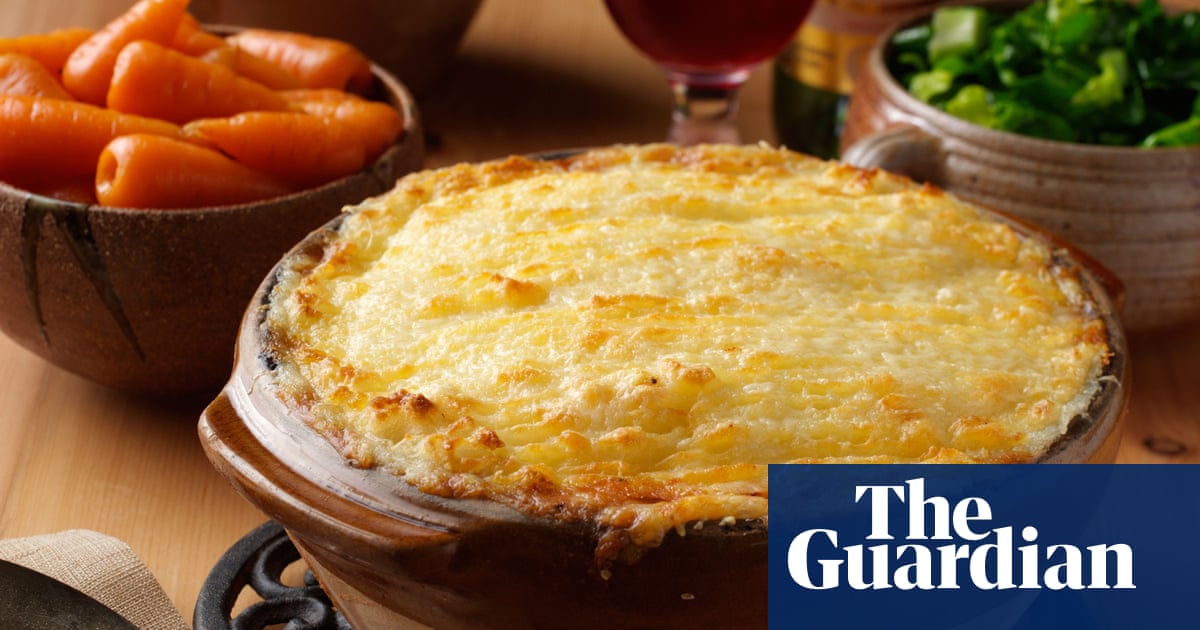
Cottage pie sales have soared 110% at Waitrose in the last month. Photograph: Tim Hill/AlamyView image in fullscreenCottage pie sales have soared 110% at Waitrose in the last month. Photograph: Tim Hill/AlamyCottage pie and glass of red, anyone? Britons shun salad despite heat in ‘reverse comfort eating’Nostalgic foods like toad-in-the-hole also in demand at Waitrose as people pivot towards familiarity amid climatic and political upheaval
Forget a crisp salad and glass of chilled rosé. Enervated Britons are seemingly more likely to crave a rich cottage pie and a robust red in heatwaves.
In a trend termed “reverse comfort eating”, Waitrose’s cottage pie sales have soared 110% in the last month and South African red wine is up 68% compared with the same period last year. The surprise spike in demand for winter comfort foods also includes retro chicken, bacon and leek pie (up 41%), chicken korma (up 67%) and chicken and ham gratin (68%).
Meanwhile, home cooks are happy standing over the stove despite the sweltering heat, with searches for traditional food classics on the supermarket chain’s recipe site up 67% for toad-in-the-hole, 91% for spaghetti bolognese and 57% for rarebit mac and cheese.
Another 1950s staple, along with cottage pie and toad-in-the-hole, trifle is also high on shopping lists, with the supermarket seeing a 100% year-on-year increase in sales of its strawberry version.
View image in fullscreenToad-in-the-hole. Photograph: Dan Matthews/The GuardianThe food historian and author Seren Charrington-Hollis recently catered for a VIP event at the Llangollen Eisteddfod music festival, where her cottage pies and lamb hotpots were in huge demand – to her surprise, “as it was unbearably hot”, she said. “But they all wanted these home-cooked meals,” she said, adding that the guests were fed up of salads.
The cost of living crisis, global wars and conflicts and political change at home all contributed to uncertainty, while the unusual heat added to the feelings of discomfort, said Charrington-Hollis, whose forthcoming book is on nostalgic food from childhood.
If it all seemed very “school dinners,” she said, “I think it’s very much a psychological switch, of people wanting to really indulge in home-cooked food and traditional food.
“I mean, not just politically, economically, but also the weather is not quite right. I think we’re completely out of sync. We’re not used to all this warm weather. And what better way to connect with ourselves and almost get back to our roots than through food. And I think that’s what’s going on.
“Just simplifying things, because I think we just need to be able to cope and reset. It’s almost like a reset button, that’s what I’m feeling.”
View image in fullscreenAnother 1950s staple, trifle, is also high on heatwave menus. Photograph: Shaun A Daley/AlamyThe chef Simon Wood believes the cost of living crisis is a factor. Such dishes have long been pub classics. But with cutbacks on eating out, “I think they’re trying to get that hint of going out to the pubs but maybe doing it at home,” said the 2015 MasterChef winner.
As for choosing hot and hearty ready meals in the heat, Wood said time constraints and lack of skills in the kitchen were drivers. Also, people are “sick of salad”, and for those supermarket shopping just once a week “salad may not last”.
View image in fullscreenIt’s not all 1950s trad wife stuff – chicken korma sales were up 67%. Photograph: Old Visuals/AlamyIn the sense of comfort eating, said Prof Rebecca Earle, food historian the University of Warwick, “trying to use food as a way of assuaging some kind of unhappiness or distress, then I think this is what people have done for a very long time”.
That the popular dishes also included chicken korma showed it was “not all 1950s, trad wife stuff”, she said. “Amid all of those, let’s say, postwar kind of white British dishes, we have a little glimmer of a multicultural Britain coming through.”
Stephen Parkins-Knight, Waitrose’s senior innovation chef, has his own theories on why people are craving the nostalgic staples. “Forget the thermostat – when a heatwave goes on, raw salads and chilled plates can often lose their cool fast,” he said.
“What we’re seeing is a trend in ‘reverse comfort eating’ – after spending all day drained by the heat, people crave rich, grounding staples to recharge, pivoting back toward comfort and familiarity.”