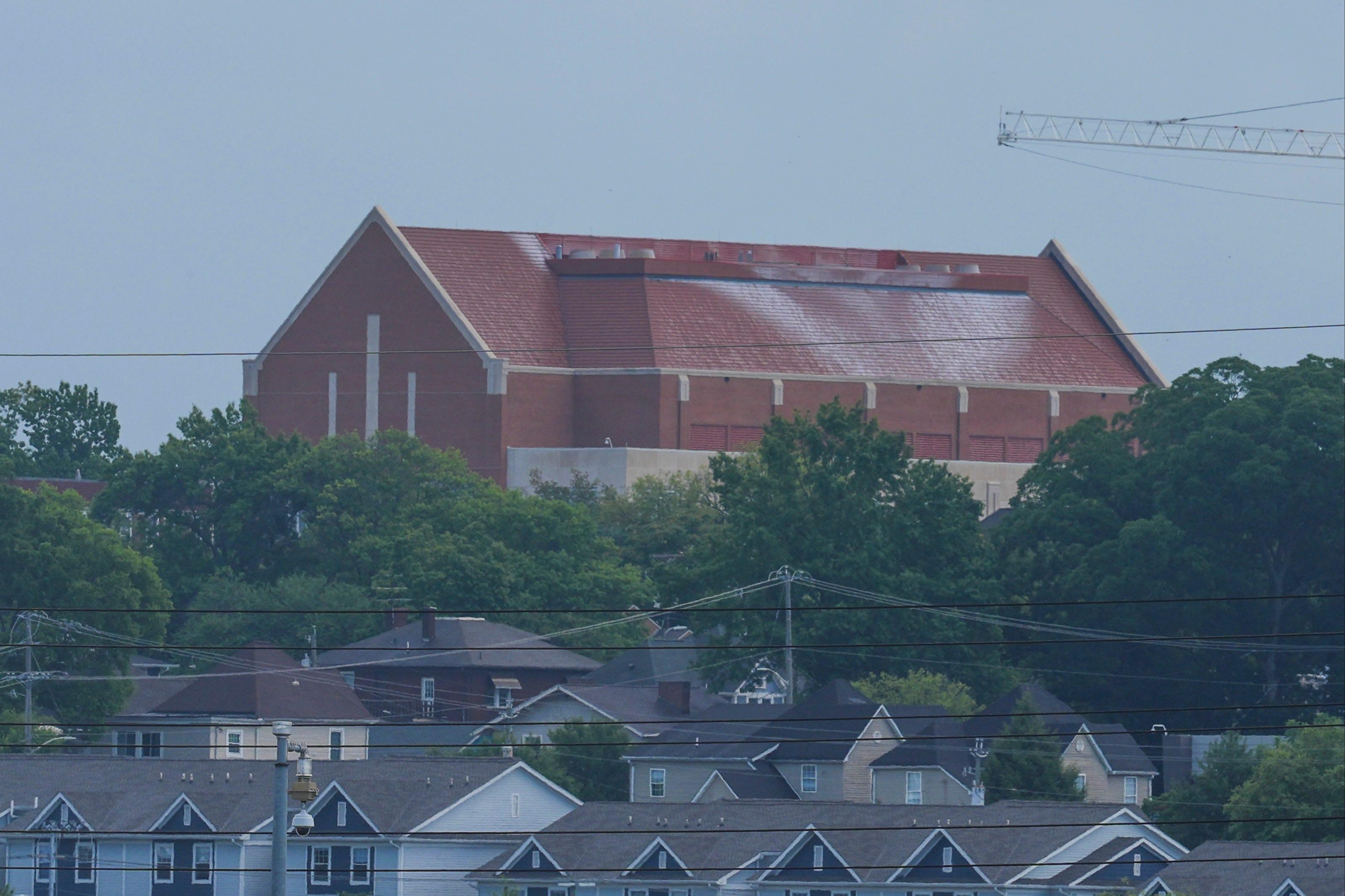
Strong Hall on the University of Tennessee campus in Knoxville, Tenn., on July 9, 2026. USA TODAY Network via Reuters Connect See more of our coverage in your search results.
Add The New York Post on Google Academia has a diversity problem, and people are starting to notice.
Oh, it’s not a race/gender diversity problem; academia has paid a lot of attention to that.
One person raising alarms is Tennessee’s former governor, Phil Bredesen — a Democrat.
Bredesen recently flagged research he’d done that showed virtually all (over 90%) of Tennessee faculty members’ political donations have gone to Democrats.
How long, he asked, can such overwhelmingly blue higher-ed command political support, or even legitimacy, in a deep-red state like Tennessee (where more than 64% of voters went for Trump in the last election)? Good question.
It’s not just Tennessee. In the 2022 election cycle, 93% of donations by professors nationwide went to Democrats; just 7% went to Republicans, per a study of educators’ donations done by Data Orbital for the Education Freedom Institute.
By contrast, 51% of the votes in that election went to Republicans. That’s quite a gap.
In an ideal world, of course, it wouldn’t really matter: Faculty members’ political views shouldn’t have much, if anything, to do with how they teach English literature, or anthropology, or chemistry.
Politicizing the curriculum isn’t even controversial — you’re more likely, on most campuses, to see professors criticized for refusing to do so.
And even if you believe this doesn’t affect instruction, one of the arguments made on behalf of “diversity and inclusion” programs in general is that students should have professors, and fellow students, who “look like them.”
Well, Trump voters who come to the University of Tennessee won’t see a faculty that went for Trump by over 64%. Or, probably, even a tenth of that.
This huge political imbalance in the professoriate affects student learning directly.
A recent study by Forest Romm and Kevin Waldman involving confidential interviews with 1,452 students at Northwestern University and the University of Michigan found that a whopping 88% of students said they had pretended to hold more “progressive” views than they really did to get ahead.
More than 80% said they submitted classwork that misrepresented their views in order to align with those of professors.
Anecdotal evidence suggests this is the case pretty much everywhere.
The problem isn’t professors’ donations — every American has a right to support politicians and causes — but rather what it says about the uniformity of today’s academic culture.
There are excuses: Conservatives, we are sometimes told, are too dumb, or too greedy for big bucks to get involved in academia.
Not only does this sound troublingly like what was said about black people and women in the past, but it runs counter to the facts: Academia used to be much less overwhelmingly leftist than it is now.
In a SCOTUSblog column, law professor Brian Fitzpatrick recalls that when he wanted to teach race discrimination law, he asked his former law professor Elena Kagan (then dean at Harvard Law, now a Supreme Court Justice) for advice.
“Her response: don’t do it. She explained that, in order to get a job as a race discrimination scholar at any school, I would have to win over the other scholars at that school who worked in that area.
“Kagan said that at every school the scholars who worked in that area all supported racial preferences. The problem was that I was against racial preferences. She said for that reason alone no one in the field would support hiring me.”
This is true all over. A new study by the America First Policy Institute found that 40% of faculty would oppose hiring any Trump supporter; one in four were in favor of purging existing faculty who expressed conservative views; 43% of conservative faculty report being penalized for their views.
Academia is a far-left institution in a center-right nation. Yet professors who regard Trump voters as anathema are supported, at least in part, by taxpayers who the faculty regard as beyond the pale.
How can an institution — industry? — that depends so heavily on taxpayer money expect to retain its legitimacy, and funding, under such circumstances?
The rejoinder is that people wanting to cut academic budgets are “anti-intellectual.”
But some may find it hard to be pro-intellectual when the intellectuals are so anti-them.
Anyway, there is nothing intellectual about one-sided discourse.
People on the right have been talking about this problem for a while.
But now, with even those on the left, like Phil Bredesen and Elena Kagan, noticing, it’s becoming impossible to dismiss.
Academia needs to vastly broaden its intellectual base, or face an end to business as usual. Will it?
Glenn Harlan Reynolds is a professor of law at the University of Tennessee and founder of the InstaPundit.com blog.