Documented cases of violence against LGBTQ+ people in Serbia have never been higher. The attacks are part of a larger shift in society targeting marginalized people.
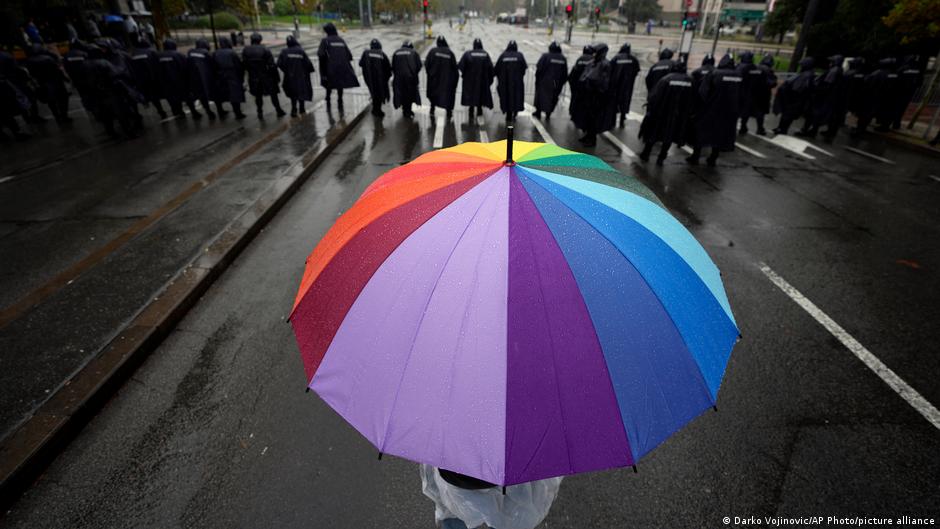
https://p.dw.com/p/5Hl6lViolence against people who don't look or act like the mainstream in Serbia is becoming increasingly commonImage: Darko Vojinovic/AP Photo/picture allianceAdvertisementAmid a slew of blows and homophobic insults, the woman on the bus lashed out at Aleksandar Savic and stabbed him with a sharp object. Later, in the emergency room, doctors treated Savic for a cut to the calf and injuries to his eye.
Incidents like the July 11 attack on Savic — also know as drag queen Alexis Plastik — don't happen often in Belgrade. But violence against people who don't look or act like the mainstream in the EU candidate country is becoming increasingly common.
Just a few hours earlier, Vladimir Arsenijevic, author and program director of the annual Krokodil Literary Festival, was attacked in central Belgrade in the middle of the day by right-wing thugs, as he was preparing for a memorial event commemorating the 1995 Srebrenica genocide.
Speaking with broadcaster N1, Plastik called out the "epidemic of violence" in Serbia. The increasing violence by groups associated with President Aleksandar Vucic and his Serbian Progressive Party, SNS, has reinforced the feeling among many people that anyone who is different can become a target, and that no one is safe.
"Violence is becoming increasingly normal, while protection against it is anything but guaranteed — especially for those who speak out against social or political problems, or who are unpopular with the general public," said Matija Stefanovic, the program coordinator for the LGBTQ+ group Da se Zna! ("For Your Information!"), which documents violence against queer people in Serbia.
"The fact that most of these attacks aren't investigated and that the perpetrators are rarely held accountable means they can't be dismissed as isolated incidents," said Stefanovic. "They represent a systemic problem that further stokes violence and emboldens perpetrators to continue attacking marginalized people, without having to fear significant consequences."
The social climate has become decidedly harsher for Serbia's LGBTQ+ community over the last few years, with the community also increasingly the target of right-wing nationalist government.
Da se Zna! is based in an unassuming office on a side street in the center of the Serbian capital. Aside from a lone rainbow-colored nutcracker standing on a shelf, hardly anything indicates the group's purpose: it's the only organization in Serbia to document attacks on queer people — threats, vandalism, physical assault.
"Last year, we counted 110 cases — more than ever before," said Stefanovic. That's due in part to the fact that the NGO is becoming more well-known, and queer people are increasingly ready to report incidents. But dramatic, high-profile cases like the aggression against Alexis Plastik are also happening more and more.
In mid-May, unknown assailants attacked Mornar, a queer bar in Belgrade, with tear gas. At the end of May, a trans woman and her partner were beaten unconscious one night — again, by unidentified attackers.
Many queer people in Serbia are scared of openly showing their identity. In a recent survey by the European Union Agency for Fundamental Rights, some 80% of respondents said they avoided holding the hand of their partner in public.
The latest edition of the Rainbow Map, compiled by the International Lesbian, Gay, Bisexual, Trans and Intersex Association, shows that Serbia has slipped to 29th place in Europe, six spots below the European average. Five years ago, it was in 22nd place.
The only solution to this stigmatization and violence is education, said Stefanovic. Next to the yearly Pride parade co-organized by Da se Zna!, activists also travel to small towns around the country with a Pride Caravan to send a message: we're here, and we're not going anywhere.
In some of the towns, they're greeted by a handful of supporters holding rainbow flags — and dozens of demonstrators shouting homophobic slogans.
LGBTQ+ activist in Serbia: 'I was abused by the police'To view this video please enable JavaScript, and consider upgrading to a web browser that supports HTML5 video
After the group published a list of the planned destinations for this year's caravan, they received several death threats. The event in Pirot, in Serbia's southeast, was called off on short notice in mid-July because police could not guarantee the group's safety. Three journalists covering the event were attacked by the mob.
"These protests show the sad reality for queer people living in a small Serbian town," said Stefanovic. "We try to show the people living in these towns that we know how hard it is — and that we haven't forgotten about them."
Stefanovic knows exactly how it feels to grow up queer in a small town far from the cosmopolitan city of Belgrade.
"I wanted to be a boy for as long as I can remember. Every night I prayed to God that he would turn me into one," he told DW.
Only as a teenager did Stefanovic learn about other people that felt like him — and that they were known as trans. But this knowledge did nothing to ease his worries.
"Once I realized [who I was,] I felt the weight of everything I would have to go through as a result," he said.
It was only when Stefanovic moved to Belgrade for his studies that he felt free enough to openly live as Matija. He came out as trans, first to several professors at the university, then to friends. Finally, one day, he wrote to his parents, an eight-page letter in which he explained everything that had preoccupied him for years.
Stefanovic then made two life-changing decisions: he began hormone treatment to align his biological sex with his gender identity — and he did so openly. At the time, there were very few people living openly as trans in Serbia, and not much information was available on how to undergo gender-affirming treatment.
"It sounds totally cliche, but I wanted to become the person that I needed in my life when I first exploring my own gender identify," said Stefanovic. He filmed his transition, first putting his videos on YouTube and then on TikTok.
TV interviews followed soon after — and the attention of right-wing groups on Facebook. At first, the hate directed toward Stefanovic seemed unbearable. But he decided to keep going, to stay visible, so that trans people would someday belong.
Stefanovic knows that acceptance is a process, and that people can change their views. His family is a prime example — his conservative father was the first person to consistently use the right pronoun and new name. And last year, both his parents took part in Belgrade's Pride parade for the first time.
"I'm so proud of them," said Stefanovic. "My parents have become my greatest allies."
How to support my trans child?To view this video please enable JavaScript, and consider upgrading to a web browser that supports HTML5 video
This article was originally written in German.