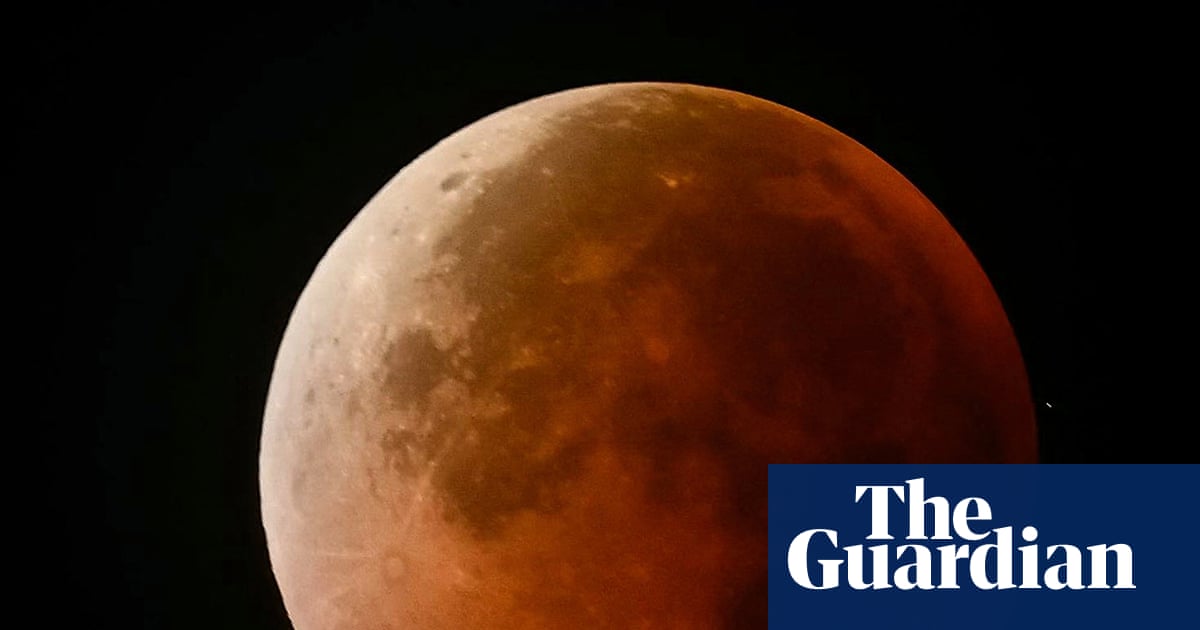
A full moon also known as ‘blood moon’ is seen in the night sky in Yangon on September 7, 2025. A total lunar eclipse will be visible tonight across Australia, North America and other parts of the world. Photograph: Ishara S Kodikara/AFP/Getty ImagesView image in fullscreenA full moon also known as ‘blood moon’ is seen in the night sky in Yangon on September 7, 2025. A total lunar eclipse will be visible tonight across Australia, North America and other parts of the world. Photograph: Ishara S Kodikara/AFP/Getty ImagesRare ‘blood moon’ total lunar eclipse to loom over North America, Australia and New ZealandEclipse will feature a deep, coppery-red full moon on 3 March. From Sydney to New York, use our guide to find out when the eclipse will be visible and the best time to see it tonight.
What is a blood moon?What time is the blood moon in Australia?What time is the blood moon in New Zealand?What time is the blood moon in North America?When is the next total lunar eclipse?What is the meaning of the blood moon?North America, Australia and New Zealand will be treated to a rare total lunar eclipse on Tuesday known as a “blood moon”.
As the full moon dips into the planet’s shadow tonight it will change colour to a “deep and coppery red”, says astrophysicist Dr Rebecca Allen of Swinburne University.
It will be the last time people will get to see this celestial phenomenon for nearly three years.
A lunar eclipse occurs when the Earth lines up between the moon and the sun. The sun’s light is blocked – casting a shadow on to the moon.
But in some eclipses sunlight does reach the moon indirectly, daubing the moon in a sunset palette.
“Any light that does pass shines through our atmosphere and transforms the lunar surface into a deep, coppery red,” Allen says.
Dr Brad Tucker, an Australian National University astrophysicist, described it as a little bit of sunlight that “skims” the Earth’s atmosphere.
“Just as a sunset or sunrise can be pink or red, this light is also refracted and so lights up the moon in an orange-red colour,” he says.
For the best experience, Allen suggests finding a dark location away from city lights and allowing 10 to 15 minutes for your eyes to adjust.
Jupiter will also be visible high in the sky, making for what Allen calls “a great pairing”.
0:45Visibility map for total lunar eclipse on March 3 – videoWhat time is the blood moon in Australia?Allen says the best time to view the eclipse in Australia on Tuesday night are:
Read more Sydney, Canberra, Melbourne, Hobart – starts 10.04pm, ends 11.02pm
In New Zealand the eclipse will reach its “deepest point” shortly after midnight on Tuesday, when the moon is high in the sky, says Prof Richard Easther.
“It will be visible everywhere in the country,” the University of Auckland physics professor says. “Everyone who can see the moon will see the eclipse.
“As an astronomer, I am excited by anything that encourages people to ‘look up’ and experience the night sky for themselves.”
The total lunar eclipse will be visible in the early morning of Tuesday 3 March in some parts of the Americas.
“Observers near the edge of the visibility region may see only part of the eclipse because, for them, the moon sets,” according to Nasa.
Time and Date says the best times to view the eclipse in North America are:
New York, Washington DC – starts 3.44am, ends about 6.30am
New Orleans, Chicago – starts 2.44am, ends about 6.24am
San Francisco, Los Angeles – starts 12.44am, ends about 6.23am
Other big international cities to see the blood moon include:
Total lunar eclipses occur every 18 months to three years, Allen says.
The next total eclipse will be New Year’s Eve 2028. It will be visible to most of the world: Europe, Asia, Australia and Africa – but not the Americas. The next total lunar eclipse visible in North America will be in June 2029.
Read moreA partial eclipse is due on 28 August 2026. The Americas and Africa will have the best view but it will be almost entirely invisible from Australia and New Zealand.
In the modern age, of course, a blood moon is simply a dramatic astronomical event.
“[They are] a breathtaking reminder that we are living on a moving planet, in a dynamic solar system. Just one small, wonderful world, drifting through space,” Allen says.
In ancient times, though, they were invested with grim portents.
Daniel Brown, a lecturer in astronomy at Nottingham Trent University, wrote for the Conversation that the ancient Inca people interpreted the deep red colouring as a jaguar attacking and eating the moon, and in ancient Mesopotamia a lunar eclipse was considered a direct assault on the king.
The native American Luiseño tribes from California would sing and chant healing songs towards the darkened moon, believing it to be wounded or ill.
More recently, the 2013 book Four Blood Moons by Christian minister John Hagee promoted an apocalyptic superstition dubbed the “blood moon prophecy”.
The March full moon is also known as the “worm moon”, according to the old Farmer’s Almanac, because in the northern hemisphere in March the soil begins to warm and the first signs of life begin to return.