Add The New York Post on Google They were absolutely floored.
For the first time ever, scientists have recorded the birth of a seafloor in real time, way down in the Southern Hemisphere, according to a groundbreaking report in the journal Nature.
“We did not dream of capturing such a massive event,” marine geophysicist Jean-Yves Royer of the French National Center of Scientific Research told ScienceAlert.
The expert was referring to an ultra-secretive tectonic tango that occurs at depths where the sun doesn’t shine.
At the certain ridges on the ocean floor, the rock plates comprising our planet’s crust collide, pushing old crust under.
At other intersections, they come apart, prompting magma to burble forth and harden, forming a new layer of ocean floor — much like a snake shedding and regrowing its skin.
While this seismic overhaul has been transpiring from billions of years, the creative process hadn’t been observed by humans — until recently.
This rockbottom revamp had until now been incredible hard to observe as the seafloor generally only adds several inches per year, unless expedited by earthquakes or other tectonic disruptions.
That was the case in 2024, when a series of tremors tacked on a staggering three feet the bottom of the Indian Ocean, allowing researchers to witness and record the elusive phenomenon.
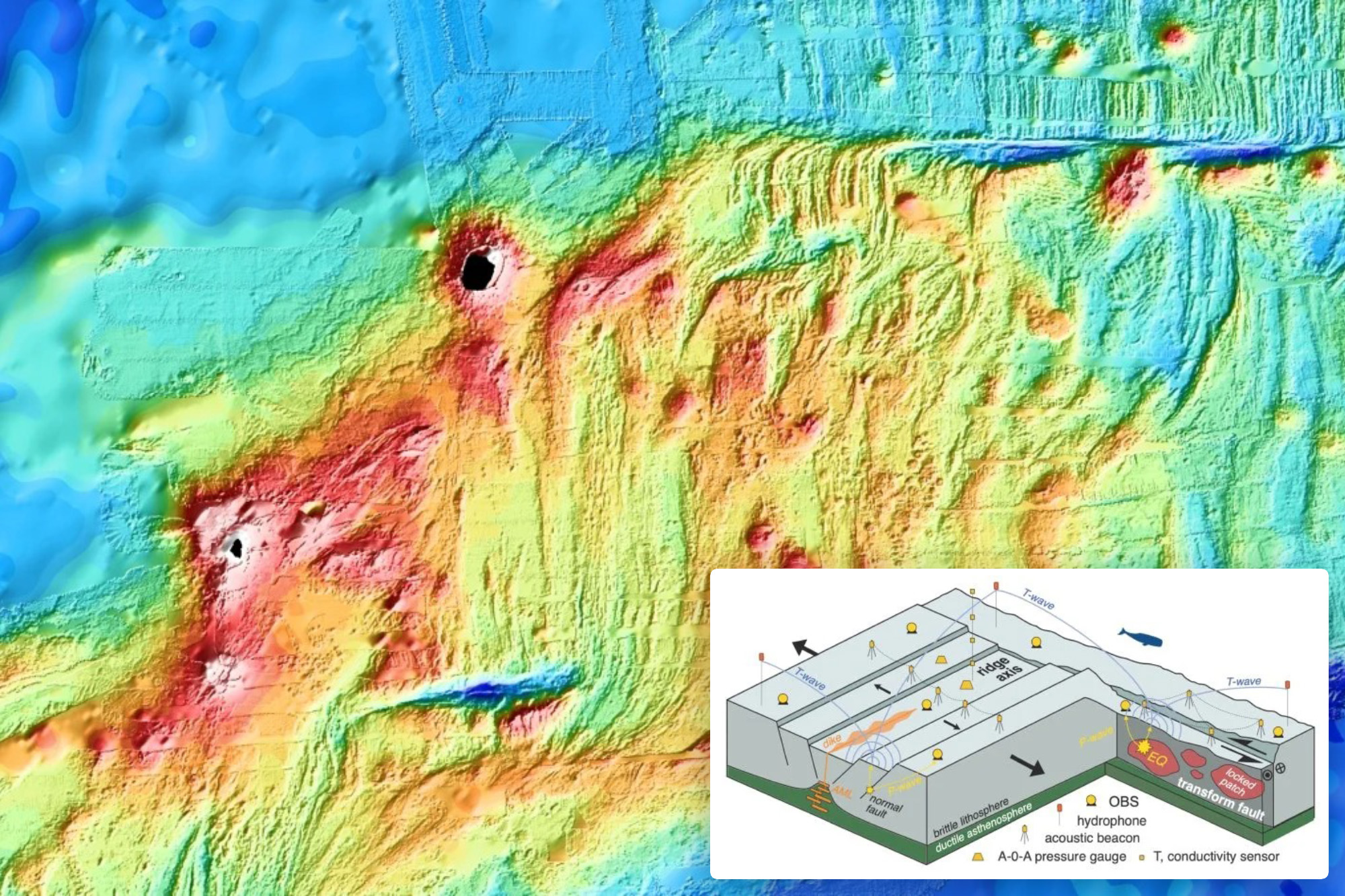
Thankfully, just several months prior, Royer and his team had established a special observatory called OHA-GEODAMS Southeast Indian Ridge between Australia and Antarctica with the hopes of recording this cataclysmic upheaval.
This lab was outfitted with five autonomous hydrophones, pressure sensors and other instruments that, like a subaquatic ultrasound, allowed them to capture the process of seafloor spreading much better than prior experiments had.
“We have been very lucky to have had all these instruments set up when it happened,” said Royer. “But also we are lucky because these big piles of lava outpoured one or two kilometers away from our instruments, so we didn’t lose any data.”
The team determined that the process starts with large, high-pressure reservoirs of magma beneath the crust. When the pressure becomes too great, they get propelled between the layers of rock and crust, causing the earth above the former gap to cave inward.
In turn, the tectonic plates are ripped apart by earthquakes, paving the way for magma to burst forth and form a new seafloor.
In this instance, the floor of the valley that marks the juncture of the ridge collapsed a staggering 14 feet. Meanwhile, this same formation was being ripped apart at a rate of almost 5 centimeters every minute — just one centimeter slower than the yearly rate of seafloor spreading if the movement is continuous.
All told, the rate of movement was around a million times faster than its long-term average, allowing researchers to get a timelapse view of a process that’s generally too incremental to perceive.
“We were hoping to at least measure the steady stretching of the ridge (maybe a few centimeters) that allows stresses to build up between events, like a loaded spring,” said Royer. “Instead, we were treated to a once-in-forty-year event and measured several meters of displacements in both directions!!”
Most importantly, they showed that measuring this elusive phenomenon was possible with a little luck and ingenuity.
“It opens new horizons for marine geophysicists,” said Royer.