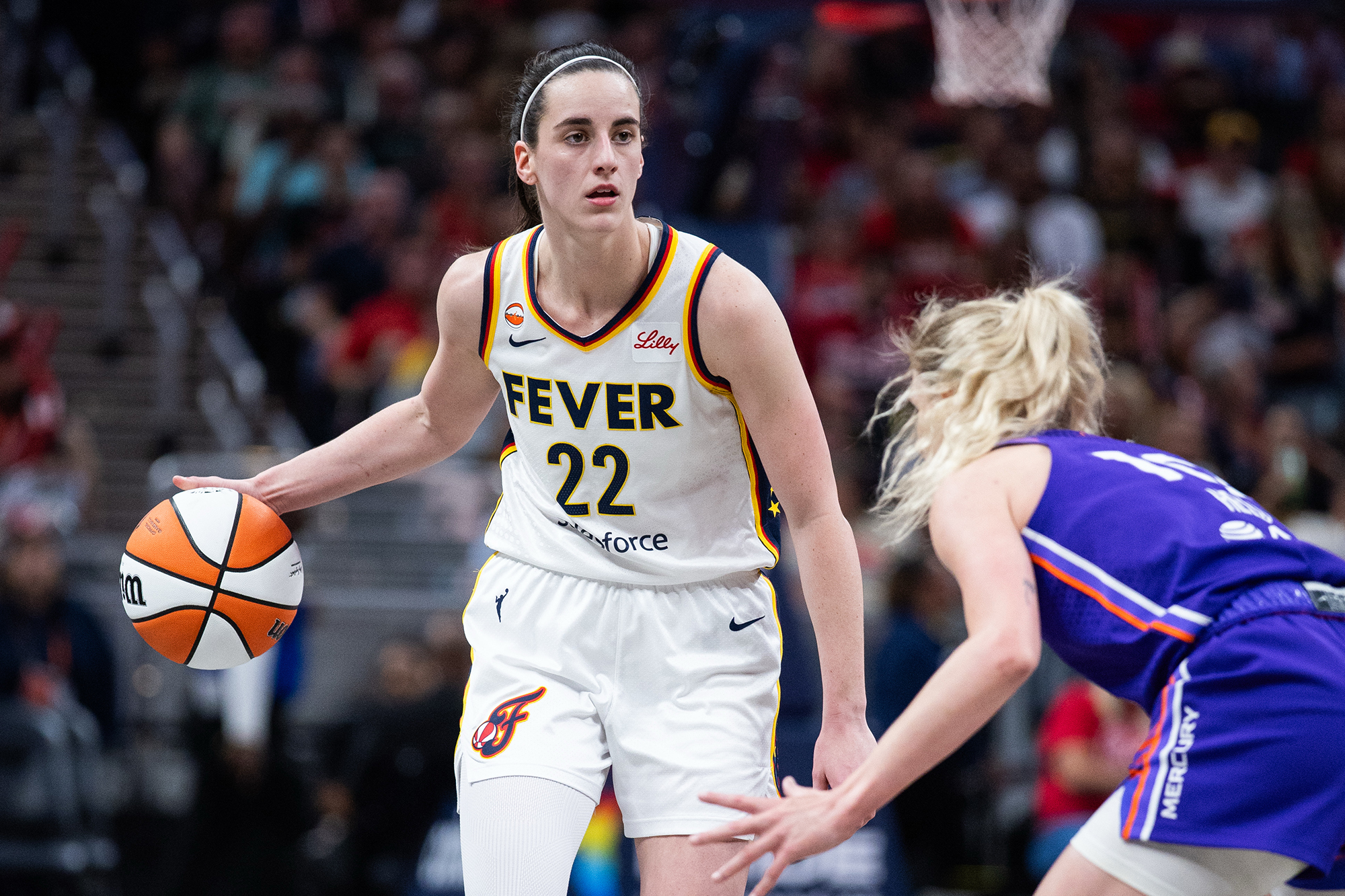
Indiana Fever guard Caitlin Clark (22) dribbles the ball while Phoenix Mercury guard Lexi Held (10) defends in the second half at Gainbridge Fieldhouse. Trevor Ruszkowski-Imagn Images See more of our coverage in your search results.
Add The New York Post on Google What sports league, handed a generational talent who has played brilliantly and delivered massive commercial dividends, would make this very same player seem unwelcome and an object of scorn?
Caitlin Clark arrived in the league three seasons ago already a superstar considered one of the greatest college players in the history of the sport, and instantly boosted the league — otherwise a commercially marginal outfit — to another level.
For her trouble, the Indiana Fever star has been treated like a virus that the league’s antibodies seek to reject.
The latest controversy erupted after a player with the Phoenix Mercury named Alyssa Thomas pressed her fist to Clark’s neck when the Fever guard was prone on the court.
The officials missed the foul in real time, but the league later deemed it a flagrant foul and suspended Thomas for one game.
The episode was shocking given Clark’s importance to women’s basketball — a little like Tom Brady getting clotheslined, or Shohei Ohtani getting hit by a pitch, and the refs or umps not noticing.
Still, ABC News ran a sympathetic segment about Thomas, who is black, getting death threats after the incident.
Meanwhile, sports influencer Emmanuel Acho claimed the incident showed that Clark is more trouble than she’s worth.
That’s a little like saying in the 1940s or 1950s that Major League Baseball didn’t need Ted Williams.
Now of course, Clark hasn’t proved herself one of the greatest offensive forces in her league’s history, the way Teddy Ballgame did.
She has a chance, though, if she stays healthy — all the more reason for the WNBA to keep her from getting singled out for hard fouls on the court.
Players envious of Clark should realize that the only reason a segment of fans care about the league is that she is playing in it.
A player who is very good, and also famous and charismatic, is a priceless commodity for any league — and the entire WNBA should be grateful for what it has in Clark.
They used to say of the New York Yankees that Yankees are born, not made.
In a similar vein, the WNBA could have had a limitless marketing budget and would have been unable manufacture the Caitlin Clark phenomenon.
Clark fills arenas at home and away, so much so that teams sometimes temporarily move to larger NBA arenas to accommodate the crowds.
In terms of sheer economic value, Caitlin Clark is the Elon Musk of the WNBA.
The root of her appeal is that she’s truly extraordinary on the court, a top scorer and exceptional playmaker.
This year, she’s been averaging roughly 21 points and 8 assists per game.
She holds the record for most assists in a game, and most assists in a season, and reached 500 career assists at the fastest pace in WNBA history.
Her total offensive production per game — points plus assists — is tops in the league this year.
But her WNBA tenure has been marked by controversies with an identity-politics edge, since it’s not hard to imagine that the predominantly black league with a disproportionate number of openly lesbian players looks askance at the white, straight player who gets outsized attention.
Clark’s teammate Sophie Cunningham said after the latest incident that Clark is clearly being targeted.
The league should make it clear that — as a sport and entertainment business — it wants no part of such an agenda, and that it highly values its most valuable player.
Clark’s agent has said, correctly, that there’s no way the WNBA can pay Clark what she’s worth.
But the league can provide an environment for her to reach her full potential — the very least it can do for Clark, the sport and their fans.