Drone production, technology transfer and training have enabled Iran's regional allies to operate with far greater independence. Has this network become too resilient to be dismantled through military strikes?
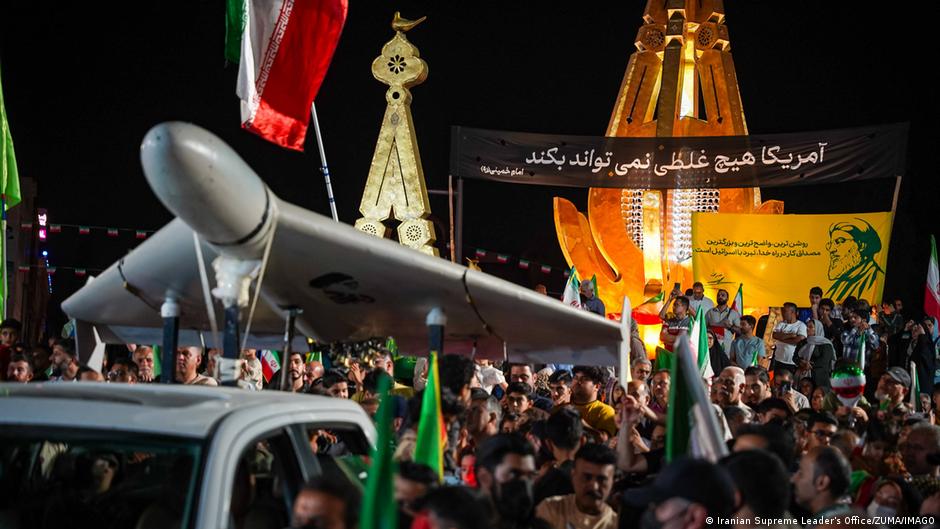
https://p.dw.com/p/5Gi2WAll of the paramilitary groups that Iran supports in the Middle East now have drones of their ownImage: Iranian Supreme Leader's Office/ZUMA/IMAGOAdvertisementWhen the United States and Israel launched the war on Iran in late February, they hoped to cripple both the Islamic Republic and its so-called "Axis of Resistance" in the Middle East. This comprises Iran's paramilitary proxy groups, including Hamas in Gaza, Hezbollah in Lebanon, the Houthis in Yemen and militias in Iraq, all of whom are opposed to the US and Israel.
The assumption was that "by hitting the right leaders, weapons facilities and supply lines, an outside actor could induce catastrophic failure across the Iranian regime and its web of Middle Eastern allies," said Peter Salisbury, a fellow at US think tank Century International and lead author of the think tank's recently published report"Beyond the Axis."
Despite the US and Israel achieving many of those military objectives, Iranian forces were able to continue launching drone attacks on neighboring Gulf states and shipping in the Strait of Hormuz, while their allies in Lebanon and Yemen intensified attacks against Israel and commercial shipping in the Red Sea.
For Wolf-Christian Paes, associate fellow at the International Institute for Strategic Studies, and one of the contributors to the "Beyond the Axis" report, the term "proxies" is actually misleading as it implies a command-and-control relationship between Tehran and the members of the axis.
"Unmanned aerial vehicle [UAV] proliferation is a good example," he told DW. A few years ago, Tehran transferred complete systems and the necessary training to its allies. "Today these militias can build their own UAVs, based on Iranian designs, with most of the parts coming from countries other than Iran," Paes said.
For example, according to the report, which was published after two years of research, these groups are able to source large quantities of engines for the Shahed-136 drone directly from Chinese manufacturers.
"Dual-use technology is difficult to control in the first place and without a traditional hub for smuggling, tracking the supply chain is like looking for a needle in a haystack," Paes told DW, adding that for example China, Russia but also Oman have so far made no real attempts to control the movement of these items.
According to the "Beyond the Axis" report, drone-related conflict incidents around the world rose from 140 in 2016 to more than 58,000 in 2025, a 41,000% increase.
"The growing ability of Iran's partners to manufacture and deploy drones independently is also changing the nature of their relationship with Tehran," Neil Quilliam, an associate fellow with the Middle East and North Africa program at the UK-based think tank Chatham House, told DW.
In his view, the Houthi militia in Yemen illustrates this trend. The group now possesses a level of operational autonomy that would have been difficult to imagine a decade ago. "Iran and Lebanon's Hezbollah helped establish the foundations of the Houthis' drone and missile programs, while years of conflict and isolation compelled them to develop domestic production capabilities," he told DW.
During the two-year war in Gaza from 2023 to 2025, the Houthis attacked Israel as well as international shipping in the Red Sea with drones and missiles in what they said was a bid to show support for Palestinians in Gaza. During the war in Iran from February to April 2026, the Houthis resumed attacks.
The report also notes that, since at least 2022, a small group of senior Houthi officers in Sanaa have built relationships across the African coasts of the Red Sea and the Gulf of Aden. "Houthi smuggling networks are now present in Somalia, Djibouti, Eritrea and Sudan," the report said.
For many years, Lebanon's Hezbollah militia was Tehran's best equipped proxy largely because of its proximity to Israel. A day after Hamas attacked Israel on Oct.7, 2023, Hezbollah opened a second front in Israel's north which escalated into a war in Lebanon.
"Israeli efforts to degrade the organization's leadership and military infrastructure created a situation in which Iranian assistance became essential for recovery," Quilliam said.
A November 2024 ceasefire fell apart in early March 2026, after Hezbollah attacked Israel with drones and missiles following the Israeli killing of the Iran's leader Ali Khamenei, who Hezbollah also pledged allegiance to. In the peace talks between the US and Tehran, the front in Lebanon has since become a key issue.
"Hezbollah's participation alongside Iran during the recent conflict, coupled with Tehran's insistence that any ceasefire arrangement include Lebanon, demonstrated how closely the two remain linked," Quilliam said.
As a consequence of Israel's prolonged military campaign in Gaza, Tehran's access to Gaza and Hamas is reduced, Quilliam said. "That should not be mistaken for a permanent decline in Iranian relevance, as the relationships, training networks and technical expertise developed over decades have not disappeared," he told DW. In his view, Tehran's ties to Hamas illustrates how military cooperation can survive even when political influence temporarily recedes.
In Iraq, Tehran-linked armed groups need to balance local Iraqi interests against their ties with Iran, Quilliam observed. While greater drone self-sufficiency gives them more independent means of projecting power and expanding influence, "the challenge for Tehran increasingly lies in coordinating a growing number of capable actors whose interests only partially overlap," Quilliam said.
In his view, Iran retains influence through political relationships, training, intelligence sharing and strategic coordination across all of these groups. "But influence is not the same as control," he told DW.
Salisbury, of Century International, agrees that Iran is still the militia groups' most powerful and consequential node but the relationship between Tehran and the proxies has turned into one of mutual interdependence. "Capabilities, data and strategic needs flow in multiple directions," he said.
Does all this make it harder for Iran's opponents to dismantle these networks, and to reduce the threat of drone warfare from them?
"Looking ahead, the most significant consequence of drone proliferation across the so-called 'Axis of Resistance' may be the emergence of multiple centers of expertise within what was once viewed primarily as an Iranian-led system," Quilliam told DW. "This makes the wider network more resilient, harder to disrupt and potentially more unpredictable."
What is Iran's 'Axis of Resistance'?To view this video please enable JavaScript, and consider upgrading to a web browser that supports HTML5 video