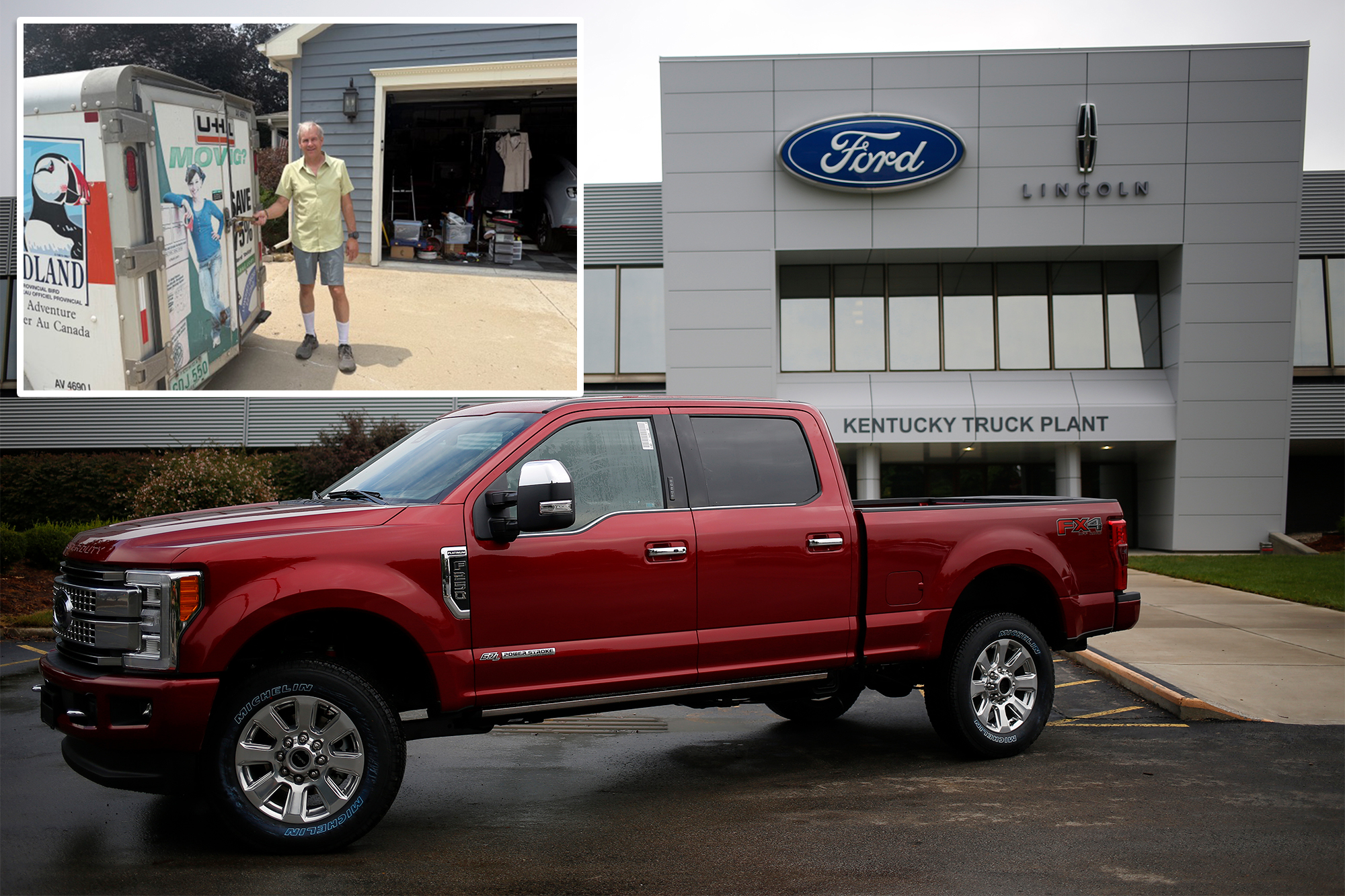
Add The New York Post on Google Ford has asked a veteran electrician it wrongly accused of stealing a $1.95 cookie to come back to work — but the worker has refused to return, claiming he never got an apology after the fiasco.
The bizarre saga began at Ford’s Kentucky Truck Plant in Louisville, Ky. in the wee hours of May 9, when Kurt Kromm approached an Aramark self-checkout kiosk to buy two Grandma’s Chocolate Chip Cookies for $1.95.
Kromm — who spent 11 years repairing robots and automated equipment at Ford’s Kentucky Truck Plant in Louisville, Ky. — told The Post he swiped his debit card, but the payment screen flashed red, indicating the transaction had failed.
Kromm — a 60-year-old diabetic whose blood sugar had dropped to 60 during his overnight shift — swiped again. This time, the machine never displayed the usual green approval checkmark, but it didn’t reject the payment either.
Believing the purchase had gone through, Kromm returned to work.
“I figured, well, it probably went through,” Kromm said. “And I might have went over to the other kiosk and paid. This was so inconsequential to me — $1.95. I figured I paid.”
A week later, on May 16, two supervisors summoned him to the labor office, where he was shown surveillance video and fired for allegedly stealing the cookie.
“The bargainer says, ‘This is bad,’” Kromm recalled.
“I said, ‘For what?’ They said, ‘They want to terminate you for taking a cookie.’ I was like, ‘What are you talking about?’”
Kromm told The Post that company officials showed him surveillance footage from an Aramark self-checkout kiosk that appeared to show a failed transaction after he swiped his debit card.
Ford immediately escorted him from the plant, refusing to let him retrieve his belongings, he said.
“They just terminated me, walked me out of the building,” Kromm recounted. “I had to get the union steward to even go get my personal laptop because they wouldn’t let me go get anything — ‘you are terminated, get out.’”
After being let go, Kromm went to work gathering evidence that he had indeed paid the $1.95 fare for the cookie.
Days later, he asked a former coworker to photograph the break-room kiosk showing the cookie’s actual price. He then checked his bank records again.
“The charge was there,” Kromm said. “It was on my credit card, the first charge of the day at 3:38 in the morning.”
He immediately emailed screenshots of the transaction to Ford labor executives and union officials.
According to Kromm, the company responded about 10 days later by demanding a notarized bank statement verifying the payment. Kromm supplied it, and weeks later, Ford informed him he would be reinstated with full back pay — roughly $33,000 — and invited him to return.
But by then, Kromm said, the damage had already been done. He refused.
“I emotionally couldn’t go back,” he said. “I worked with 8,500 people. I didn’t get to say goodbye to anybody. I’d been there 11 years.”
“There was no apology. There was no serious, ‘We’re sorry,’” Kromm told The Post. “There was just, ‘Oh, you’re not coming back?’ No, I am not interested in coming back.”
Instead, he said, the company lost an exemplary employee.
“I’m a pretty damn smart guy,” Kromm told The Post. “I fixed every piece of equipment you asked me to work on. And in the end, you did this to me.”
Despite receiving back pay and another chance to reclaim his old job, Kromm said his trust in the company is gone.
“I expected to work for Ford until I retired,” he said. “I loved working for Ford. I never thought it would end this way. It was a home away from home. This was tremendously difficult for me, but I couldn’t go back. I just couldn’t do it.”
The bizarre case was first reported by journalist Phoebe Wall Howard’s Substack newsletter Shifting Gears.
Ford, while declining to discuss Kromm’s individual case, previously acknowledged to Shifting Gears that “there are times when we look into things and realize it could have been handled differently. When that happens, we try to rectify it.”
Kromm also faulted both Ford and his union for failing to give him an opportunity to clear up what ultimately proved to be a simple payment error.
“Most companies would just ask you to pay for the cookie,” he said.
“I can’t come back to a company that just fired me like this and not give me any chance to show I paid,” Kromm told The Post. “It was just ridiculous. I can’t.”
A Ford spokesperson told The Post that the company’s “focus is on delivering top-quality vehicles.”
“We’re focused — especially as it relates to our manufacturing plants — on competing with the world’s best in quality,” the spokesperson said.
The Post has sought comment from United Auto Workers.
Kromm said he believes Aramark, which operates the self-checkout kiosks inside the plant, bears responsibility because it allegedly forwarded surveillance footage to Ford without confirming whether payment had ultimately been processed.
“They lied about me,” he said of Aramark, whom he accuses of being the first to raise the theft allegation.
“All they had to do was look for a transaction at that time, and they would’ve saw I bought a cookie.”
Aramark is the $15 billion Philadelphia-based food services giant that manages cafeterias and dining halls at businesses, sports stadiums, hospitals and colleges worldwide.
“We fully cooperate with investigations of this nature,” an Aramark spokesperson told The Post.
“At the same time, we remain focused on providing convenient, flexible snack options that support our hardworking customers every day.”