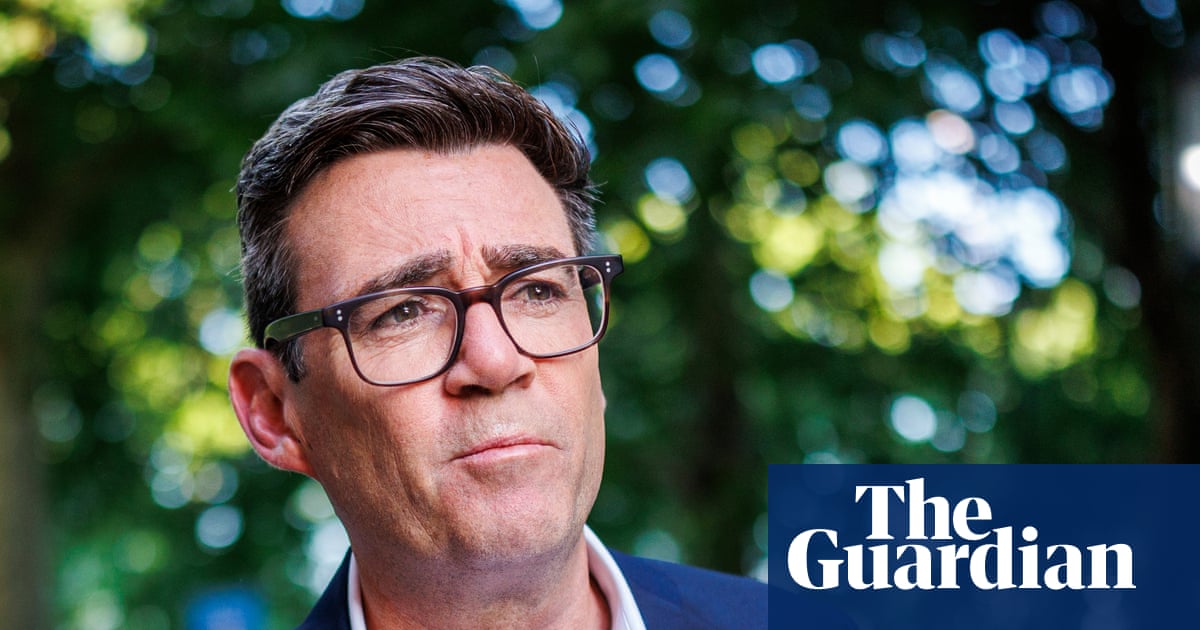
Burnham arriving for LBC’s Andrew Marr show, after taking the unusual decision not to take any questions after Monday’s speech in Manchester. Photograph: Dan Kitwood/Getty ImagesView image in fullscreenBurnham arriving for LBC’s Andrew Marr show, after taking the unusual decision not to take any questions after Monday’s speech in Manchester. Photograph: Dan Kitwood/Getty ImagesAnalysisAndy Burnham: dodging scrutiny, or just a different type of communicator?Peter Walker, Alexandra Topping and Pippa CrerarAvoiding traditional questions and stilted broadcast clips, PM-in-waiting has evolved his style of media management
He is due to become prime minister in just over a fortnight as parliament begins its six-week summer break. But at a marquee speech this week, he took precisely zero questions. So is Andy Burnham, as opposition leader Kemi Badenoch claims, dodging scrutiny? His allies say no: he is simply going about it in his own way.
The former Greater Manchester mayor is very obviously a different type of communicator from Keir Starmer, and thus always likely to convey his message in methods beyond Starmer’s traditional questions after a speech and the occasional stilted broadcast clip.
Burnham’s media strategy so far has been shaped by two things: his greater ability to communicate more or less like an ordinary human, as demonstrated by his relaxed, at times almost whimsical social media videos; and also the more prosaic matters of logistics and media management.
Into this latter box came the unusual decision for Burnham to not take any questions after Monday’s speech in Manchester. Timetabling was the official excuse. The real reason was a desire to convey his vision for the UK without it being demolished by unanswered queries about cabinet posts.
Similarly, Burnham’s diary has now been compressed by access talks with the civil service in advance of his entering No 10, leaving minimal time to draft set-piece speeches, or even to prepare for a mass of interviews.
This is not ideal, and while Burnham’s team were pleased by the coverage of Monday’s speech, they accept that Westminster’s political editors are unlikely to get on another early train to Manchester just to silently watch an address they could see on TV.
Burnham thus submitted to an interview with Andrew Marr on LBC on Thursday night. Friday was to bring an “AMA” – ask me anything – reader Q&A on Reddit, with a grilling by users of Instagram on Saturday to follow.
This approach has brought a slightly sniffy response from some opponents, with Badenoch saying on Friday: “I wouldn’t use Reddit as a way to show I was open to scrutiny. I think he can do a bit better than that.”
It is, however, very deliberate that Burnham’s media plan is broad in scope and often based on direct questions from voters. “The biggest asset we have when it comes to Andy’s comms is his ability to connect with people,” a source in his camp said. “So we want to create opportunities for him to be able to do that.”
This will also include, time allowing, more traditional engagements like newspaper interviews and the breakfast TV sofa, with allies saying he will be very visible throughout the summer, avoiding an impression of a vacuum.
It is also the case that while Burnham was elusive on the night of the Makerfield byelection, which returned him to parliament, he began the campaign with an event which saw him take well over an hour of combined questions from the broadcast and print media, covering everything from migration to electoral reform.
No one could fairly accuse Burnham of hiding from the media when he was mayor, but a much bigger test awaits his still-nascent communications team, now led by Sarah Brown, an experienced hand who until a few days go did the same job for Sadiq Khan, the London mayor.
With Grace Pritchard, another seasoned Labour comms professional, already in place and likely to become No 10 press secretary, in charge of day-to-day matters, the talk is of recruiting others into what is intended to be a collegiate and “empowered” comms team, in theory free of the backbiting and briefing of other regimes.
This is, of course, all very well in theory, and the sheer chaos and relentlessness of Downing Street has repeatedly demonstrated the political version of Mike Tyson’s boxing adage about everyone having a plan until they get punched in the face.
Folksy, straight-to-viewer videos can only get you so far, said Craig Oliver, who was head of communications under David Cameron: “How do you react when it gets serious, and how do you react when the tide starts to turn? A lot of these methods of communication are quite good when the tide is in your favor, but become a struggle when the shit hits the fan.”
One of Burnham’s advantages, according to Paul Ovenden, formerly Starmer’s head of political strategy in No 10, is his evolution as a communicator from a more traditional approach when first an MP and minister, to the methods he developed as mayor.
Ovenden said: “I suspect that moving to Manchester has enabled him to change his communication style. I don’t think it’s kind of a cynical thing, where he’s decided he’s going to be a bit more like a populist politician, I suspect he’s just communicating in a more natural way now.
“There are different ways to skin a cat, and Andy’s particular style – sort of earthy, genuine, talking like a lot of normal people do – is one which is quite fitting for the moment.”