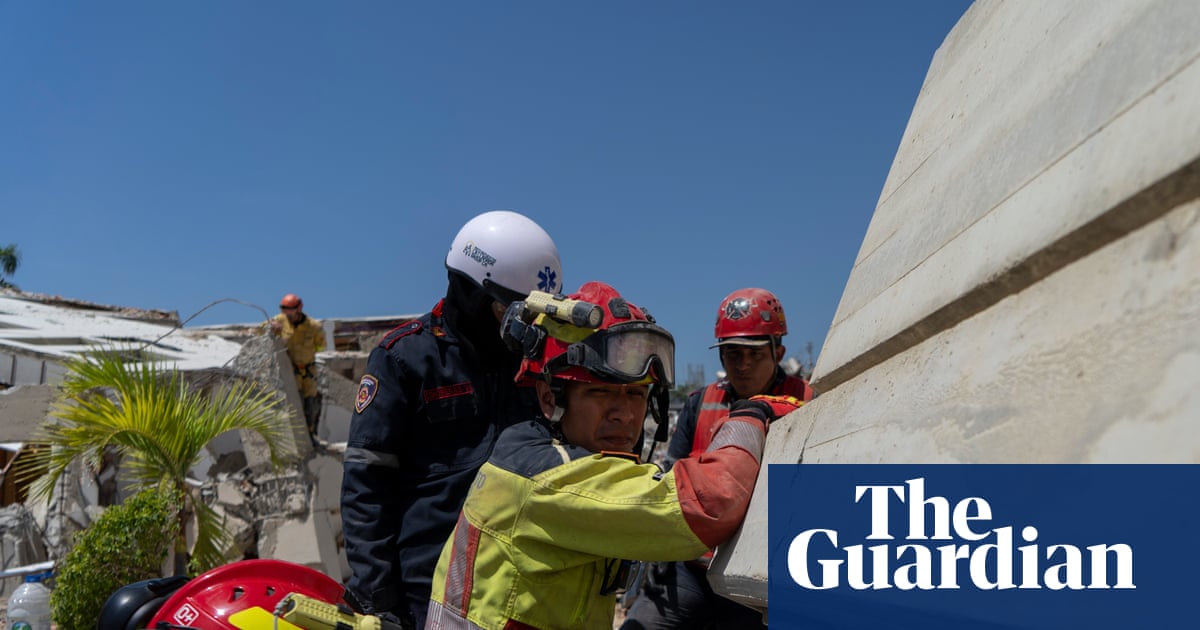
Sign in Firefighters and international rescuers search the remains of a collapsed building in La Guaira, Venezuela. Photograph: Manu Quintero/The GuardianView image in fullscreenFirefighters and international rescuers search the remains of a collapsed building in La Guaira, Venezuela. Photograph: Manu Quintero/The Guardian‘I can only describe it as a war zone’: the rescuers navigating Venezuela’s post-quake hellscapeThousands of volunteers are joined by overseas teams in the hope of finding more survivors in the rubble
When twin earthquakes tore through Venezuela’s northern coast last week, Israel Rivas was at home hundreds of miles away in the industrial city of San Félix. As the scale of the catastrophe became clear, the 24-year-old knew he had to react. A mechanic and budding photographer, Rivas gathered the money he had been saving to buy a new camera lens and jumped on a bus to make the 12-hour journey to La Guaira, the coastal state that has suffered the most damage.
Destroyed buildings in La Guaira, Venezuela – loop“I couldn’t eat well. I couldn’t sleep well, knowing that my brothers and sisters from this country are dying, so I … came here and I’m doing the best I can,” he said on Wednesday, exactly a week after the disaster, as he stood outside Residencia La Gabarra, a 12-storey block of beachside apartments that had collapsed into a jumble of reinforced concrete and bricks with at least three children inside.
View image in fullscreenA Brazilian firefighter climbs over the rubble of an apartment block in La Guaira. Photograph: Manu Quintero/The GuardianView image in fullscreenInternational teams from Brazil, Ecuador and the UK inspect a ruined building in La Guaira. Photograph: Manu Quintero/The GuardianView image in fullscreenIsrael Rivas, centre, a volunteer interpreter from San Félix, has been helping British rescuers search for survivors. Photograph: Manu Quintero/The GuardianRoaming the devastated streets of Caraballeda, a resort town east of La Guaira’s capital, Rivas stumbled across a group of British search and rescue workers who had flown in from Merseyside, the West Midlands and Wales. “If you need me, I’m here,” he remembers telling them. They told him that they did.
Since then, Rivas, who is a fluent English speaker, has been working as the interpreter for the UK’s International Search and Rescue team (UK ISAR) as its members navigate a hellscape of broken properties to try to find life beneath the debris.
“It’s a hard job. It’s hard to see so many dead people around you. It’s hard to say we can’t recover the body because it is 10 floors down and we don’t have the equipment. It’s hard,” Rivas said as his British colleagues and searchers from Ecuador investigated possible signs of life detected under the wreckage of La Gabarra.
“But that’s one side of the coin, which is death The other side of the coin is life. Coins are always flipping and we are always [hoping they land] on life.”
Rivas is one of thousands of Venezuelan volunteers who have mobilised in the aftermath of two giant earthquakes that – in the space of 39 seconds – brought death and destruction to La Guaira, created a major humanitarian crisis and made the country’s already uncertain political future even more unpredictable.
The official death toll so far is 2,595, but with 400 bodies reportedly being delivered to La Guaira’s morgue each day, that figure is certain to rise. At least 12,400 people have been injured while one estimate, based on satellite data, suggests more than 58,000 buildings have been damaged or destroyed.
“Along the coastline what we’re seeing is multiple-storey buildings of 20 storeys plus [that have] collapsed – pancake collapses, total collapses, where it’s floor upon floor upon floor. Buildings that are leaning over,” said Russ Gauden, UK ISAR’s national coordinator and team leader in Venezuela. “It’s [such] an apocalyptic scene that you’d think you’d seen … a disaster film.”
A few hundred metres along Los Corales beach in Caraballeda, one of Gauden’s teams has been deployed to use life-scenting dogs and a seismic and acoustic listening device to confirm whether someone was still alive under the wreckage.
Search and rescue operations in La Guaira, Venezuela – loopEarly on Wednesday, they gathered around the building’s rubble-filled swimming pool, seeking shade under dust-caked parasols from a ferocious Caribbean sun. “It’s pretty extreme. I can only describe it as a war zone in terms of collapse,” says Tristan Bowen, a firefighter from south Wales, as his crew plotted its next move.
View image in fullscreenMembers of the UK rescue team at a wrecked building in La Guaira. Venezuelans have accused their government of doing too little to help. Photograph: Manu Quintero/The GuardianView image in fullscreenA member of the UK team uses headphones linked to a listening device to try to locate buried survivors. Photograph: Manu Quintero/The GuardianView image in fullscreenThe UK team members come from Merseyside, the West Midlands and Wales. Photograph: Manu Quintero/The GuardianBowen said the 72-hour “golden window” for finding survivors had closed but believed it was still possible to find survivors. Hours later, a 43-year-old security guard is pulled from the collapsed basement of a nearby shopping centre after eight days under the rubble. “People have survived many days beyond that [golden] window, but … it depends entirely on where they are within that structure,” Bowen said.
Rivas was also optimistic. “It doesn’t smell bad which means there are no dead bodies in there, [which means there is] a higher chance for them to be alive,” he said, as British and Ecuadorian searchers crawled into cramped tunnels they had dug into the ruins and used a loudhailer to communicate with anyone who might be caught below.
View image in fullscreenEcuador’s rescue team searches rubble in the hope of finding survivors. Teams have also come from Brazil, Chile, El Salvador and Peru as well as from elsewhere around the world. Photograph: Manu Quintero/The GuardianA hundred metres away, in the remains of a neighbouring high-rise, the distraught relatives of one of those thought to be trapped inside wait for news of eight-year-old Ronald. The boy’s name is a double tribute to the Portuguese footballer Cristiano Ronaldo and the Venezuelan baseball star Ronald Acuña.
“Ronald is such an intelligent, calm, respectful boy,” said his 50-year-old grandmother, Olivia Sandoval, breaking down as she described her vigil outside what is left of La Gabarra. Her grandson had been playing with his two cousins, 10-year-old Victoria and eight-year-old Leonardo, when the earth shook and the building came crashing down.
Ever since the earthquakes, Sandoval has knelt down by the pool or in the rubble to beg for divine help. “I just can’t get my head around how such a monstrous thing could happen to these children,” she said as the search continued.
Sandoval – and many other Venezuelans – are struggling to comprehend something else: how in the hours and days after the earthquakes, Venezuela’s government failed to come to their aid.