play Live Sign upShow navigation menuplay Live Click here to searchsearchSign upNews|Russia-Ukraine warRussia’s triumphant tone shifts as Ukraine deploys ‘asymmetrical tactics’Putin wobbles as Russia’s top brass stays mum on Kyiv’s long-range strikes, which analysts say look set to continue.
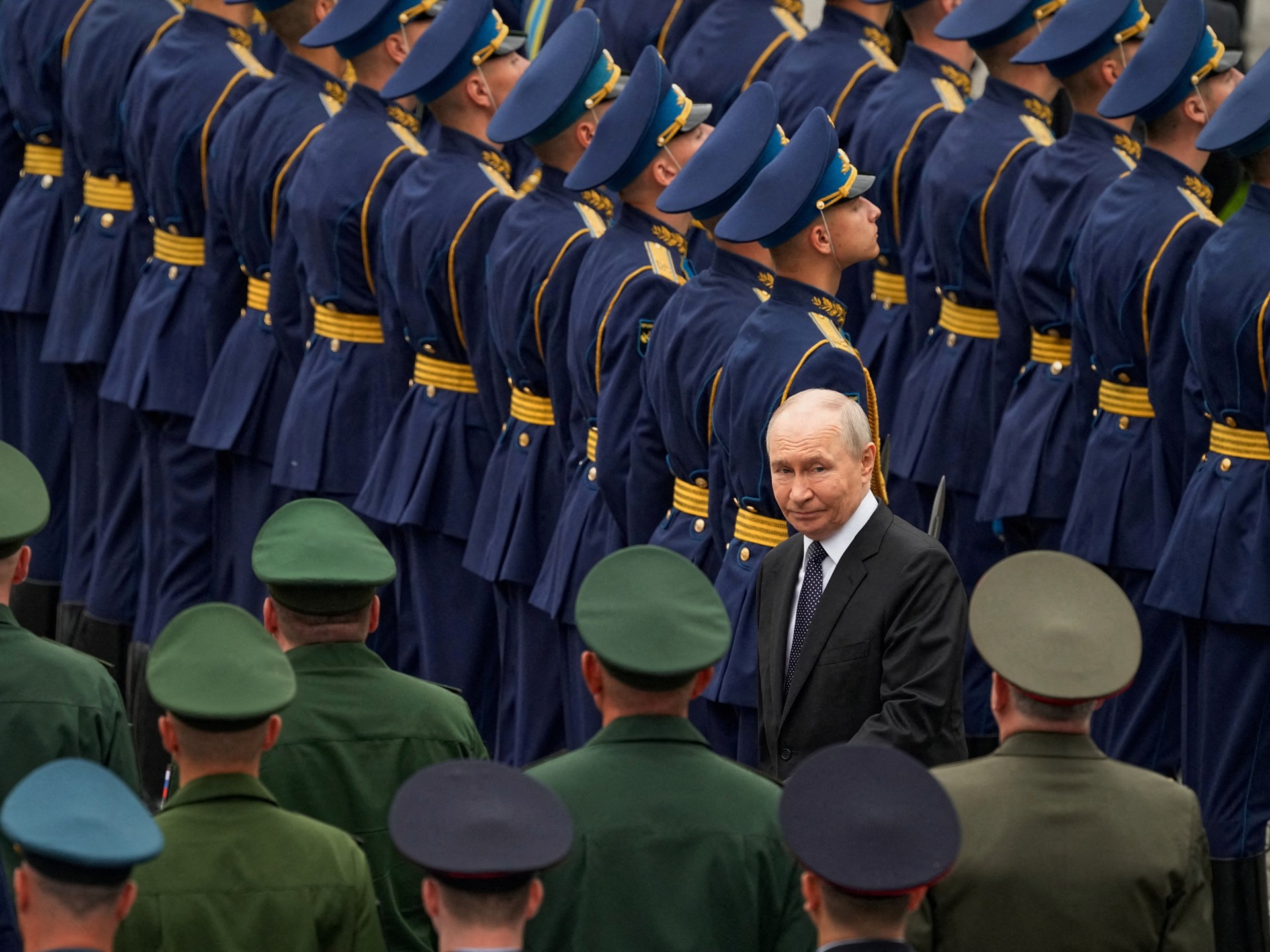
xwhatsapp-strokecopylinkgoogleAdd Al Jazeera on GoogleinfoRussian President Vladimir Putin arrives for a wreath-laying ceremony marking the 85th anniversary of the Nazi German invasion into the Soviet Union in World War II, on the Remembrance and Sorrow Day at the Tomb of the Unknown Soldier by the Kremlin wall in Moscow, Russia June 22, 2026. Alexander Zemlianichenko/Pool via REUTERS TPX IMAGES OF THE DAYBy Mansur MirovalevPublished On 3 Jul 20263 Jul 2026The overpriced gas Anatoly has been buying in recent weeks in Moscow will ruin his white Kia’s engine.
“It’s low-quality,” the taxi driver told Al Jazeera withholding his last name for security purposes. “The engine already sounds like a sick heart …The government allows a ‘temporary decrease in quality,’ but what am I to do when I need new spare parts” that are barely available because of Western sanctions, he asked rhetorically.
Anatoly fumed about the Kremlin’s military miscalculations and Ukraine’s almost daily strikes on Russian oil refineries and fuel depots that have led to nationwide gas shortages.
Ukraine “got us good. They don’t knock, they kick the door,” said the 49-year-old with a three-day stubble and bloodshot eyes.
Russia’s top military brass has not commented on Ukraine’s assaults.
But even the Kremlin’s most outspoken supporters have changed their once-triumphant tune.
“We have to get ready for hardships and self-sacrifice,” Vladimir Solovyov, a popular talk show host on the Rossiya 1 television network, said in mid-June.
Solovyov has a penchant for aggressive, loud monologues and military-style attire. He once urged the Kremlin to “erase” Ukrainian cities with nuclear strikes and said that Kyiv and its Western allies “serve the prince of darkness.”
Military bloggers are even more pessimistic because of their proximity to the frontline.
One of them, Prizrak Novorossii (The Ghost of New Russia), wrote on Telegram in late June that the Kremlin should conduct a massive mobilisation campaign because Russians already “foresee big changes and possible cataclysms because of, to put it mildly, the unfavourable dynamics of hostilities.”
The reason is simple – outmanned Ukrainians use “an asymmetrical tactic of long-range drone strikes with technological solutions that Russia is only catching up on,” he wrote.
“So, the question isn’t about whether or not to have mobilisation, but about how to conduct it,” the blogger concluded, adding that recent events “inspire little optimism.”
“I’m afraid my son will be drafted, but we don’t have money to send him abroad,” Kseniya, a mother of two from the western city of Tula, told Al Jazeera.
She withheld her last name and personal details for security purposes.
“We’ve been told a thousand times that [Russian President Vladimir] Putin brought stability, and instead, we see total chaos. Turns out, the emperor has no clothes,” she said.
She is furious about Putin’s response to the gas shortages and Ukrainian strikes.
“We observe a certain deficit [of gas], but it’s not critical,” Putin said in televised remarks on June 28. “There is damage, but all the affected sites are being restored quite quickly, and emerging problems aren’t critical.”
In a rare acknowledgment of Ukraine’s power, he said the drone attacks were “creating problems, that’s obvious”.
Military analysts say that the Kremlin seems to have placed its bets on the wrong war horses, while Western sanctions hobble its attempts to scale up the manufacturing of new weaponry.
Moscow invested heavily in making drones, mostly the constantly-modified versions of Iranian-designed Shaheds, and Iskander ballistic missiles.
“That’s something that lets it painfully strike Ukraine, but doesn’t solve the defence of Russia’s rear,” Nikolay Mitrokhin, a researcher with Germany’s Bremen University, told Al Jazeera.
Russia appears to be in retaliation mode; this week its strikes have killed dozens across Ukraine, including in the capital.
An Iskander exploded just metres away from Vitaly Yarokhno’s apartment building in central Kyiv at 2:27 am on Thursday.
Yarokhno knows the exact time because a glass shard damaged and stopped the clock on his wall – and another dagger-like piece stuck next to it.
The blast destroyed all the windows and most of the furniture in his two-bedroom apartment, while his two cars parked under his balcony burned down and exploded.
But Yarokhno, his wife and son got away with minor cuts and scratches. He wondered aloud about Russia’s motives.
“I still don’t understand why they use Iskanders to strike civilians,” the tall, burly 43-year-old told Al Jazeera.
Moscow’s reliance on Iskanders and other missiles was a dire miscalculation, analyst Mitrokhin said.
To fully block Ukrainian mid-range and long-range drones, the Kremlin should have invested in the manufacturing of mobile Pantsir air defence systems.
They rely on multi-mode tracking radars and thermal imaging and fire guided missiles for long-range intercepts and auto-cannons for short-range kill zones.
Other Russian air defence systems are no aegis against Ukrainian attacks because they were designed to shoot down Cold War-era missiles – not swarms of much slower, low-flying drones.
Russia currently needs at least 6,000 Pantsirs systems with trained crews and enough missiles to create three layers of protection of air space along the 1,200-kilometre long (745-mile) frontline, Russia’s border with Ukraine and its Black Sea coast, Mitrokhin said.
“But there are none, and none will appear in the nearest future,” he said. “Which means that effective Ukrainian strikes will continue.”
Moscow also has no equivalent for Starlink, satellite modems made by Elon Musk’s SpaceX company, to make drones over Ukrainian highways pilotable manually at more than 100 kilometres (62 miles) from their operators, he said.
Western sanctions also prevent Russia from scaling up its arms manufacturing, while its response to Ukraine’s threats is belated because it “underestimated the enemy,” he said.
Moscow’s battlefield losses coincided with economic and political upheavals.
As it faces a record budget deficit and an economic nosedive, Russia’s crackdown on dissenters continues and public dissatisfaction is growing.
“One can compare recent trends with a constantly wound spring that will have to either unwind or simply break,” Russian economist Vyacheslav Inozemtsev, a Kremlin critic, wrote on Telegram on Thursday.
Other observers say Russia’s problems stem from its obscurantist, inflexible and heavy-handed approach that loses an evolutionary battle to Ukraine’s democratic, decentralised ways.
Ukraine’s “republican culture with developed horizontal civilian connections is at war with [Russia’s] authoritarian, harshly hierarchical culture that is also implementing a domestic policy of counter-englightenment,” said Pavel Luzin, a military analyst with the Jamestown Foundation, a think tank in Washington, DC.
“Russia can still learn some lessons, but has difficulties in the practical implementation of the knowledge it gains,” he told Al Jazeera.
Moscow can concentrate its resources on solving a certain priority, but its approach lacks the flexibility of Ukraine’s approach, he said.
That’s why Moscow’s reliance on missile strikes only emphasises its battlefield losses.
“Russia’s terror tactics stem from its fundamental organisational, intellectual, technical and technological weakness,” Luzin said.