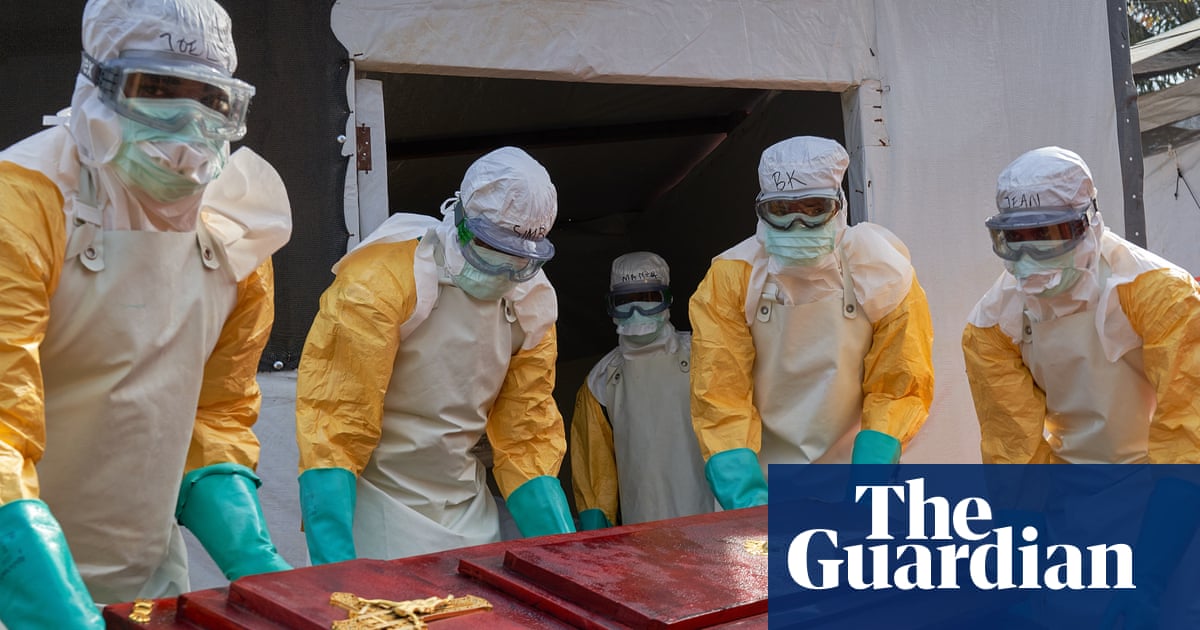
Staff carry a coffin at a hospital in Mongbwalu, Ituri. The outbreak has so far resulted in 254 deaths. Photograph: Dieudonne Dirole/EPAView image in fullscreenStaff carry a coffin at a hospital in Mongbwalu, Ituri. The outbreak has so far resulted in 254 deaths. Photograph: Dieudonne Dirole/EPAAnalysis Understanding Ebola’s wildlife origins is crucial to preventing next big outbreak Dan SalkeldIf we don’t know the source, not only do humans remain at risk but wildlife can suffer needlessly via retaliation
While virologists and public health departments were palpitating over the news of an Andes virus infectious disease outbreak on a cruise ship (13 cases, three deaths), in the Democratic Republic of the Congo the Bundibugyo virus, the root of the current Ebola outbreak (currently more than 1,250 cases and at least 362 deaths), was smouldering under the radar.
Bundibugyo virus is a horrifying, highly fatal pathogen. Symptom onset is sudden and includes headaches, diarrhoea, malfunctioning kidneys and liver, and, less frequently, internal and external bleeding (hence the term “haemorrhagic disease”). Grimly, contagiousness remains after death, meaning the family and loved ones of the deceased can be exposed when they wash and clothe the body in preparation for the funeral.
The priority right now is to dedicate resources to fight the outbreak. Without a proven established vaccine, health workers will have to combat disease spread by isolating patients and tracing contacts who may have been exposed.
But when the outbreak is controlled, it will be time to ask two questions: why did this outbreak happen? And where did the disease come from? The answers are critical to try to prevent or mitigate the next outbreak.
View image in fullscreenBundibugyo virus is a relative of the more infamous Zaire Ebola virus, which has caused outbreaks in remote African rainforests since the 1970s. Photograph: Bsip Sa/AlamyThe virus is a relative of the more infamous Zaire Ebola virus that has sporadically caused outbreaks of Ebola virus disease in remote African rainforests since the 1970s, but exploded spectacularly to cause a pandemic in west Africa from 2014 to 2016.
Terrifyingly, even though Ebola viruses are highly ranked on lists of bio-terror agents, we know very little about these viruses in the wild. Marburg virus, a more distantly related haemorrhagic fever virus, is known to persist in large fruit bats, and this has generated the reasonable but unproven assumption that bats are the reservoir hosts for the rest of the Ebola virus family.
Fruit bats are widespread, abundant, large and conspicuous animals and are easily blamed as a source for each Ebola virus outbreak. Yet proof that bats are viable incubators of the Zaire Ebola virus remains frustratingly elusive. Arguing that bats are the source of Bundibugyo virus is currently just conjecture. Having a distant cousin who wears a kilt doesn’t make you Scottish.
In fact, historically, the first human cases in Ebola virus outbreaks were linked to exposure to other mammal species: forest antelopes, gorillas and chimpanzees. Experimentally infected pigs can shed infectious Ebola viruses and can infect primates. So it appears that Ebola viruses have a varied approach when it comes to host animals. It’s also possible the virus can hide away in the same host for years before recrudescing, a mechanism that could explain the long periods when Ebola viruses seem to vanish without trace.
View image in fullscreenFruit bats are frequently cited as a source for Ebola virus outbreaks, yet proof that they are viable incubators remains elusive. Photograph: Michel Lunanga/Getty ImagesHow then would you go about determining Bundibugyo virus transmission patterns in tropical forest? How do you convince a group of wary canopy-dwelling monkeys to provide samples? Capture them? Shoot them? Analyse their faeces? Or should you target herds of bush pigs? Or giant fruit bats? Or all of the above? And if this disease is rare, and outbreaks in humans occur after the disease has spilled from wildlife, then how on earth do you capture the virus red-handed?
These issues make muddy waters for understanding how diseases emerge; just look at the controversies surrounding the origins of Covid-19. And now imagine attempting this kind of scientific research in an area of political unrest, and in the face of ruthless cost-cutting of research and health funds by the US and UK and the consequent evaporation of infrastructure.
Yet these questions need to be answered. Before 2010, the largest Ebola virus outbreaks rarely exceeded 300 cases, but since then there have been three outbreaks where cases are counted in the thousands. The trend is indubitably one of larger epidemics.
If we knew how Ebola viruses worked, we could mitigate against them by reducing human exposure, whether it be using wildland buffers or discouraging consumption of wild animals. Or we could adopt integrated surveillance programmes that look for signs of disease spread among wildlife, livestock and humans.
View image in fullscreenThe first human cases in Ebola virus outbreaks were linked to exposure to mammal species such as gorillas, chimpanzees and antelopes. Photograph: Nature Picture Library/AlamyThe problem is, if we don’t know the source, not only do humans remain at risk but local wildlife can also suffer needlessly via retaliations against perceived wildlife culprits, like the bat-killing sprees in the aftermath of Covid-19: in Cuba, people set fire to roosts; in Rwanda, government workers aimed water cannon at bats; and in many other countries bat roosts were attacked and destroyed.
This kind of action will achieve nothing for human health if the species is unrelated to the pathogen’s transmission, and disturbing or culling wildlife populations can unintentionally exacerbate disease spread, whether it’s Marburg virus, rabies or bovine tuberculosis. And if habitat destruction is the driver of recurrent Ebola virus outbreaks, Bundibugyo or otherwise, we ought to get smarter at answering these questions.
These links between humans, wildlife and environment are cruxes of the so-called “one health” approach, explicitly recognising the connections and how that might affect the health of all three components.
The interwoven implication is that optimising health for one element can simultaneously boost health in another. It’s not a concept that is limited to Bundibugyo. It can be locally applied anywhere: chicken farms and wild swimming in the Wye or bovine tuberculosis in badgers and cows. The burning question is whether this outbreak might provide the incentive to act to try to prevent future epidemics.
Dan Salkeld is a disease ecologist and the author of Emerging Zoonotic and Wildlife Pathogens