Some people have a midlife crisis. Other people, the kinds of people they make murder mysteries about, have a midlife crisis. It’s a bit like Jesse Pinkman’s old distinction between a criminal lawyer and a criminal lawyer. For example, there’s having an affair, and then there’s having an affair in which one of the participants ends up dead.
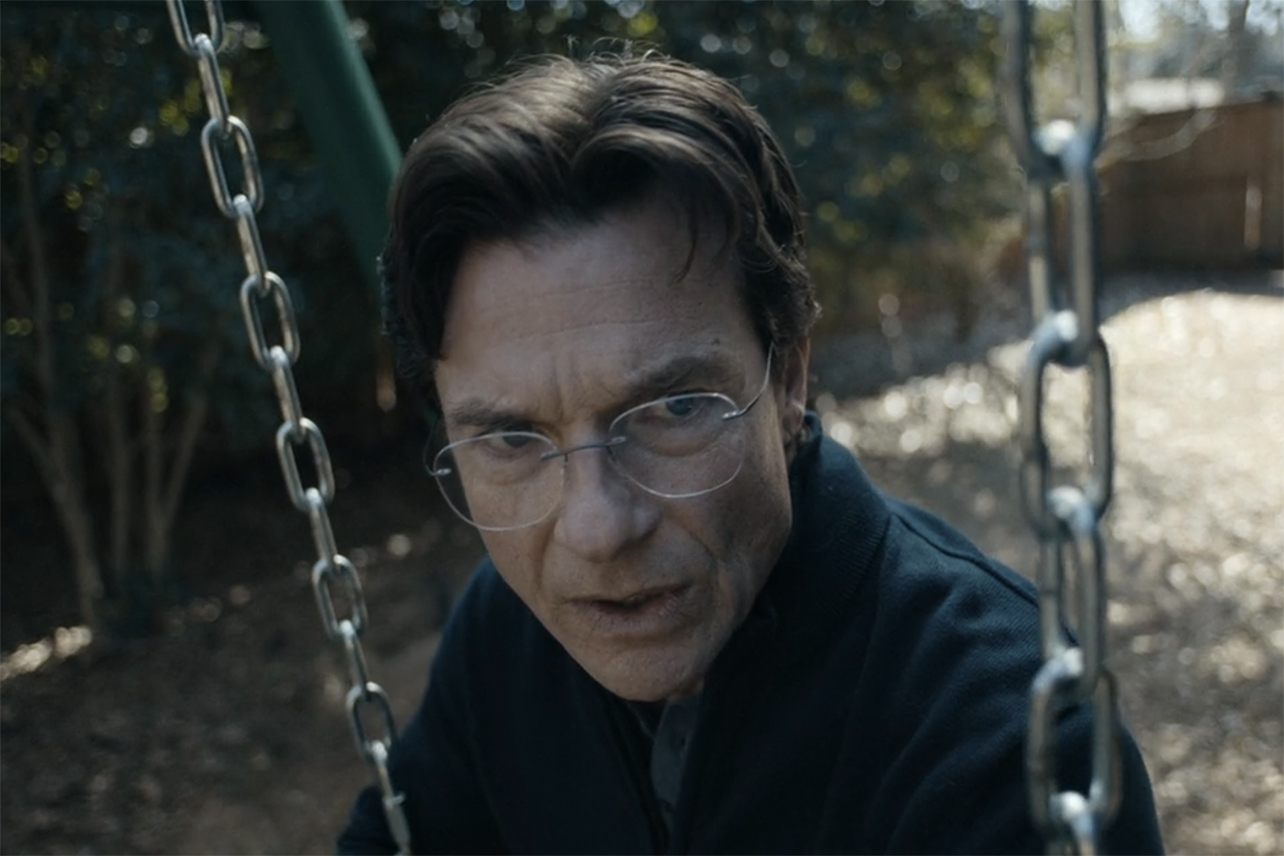
Written and directed by series creator Steven Conrad (Patriot, the kind of under-the-radar show about which you only ever hear good things), the premiere of DTF St. Louis introduces us to the people who are, in effect, the title characters. Jason Bateman is at his most clipped, mild-mannered, and creepy-cheery as Clark Forrest, a well-known local weatherman living in a St. Louis suburb. “The kind of guy who wears a helmet on the recumbent bike he pedals to work” sums Clark up nicely.
David Harbour costars as Floyd Smernitch, a man we meet while his truculent stepson complains about his protruding gut during group therapy. (He doesn’t want to spring for larger-sized clothing because of “the snowball effect.”) Clark, by contrast, appears to have a happy family.
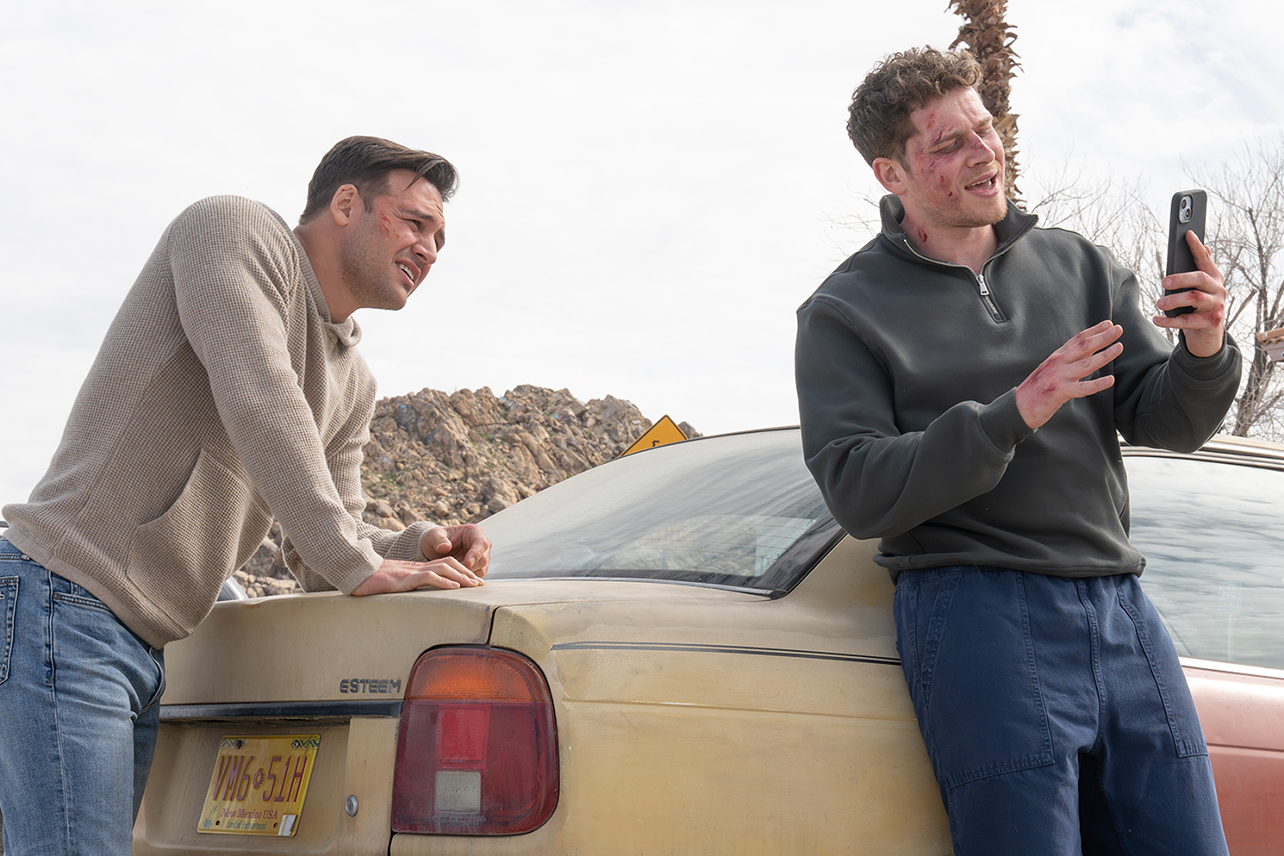
But he wouldn’t have much of anything if not for Floyd’s quick thinking. Working as Clark’s American Sign Language interpreter for an outdoor broadcast during a cyclone, Floyd saves Clark from a flying stop sign that would have impaled him had the big man not pulled him out of the way. Clark appears grateful to Floyd to the point of near-infatuation when they talk it over in a convenience store after the fact.
The pair strike up a fast friendship. Clark makes sure Floyd, who’s new to the station, is always his ASL interpreter. We see them doing various lightly homoerotic workout activities together. Their families become friends, and they start attending parties at one another’s houses, where games of cornhole are apparently of central importance. (I’m from Long Island and grew up referring to this game as a bean-bag toss, so there’s never not a double entendre when I hear the c-word.)
It’s at one such party where Clark, swinging on his daughters’ swing set side by side with Floyd, makes a pitch. Apparently, hey wouldn’t you know, isn’t this crazy, but apparently there are married people in their area who use an app called DTF St. Louis to arrange for sex with other people, ostensibly as a part of spicing up their still strong and loving marriages.
And gosh, wouldn’t it be nice to spice things up? Floyd hasn’t had sex with his gorgeous wife, Carol (Linda Cardellini), since she started a side hustle as an umpire. The boxy padded uniform turns him off. Carol, meanwhile, complains to Clark’s wife Eimy (Wynn Everett) that her husband is a slovenly dullard who’s barely capable of following a Batman comic book. I’ve read a lot of superhero comics, but Floyd lost my sympathy the moment he cried tears of relief that Batman didn’t die, in a comic book called Batman, which has been published on a monthly basis since 1940. Grow up, dude!
By contrast, Clark’s complaint seems relatively benign: He and his wife simply don’t see much of each other now that she’s doing volunteer work on top of his unusual early-morning schedule. Nevertheless, Clark coaches Floyd through setting up a semi-truthful profile on the app — without his wife’s knowledge or permission, which seems to defeat the whole mission statement on which Clark pitched him.
Eight weeks later, Floyd is dead. All they find near him is a can of premixed Bloody Mary and a vintage Playgirl with a nude Indiana Jones wannabe’s face scratched out. (His penis is intact.)
Floyd’s death is investigated by Detectives Homer (the magnificent Richard Jenkins) and Plumb (Wednesday scene-stealer Joy Sunday), from the St. Louis County Sheriff’s Department and the local suburban cops respectively. There’s some initial jurisdictional dick-measuring and condescension by the (old, male, white) Homer towards the (young, female, Black) Plumb.
But Plumb cracks the case. Like Dragnet’s Sgt. Joe Friday with several OnlyFans subscriptions, she explains to the oblivious Homer that this isn’t a case of a guy jerking off to a porno mag in a pool house three miles from home and dying of a heart attack. If he wanted Indiana Jones dick, he could get tons and tons of modern, erect-as-hell Indiana Jones dick with a simple google search on his phone in his bathroom at home.
So she goes digging into security camera footage taken by businesses in the area (haha, we are all constantly surveilled, it’s totally rad and not going to come back to bite us all in the end) and discovers a recumbent bike pedaling through the area before parking itself at the same pool house (at the Kevin Kline Junior Community Pools, a fantastic gag) the night of Floyd’s death. Only two such bikes have been sold by the bike shop in that area in recent years, both of them to Clark. (I don’t know why they rule out online sales, but hey, just go with it.)
It’s enough info to get a warrant to search Clark’s phone, which Homer has seized after luring Clark into a conversation in his bizarre, brutalist police station. He uncovers the story of a three-month affair between Clark and Carol, which she attempted to cut off some time ago in order to return to a normal life with Floyd. The resulting picture is clear enough for the cops to arrest Clark for Floyd’s murder by poison on live TV. It’s described as a crime of passion by Clark’s own on-air colleagues.
There’s one last twist, however. In an ASL conversation that goes untranslated for a decent chunk of the episode until it’s revisited in the show’s final moments, Floyd signs to Clark, who’s learning the language, “I know you’re fucking my wife.” When exactly this conversation takes place isn’t clear, but Floyd isn’t upset, that’s for sure. If anything, he seems elated. How does that lead us to murder a few short weeks later?
I suspect that whether you’re interested in the answer depends on how much the dry vibe Conrad conjures here resonates with you. From Floyd’s restrictive clothing to Clark’s pinched smile, from Plumb’s crisp professionalism even when talking about her and her husband’s porn use to Homer’s mausoleum of a police station, there’s an austere air to the proceedings here, as darkly comic and motivated by sexual desire as they are.
This isn’t to say the show never goes for broad jokes; Carol’s umpire outfit and Floyd’s lack of Batman reading comprehension are pretty damn broad. It’s simply to say that there’s a welcome chilliness to the proceedings, one that cuts against the comedy of the title. Fittingly, Conrad frequently keeps each of the key figures isolated in the frame — except Floyd and Clark, whom he puts together over and over again, from that convenience store to a restroom in an Outback Steakhouse. It makes moments like the footage of Floyd performing ASL translations for some kind of pop act stand out all the more for their exuberance.
So what will it take to sever the two men’s connection? And to what degree is Carol a proxy for a relationship between Clark and the man who saved his life — who several flash-forwards or flashbacks or whatever they are show embracing, shirtless? Whodunit is one thing. Whydunit is where the good stuff can be found.
Sean T. Collins (@seantcollins.com on Bluesky and theseantcollins on Patreon) has written about television for The New York Times, Vulture, Rolling Stone, and elsewhere. He is the author of Pain Don’t Hurt: Meditations on Road House. He lives with his family on Long Island.