Earn your stripes on America's 250th b-day this Fourth of July. Visit Baltimore See more of our coverage in your search results.
Add The New York Post on Google The flag is waving far and wide this summer.
Amid celebrations and ceremonies marking America’s 250th anniversary, the Stars and Stripes take center stage thanks to a wave of flag-centric events, exhibitions and ceremonies across the country.
Since 1776, the flag has had more than two dozen makeovers — 27, to be exact — making it a living record of a nation that continues to evolve. Here’s where to see it, in all its glory, from sea to shining sea.
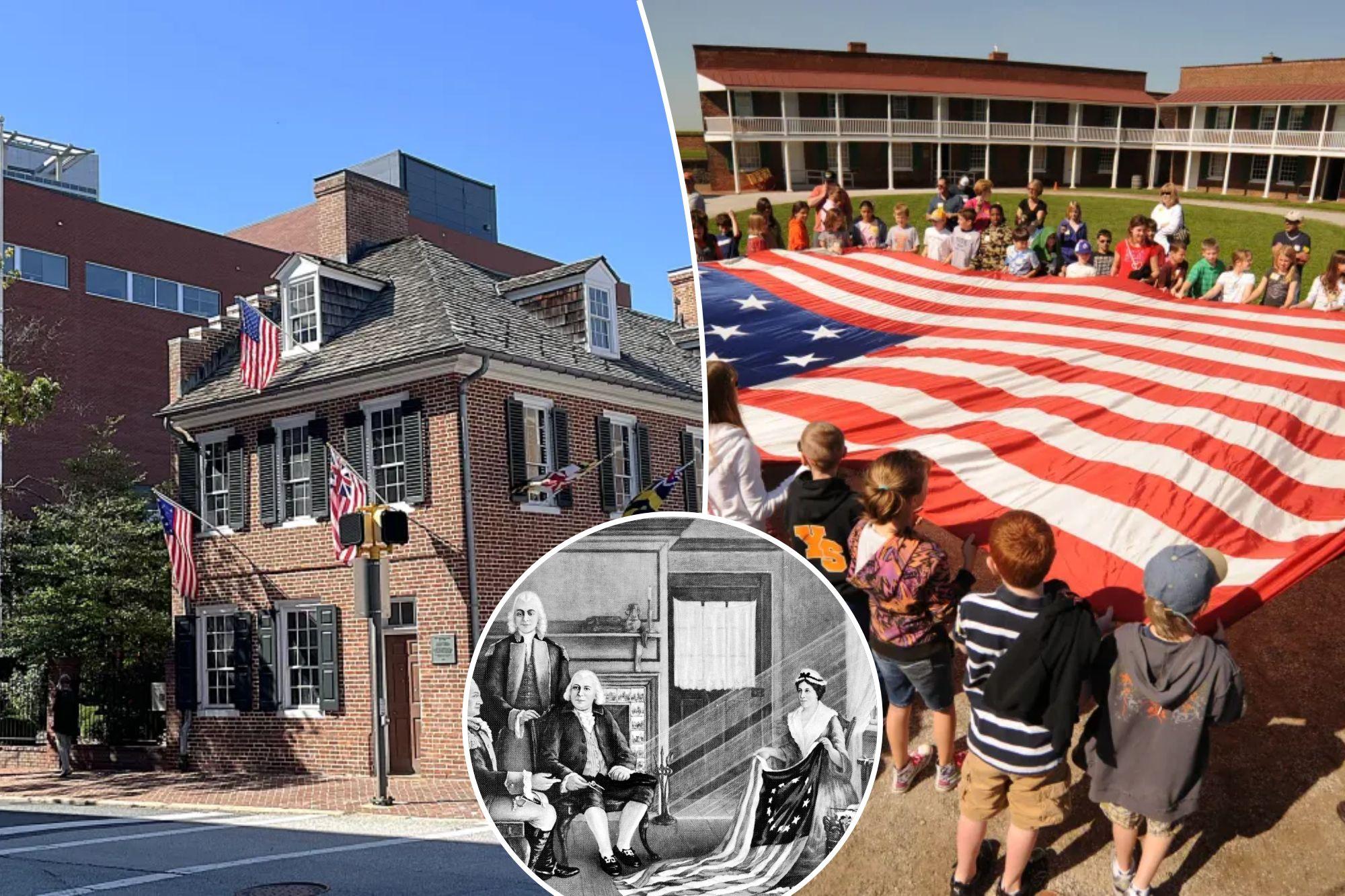
Betsy Ross may be the OG Stars and Stripes seamstress, but Baltimorean Mary Pickersgill’s hand-sewn 30-by-42-foot garrison flag is the banner that inspired the nation’s anthem.
In 1814, it flew over Fort McHenry during a British bombardment, giving Francis Scott Key the inspiration he needed to write “The Star-Spangled Banner.”
The original artifact, commissioned in 1813, is now housed at the Smithsonian Institution’s National Museum of American History in Washington, DC, but Baltimore’s Star-Spangled Banner Flag House and Museum, which preserves Pickersgill’s circa-1793 home, pays homage to her accomplishments as a seamstress, businesswoman and philanthropist.
“We try to highlight just how much she did for not only her local community and the country, but for us,” said museum executive director Chris Sniezek. “We are still feeling the effects of her impact, even today.”
On-site is a true-to-scale replica of Pickersgill’s original — whose imposing size was intended to intimidate British attackers. With just eight weeks to pull off the project, Pickersgill and her team used more than 400 yards of fabric (including, ironically, English wool bunting) to create a flag so massive they had to assemble it in a local brewery.
Over at Fort McHenry National Monument and Historic Shrine, a modern-day Star-Spangled Banner still waves 24/7. Summer programming includes daily flag changes, ranger talks and performances of the quintessential Colonial-era soundtrack by the Fort McHenry Guard Fife and Drum Corps.
Baltimore’s collective pride in its flag-tastic history runs deep year-round, however. Defender’s Day, its oldest holiday, is celebrated on Sept. 12 to commemorate the city’s successful stand against the British.
Speaking of Betsy Ross, did she really sew that first American flag?
Visitors can decide for themselves at the Betsy Ross House, where, according to oral history, the 24-year-old widow stitched a flag with 13 stars in a circle and 13 red-and-white stripes — with the goal of creating a powerful symbol of unity for a brand-new nation (no pressure).
Alongside information about ongoing research to settle the big question, Betsy herself (i.e., a costumed interpreter) happily answers visitor inquiries — like why she suggested five-pointed stars instead of the original six-pointed ones. Tours include access to rotating exhibitions at the recently opened Flagmakers’ Hall.
Meanwhile, a visit to Pittsburgh’s National Flag Foundation Education Center, dedicated to flag history, education and handling etiquette, will whip your symbology skills into shape (fun fact: the group of 50 stars is called the union).
Albany is home to the country’s largest publicly held flag collection. Vast and varied, this flamboyance of emblems will enthrall casual enthusiasts and serious vexillologists alike.
Established in 1863, the collection is housed across the Flag Room at Empire State Plaza and the New York State Military Museum in Saratoga Springs. It contains more than 2,200 flags dating back to the War of 1812. Approximately 60 percent are from the Civil War, and more than 500 have been professionally conserved so far.
Battle scars add to the appeal of these time-worn beauties, and instead of restoring the artifacts to their original appearance, conservation preserves what’s left, letting holes, tears and even bloodstains “help tell the story of the flag,” said Chris Morton, associate curator at the New York State Military Museum, who oversees the collection.
“Why would we want to conceal the battle damage that was inflicted upon the flag as the color bearer heroically led the regiment across the battlefield?”
In Western New York, Old Fort Niagara is North America’s oldest continuously occupied military site and houses one of the oldest U.S. flags in existence — one of only about 20 known surviving examples of the Stars and Stripes dating from before 1815.
After being captured by the British and sent to Canada and later Scotland, the flag, which was commissioned in 1809, returned to the U.S. in the mid-1990s. A $6 million visitor center opened in 2006 to house the rare artifact, whose requirements rival a diva celebrity’s rider list.
“You can’t hang it vertically because it stresses out the fibers, so it’s displayed at an angle in its own little environmental cubicle. The light in the chamber is controlled, the humidity is controlled, and the temperature is controlled with special HVAC systems,” explained Bob Emerson, executive director of the fort, which will host an America 250 event on Aug. 1.
For a literal taste of Old Glory, head to Clarksville, Tenn., where you’ll be hard-pressed to find a more patriotic place for a tipple than Old Glory Distilling Co. Flags are omnipresent, both on bottle labels and throughout the distillery and on-site restaurant.
Founder Matt Cunningham opened the distillery in 2016, aiming to create a place where the local community and service members stationed at nearby Fort Campbell, Kentucky, could kick back. The former firefighter also wanted the “grain-to-glass” distillery, which produces “damn fine” Tennessee whiskey, bourbon and other spirits, to reflect the work ethic and integrity of 1940s America.
“That was a time period when people gave a damn about whatever it was they did, whether they were a woodworker, metalworker or fighting in World War II,” Cunningham said. “We wanted to represent those strong American values and create a brand around that.”
In true Americana spirit, the flag takes an epic summer road trip every year: about 15,000 miles over 115 days to all 50 states, billowing from a motorcycle and joined by as many as 500 other riders.
In its 17th year, the Patriot Tour is organized by Nation of Patriots, a nonprofit that has raised more than $2.5 million for US veterans and their families.
The 2026 tour is scheduled to reach Aiken, South Carolina, for the Fourth of July before heading farther south and then west, where stops include Seligman, Arizona, on Historic Route 66.
For decades, Disneyland Park in Anaheim has quietly carried out a patriotic tradition that tends to get overshadowed by Mouse mania: daily flag ceremonies.
Staff have raised and lowered the American flag every day since July 17, 1955 — even during the pandemic — in a celebrated ritual featuring performances by the Disneyland Band.
A similar ceremony has taken place at Kissimmee’s Magic Kingdom since it opened in 1971, a tradition that includes a service member or veteran chosen from the park’s daily visitors as the “U.S. Armed Forces Representative of the Day.”
At Cloud Camp, a luxe wilderness retreat at The Broadmoor Hotel in Colorado Springs, amenities include a hot tub in the treetops and elevated comfort food. But for many guests, the most memorable moment of their stay comes every evening with the retreat’s signature flag ceremony.
At precisely 5:50 p.m., Old Glory is lowered from her staff as “America the Beautiful” plays. Many guests are surprised to learn the song traces its origins to nearby Pikes Peak, the famous fourteener that inspired Katharine Lee Bates to write the lyrics after she reached the top in 1893.
Staff rotate several versions of the song, though “the fan favorite is Frank Sinatra,” said Kurt Reineke, resort manager of Cloud Camp. Whichever one plays, many guests find themselves misty-eyed listening to the music in the very landscape that inspired it.
“When we get service members up there, I’ve seen tears just flowing,” Reineke said. “It’s very emotional and touching.”