U.S. Army · Division

82nd Airborne Division

“All American”

Constituted 1917 · 17 honoured here served in it

The Heraldry 5
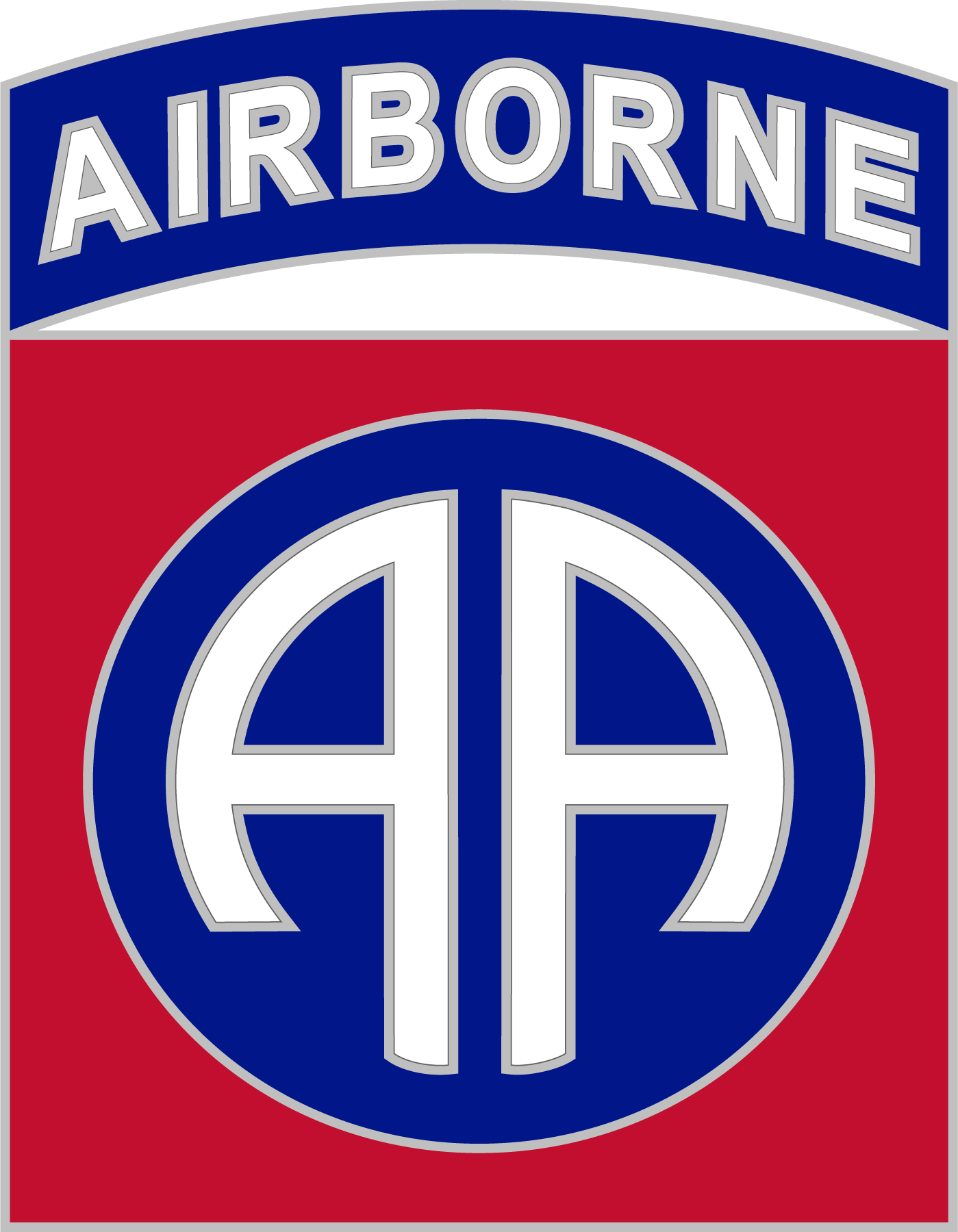
82nd Airborne Division — Shoulder sleeve insignia
Shoulder sleeve insignia

The insignia was redesignated for the 82d Airborne Division and an "Airborne" tab authorized on 31 August 1942.

Upon a red square 2 3/8 inches (6.03 cm) on a side a blue disc 1 3/4 inches (4.45 cm) in diameter with the letters AA in white. The inner elements of the two A's vertical lines and the outer elements arcs of a circle 1 3/8 inches (3.49 cm) in diameter, elements of the letters 1/8 inch (.32 cm) in width. Worn immediately above the square is a blue tab with the word "AIRBORNE" in white.

The double "A" refers to the nickname "All American Division" adopted by the organization in France during World War I.

The shoulder sleeve insignia was approved for the 82d Division by the Adjutant General, American Expeditionary Forces on 21 October 1918 and was confirmed by The Adjutant General on 8 July 1922. The insignia was redesignated for the 82d Airborne Division and an "Airborne" tab authorized on 31 August 1942. Authorization for the tab was rescinded on 29 January 1947 and subsequently restored on 23 December 1948 and announced later on 1 March 1949. (TIOH Drawing Number A-1-129)
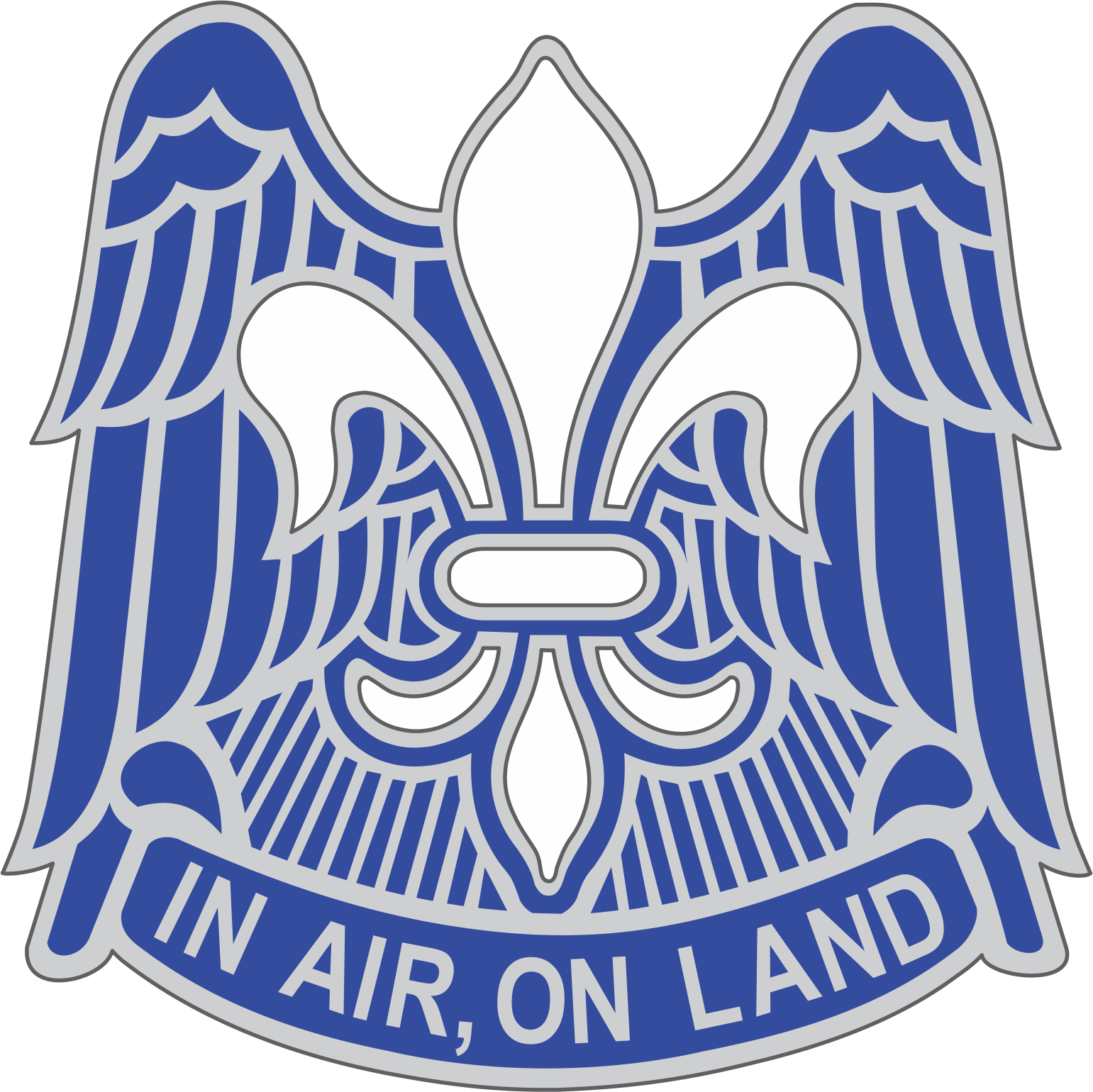

82nd Airborne Division — Distinctive unit insignia
Distinctive unit insignia

The insignia was cancelled and a distinctive unit insignia of the same design as the shoulder sleeve was authorized on 31 July 1990.

A silver color metal and enamel device 1 1/8 inches (2.86 cm) in height overall consisting of pair of blue stylized wings, tips down surmounted by a white fleur-de-lis supported by a blue scroll inscribed, "IN AIR, ON LAND" in silver color metal letters.

The fleur-de-lis is representative of the battle honors earned in France during World War I. The wings are symbolic of the Division's mission. The motto is expressive of the personnel of the organization either on land or in the air.

The distinctive unit insignia was approved on 23 October 1942. It was redesignated for the Command and Control Battalion, 82d Airborne Division on 21 April 1958. It was redesignated for the noncolor bearing units of the 82d Airborne Division on 6 June 1966. The insignia was cancelled and a distinctive unit insignia of the same design as the shoulder sleeve was authorized on 31 July 1990. The original insignia was reinstated on 21 May 1998.

82nd Airborne Division — Beret flash
Beret flash

Authorised 17 June 1986

A red shield-shaped embroidered item with a semi-circular base, 2 1/4 inches (5.72 cm) in height and 1 7/8 inches (4.76 cm) in width overall, edged with a 1/8 inch (.32 cm) red border. The beret flash was originally approved for the 82d Airborne Division Artillery on 17 June 1986. It was redesignated for the 2d Battalion, 321st Field Artillery Regiment on 18 May 2007. It was redesignated for the 82d Airborne Division Artillery effective 16 October 2014.

82nd Airborne Division — Background trimming
Background trimming

Authorised 17 June 1986

A red oval-shaped embroidered item 1 3/8 inches (3.49 cm) in height and 2 1/4 inches (5.72 cm) in width overall, edged with a 1/8 inch (.32 cm) red border. The background trimming was originally approved for the 82d Airborne Division Artillery on 17 June 1986. It was redesignated for the 2d Battalion, 321st Field Artillery Regiment on 18 May 2007. It was redesignated for the 82d Airborne Division Artillery effective 16 October 2014.

82nd Airborne Division — Combat service identification badge
Combat service identification badge

A silver color metal and enamel device 2 inches (5.08 cm) in height consisting of a design similar to the shoulder sleeve insignia.

Lineage and Honours
World War I
Where It Sits

17 of the men and women on this memorial served in this formation. See them.

In Our Keeping
Country United States
Service U.S. Army
Echelon Division
Status Active
Stewarded by NeuraWeb Global Inc.
Permanent identifier neuraspine_01krc4nv6r88wf89hpdd7tqb78

Held by NeuraWeb Global Inc. and kept permanently. The formation itself may claim this record and maintain it.