U.S. Army · Regiment

506th Infantry Regiment

Constituted 1942 · 663 honoured here served in it

The Heraldry 2
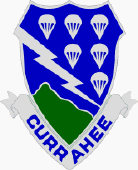
506th Infantry Regiment — Distinctive unit insignia
Distinctive unit insignia

Authorised 20 April 1943

A silver color metal and enamel device 1 1/4 inches (3.18cm) in height overall a shield blazoned: Azure, a lightning flash in bend throughout Argent, in chief, six parachutes, three, two and one of the last, in base a mountain issuant Proper. Attached below the shield a silver motto scroll inscribed "CURRAHEE" in blue letters.

The blue field is for the Infantry, the 506th's arm of the service. Thunderbolt indicates the regiment's particular threat and technique to attack: striking with speed, power, and surprise from the sky. Six parachutes represent the fact that the 506th was in the sixth parachute Regiment activated in the U.S. Army, of which, the unit is proud. The green silhouette represents the Currahee Mountain -- the site of the regiment's activation (Taccoa, Ga.) -- and symbolizes the organization's strength, independence, and ability to stand alone for which paratroops are renowned. In fact, Currahee is the Cherokee Indian equivalent for "Stands Alone."

The distinctive unit insignia was originally approved for the 506th Parachute Infantry Regiment on 20 Apr 1943. It was redesignated and amended for the 506th Airborne Infantry on 18 Mar 1949. On 27 Feb 1958 the insignia was redesignated for the 506th Infantry. Coat of Arms
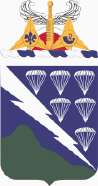
506th Infantry Regiment — Coat of arms
Coat of arms

Authorised 20 April 1943

Azure, a lightning flash in bend throughout Argent, in chief, six parachutes, three, two and one of the last, in base a mountain issuant Proper. On a wreath Argent and Azure, in front of a demi-plate bearing a demi-torteau surmounted overall in pale by a winged sword-breaker point to base Or wings elevated of the first, two caltraps conjoined gold that to the dexter bearing a fleur-de-lis of the second and that to the sinister a bugle horn of the like. CURRAHEE (American Aboriginal, Cherokee Tongue: (Stands Alone).

The blue field is for the Infantry, the 506th's arm of the service. Thunderbolt indicates the regiment's particular threat and technique to attack: striking with speed, power, and surprise from the sky. Six parachutes represent the fact that the 506th was in the sixth parachute regiment activated in the U.S. Army, of which, the unit is proud. The green silhouette represents the Currahee Mountain -- the site of the regiment's activation (Taccoa, Ga.) -- and symbolizes the organization's strength, independence, and ability to stand alone for which paratroops are renowned. The winged sword-breaker represents airborne troops. The conjoined caltraps stand for the enemy line of defense behind which paratroopers are dropped. They are two in number in reference to the unit's two air assault landings. The fleur-de-lis is for the Normandy invasion and the bugle horn, from the arms of Eindhoven, Holland, refers to the organization's capture of that objective. The six large spikes of the caltraps stand for the unit's six decorations. The demi-roundel represents a section of the hub of a wheel. It stands for Bastogne, Begium, strategic crossroads of highways and railways. The hub, surmounted by the winged sword-breaker, commemorates the organization's heroic defense of Bastogne in the Battle of the Bulge. CURRAHEE. American Aboriginal, Cherokee Tongue meaning "Stands Alone."

The coat of arms was originally approved for the 506th Parachute Infantry Regiment on 20 Apr 1943. It was amended on 23 Aug 1943 to correct the blazon. The coat of arms was redesignated for the 506th Airborne Infantry Regiment on 18 Mar 1949. On 27 Feb 1958 it was redesignated for the 506th Infantry.

Lineage and Honours
World War II
Where It Sits

663 of the men and women on this memorial served in this formation. See them.

In Our Keeping
Country United States
Service U.S. Army
Echelon Regiment
Status Active
Stewarded by NeuraWeb Global Inc.
Permanent identifier neuraspine_01krc4ntytkh5x8cnqzd04vcmv

Held by NeuraWeb Global Inc. and kept permanently. The formation itself may claim this record and maintain it.