USS Langley
Decommissioned 24 March 1920 · 2 battle stars
- 24 March 1920 Decommissioned 24 March 1920 She proceeded to Hampton Roads, VA, on 12 December where she was decommissioned on 24 March 1920.
- 8 December 1941 Launched 8 December 1941 At the time the Japanese launched their strategic offensive in the Pacific on 8 December 1941 (local), Langley lay off Sangley Point.
- Her fate sunk by the destroyer Edsall (DD‑219)
- Class Langley
- Battle stars two battle stars, the first for the Philippine Islands operations (8 December 1941–6 May 1942 and the other, for the Netherlands East Indies engagements, 23 Langley earned two battle stars, the first for the Philippine Islands operations (8 December 1941–6 May 1942 and the other, for the Netherlands East Indies engagements, 23 January–27 February 1942.
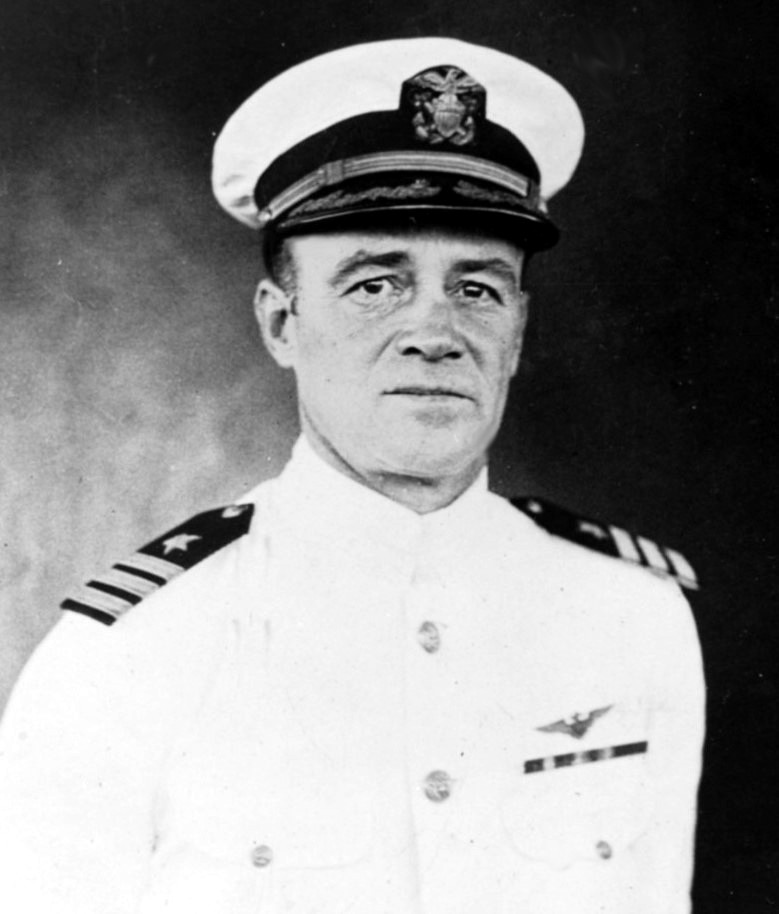
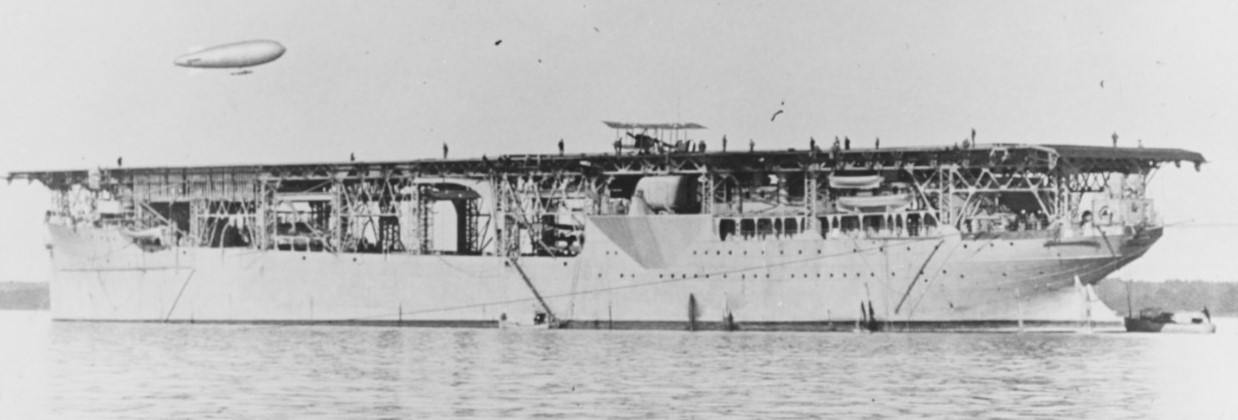
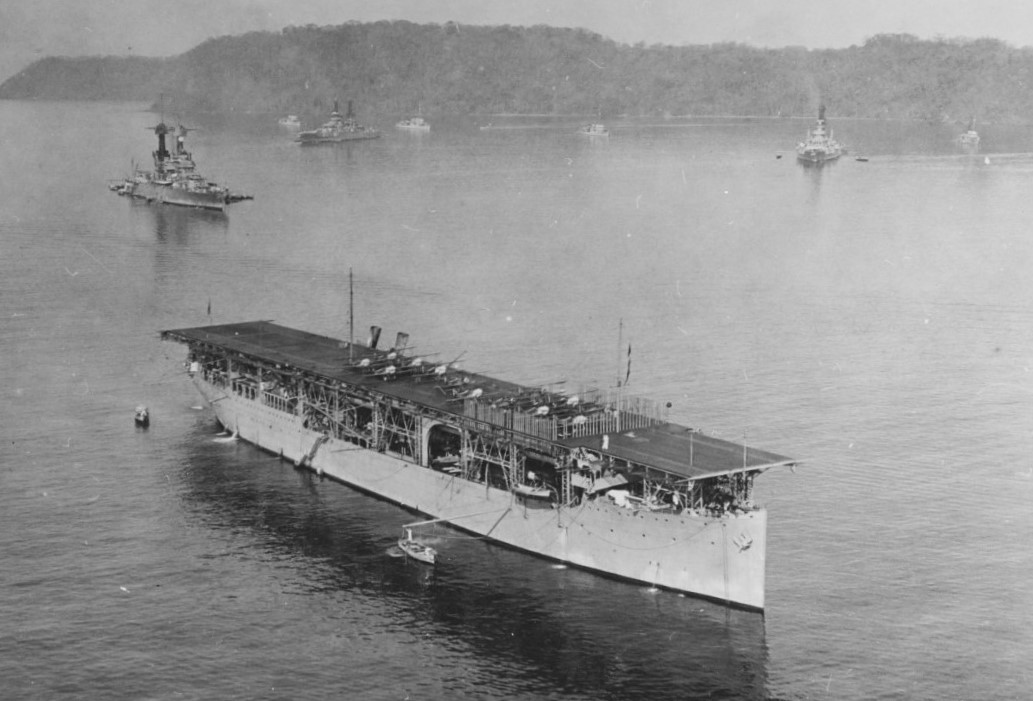
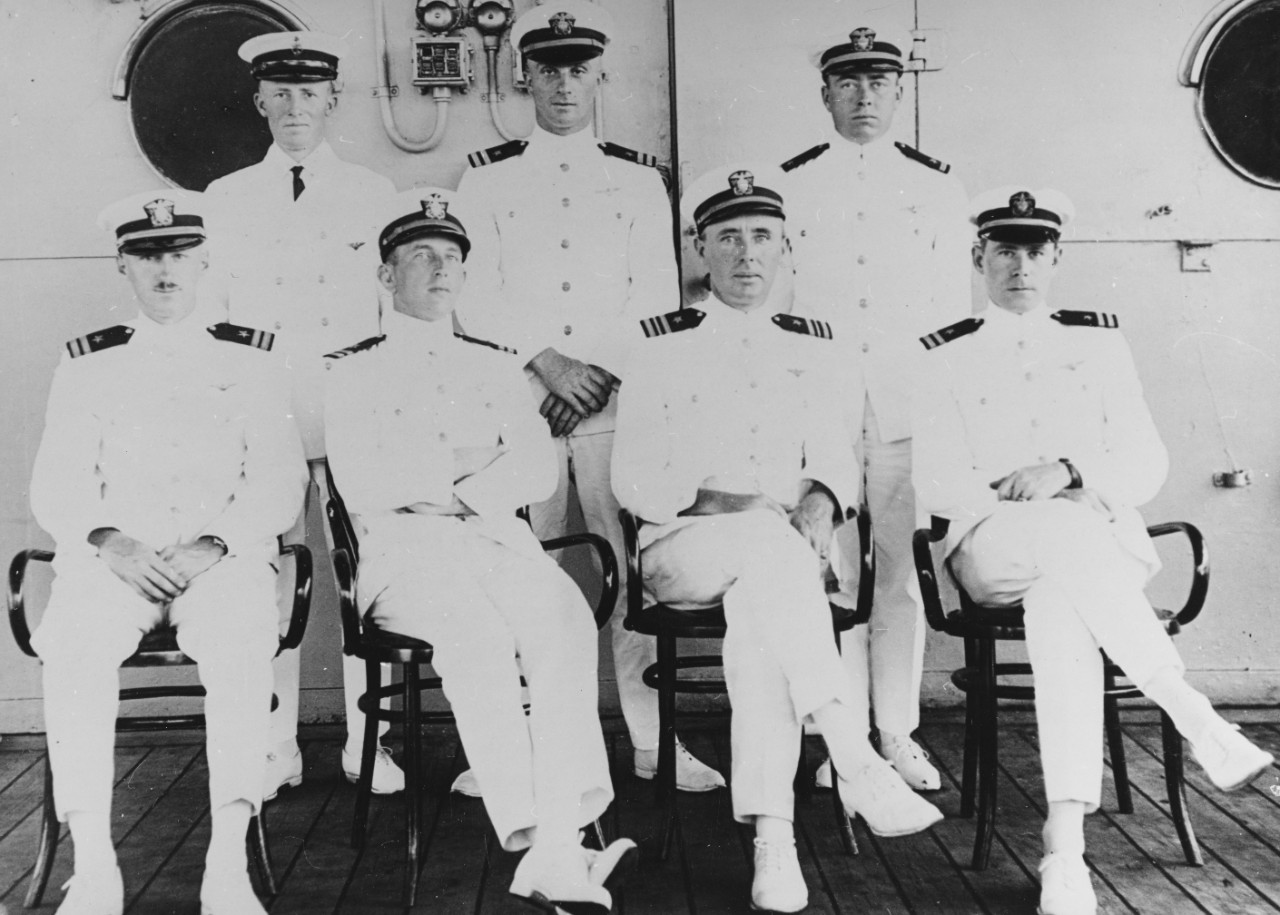
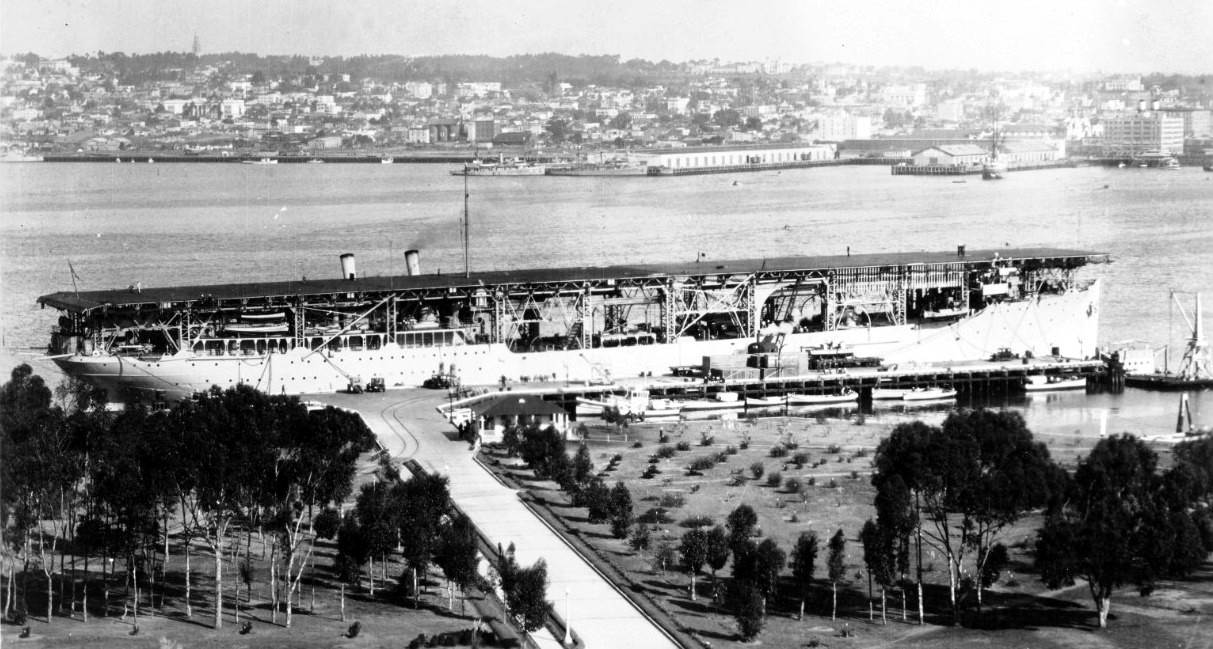
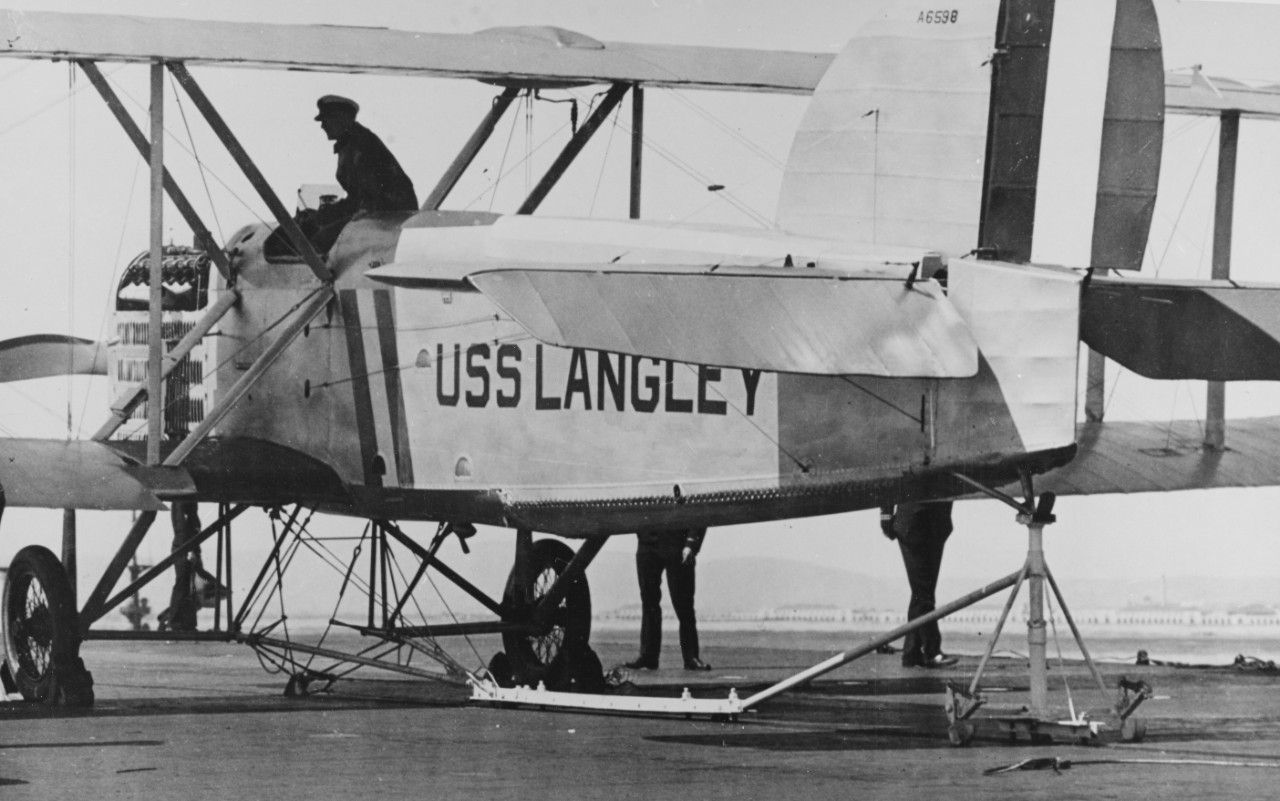
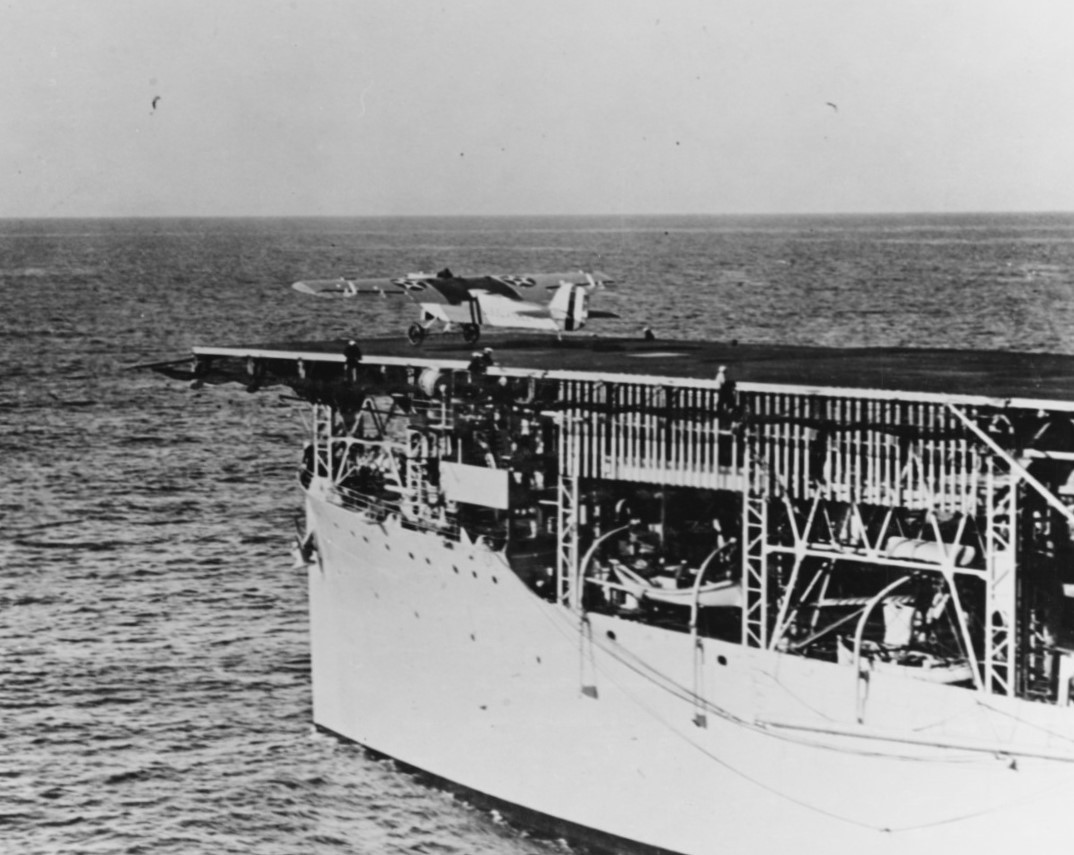
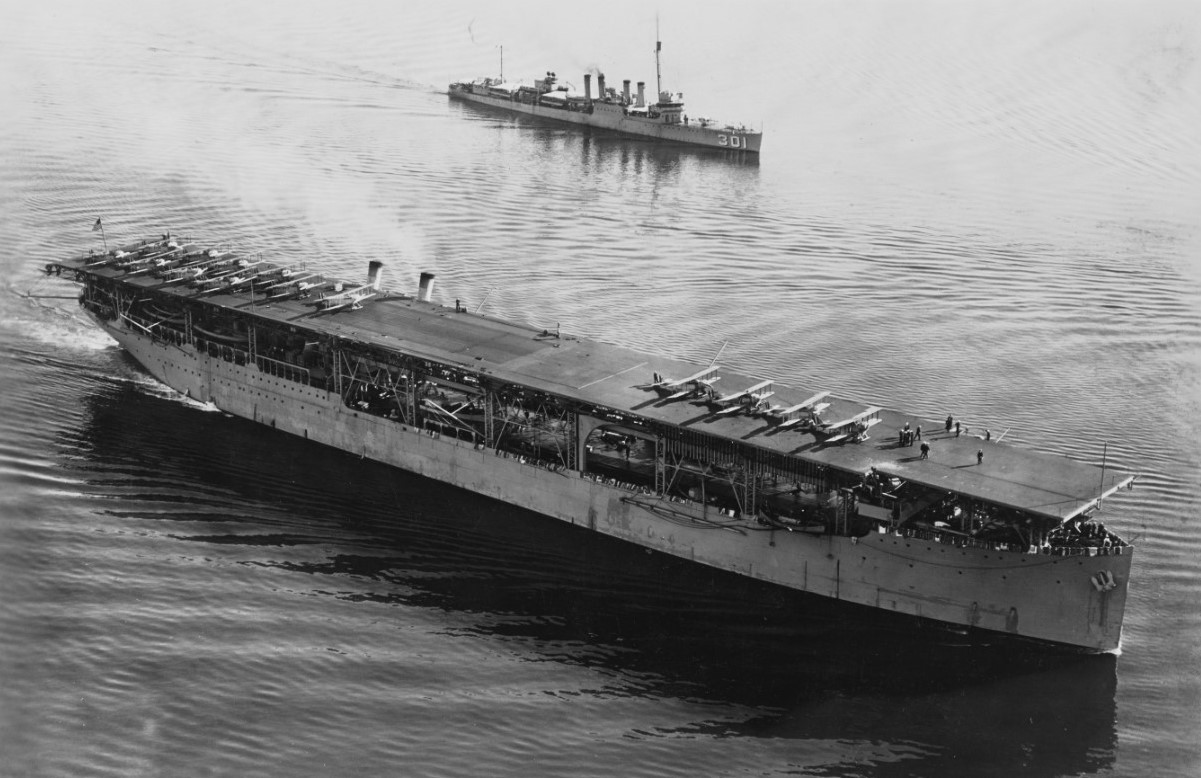
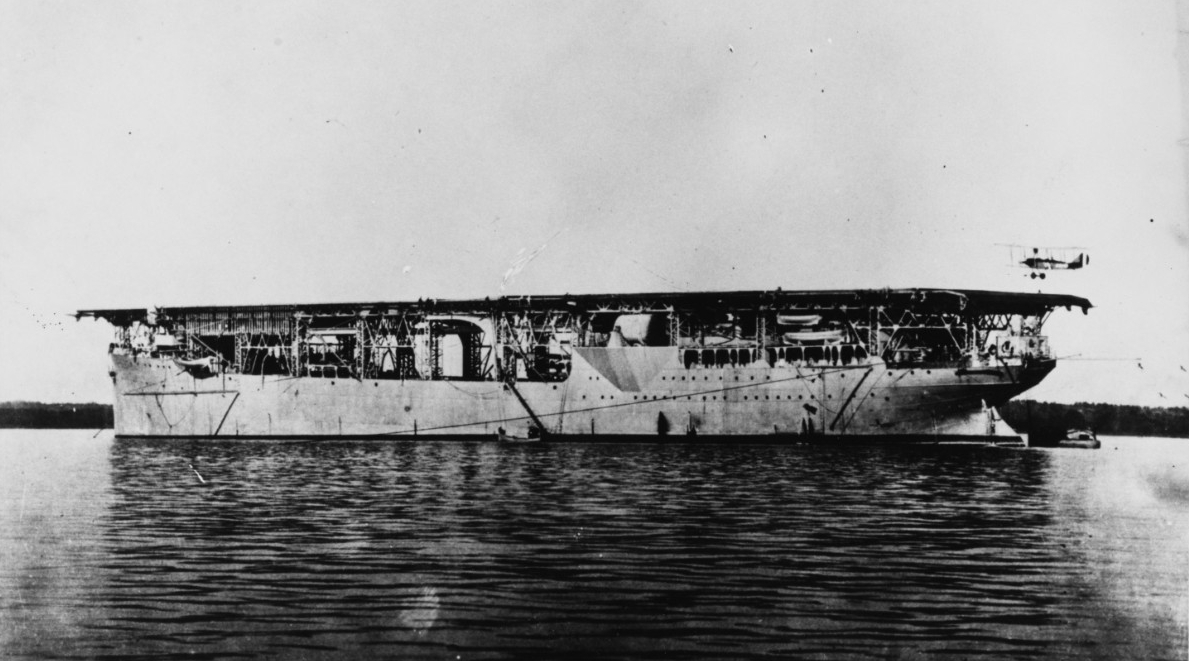
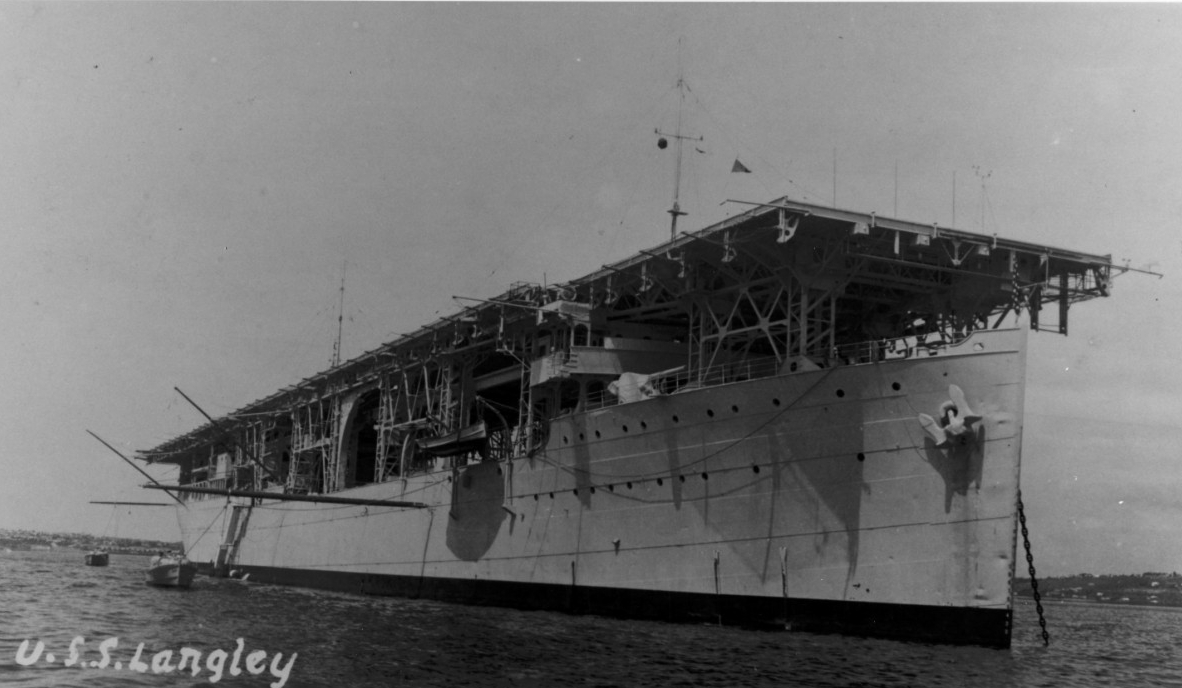
Developed from the Proteus-class collier Jupiter, USS Langley (CV-1) was converted into America’s first aircraft carrier and was recommissioned on 20 March 1922 with Commander Kenneth Whiting as her first commander. The ship was named to honor Samuel P. Langley, who was a former assistant professor at the U.S. Naval Academy and later secretary of the Smithsonian Institute. Langley’s repeated attempts to launch and land aircraft from ships at sea inspired the Navy, after his death in 1906, to carry on his legacy. Jupiter was ideal for conversion, because it had large holds that were transformed into hangars. As the first U.S. Navy carrier, Langley hosted numerous momentous events following her recommission. On 17 October 1922, Lieutenant Virgil C. Griffin made the Navy’s first carrier takeoff when he flew a Vought VE-7-SF from Langley’s decks while the ship was anchored in York River, Virginia. Nine days later, while Langley was underway, Lieutenant Commander Godfrey D. Chevalier completed the first landing on an aircraft carrier in an Aeromarine 39-B plane, and on 18 November, Whiting became the first aviator to be catapulted from the carrier's deck.
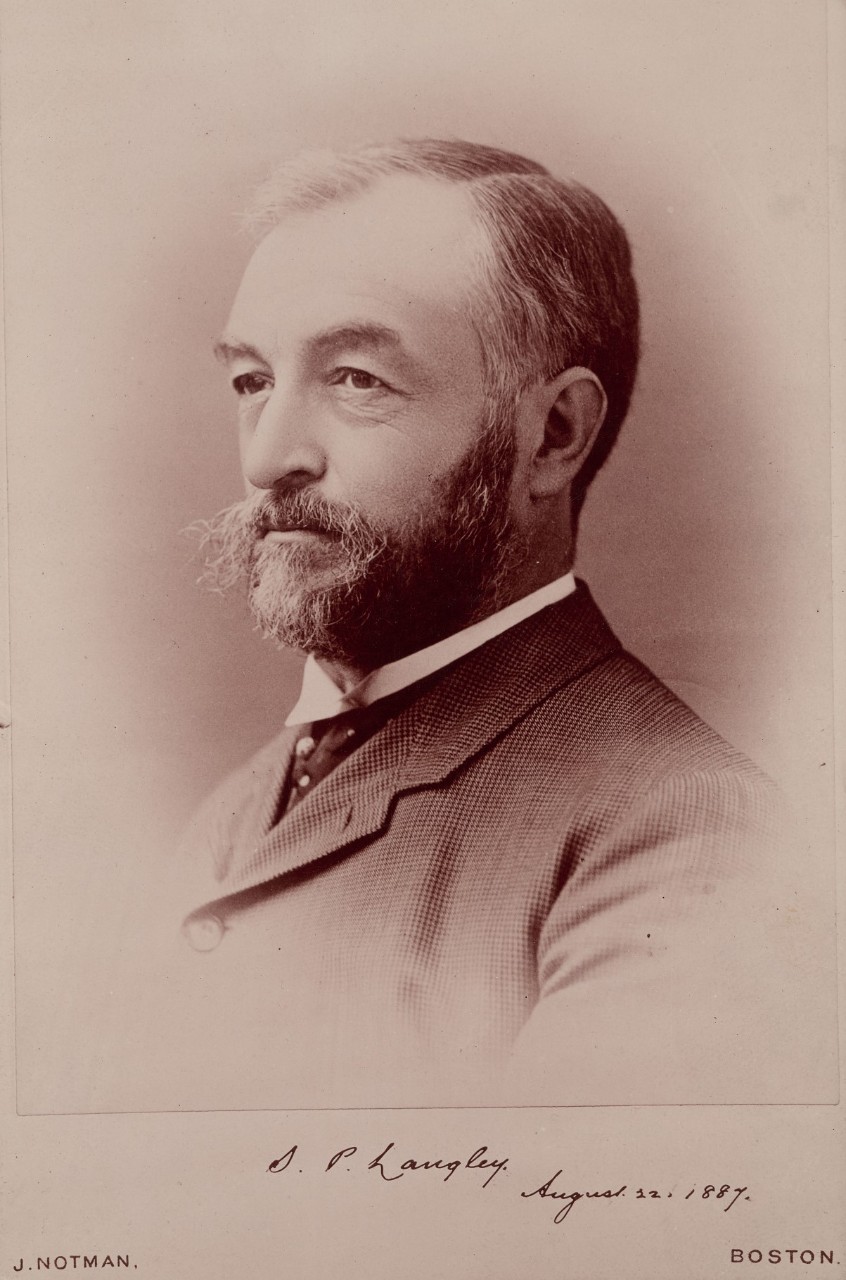
Named for Samuel Pierpont Langley, born on 22 August 1834 in Roxbury, MA. He graduated from Boston High School in 1851 and became an architect’s apprentice. After years of work in Chicago, IL, and St. Louis, MO, he returned to Roxbury. In 1865 he became an assistant at the Harvard Observatory, Cambridge, MA, and the following year an assistant professor of mathematics at the U.S. Naval Academy. Part of his duties was the restoration of academy’s observatory. Langley, in 1867, was named professor of astronomy and physics at the Western University of Pennsylvania (University of Pittsburgh). His duties included directing the Allegheny Observatory. Langley devised and constructed the bolometer (1879-80), an electrical device to measure radiant energy. He later organized a scientific expedition to Mount Whitney, CA, to document solar phenomena in 1881.
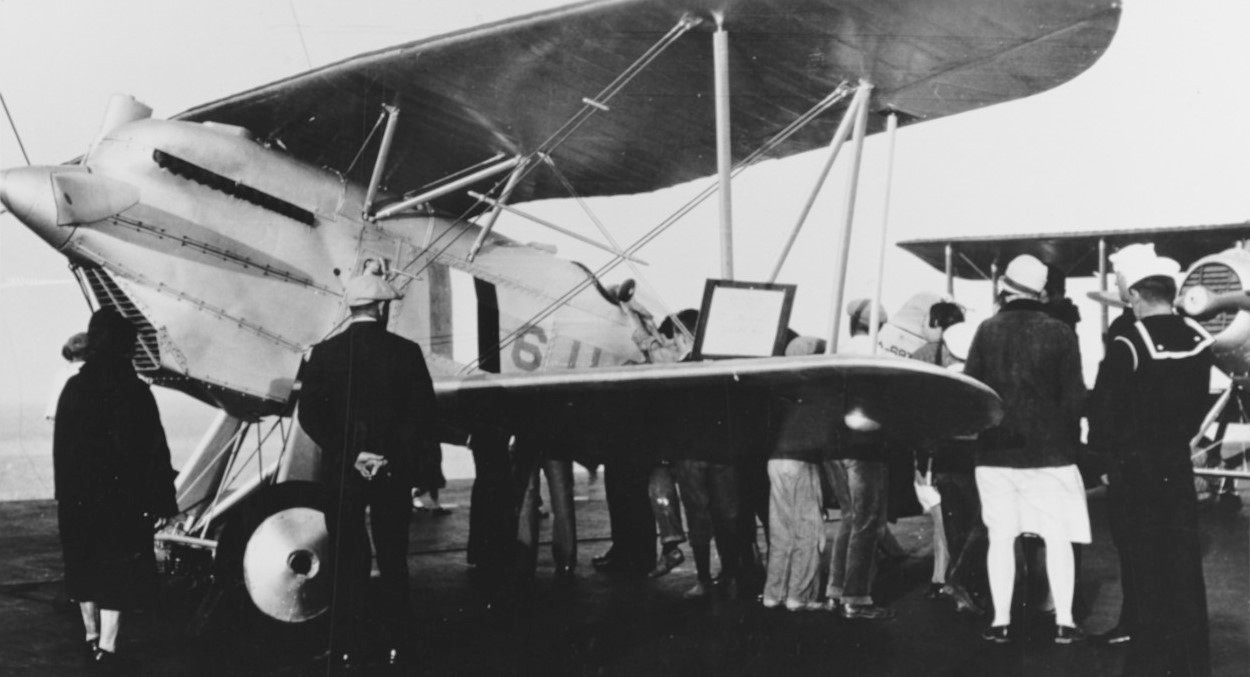
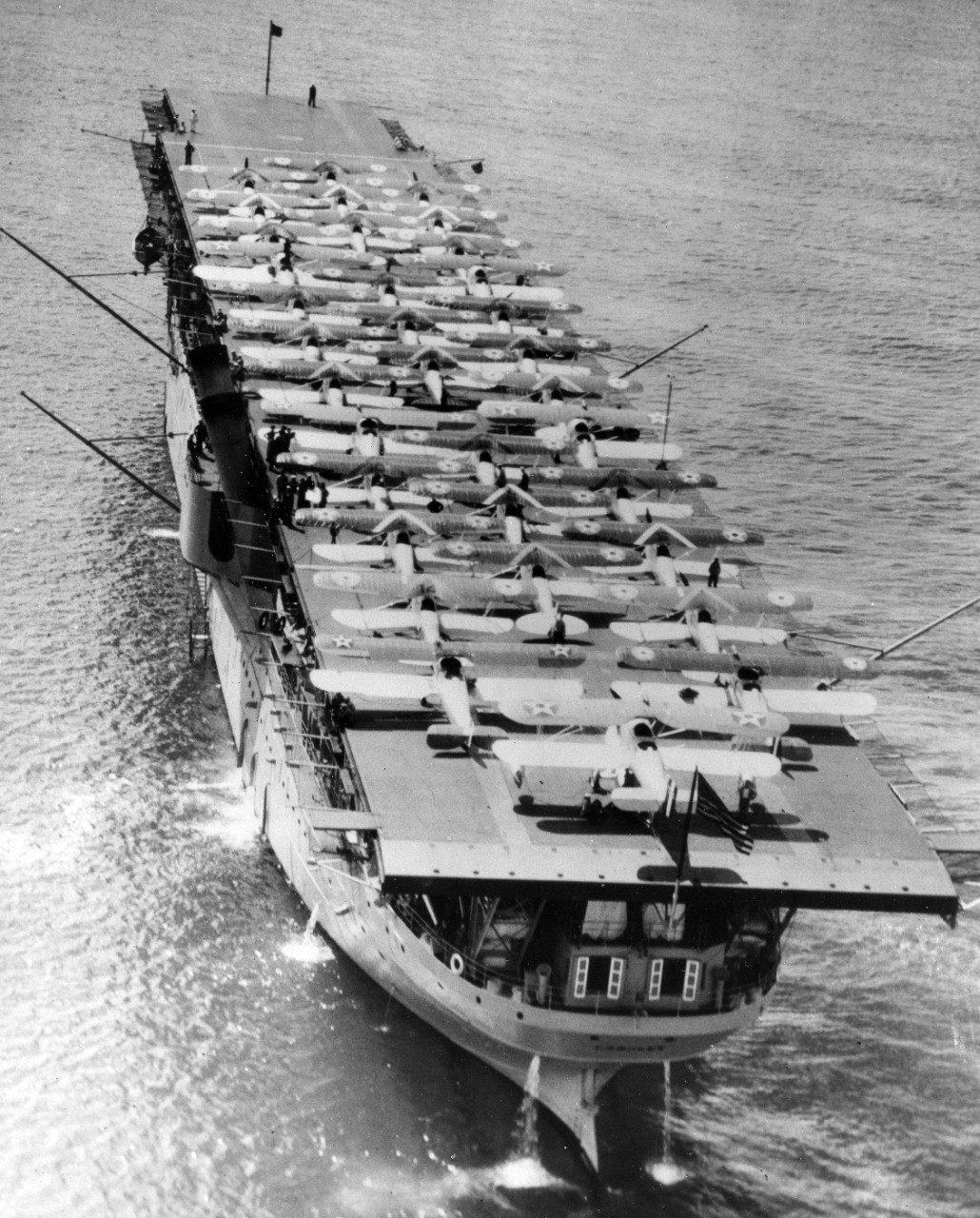
Langley served as an unarmed test bed for deck and flight operations throughout the 1920s. During this time, the Navy learned from its experiences on Langley how better to park and launch aircraft more quickly. The experiences that took place onboard Langley set the state for the fleet aircraft carriers that followed, such as Ranger, Lexington, and Saratoga, which were all built with flight decks that were wider, longer, and sturdier. The future carriers were built, based on lessons learned onboard Langley.
Following his attendance at a lecture on birds in 1886, Langley began developing an interest in aviation. Langley began aeronautical experimentation with his construction of a whirling table at the Allegheny Observatory. He subsequently created the study of aerodynamics coining the term “Aerodromics” for the art of building flying machines from the Greek aerodromoi. On 18 November 1887, he became the third secretary of the Smithsonian Institution in Washington, DC.
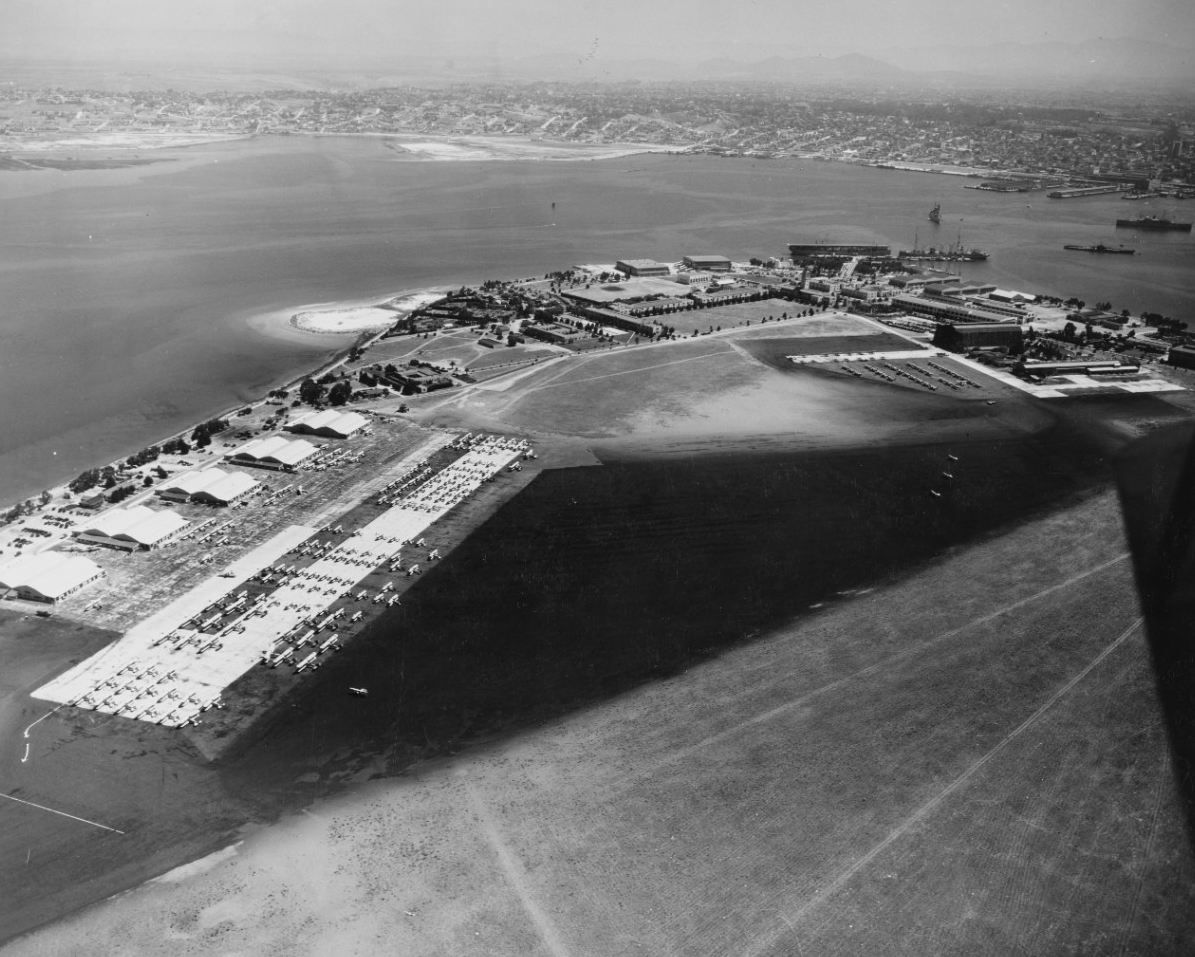
For the first half of 1923, Langley conducted flight operations and tests in the Caribbean. Later that year, she steamed to Washington, DC, for a demonstration at a flying exhibition before civil and military dignitaries. After demonstrating the Navy’s new capabilities, Langley steamed south arriving at Norfolk on 13 June, where she conducted training along the Atlantic coast and in the Caribbean through the end of the year. In 1924, Langley participated in more maneuvers and exhibitions, then spent the summer at Norfolk for repairs and alterations. She departed for the U.S. west coast later that year arriving in San Diego, California, on 29 November to join the Pacific Battle Fleet. For the next 12 years, Langley operated in California and Hawaiian waters where she engaged in training fleet units, experimentation, pilot training, and tactical fleet problems.
With his interest having turned to the skies, he spent the subsequent years researching, building, and testing aircraft. From 1892-1903, Langley conducted a series of experiments with his different “Aerodrome” machines with varying levels of success. The Wright brothers would make their successful flights at Kill Devil Hills, NC, on 17 December 1903. Only later, in 1914, would Langley’s pioneering efforts be proven by Glenn Curtiss at Hammondsport, NY. Langley received honorary degrees from Oxford, Cambridge, Princeton, Yale, among other universities.
With the advent of new, improved carriers being built, Langley was put into Mare Island Navy Yard on 25 October 1936 for overhaul and conversion to a seaplane tender. Langley completed conversion on 26 February 1937 and was reclassified AV‑3 later that year. She was assigned to the Aircraft Scouting Force and commenced operations out of Seattle, Sitka, Pearl Harbor, and San Diego. She departed for a brief deployment with the Atlantic Fleet from 1 February to 10 July 1939, and then steamed to assume duties with the Asiatic Fleet at Manila arriving on 24 September.
Having suffered a stroke in November 1905, Langley relocated to Aiken, SC, to convalesce in February 1906. While there he suffered another stroke and died on 27 February 1906. Samuel Pierpont Langley was buried at Forest Hill Cemetery, Boston, on 6 March 1906.
At the onset of World War II, Langley was off Cavite in the Philippine Islands. The day after the Pearl Harbor attack, she proceeded to Balikpapan, Borneo, and Darwin, Australia, arriving on New Year’s Day 1942. Until 11 January, Langley assisted the Royal Australian Air Force running antisubmarine patrols out of Darwin. She was then assigned to American‑British‑Dutch‑Australian forces assembling in Indonesia to challenge the Japanese thrust in that direction. She departed Freemantle, Australia, on 22 February in a convoy, but left the convoy five days later to deliver 32 P‑40 fighters to the 13th Pursuit Squadron in Tjilatjap, Java.
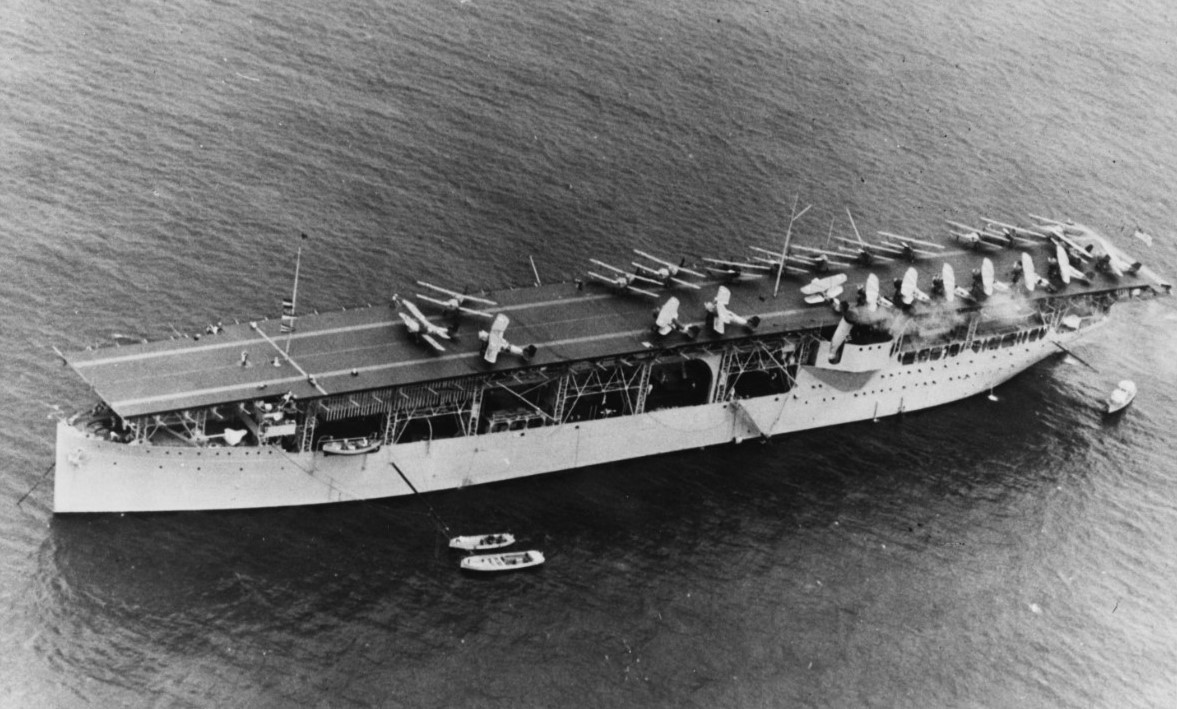
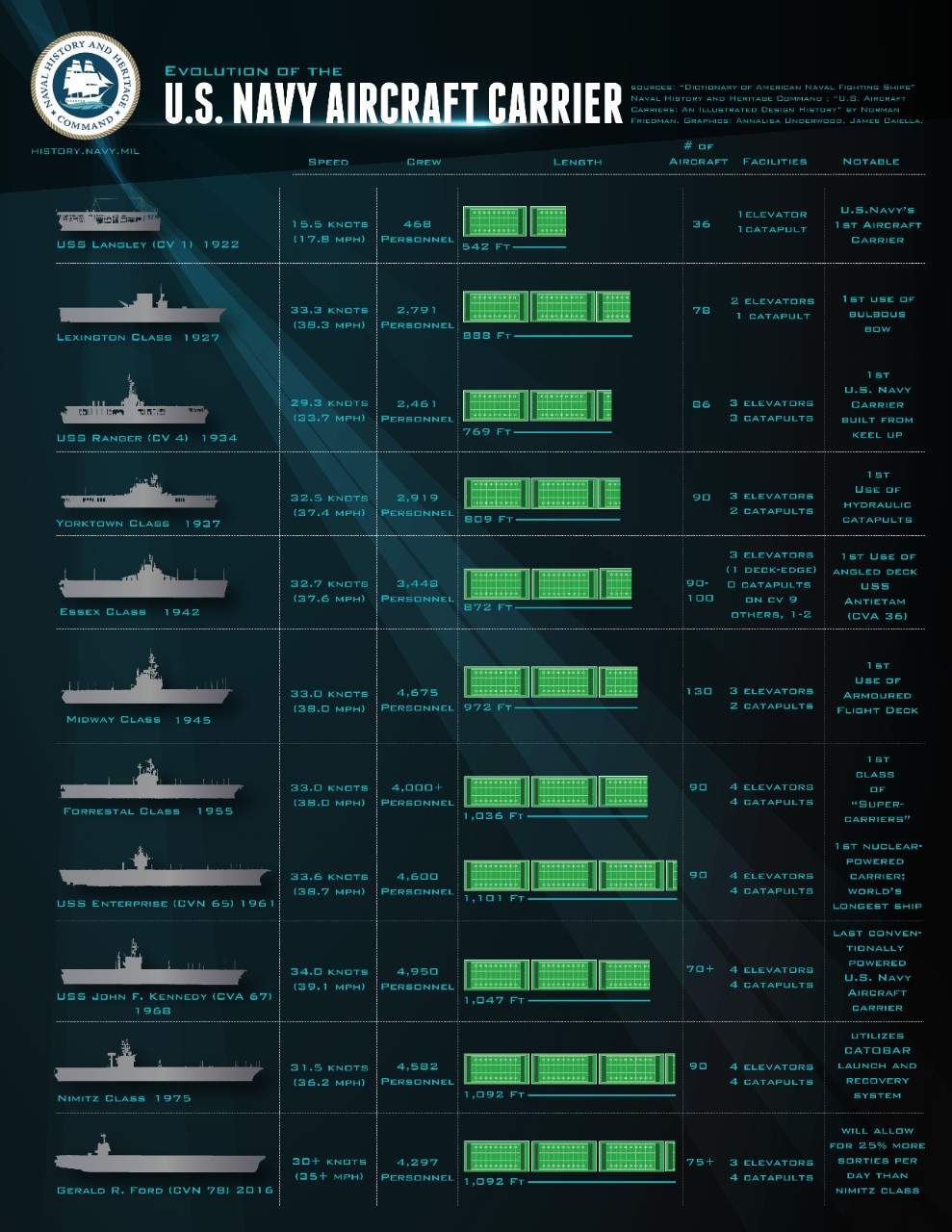
(CV-1: displacement 15,150 tons (full load); length 542'2.5"; beam 65'6"; draft 22'1" speed 14.0 knots; complement 468 (ship’s company + air group); armament 4 4-inch/50 caliber; aircraft 22; aviation facilities 1 elevator and 1 catapult; class Langley)
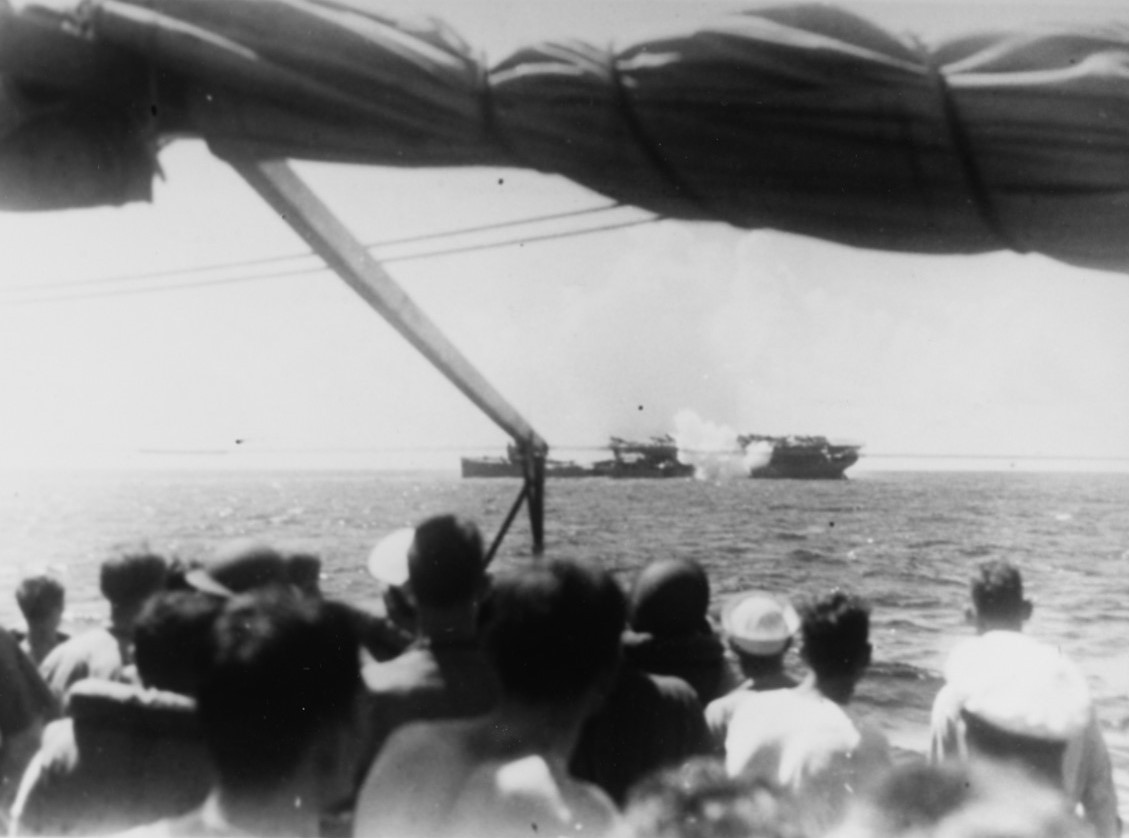
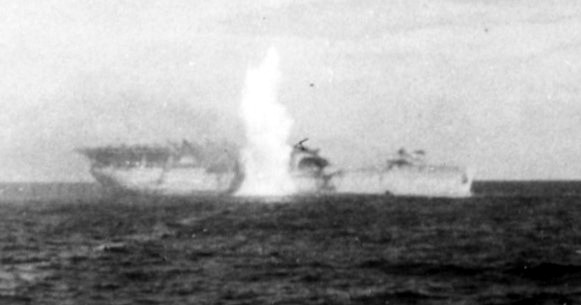
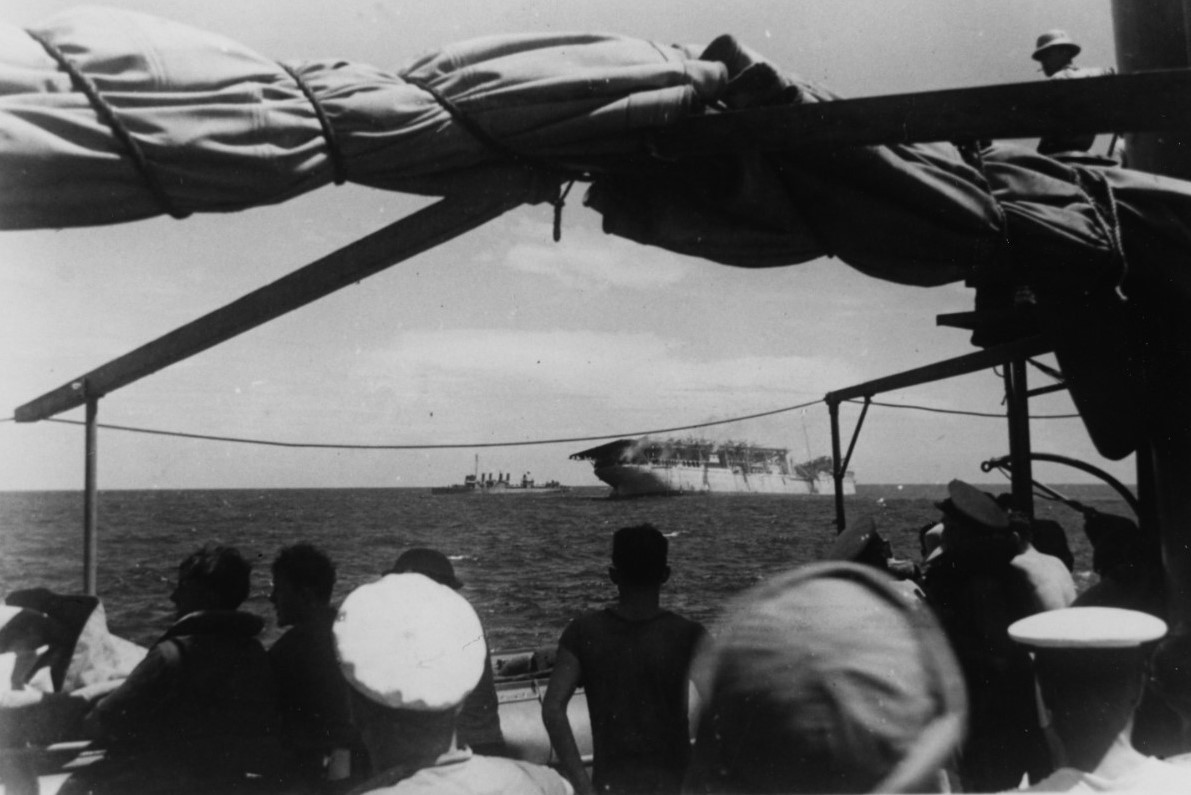
Early in the morning on 27 February, Langley rendezvoused with her antisubmarine screen—destroyers Whipple (DD‑217) and Edsall (DD‑219). Shortly before noon, nine Japanese dive bombers attacked Langley. The first and second Japanese strikes were unsuccessful, however, during the third strike, Langley took five hits. Aircraft topside burst into flames, steering was impaired, and the ship took a 10 degree list to port. Unable to negotiate the narrow mouth of Tjilatjap Harbor, Langley was dead in the water. Her main engine room was flooded. At approximately 1330, the order to “abandon ship” was given by Commander R.P. McConnell. Langley’s crew then watched from the decks of Whipple and Edsall as the destroyers fired nine 4-inch shells and two torpedoes in the bowels of Langley, so the aircraft carrier wouldn’t fall into the hands of the enemy. Langley slipped below the waves about 75 miles south of Tjilatjap. Sixteen crewmembers were lost.
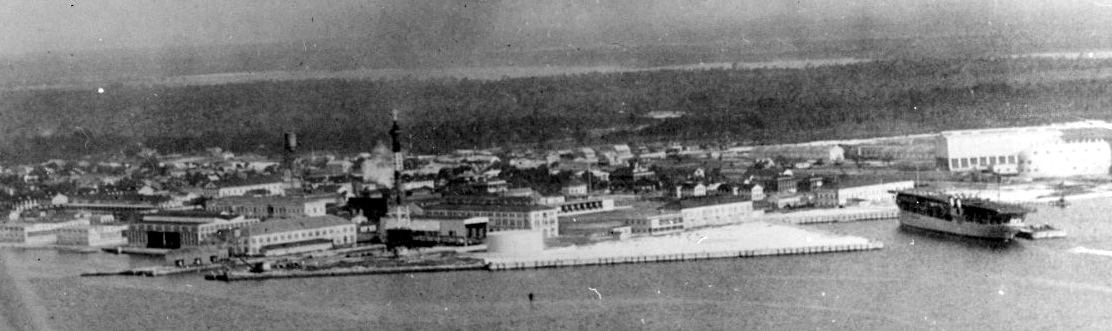
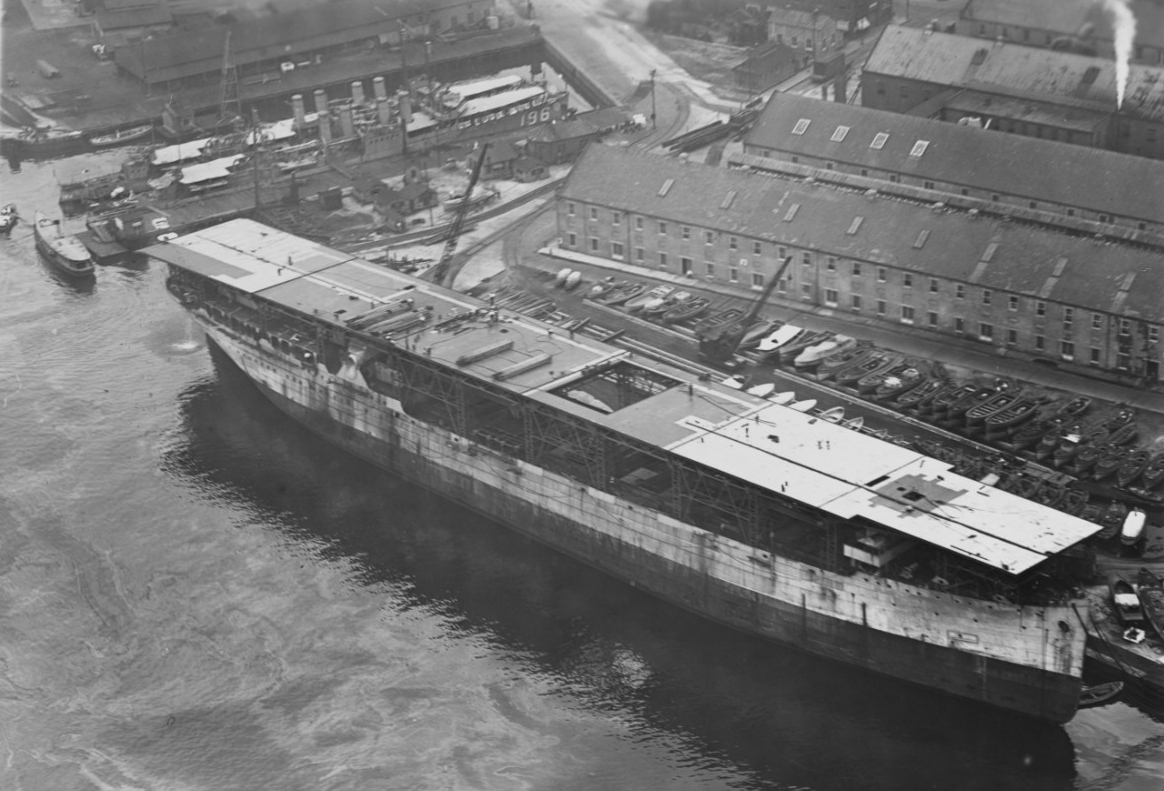
Jupiter’s conversion to an aircraft carrier was authorized on 11 July 1919. She proceeded to Hampton Roads, VA, on 12 December where she was decommissioned on 24 March 1920. The ship underwent conversion into the first U.S. aircraft carrier at the Norfolk Navy Yard, Portsmouth, VA.
Renamed Langley by General Order 529, on 21 April 1920; she was reclassified as CV-1 as part of a Navy-wide reorganization on 17 July 1920; and recommissioned on 20 March 1922, Cmdr. Kenneth Whiting in command.
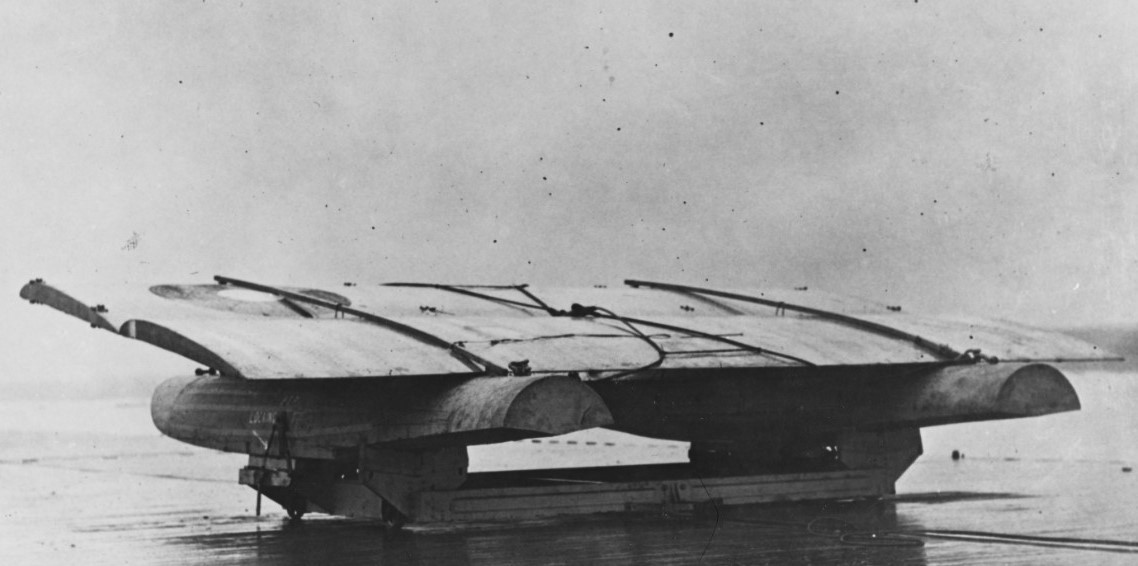
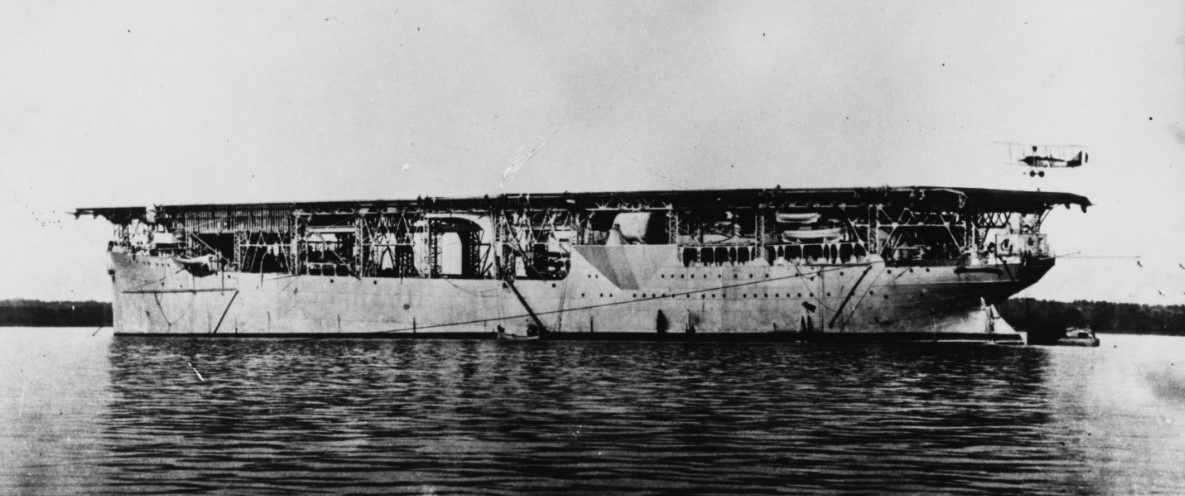
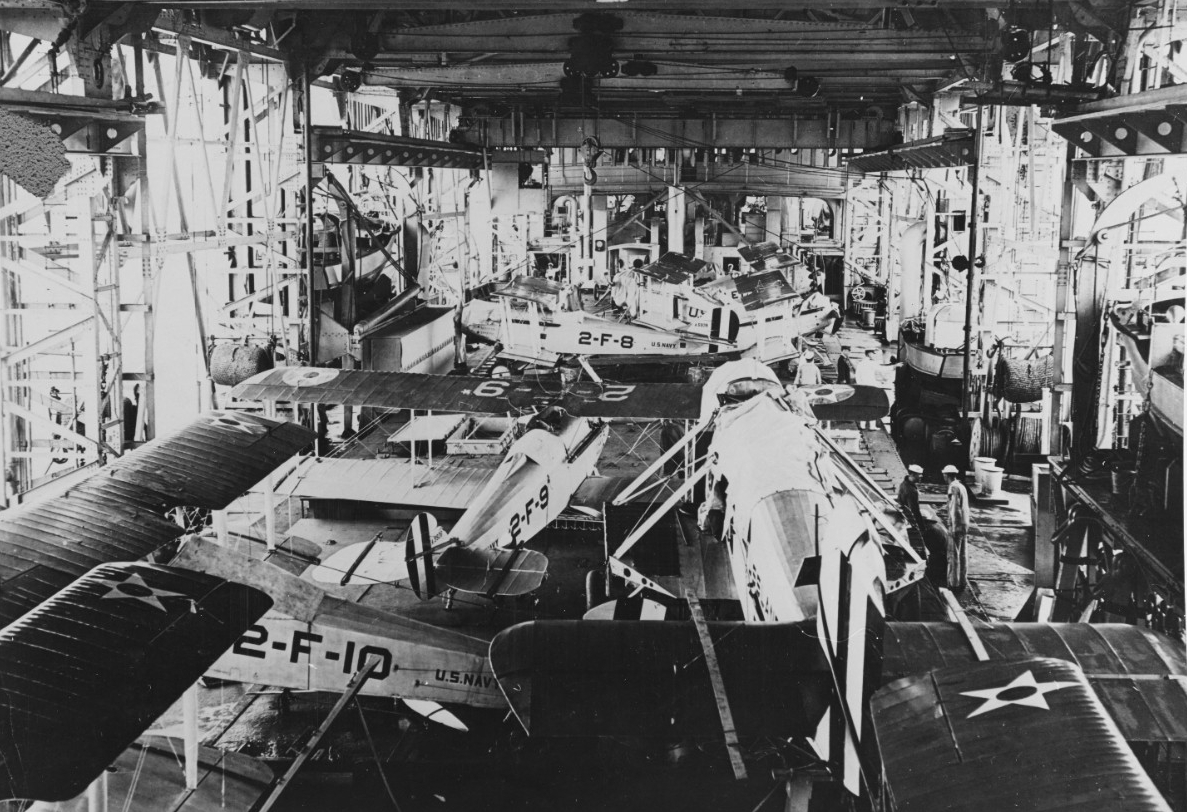
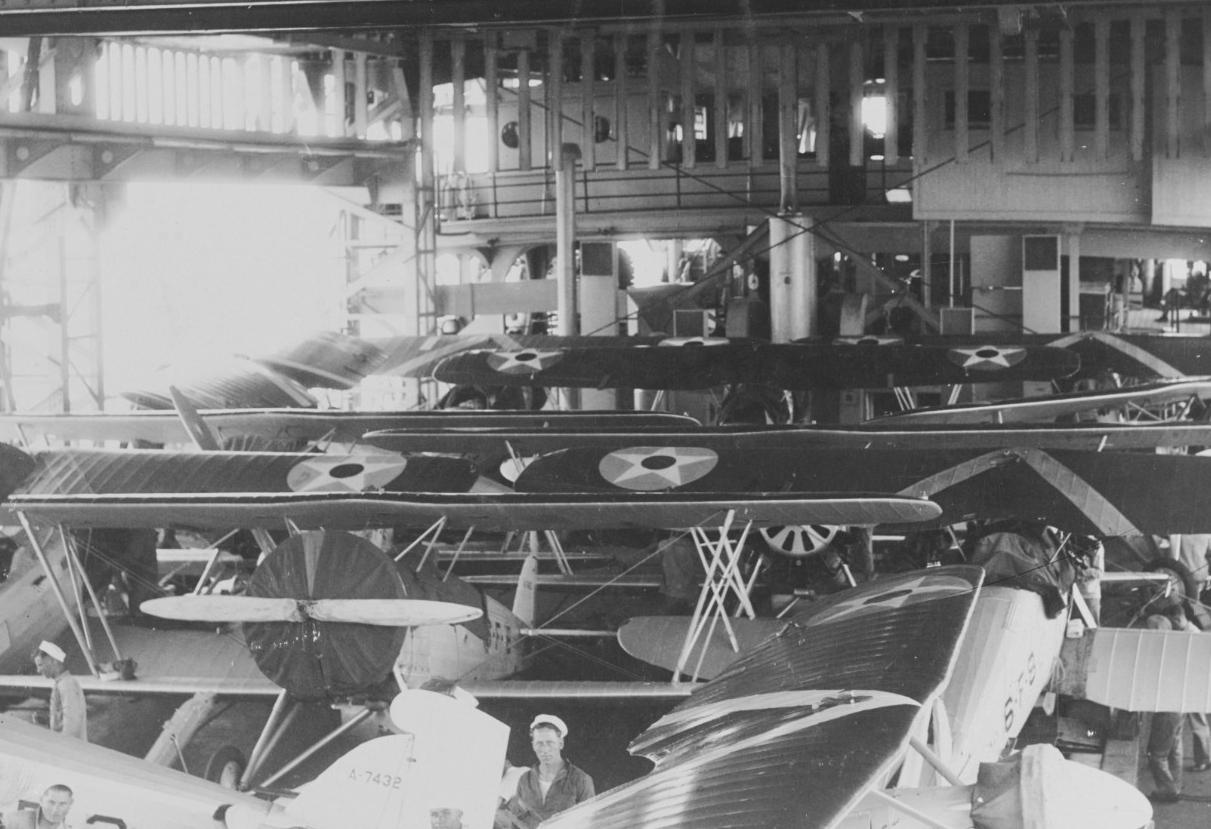
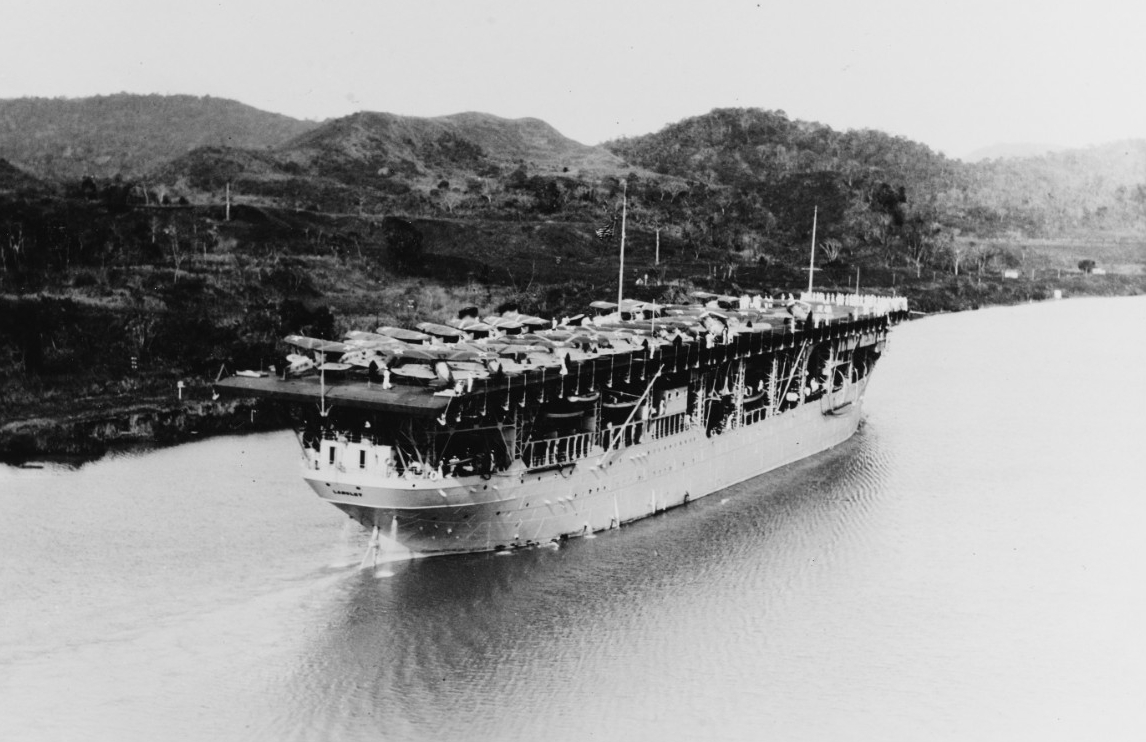
Langley underwent conversion to serve as a test platform for the aircraft carrier ship type. As the U.S. Navy’s first, she was the scene of numerous milestone events. The 534-foot flight deck was constructed over the ship’s original bridge. Concrete was poured into her coal holds for ballast. Large spaces below permitted the stowage of planes and a crane hoisted the aircraft into place. A Mark I catapult was installed on the flight deck’s bow end. A $25,000 house for message-bearing homing pigeons was erected on the fantail. Even before her commissioning, experiments were being conducted both at Naval Air Station (NAS) Hampton Roads, VA, and on board the ship. Those on board included the placement of wires equipped with weights to “arrest” aircraft as they landed. These tests resulted in the development of arresting gear for Langley that consisted of athwartship wires attached to weights fore and aft. The flight deck had a capacity of sixteen planes although the ship’s authorized complement was 22.
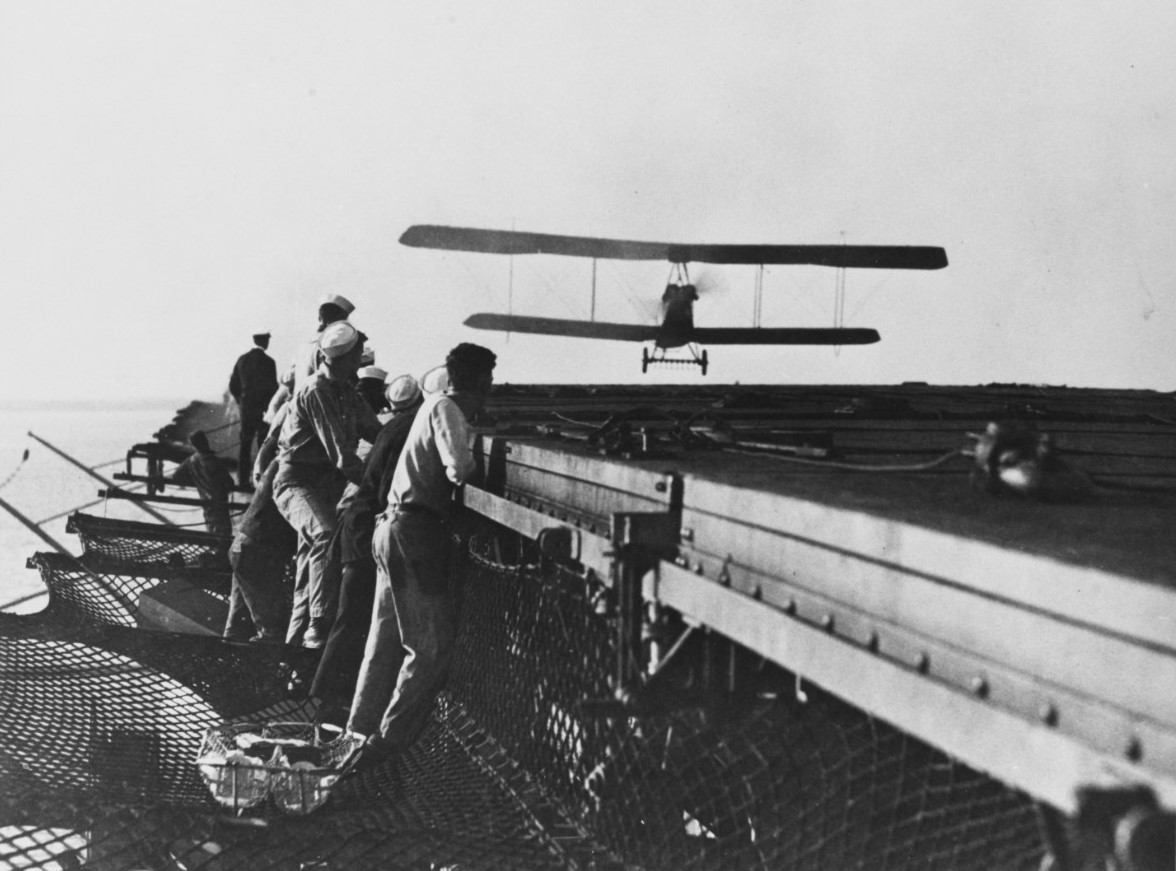
Langley departed the Norfolk Navy Yard and arrived at Tangier Sound, VA, in the Chesapeake Bay, on 18 September 1922 to shakedown and prepare for the conduct of aviation experiments. After ten days, she steamed up the York River and moored off Yorktown, VA, (28 September). Lt. Virgil C. “Squash” Griffin (Naval Aviator No. 41) piloted the first plane, a Vought VE-7-SF Bluebird (BuNo A-5932), launched from her decks, while at anchor at Berth No. 58 in the York River on 17 October. Though this was not the first time an airplane had taken off from a ship, and though Langley was not the first ship with an installed flight deck, this one launching was of monumental importance to U.S. naval aviation. Langley weighed anchor on 26 October and steamed down the York for Hampton Roads. While underway on 26 October, Lt. Cmdr. Godfrey De C. “Chevy” Chevalier (Naval Aviator No. 7) made the first landing on board, piloting an Aeromarine 39B while she steamed off Cape Henry, VA. The ship arrived later that day at Hampton Roads. Over the following ten days, landing tests continued on board the carrier, through varying wind conditions, with no casualties.
On 1 November 1922 Langley steamed back up the York River to Yorktown and remained there until 19 December. Unfortunately, during this time, Lt. Cmdr. Chevalier crashed in a VE-7 at Lochaven near Norfolk, VA, on 12 November, and succumbed to his injuries two days later while in the Naval Hospital, Portsmouth, VA. Less than a week after Chevalier’s crash, Cmdr. Whiting, at the controls of a Naval Aircraft Factory PT floatplane, became the first aviator to be catapulted from a carrier’s deck while at anchor in the York River on 18 November. Langley raised steam and got underway on 19 December for Lynnhaven Roads, VA. Arriving that same day, she entered the Norfolk Navy Yard (20-28 December). Upon the completion of her yard work, she shifted to an anchorage at Hampton Roads, where she remained through year’s end.
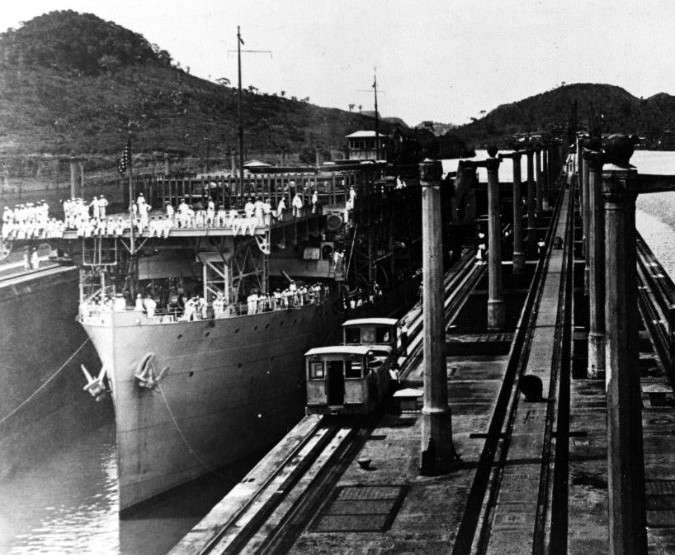
Langley cleared Hampton Roads on 6 January 1923 and steamed for Pensacola, FL, to conduct further flight operations and carrier landing tests. After a stop at Key West, FL (10-13 January), the carrier steamed into the Gulf of Mexico and reached Pensacola on 15 January. Through the following weeks, Langley and her crew conducted flight operations in the waters off Pensacola. Of note were the experiments conducted on 21 February. During these operations Langley’s flight crew tested the handling of Aeromarine 39Bs operating in groups of three. Through these exercises, it was determined that it took two minutes to prepare the deck following each landing. Unfortunately, while returning to port on 5 March, Langley grounded on the north side of the channel. With the assistance of the fleet tug Allegheny (AT-19), she was pulled free at 2213. Inspections afterward revealed that the hull and other parts of the ship were undamaged. Having completed her testing period, the carrier departed Pensacola a week later, on 12 March, and steamed on a southerly course for the Panama Canal. Anchoring at Cristóbal, Canal Zone (C.Z.) on the 17th, she transited the canal to Balboa and entered the Pacific the next day. Remaining until 30 March, she crossed the isthmus back to Cristóbal (30 March-2 April), and then steamed for a return to the U.S., first to Pensacola to conduct further flight operations (6 April-23 May) and then on to Hampton Roads making her return on 28 May.
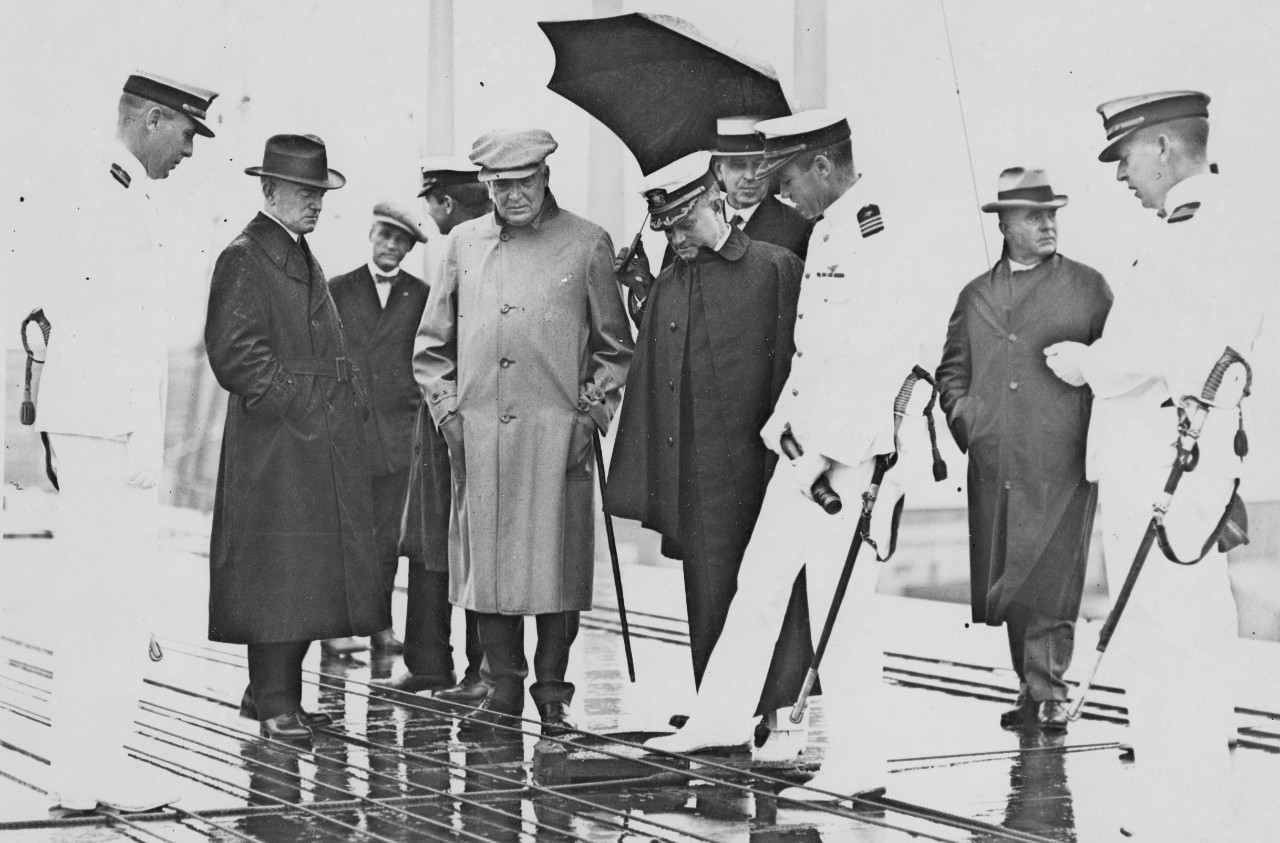
Four days later, on 1 June 1923, Langley steamed up the Chesapeake Bay and into the Potomac River via Cobb Point, MD (1-2 June) bound for Washington, DC. Arriving at the Washington Navy Yard later on the 2nd, she stayed until the 12th. During her time at the nation’s capital, she conducted a flying demonstration for civilian and military dignitaries and hosted President Warren G. Harding, the first presidential visit to a U.S. carrier.
Departing Washington on 12 June, she returned to Norfolk and entered the yard later that same day. Having undergone maintenance, she shifted to Hampton Roads on 18 July before conducting trials (19-20 July). She then got underway on 23 July. Clearing the Virginia capes, she steamed north, first for New York (24-30 July), then on to New England with stops at Newport, RI (31 July-3 August); Bar Harbor, ME (4-8 August); Portland, ME (8-13 August); and the Boston Navy Yard, Charlestown, MA. (13-19 August). Departing Boston, she continued her New England visits with stops at Portsmouth, NH (19-24 August); Gloucester, MA (24 August-1 September); and Marblehead, MA (4-8 September), before returning to Boston on the 8th. Standing out on 11 September, she steamed back into the Chesapeake and moored at Hampton Roads on the 13th. Langley entered the Norfolk Navy Yard on 19 September and remained there undergoing maintenance until 18 December. With her work completed, she cleared and moored at Hampton Roads where she remained through year’s end.
After New Year’s Day 1924, Langley was underway for the annual winter fleet exercises in the Caribbean. Departing Hampton Roads on 4 January, she steamed to the Canal Zone, reaching Colón on the 19th. Returning to sea on 25 January, she steamed to Culebra, PR (1 February), touched at Fort-de-France, Martinique, French West Indies (16 February), before returning to Culebra (17 February) en route to Pensacola. Arriving on 25 February, the carrier remained in the vicinity to conduct flight training and experimentation. On 2 May, pilot Lt. Wallace M. Dillion and gunnery officer Lt. Stanton H. Wooster launched from Langley by catapult in a Douglas DT torpedo bomber carrying a dummy torpedo while at anchor in the bay off Pensacola. With these experiments completed, she began steaming back to Virginia on 10 June. After pausing at Lynnhaven Roads, VA, on 15 June, Langley entered the Norfolk Navy Yard the following day. She cleared the yard on 16 October upon the completion of her maintenance work and moved to the anchorage at Hampton Roads. On the 18th she shifted to Cape Charles City, VA, in advance of making her way up the Chesapeake to anchor north of the Patuxent River, MD, on the 22nd. Getting underway the next day, she steamed to Baltimore, MD (23-26 October) before returning to Hampton Roads on 27 October. Reassigned to the Battle Fleet, Langley departed two days later, en route to the Pacific. After a stop at Pensacola (3-11 November), the carrier continued to the Canal Zone and transited from Colón to Balboa on 16 November. Having remained at the latter until 19 November, she resumed her journey and stood into the North Island Air Station, San Diego, CA, on 29 November. Two days later, on 1 December, Langley became the flagship of Aircraft Squadrons, Battle Fleet. Having reached her new duty station, Langley remained in port into 1925.
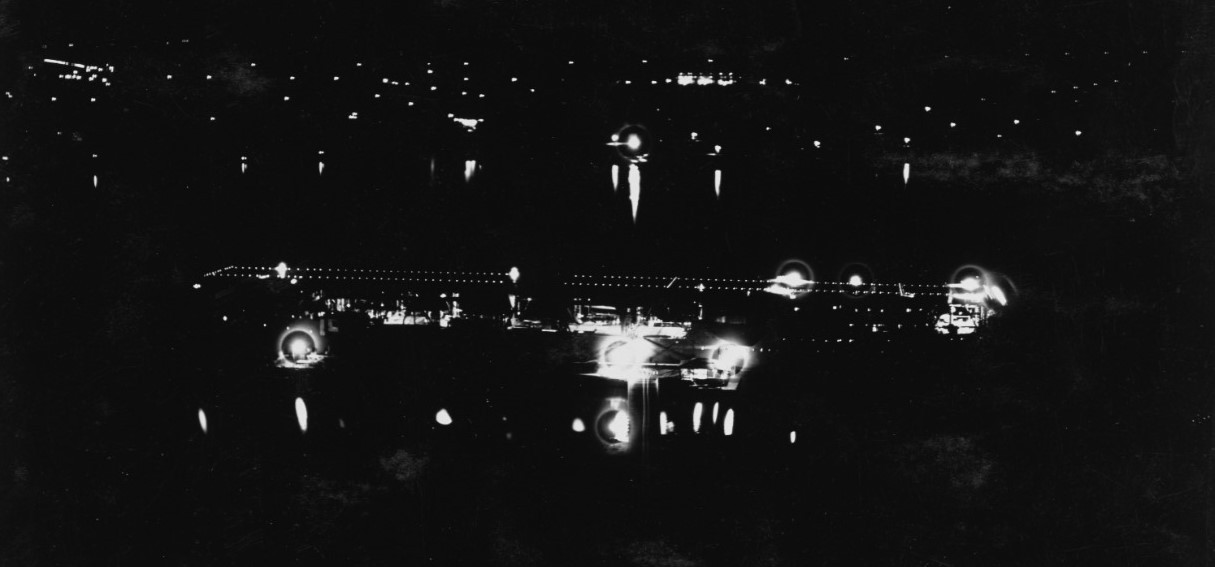
Langley and her crew’s idleness ended after New Year’s Day 1925. She was off San Diego on 22 January as VF-2 began landing practice on board. This marked the fleet’s introduction to the first command trained to operate as a squadron from a carrier, and the beginning of Langley’s operations as flagship of Aircraft Squadrons, Battle Fleet. Training continued during the succeeding weeks in preparation for Fleet Problem V, the first of the annual exercises to incorporate an aircraft carrier. Getting underway on 2 March, Langley cleared San Diego and operated in the waters off southern California as part of the Black fleet under the command of Adm. Samuel S. Robison, Commander, Battle Fleet (ComBatFlt). The ship’s relatively small size and the inexperience of her crew in aircraft handling restricted its operations to sending no more than ten planes aloft simultaneously to scout in advance of the Black fleet movement to Guadalupe Island. The fleet used the circular cruising formation developed by Cmdr. Chester W. Nimitz, Robison’s Assistant Chief of Staff. During the exercise, Langley launched ten planes in 13 minutes and also often had as many as ten aircraft aloft simultaneously conducting missions lasting more than two hours. As a result, Adm. Robert E. Coontz, Commander in Chief U.S. Fleet (CinCUS), decided to recommend the rapid completion of Lexington (CV-2) and Saratoga (CV-3). He advocated for the development of aircraft with greater durability, dependability, and radius, and the further improvement of catapult and recovery gear. Coontz also reported that experience now permitted routine catapulting of planes from battleships and cruisers. During the exercise, on 5 February, Lt. Harold J. Brow made an accidental night landing on 5 February when his aircraft stalled while practicing night approaches. The problem concluded on 12 March and Langley stood back into San Diego. The carrier went to sea again on 21 March and after visiting San Pedro, CA, (22-25 March) made her return to San Diego later on the 25th. With the carrier berthed at NAS San Diego on 2 April, Lt. Cmdr. Charles P. Mason, pilot, and Lt. Braxton Rhodes, passenger, demonstrated the feasibility of using flush-deck catapults to launch landplanes when they catapulted in a Douglas DT-2 torpedo bomber from Langley. With the ship underway again on 9 April, Lt. John D. Price of VF-1 made the first planned night landing on board a U.S. aircraft carrier when he landed on Langley (CV-1) at sea off the California coast. Lt. Delbert L. Conley, Lt. Adolphus W. Gorton, and Lt. Rossmore D. Lyon followed shortly thereafter. The ship continued on to San Francisco, CA, where she steamed into the bay on 11 April. After a four-day visit, the carrier sortied as part of the Battle Fleet. Clearing the Golden Gate, the fleet steamed westward for the Territory of Hawaii (T.H.), to conduct Grand Joint Army-Navy Exercise No. 3 (14-27 April). This movement included over 75 ships and was tracked by the Japanese tanker Hyatoma Maru. In this exercise Langley was part of the Blue fleet dispatched to re-take the Hawaiian Islands notionally captured by the Black fleet. Blue marines successfully landed on Molokai and then, after reembarking, conducted a second landing on Oahu. While Blue had accomplished its mission, poor weather limited Langley’s flight operations in support of the fleet. At the exercise’s conclusion on 27 April 1925, Langley stood into Honolulu, Oahu, T.H. Underway again on 8 May, she went to sea for training with periodic stops at the anchorage at Lahaina Roads, Maui, T.H. (9-18 May; 20-21 May; and 22-28 May) before entering the Pearl Harbor Navy Yard, Oahu, T.H., on 30 May. Clearing on 8 June. Langley shifted to Honolulu (8-11 June) before returning to Pearl Harbor on the 11th. Over succeeding months, the carrier operated in the training grounds around the Hawaiian Territory. During this time, the Bureau of Aeronautics (BuAer), on 16 June, reported that the emergency barricade on board Langley had successfully prevented landing aircraft from crashing into planes parked on the flight deck during landing operations. On 1 July, the Battle Fleet, with 11 battleships, 4 light cruisers, 32 destroyers and 13 auxiliaries departed for a fleet visit to Australia and New Zealand. Having completed its tour “Down Under,” the last of the fleet elements made their return to San Diego on 1 October.
Meanwhile, Langley remained at Pearl Harbor until 4 August 1925 when she cleared and steamed to Hilo, Hawaii, T.H., arriving on the 5th. Over the succeeding weeks, the carrier conducted training in Hawaiian waters before finally clearing Pearl Harbor on 12 September to make her return to San Diego on 21 September. After a time in port, she departed on 10 October. Transiting via San Pedro (11 October) and steamed into San Francisco Bay to enter the yard at Mare Island on the 12th. She remained there undergoing maintenance until 23 November. Undocking, she shifted to San Francisco in advance of her return to San Diego via San Pedro (26 November). She returned to her base at North Island later on the 26th. Underway again on 9 December she visited the Standardization Range at San Vincente, CA, before visiting San Pedro the next day. Having gone to sea, Langley paused at Coronado Roads, CA, in advance of returning to San Diego on the 18th. The ship and her crew would spend the Christmas and New Year’s holidays in port.
With the New Year, the carrier was again underway, clearing San Diego on 8 January 1926. After a short visit at San Pedro (8-9 January) and a week’s training off southern California, she returned to San Diego on 16 January. She continued to operate in the waters off San Diego, with regular returns to North Island through the end of January. On 1 February, she got underway and steamed south, bound for Fleet Problem VI off the coast of Central America. Given the fuel consumed by the Battle Fleet’s visit to the Antipodes, the exercise’s timeline was less than three days (11-13 February). It would be the shortest of the 21 interwar fleet problems and one of the few that did not include strategic components. Langley was a constituent of the Blue fleet under Adm. Charles F. Hughes, ComBatFlt. Despite a sea state that precluded the fleet’s battleships and cruisers from launching and recovering their aircraft, the carrier’s aircraft enabled the fleet to evade the aggressor force and avoid a direct engagement. Langley was also incorporated into the fleet’s circular defensive formation. Due to the destroyers’ need for fuel, the exercise was ended on the 13th after only 64 hours.
With the fleet problem concluded, the carrier arrived at Balboa on 19 February 1926. Underway again on 23 February, she spent the following weeks operating off Panama before clearing Balboa on 13 March for Puerto Culebra, Costa Rica (15-20 March) en route to a return to San Diego on 1 April. After three weeks in port, she shifted to Coronado Roads on 22 April in advance of engaging in a series of short training missions in the vicinity of San Diego, with intermittent returns to port (22 April-2 August). Clearing on 6 August, Langley shaped a course to visit the Pacific Northwest. While en route on 9 August, Langley conducted a day of tests to determine the speed of handling aircraft at sea. Planes of VF-1 completed 127 landings on board the carrier. The squadron later landed 12 planes in 21 minutes under emergency conditions when the ship encountered a heavy mist. Making her first stop at Seattle, WA (11-14 August), the carrier then visited Port Angeles, WA (14-16 August), before steaming south to San Francisco (20-30 August). After touching at San Pedro on 1 September, she steamed back into San Diego the next day. Afterward Langley resumed intermittent training off California through 12 November. Departing on 20 November, the carrier steamed to Mare Island and entered the yard on the 22nd. Clearing on 31 December, she was still steaming south on New Year’s Day 1927 and made her return to her base at San Diego on 2 January.
Just over two weeks after her return, Langley stood out from San Diego on 15 January 1927 and steamed to Seattle. Arriving on 19 January, she hoisted 27 Boeing FB-5 fighters onboard and departed on the 22nd, returning to San Diego on 26 January. The carrier then headed to sea on 17 February to participate in Fleet Problem VII as part of Adm. Henry R. Jackson’s “Orange” fleet. The area of operations would be in the waters off both sides of the Panamanian isthmus. The carrier reached the area around Balboa on 3 March during the Preliminary Joint Army-Navy Exercise (1-5 March). That same day, Capt. Joseph M. Reeves, on board Langley, ordered notional strikes by floatplanes and carrier-launched bombers escorted by fighters against a Blue airfield as well as the Miraflores Lock which rendered the lock inoperable. As a result of a corresponding Blue aerial counterstrike, Langley suffered some damage. After the exercise’s completion, Langley began her transit of the Panama Canal on 7 March and arrived at Colón the next day. Now part of the Blue force, she went to sea on the 9th with the initiation of Fleet Problem VII (9-14 March). Steaming into the Caribbean, the carrier launched aircraft for fleet defense and antisubmarine warfare (ASW) operations en route and arrived at Guantánamo Bay, Cuba on 13 March. The exercise concluded the next day.
With that Langley and the fleet departed on 15 March 1927. Crossing the Windward Passage, they mustered for a fleet review at Gonaïves, Haiti. From 28 March to 22 April, Langley and the fleet operated in the waters around Cuba and Hispaniola, shuttling between the anchorages at Guantánamo and Gonaïves. Finally, on 22 April, the fleet steamed to New York, reaching on the 29th. That same day, Langley entered the New York Navy Yard, Brooklyn, NY, to undergo overhaul. Clearing the yard on 15 May, she shifted to Gravesend Bay, NY, and anchored there. The following day, she steamed to Newport, RI (20-28 May) in advance of returning to Hampton Roads, on 29 May, for the first time since her transfer to the Pacific. Underway again on 4 June, the carrier steamed past Cape Charles, VA, out into the Atlantic. Rounding Florida, she continued into the Gulf of Mexico and stopped briefly at Pensacola (9 June). Soon underway for her return to San Diego, she transited the Panama Canal into the Pacific on 14 June. Departing Balboa on the 17th, she steamed back into San Diego and docked at North Island on 27 June. After remaining in port until 19 August, Langley spent the remainder of 1927 engaged in short-term training cruises to points along the southern California coast with returns to her base at San Diego. Her last return was from San Pedro to San Diego on 16 December. She spent the Christmas holiday in port and did not get underway again until the following month.
Departing San Diego on 21 January 1928, Langley steamed north and entered the yard at Mare Island for regular maintenance on the 23rd. With her overhaul complete on 17 March, the carrier undocked and returned to San Diego two days later. The carrier departed San Diego on 9 April. Initially bound for San Francisco (12-18 April), she then steamed to Hawaiian waters as part of the Blue fleet opposing Orange for Fleet Problem VIII. She conducted air operations en route. Under the command of Adm. Louis R. de Steiguer, ComBatFlt, Langley carried 42 aircraft (30 fighters and 10 observation) and was also accompanied by the tenders Aroostook (CM-3) and Gannet (AM-41). The Blue mission was to reach Pearl Harbor by the 30th. Through careful and deft planning, Blue was able to reach Pearl Harbor via an unexpected approach from the southwest and avoided detection by Orange. Interestingly, despite the incorporation of slower S-class submarines and support auxiliaries, the fleet reached its objective two days early and Langley anchored off the entrance to Pearl Harbor with the exercise declared ended on 28 April. The carrier entered Pearl Harbor the next day and remained there until shifting to Honolulu on 13 May. Langley, with a lengthened flight deck, altered arresting gear, and her crew’s improved expertise in aircraft handling, had a record 16 of her aircraft aloft at one time and reconnoitered Oahu from 70 miles away in advance of the fleet’s approach. In assessing the fleet problem, Adm. Henry A. Wiley, CinCUS, roundly criticized the Orange leadership and that fleet’s effort, but believed that the performance of Langley’s aircraft demonstrated future promise. He tempered that enthusiasm, however with his comments that “little could be expected from a problem in which air operations were so limited and where the air forces available were so small.”
In the wake of the fleet problem, Maj. Gen. Fox Conner, Commander, Hawaiian Department proposed a minor joint Army-Navy exercise to test the Hawaiian Territory’s defenses. Langley made turns and got underway clearing Honolulu on 14 May 1928 and reached the anchorage at Lahaina Roads the next day. The exercise began on 16 May. Two battleship task forces and another, smaller task force led by Rear Adm. Reeves in Langley steamed south from Lahaina. After dark, the three task forces turned north toward Oahu. Around 0300 on 17 May, Langley’s force was south of Diamond Head flanked by the four-battleship force to her southeast and the five-battleship force to her left, south of the entrance to Pearl Harbor. Langley launched 35 of her aircraft beginning at 0430 and, at dawn, obtained complete surprise on the unsuspecting forces defending Wheeler Field and the island’s other installations. At 0730, the battleships withdrew, covered by the carrier’s aircraft which were able to parry the Army Air Corps attempt to damage the fleet. The attack impressed Gen. Conner, on board California (BB-44), and caused him to acknowledge the importance of aviation for Hawaii’s defense. Having withdrawn from Oahu, Langley returned to Lahaina (17-18 May) before steaming back into Honolulu on the 19th. Subsequent to the exercise’s completion the newly commissioned aircraft carriers Lexington (CV-2) and Saratoga (CV-3) received orders to speed to Hawaiian waters. With their arrival, Reeves transferred and broke his pennant onboard Lexington. Langley remained in Hawaiian waters conducting flight operations and experimentation with the newly arrived carriers into June. Departing Honolulu on 16 June, she returned to San Diego a week later on the 23rd. The carrier remained there through July and August 1928. During this time in port, BuAer authorized the removal of the ship’s bow and stern catapults because she had not operated either for three years. Finally getting underway again on 7 September, the carrier spent the next two months conducting short training cruises in southern California waters based from San Diego. On 17 November she departed San Diego and steamed to Mare Island. Docking on 19 November, the ship underwent a much needed overhaul through year’s end.
Having missed Fleet Problem IX, which was conducted while she was in the yard, Langley undocked on 20 February 1929 and steamed for her base at San Diego, arriving on the 22nd. The carrier was underway again within the week, departing on 27 February with orders to return to the Atlantic. After touching at Corinto, Nicaragua, on 8 March, she reached Balboa on the 11th. Transiting to Colón on 12 March, she resumed her voyage on 14 March and steamed through the Delaware Bay and into the Philadelphia (PA) Navy Yard on the 20th. After some post-voyage maintenance, Langley cleared the yard on 6 April and steamed south for Hampton Roads, where she arrived the next day. Going to sea on 8 April, Langley’s aircraft conducted launch and recovery operations in the Southern Drill Grounds off the Virginia capes on the 9th. These tests confirmed the feasibility of abandoning fore-and-aft wire arresting gear. Additional testing onboard Saratoga later in the month, culminated a year of experimental development on the landing platform at NAS Hampton Roads, VA, and led Secretary of the Navy Charles F. Adams to authorize the wires’ removal. Langley’s tests with a Martin T4M-1 torpedo plane equipped with brakes and wheel-type tail skids proved their viability and led BuAer to provide all carrier planes with the equipment (after 8 May 1929). Langley, having returned to Hampton Roads later on 9 April, cleared on the 13th and steamed for Pensacola (18-20 April). After a stop at Guantánamo (24 April), she steamed to Colón (27 April) and transited the canal to Balboa (28 April). Underway again on the 29th, the carrier touched at Corinto (2 May). She stood back into San Diego and docked at North Island a week later. She remained there until 3 November, when she steamed to San Pedro (3-4 November). She briefly returned to San Diego before steaming to the Pacific Northwest. Entering the Puget Sound Navy Yard, Bremerton, WA, on 13 November, the carrier underwent overhaul and modifications into the next year. It was during this yard work that Langley became the first carrier to have her fore-and-aft wires and other associated equipment removed.
Langley undocked on 18 January 1930 and briefly conducted trials before returning to Bremerton that same day. With her work done, she departed Bremerton on 24 January and arrived back at San Diego on the 29th. After some preparation, the carrier departed San Diego, as part of the Blue fleet, on 15 February, for Fleet Problem X. Under the command of Rear Adm. Lucius A. Bostwick, Commander Battleships, BatFlt, the force transited the Panama Canal (3 March) and anchored at Colón. The fleet problem commenced on 10 March with Blue entering the Caribbean screened by submarines. Bad weather during the first two days, prevented Blue launching reconnaissance aircraft to scout ahead of the fleet’s movement. Langley and Saratoga launched patrols on both the 12th and 13th but failed to discover Black forces. On the 14th, both carriers again launched their aircraft. Initially, Saratoga’s provided fleet protection while Langley’s conducted reconnaissance. Due to adverse conditions, this scout failed to find Black and with their fuel running out most of the Blue aircraft were back onboard their respective carriers. Langley, however, was able to launch 12 of her aircraft for fleet protection. They did detect three Black aircraft but they were unable to engage the aggressors which had found the Blue force and dived on Saratoga. The umpires ruled that her flight deck was holed and while Saratoga’s flight crew tried to launch aircraft for her defense, five successive waves of planes—42 total—launched from the Black Lexington, “pummeled” Saratoga and Langley. By 0835 both were ruled hors de combat. In only 20 minutes, they were out of the action. Lexington’s planes then turned to the Blue battleships and other supporting ships, severely damaging them as the Black battle line closed to engage in a surface action. Though the fleet problem did not officially end until the next day, Rear Adm. Bostwick was forced to declare the exercise effectively ended at 1125. Black had decisively won what the press called “The Battle of Navassa Island.”
Langley and the other ships of the fleet relocated to an anchorage in Cuatro Reales Channel, Guacanayabo, Cuba, on 20 March 1930 and she remained there until 30 March conducting required maintenance on her boilers. Afterward, with a brief visit to Guantánamo on the 30th, she then steamed to Port-of-Spain, Trinidad, via Guacanayabo (1 April), arriving on 5 April. Langley subsequently engaged in tactical exercises to include notional engagements fighting both Lexington and Saratoga. She went to sea again on 14 April to participate in Fleet Problem XI (14-18 April). The problem focused on scouting along with the dynamic interactions of dispersed and concentrated forces. Langley began the exercise as part of the Black force. On both the 15th and 16th, she launched reconnaissance patrols but failed to make contact with the Blue aggressors. On 18 April, Langley’s aircraft in conjunction with Saratoga’s to attack Blue forces. Following a surface action between the fleets, the exercise’s result was ruled a Black victory. The experiences of Fleet Problem X and Fleet Problem XI prompted BuAer to advocate for the creation of several “semi-permanent task groups [each] consisting of carrier, cruisers and destroyers.” The bureau also wanted to equip of all aircraft with radios; to develop “proper” scouting planes; to increase the size of scouting squadrons to 18 aircraft; and to increase the value of extreme long-range patrol planes.
With the fleet problem completed, Langley moved to Guantánamo (18-21 April 1930) to refuel and take on provisions. Departing, she steamed to Pensacola to exchange aircraft with the naval air station (25-28 April) before returning to Hampton Roads (2 May) in advance of entering the Norfolk Navy Yard on 3 May to complete needed fixes of the ship’s elevator and fuel stowage systems. Clearing the yard on 24 May, she conducted trials on the Southern Drill Grounds (25-26 May) then returned to Hampton Roads. She departed later on the 26th. Passing through the Virginia capes, she rendezvoused with the Battle Fleet en route to its return to the Pacific. Reaching Colón on 1 June, she transited the canal the next day to Balboa. After a lengthy liberty, Langley raised steam and made turns on 11 June for her return to San Diego on 21 June.
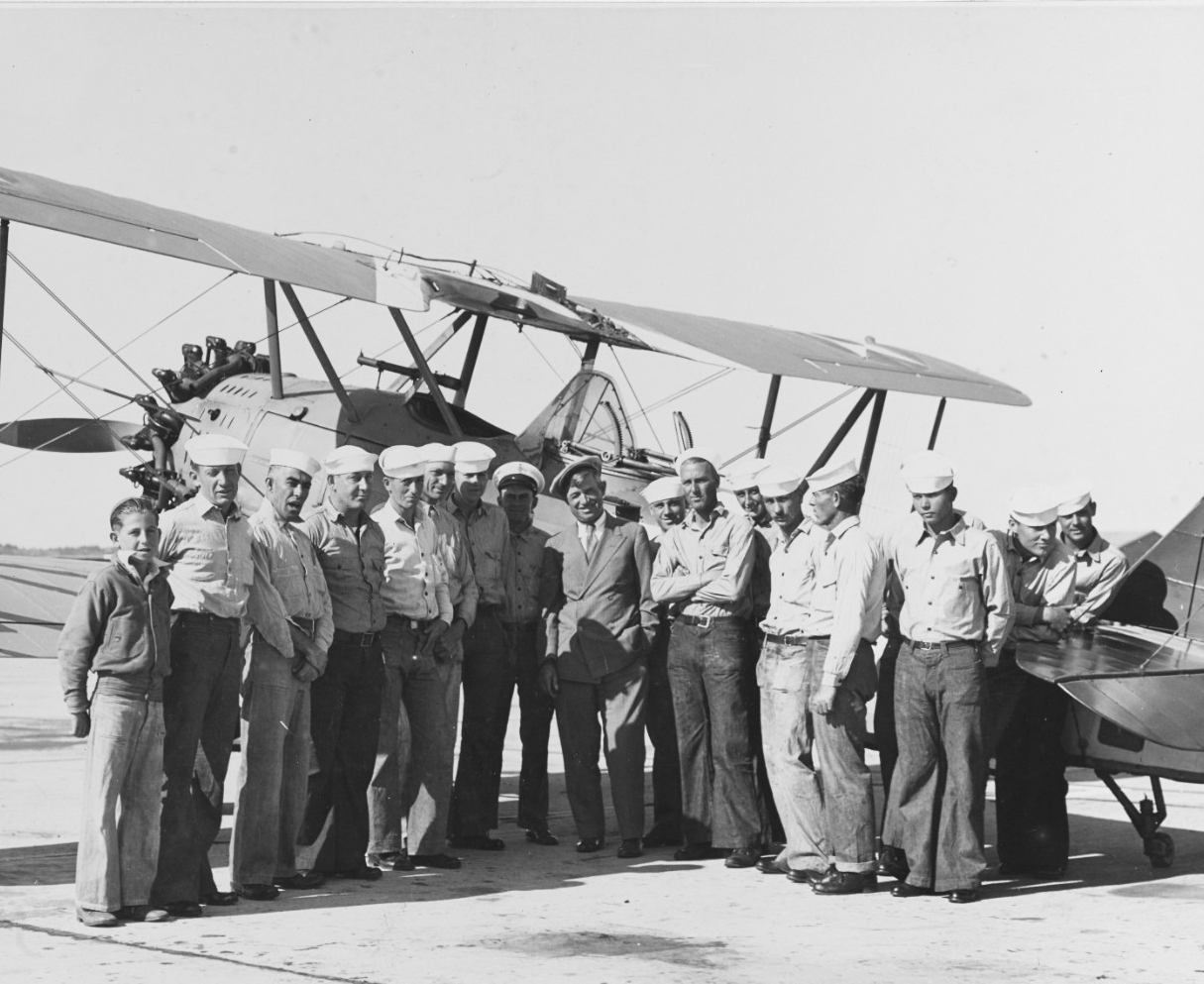
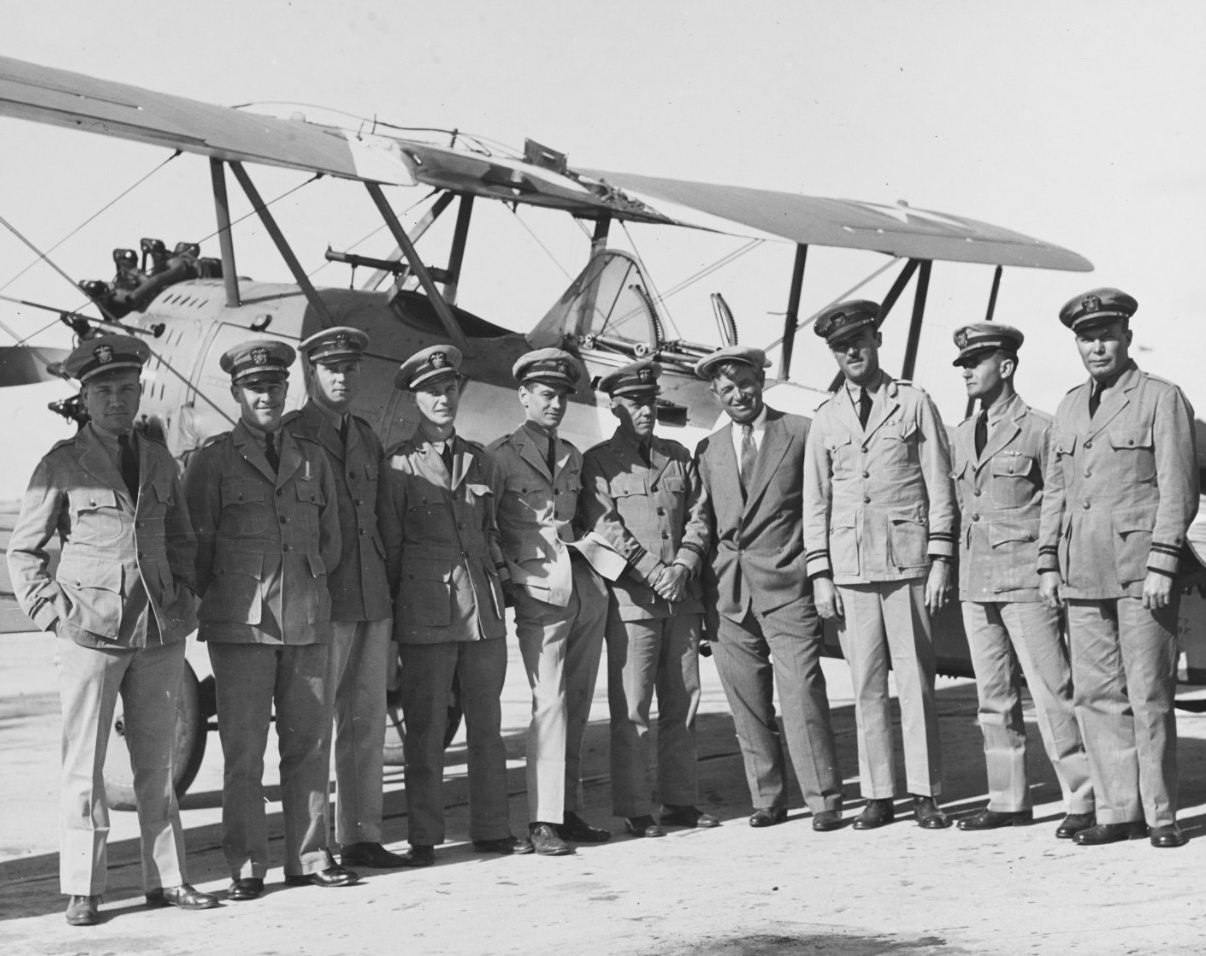
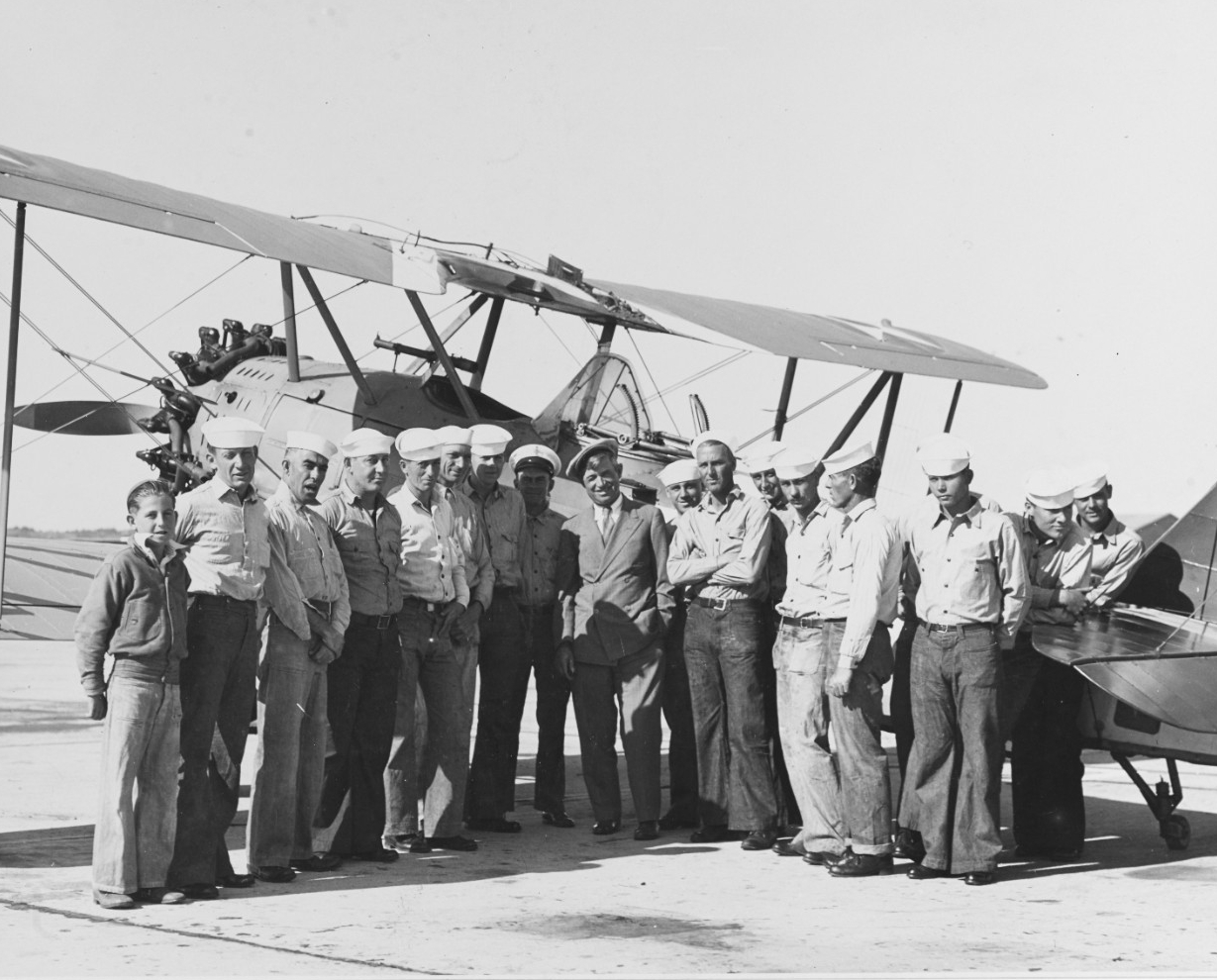
After some weeks in port, Langley was underway again on 12 August 1930. Steaming northward, she reached San Francisco on 16 August in advance of entering Mare Island for maintenance on 26 August. She remained in the yard until undocking on 8 September and shifting to San Francisco. Departing on the 10th, she returned to San Diego two days later. The ship largely remained in port though did periodically conduct training and preparatory workups in southern California waters through the rest of the year. During this time, David S. Ingalls, Assistant Secretary of the Navy, piloting a Curtiss F8C Helldiver visited NAS North Island on 7 November. After conducting tours and inspections, he departed for other West Coast locations only to return to North Island on 14 November. Accompanying the assistant secretary was famed humorist Will Rogers. Ingalls wanted to become a “carrier qualified” aviator and Langley got underway off Coronado to accommodate him. He conducted a series of launchings and landings on board Langley. Rogers accompanied him on some of these hops. The carrier later went to sea on 5 December. In conjunction with 10 destroyers, she commenced an air search for the fishing smack, Fidelity, missing since 22 November. Her scouting planes searched an area more than 400 miles from her base. After three days of continuous operations, the search was terminated with no trace of Fidelity. Despite not having found the vessel, Adm. William V. Pratt, CNO, radioed Adm. Frank H. Schofield, ComBatFlt, noting that the effort was “well done.” The carrier returned to port on the 10th and remained at her North Island berth well into the next year.
Having remained in port through New Year’s Day 1931, Langley was finally underway again on 5 February. Not only was she bound for Fleet Problem XII, but also for a new assignment ̶ with the Scouting Fleet in the Atlantic. The exercise began with Langley, in conjunction with Lexington, and Saratoga and the tenders Wright (AV-1), Patoka (AO-9), and Swan (AM-34), transiting through the eastern Pacific’s heavy seas toward Panama. The problem emphasized and evaluated strategic scouting, the employment of carriers and light cruisers, the defense of a coastline, and the attack and defense of a convoy. It pitted one fleet strong in aircraft and weak in battleships, Blue, against another with weaker aviation assets and stronger in surface assets, Black. The rigid airship Los Angeles (ZR-3) took part as a scout, but her “extreme vulnerability,” demonstrated by her downing by Langley’s Black aircraft, generated controversy. Aircraft checked but did not stop the battleship fleet advance, and despite inferior air support, the battleship fleet defeated the carrier fleet. The carriers’ limitations were demonstrated by their aircraft expending half of their fuel and ammunition in just two days. In addition, many heavy cruisers lacked sufficient stability for catapult and recovery operations. The problem concluded on 21 February and Langley anchored in Panama Bay. Shifting to Balboa on 22 March, she transited the Panama Canal that same day and moored off Colón (22-26 March). The ship then shaped a course for Guantánamo (30 March). During the following weeks Langley participated in additional exercises before visiting Puerto Cabezas, Nicaragua (22 April-1 May), in the wake of the 31 March earthquake. After this humanitarian response mission, the ship returned to Guantánamo to take aircraft on board in advance of steaming to Pensacola to transfer them (8-11 May). After completing that mission, Langley steamed for Hampton Roads. Passing through the Virginia capes, stopping at Hampton Roads on 15 May, she shifted into and docked at the Norfolk Navy Yard on the 22nd. She remained their undergoing maintenance until undocking on 10 June and shifting elsewhere in the yard to undergo additional work and a second docking through 8 September. Part of this time in the yard included modifications to the ship’s arresting gear. Over the next few weeks, Langley conducted workups in the drill grounds off the Virginia capes.
During this time, on 22 September 1931, the Navy Department authorized initial landing tests of a naval autogiro plane (helicopter). The next day, 23 September, Lt. Alfred M. Pride, pilot, and Capt. Kenneth Whiting, passenger, completed three landings and takeoffs in an XOP-1 on board Langley while she was underway. This marked the first such on board autogiro operations at sea. On 5 October, she departed Hampton Roads for bombing experiments at Tangier Sound, VA, targeting the decommissioned heavy cruiser Pittsburgh (CA-4). The tests, conducted on 6 October, proved successful and she made her return to Hampton Roads on the 9th. The carrier was underway on 13 October to conduct flight operations before steaming up the York River to Yorktown, VA, to commemorate the 150th anniversary of the British surrender. As part of this celebration, the carrier hosted a contingent of French sailors for a boxing smoker on the 16th. She departed on the 19th and returned to Hampton Roads before entering the Norfolk Navy Yard that same day.
Langley cleared the yard on 17 November 1931 and then went to sea on 28 November bound for cold weather flight operations tests off New England. Langley arrived at Provincetown, MA, (30 November-1 December), then moved on to Bar Harbor, ME (2-4 December) and Frenchman’s Bay, ME (5-9 December). Departing from Bar Harbor on the 9th, Langley completed nine days of operations off New England during which sailors tested the cold-weather operating capabilities of carrier deck gear and aircraft as well as the effectiveness of protective flight clothing. Afterward, the carrier steamed south to the Southern Drill Grounds off the Virginia coast conducting additional training before steaming back into Hampton Roads on the 13th. Shifting to Naval Operating Base (NOB) Hampton Roads on 19 December, she remained there through the Christmas and New Year’s holidays.
Langley resumed operations on 4 January 1932, departing NOB Hampton Roads and steaming to Port Everglades, Fla., (7-11 January) and Guantánamo (14-19 January). After one day at sea, 20 January, the carrier returned to Guantánamo (20-30 January) before departing for the Canal Zone, accompanied by Wright. The ships reached Cristóbal on 1 February and after a two-day liberty, both transited the Panama Canal to Balboa on the 3rd. Departing the next day, Langley paused at Corinto to refuel aircraft there (7-9 February) before making her return to San Diego on 17 February. After several weeks of preparations, the carrier was underway again on 12 March to participate in Fleet Problem XIII as part of the Black fleet under Vice Adm. Arthur L. Willard, Commander, Scouting Fleet (ComScoFlt). Planners envisioned this exercise off the West Coast as the first step in an overseas campaign in which an advanced force moved from a concentration point to a first objective. Langley, Lexington, and Saratoga all participated including scouting and tracking, convoy attack and defense, and attrition attacks by aircraft, light vessels, and submarines. Willard’s Black force included Langley and Lexington under the command of Capt. Ernest J. King, the future Chief of Naval Operations (CNO) and Commander in Chief, U.S. Fleet (ComInCh). Their combined air component included 98 aircraft supplemented by the airship Los Angeles, as well as 36 patrol bombers supported by tenders and 36 cruiser-launched patrol aircraft. The Black fleet was largely concentrated between the Channel Islands and San Diego. While there was some notional engagements of surface elements during the exercise, Langley did not play a substantive role due to weather and the respective maneuvers of the competing fleets. The problem concluded on 18 March and Langley set a course for San Pedro and arrived the next day.
Over the following weeks Langley conducted tactical exercises with the fleet before making her return to San Diego on 24 April 1932 to complete boiler repairs. On 2 May, BuAer directed the installation of hydraulic cylinder-type arresting gear on board Langley to replace the weight-type gear. This decision resulted from operational experience with two sets of hydraulic gear installed on board Langley in June and September 1931. The carrier departed San Diego on 4 June and steamed northward. Entering Mare Island on 6 June, Langley underwent the mandated modifications and other work until undocking on 22 September. After briefly shifting to San Francisco (22-23 September, she cleared the Golden Gate and steamed for her home port, arriving at San Diego on 25 September. She would get underway to conduct exercises with Lexington and Saratoga in October. While underway at night on 5 November, a Boeing F3B crashed onto the deck, broke up, and skidded overboard. While the pilot was rescued by the plane guard it was determined that Langley should no longer serve as a nighttime training platform given her slow speed. Vice Adm. Harry E. Yarnell, Commander Aircraft, Battle Force, concurred. The following week, Langley conducted gunnery practices off the California coast followed by air operations in mid-December. When completed, she returned to her berth at North Island, remaining in port through the holiday season.
The carrier was underway again operating with the Battle Force during the first week of January 1933. She then anchored at Coronado Roads on the 9th and operated with the converted battleship Utah (AG-16), now a radio-controlled target ship, for a few days. On 9 February, she cleared Sab Diego and steamed to northern California to participate in Fleet Problem XIV. The carrier and her fellow constituents of the Blue fleet under the command of Adm. Luke McNamee, ComBatFor, were dispersed north to south along the Pacific coast to defend against the Black fleet sortieing from the Hawaiian Islands. Langley and her cohort took up station in the vicinity of the Farallon Islands in order to defend San Francisco. The exercise concluded and Blue was credited with the victory by Rear Adm. Reeves for having conducted successful attacks on Army installations ashore. During the action, while Langley’s strike force was able to inflict damage on Saratoga, the latter’s strike force, aloft before Langley’s planes arrived, found the smaller carrier and rendered her a “drifting hulk” in the meantime. With the exercise’s end, the ship entered San Francisco for liberty on 17 February. Clearing with the fleet on the 27th, Langley steamed independently and returned to her berth at North Island on 1 March. She returned to sea on 6 March to conduct tactical exercises off southern California. While at San Pedro on 10 March, the city was hit by an earthquake. The ship’s crew rendered humanitarian aid and provided security to prevent looting for a week. She resumed operating with the Battle Force for Advanced Torpedo Practices (20-24 March) before returning to San Diego on 24 March. Underway again on 28 March, she anchored that evening in Coronado Roads before returning to San Diego the next day. Langley conducted gunnery training in the vicinity of San Diego through much of April in advance of the monthly tactical exercises conducted 2-5 May. She then cleared San Diego on 6 May, steamed to Mare Island and entered the yard (8-11 May) for a short maintenance period before returning to San Diego on 13 May. She remained in port until 12 June when she went to sea to conduct two days of training with Saratoga. After almost two weeks in port, she again went to sea on 27 June and returned that same day. The carrier would spend most of July engaged in gunnery practices off Point Loma, CA. On 26 July, the ship was underway for flight operations. The following month, on 8 August, Commander Aircraft, Battle Force, requested authority to use variable-pitch propellers on six Boeing F4B-4 fighters of VF-3, based on board Langley, and on one F4B-4 of VF-1, operating from Saratoga, during future exercises. This stemmed from VF-3’s successful trials conducted earlier on board Langley and marked the Navy’s initial acceptance of variable-pitch propellers. She departed San Diego on 9 August and steamed into San Francisco where her crew participated in a series of public events ashore. Departing on 23 August, she stood back into San Diego two days later. The carrier then spent much of September immobile while her aircraft conducted training based from NAS North Island. She got underway again on 25 September and returned to her berth on the 29th. Through October and November, Langley engaged in short-term training exercises of the southern California coast and routinely returned to San Diego upon their respective completions. The exception was a visit to San Francisco to participate in the Armistice Day commemorations (10-12 November). During the ship’s return she launched four aircraft on the 13th, as a result of the ship’s change of course and the failure of having communications continually staffed, the aircraft ran out of fuel and were subsequently required to ditch. Fortunately, all of the flight crews were rescued. Returning to San Diego on the 16th, Langley spent the remainder of the year in port.
On 2 January 1934, Langley sortied, then relocated to the Coronado Roads anchorage the next day before returning to San Diego two days later. She went to sea again twice (10-12 January; 17 January) before departing San Diego on 22 January. Bound for Mare Island, she docked at the yard on 24 January and underwent overhaul into March. With her two-month maintenance period completed, she undocked on 24 March and steamed back into San Diego two days later. The carrier was underway again on 9 April in company with Lexington and Saratoga and much of the rest of the fleet, for Fleet Problem XV. With the Navy’s budget at its lowest level since 1916, the exercise almost did not take place. Nevertheless, Langley and her cohorts steamed for the Panama Canal. The initial part of the fleet problem would take place in the Pacific. Langley and Saratoga were paired in the Blue fleet’s “Carrier Group” while Lexington and her supporting ships operated as an independent “Striking Group” against the Brown fleet. Notional contact occurred on 19-20 April with Blue declared the winner. With the first stage of the problem, “Exercise L” (fleet concentration), completed, the fleet converged at Balboa on 21 April. Langley then transited the canal (24-25 April) and stood at Cristóbal (25 April-5 May) in advance of the second phase, “Exercise M” (movement to contact) between the Blue and Gray fleets. Langley departed Cristóbal on 5 May. Steaming into the Caribbean, the Blue fleet was bound for an intended engagement around Puerto Rico with Langley notionally serving as the new carrier Ranger (CV-4). The movement produced a significant “engagement” between the competing forces with Langley [Ranger] being placed out of action by a Lexington strike force. With her termination in “Exercise M,” Langley, detached from Blue on 8 May, steamed for Puerto Rico with the crew being granted liberty at Ponce, P. R., on 10 May. The next day, she rendezvoused with Gray for “Exercise N” (fleet tactics) on 11 May. During the exercise, Langley was bombed by strikes launched from both Lexington and Saratoga. With the end of the exercise on 12 May, the carrier moved to the fleet anchorage at Gonaïves, Haiti (14 May). Over the next 11 days, she shuttled between the anchorage and Guantánamo, finally departing Gonaïves on the 25th for Hampton Roads. Arriving on 29 May, she spent two days in Virginia before steaming out of the Chesapeake to New York and touching at Tompkinsville, Staten Island, NY, before entering the New York Navy Yard, Brooklyn, NY, on 1 June. After her yard work, she departed on 18 June and returned to Hampton Roads on 23 June. Standing out from the Virginia capes on 7 July, Langley visited the Philadelphia Navy Yard (9-10 July) before steaming into Narragansett Bay to call at Newport (10-11 July) before returning to NOB Norfolk on the 13th. The carrier stood there until she entered the Norfolk Navy Yard on 31 July. Having undergone overhaul to correct her engineering problems, the ship undocked on 1 October and shifted to a mooring at Lynnhaven Roads. In the days following, she undertook full-power trials before returning to NOB Norfolk on 5 October. With her propulsion issues finally resolved, she took on her aircraft and embarked their flight crews and departed for a return to the Pacific on 12 October. Steaming via Guantánamo (16-20 October); Cristóbal (24 October); and Balboa (25-29 October), she made her return to San Diego on 9 November. During the following month, the carrier steamed to San Francisco, touching at San Pedro (5 December), for a one-day visit on 8 December before returning to San Diego on the 10th. The ship remained at her North Island berth through the Christmas and New Year’s holidays.
Though she was underway in mid-January 1935 to conduct a training exercise with Saratoga and the rigid airship Macon (ZRS-5), Langley spent most of the first quarter in port. On 15 April, Ranger joined Langley at San Diego. Fleet Problem XVI commenced two weeks later on 29 April and its five phases covered a vast area from the Aleutians to Midway and the eastern Pacific. Ranger, in her first fleet problem, joined Langley, Lexington, and Saratoga in the main body of the White fleet. The slowness of launching patrols on 30 April enabled Black submarine Bonita (SS-165) to close within 500 yards and fire six torpedoes at Ranger as she recovered planes, and for Barracuda (SS-163) to fire four torpedoes from 1,900 yards. Planes pursued the submarines, and a dive bomber caught Bonita on the surface and made a pass before she submerged, but the ease with which the boats penetrated their ASW screen boded poorly for the carriers. Langley, accompanied by her plane guard, Partridge (AM-16), departed San Diego on 2 May, three days into the exercise. They then took up station trailing the auxiliary convoy and Langley’s scouts launched to search for Black submarines. As the White train approached the Hawaiian Islands, the Black submarines pressed the attack and Langley was likely “sunk.” With the completion of Phase II, the ship stood into Pearl Harbor’s anchorage.
Underway again with the re-constituted White fleet on the 16th, she departed as part of the train in company with California (BB-44), bound to recover Midway from the Black fleet. On the 21st, the carrier maneuvered to evade a strike from Midway. The following day Midway-based scouts located the White fleet. The subsequent engagement was ruled a Black victory. Langley and the train, however, were already en route to a return to Pearl Harbor. While underway, she launched aircraft in a futile search for a missing Black reconnaissance plane. The carrier returned to Pearl Harbor on the 26th. Later, as part of the Blue fleet, she again departed Pearl Harbor to participate in the final phase of the fleet problem. She steamed with Lexington, Saratoga, and Ranger as the rear of “Carrier Division I.” Conducting flight operations daily while en route, she made her return to San Diego concurrent with the exercise’s conclusion on 10 June. After a time in port, Langley went to sea in July and on 30 July, Lt. Frank Akers made the first blind landing on board a carrier in a Berliner-Joyce OJ-2 observation biplane with a hooded cockpit. Akers took off from NAS San Diego, CA, located Langley underway in an unknown position, and landed on board catching the number four arresting wire. Akers subsequently received the Distinguished Flying Cross. On 17 August, Langley singled up her lines and steamed to Mare Island, entering the yard on 19 August. She remained there undergoing maintenance until undocking on 8 October and making her return to San Diego two days later. Departing San Diego on 12 November, the carrier conducted flight operations off San Clemente, CA, in a heavy swell on 14 November. In the following weeks, she conducted gunnery practices in preparation for Short Range Battle Practice at Pyramid Cove, CA. (25-28 November). Later, in December, Langley conducted routine flight operations before returning to San Diego on the 17th to anchor in the harbor, her regular berth now being occupied by Ranger. She would remain there through Christmas and into 1936.
Langley resumed operations underway on 6 January 1936, returning on the 8th after just two days at sea. Twelve days later, on 20 January, she stood out from San Diego and steamed back to the yard at Mare Island, docking late on 21 January for maintenance and modifications. Perhaps the most significant addition to the ship was the incorporation of the Link Trainer flight simulator. With her work completed, she cleared Mare Island early on 6 March and sped back into San Diego later the following day. During the subsequent weeks, she was underway conducting tactical training exercise in preparation for the upcoming fleet problem.
Begun on 27 April 1936, Fleet Problem XVII ranged from the West Coast to Panama, and the western coast of Central America and consisted of a multi-phase exercise to meet a surprise offensive by an enemy fleet at a time when the U.S. Fleet had divided. All four carriers participated with two carriers attached to either side. Langley departed San Diego on the first day of the problem as part of the Blue fleet under Adm. William D. Leahy, ComBatFor. En route to the Canal Zone, she partnered with Saratoga. The fleet’s other assets comprised ten battleships, six light cruisers, 30 destroyers, and auxiliaries including six aircraft tenders, Wright, Gannet, Lapwing (AVP-1), Sandpiper (AVP-9), Teal (AVP-5), and Thrush (AVP-3). Leahy also had access to patrol aircraft based ashore. Leahy organized independent groups around each of his carriers. Langley remained closer to the main body in a protective posture, while the larger more capable Saratoga operated with greater independence. Meanwhile, Vice Adm. Arthur J. Hepburn, ComScoFor, commanded the opposing White fleet which counted Lexington and Ranger and their superior number of shipboard aircraft among its assets. Patrol squadrons supported by the tenders, played a significant role during the various phases of the problem especially as weather conditions hindered carrier based launching and recovery operations. During the problems third phase (8-9 May) Leahy decided to allow Langley’s force to depart early for Balboa. Whether their presence would have swayed the result is uncertain, but this decision proved unfortunate as White closed with and defeated the Blue during their absence. The carrier and her force reached Balboa on 9 May and the crew was granted liberty. After a week in port, she was underway again on 16 May to continue the fleet problem with Phase IV. Again paired with Saratoga, the carriers were now a part of the Green fleet under Hepburn’s command which opposed the Gray fleet under Leahy. Phase IV only consisted of 4.5 hours of action on a single day. The final Phase V consisted of another re-organization and renaming of forces with new commanders. Rear Adm. Thomas C. Hart commanded the Brown, with Langley and Saratoga, opposing Vice Adm. Clarence S. Kempff’s Black. On 19 May the exercise was suspended as the respective fleets steamed south across the equator to induct 29,751 “pollywogs” into the Royal Order of Shellbacks. Afterward, turning back northward on 21 May, the exercise resumed with an emphasis placed on aerial operations. Langley stood into Balboa (22-26 May) before getting underway for a return to California. The problem concluded on 6 June and the carrier moored at San Diego on the 7th. The fleet problem’s lessons learned included the requirement for the installation of automatic pilots in all planes, the improvement of optical equipment for patrol planes, and the ineffectiveness of aircraft tenders. On 18 August, the carrier was underway and conducting flight operations near San Clemente, when an airplane conducted the 16,511th and final trap on her flight deck. Returning the following day, she conducted one last launch of her flight crews in advance of standing back in to San Diego.
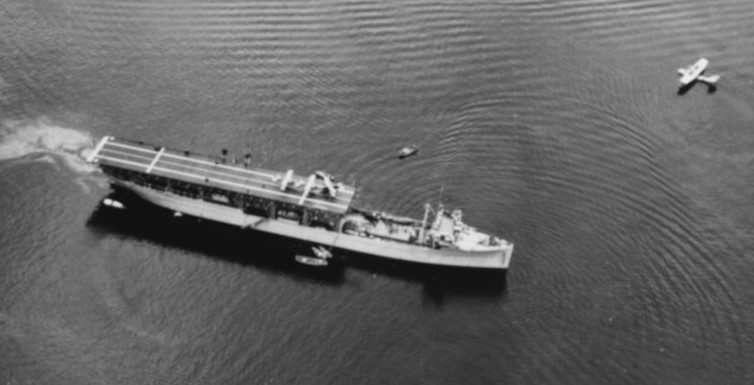
Langley detached from the Battle Force on 15 September 1936 and attached to Commander Aircraft, Base Force, for duty as a seaplane tender. Following a brief operational period, she entered the Mare Island Navy Yard for conversion to a seaplane tender on 25 October. Langley completed conversion on 24 February 1937 and, with the forward part of her flight deck removed, made her return to San Diego on 26 February. Her return to her long-time home port prompted some confusion among those who were unaware of her new configuration. Now resembling the Japanese carrier Hosho, she was given the nickname “Langley Maru.”
Underway again on 15 March 1937, the new-look Langley steamed to San Luis Obispo, CA, to conduct operations with VP-11F and the prototype of the Consolidated PBY Catalina flying boat (16-19 March) before making her return to San Diego on the 20th. She cleared on 16 April for the Territory of Hawaii and Fleet Problem XVIII. While en route, she was redesignated as a seaplane tender, AV‑3, on 21 April. The ship reached Pearl Harbor on the 23rd. Langley, attached to Black under Adm. Claude C. Bloch, supplemented the fleet’s aviation contingent of Lexington and Saratoga. They were opposed by White under Vice Adm. William T. Tarrant’s command. Langley, as part of Lexington’s task force was to secure French Frigate Shoals. Departing on 29 April, the task force arrived in the vicinity of their objective when Lexington sustained a torpedo from a White submarine. Despite this, Black secured the atoll on 6 May and Langley established a seaplane base for VP-11F’s Catalinas. White aircraft soon attacked the base, followed by two light cruisers that shelled the tender and the base. Langley was assessed as having suffered significant damage and was limited to five knots. These limitations notwithstanding, the tender continued to operate the seaplane base servicing fleet aircraft until getting underway on 10 May. No longer involved in this phase of the fleet problem, she steamed to Oahu, briefly stopping at Mamala Bay (11 May) before entering Pearl Harbor on the 12th. Departing in company with Wright on 19 May, the tenders steamed for San Francisco to participate in further fleet problem phases. Arriving on 27 May, they steamed under the opening of the Golden Gate Bridge to pedestrian traffic and anchored in the bay to await the rest of the fleet’s arrival on 28 May.
Underway again on 1 June, she shaped a southerly course to return to San Diego on 3 June 1937. Just over three weeks later, on 25 June, Langley unmoored and steamed for Seattle, WA (30 June-10 July), en route to conduct operations in Alaskan waters. Arriving at Sitka, Alaskan Territory, on the 13th, in conjunction with VP-7 and VP-9, she conducted operations to evaluate conditions and the requirements for seaplane operations in those waters. With the tests completed, she departed Sitka on 22 July and steamed south, stopping at Seattle (25 July-2 August) and San Francisco (4-14 August) before returning to San Diego on 16 August. Underway again on 25 September, she steamed via San Pedro (25 September) into the Mare Island Navy Yard on 27 September and docked for a brief availability. Undocking on 30 September, she made her way back to San Diego, again briefly touching at San Pedro, and standing into her base on 2 October. Sortieing on 8 October, she steamed west to Pearl Harbor (16 October-22 October) and then for French Frigate Shoals. A seaplane base was established ashore on the 25th and the ship remained offshore in support. During this time there was a two-day typhoon which did not damage the ship. Underway on 1 November, the ship returned to Pearl Harbor on the 3rd. After a week, she departed for San Diego, making her return on the 18th. Two days later, she stood out bound for the Canal Zone. While en route, Langley conducted exercises and sustained simulated attacks. She crossed the isthmus to Cristóbal on 1 December and conducted additional exercises on the Atlantic coast before passing back through the canal on 6 December and steaming to a return to San Diego, via the Gulf of Fonseca, on 17 December. The ship remained in port through the holiday season.
Langley began her 1938 operations on 14 January. Standing out from San Diego, she steamed to an area between California and the Hawaiian Territory to support the flight of VP-10 from the continent to the islands. She made her return to San Diego on the 23rd. During a training exercise on 2 February, two PBY-2 Consolidated Catalinas (BuNo 0462 and BuNo 0463) collided in the dark. The collision occurred when a formation of nine planes on a bombing training run from Langley entered a cloud bank without warning. Both Catalinas crashed, burned, and sank within two hours. Lt. Carlton B. Hutchins remained at the controls of his flying boat to enable others in his crew to escape with injuries. For this action, he received the Medal of Honor, posthumously. All the men on board the other Catalina perished. In the weeks following the mishap, Langley conducted annual gunnery practices off San Clemente in conjunction with Lexington, Saratoga, and Ranger. Afterwards, the tender’s crew prepared in port for the upcoming Fleet Problem XIX. The problem began on 9 March, though Langley did not make her initial deployment until departing from San Diego on 15 March. She stood out for the Hawaiian Island as part of the Blue fleet under Vice Adm. Edward C. Kalbfus. After her arrival there, she was not made an integral part of the problem and was dispatched to shuttle to Johnston Island and back, over 700 miles each way. After returning to Oahu on 31 March, the ship stood at Pearl Harbor before being ordered to Hilo, Hawaii, T.H., to establish a support base there. Afterward, she returned to Pearl Harbor. Following an interlude, she departed on 14 April and made her return to San Diego on the 21st. After almost two months in port, Langley cleared San Diego on 20 June and again steamed for the Pacific Northwest en route to Alaska. Reaching Seattle on the 24th, she remained there until 5 July when she departed for Sitka. Arriving on 8 July, Langley again conducted flight operations tests until 19 July, when she shaped a course for Pearl Harbor. Arriving on the 27th, she entered the Navy Yard and docked for three days of maintenance. Underway again on 30 July, she arrived at San Diego on 7 August. After unloading equipment (7-11 August), the tender departed for the Puget Sound Navy Yard (15-18 August) before docking at Mare Island on 21 August. Langley would undergo an extensive overhaul, replacing her boilers, through the year’s end.
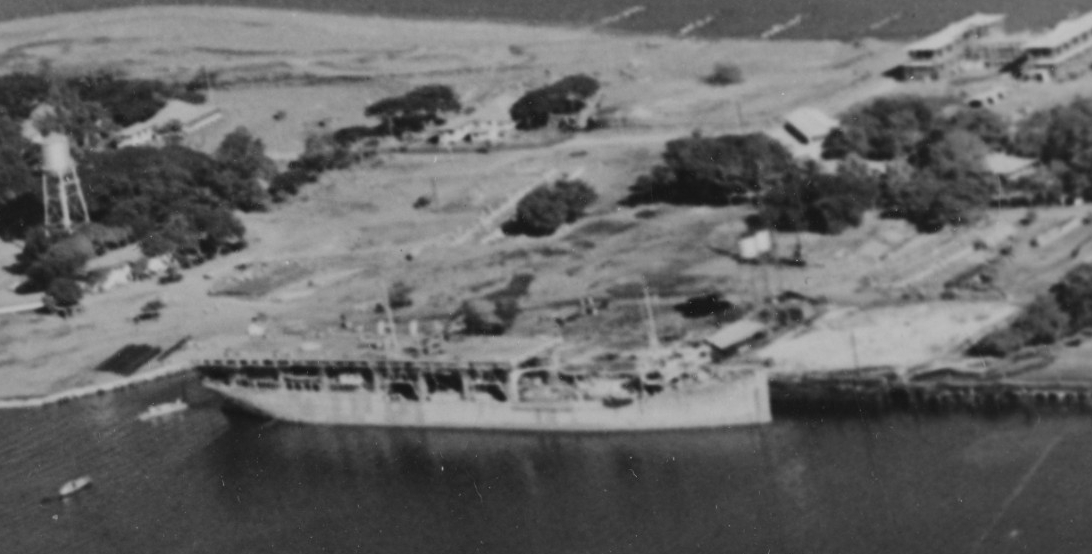
Finally undocking on 27 January 1939, Langley passed through the Golden Gate and arrived back at San Diego on 30 January. In port for only two days, the tender was underway again on 2 February. Bound for the Atlantic and Fleet Problem XX, her last, she steamed for the Canal Zone. Reaching Balboa on the 11th, she transited the Panama Canal that same day to the anchorage at Cristóbal. Langley and Ranger were constituents of the Black fleet that opposed the White fleet built around Lexington and the new carriers Yorktown (CV-5) and Enterprise (CV-6). Langley was to steam to Samana Bay, Dominican Republic, but as the ship made preparations for getting underway, she suffered explosions in her boilers. Through the repair efforts of her crew, she departed on 14 February and made her way to Samana Bay. Arriving on the 17th, she participated in the fleet problem. While her aircraft, in a coordinated strike with land-based squadrons from San Juan, PR, successfully struck Lexington on 23 February an Enterprise-launched strike on the 25th, located the tender in Samana Bay and notionally sent her to the bottom. As the exercise continued with the fleets engaging in a surface action, Langley was removed from play ahead of the fleet’s movement to Norfolk. Departing on 3 March, she stood into N.O.B Norfolk on 7 March in advance of docking at the Norfolk Navy Yard a few days later to repair her propulsion plants. Undocking on 20 April, she underwent a week of trials before steaming to New York for the opening of the 1939 World’s Fair. Arriving on the 29th, she remained there until 17 May, then making her return to NOB Norfolk the next day. The crew’s expectation was that she would continue to serve with the Atlantic Fleet. In early June, she conducted gunnery practices off Lynnhaven Roads, further reinforcing that belief. On 16 June, however, Langley was underway again bound for a return to the Pacific and duty with the Asiatic Fleet. Reaching Cristóbal on 22 June and after transiting the Panama Canal one last time, she departed Coco Solo, C.Z., on 24 June and made her return to San Diego on 3 July. After enjoying the Independence Day holiday and a week in port, the tender was underway again on 10 July. Transiting via Pearl Harbor (18 July-7 September) and Apra, Guam (18 September), Langley, the only seaplane tender assigned to the Asiatic Fleet, reached Manila on 24 September. Having arrived, the tender remained in port, moored at Sangley Point across from the navy yard at Cavite, Philippine Islands (P.I.) through the end of 1939.
Langley finally got underway again on 12 February 1940. Clearing Manila, she steamed to Puerto Princesa, Palawan, P.I., arriving the next day. During her time at Palawan, she serviced the Catalinas of VP-21 until 15 February and then returned to Manila on 17 February. The ship then conducted battle practices in the waters outside Manila Bay from 5-8 March, returning to port upon their completion. Now assigned to the Far East Neutrality Patrol, she cleared for Tacloban, Leyte, P. I., on 15 April, arriving on the 17th. She got underway again the next day and returned to Cavite to enter the yard there on 20 April. Having undergone maintenance until 27 May, Langley sortied for Guam, the U.S. possession in the Marianas Islands. Reaching her destination on 2 June, she raised steam two days later and returned, via the San Bernadino Strait, to Manila Bay on the 10th. Departing on the 13th, she made the short run to Tacloban (15-16 June) before returning to Manila on 18 June.
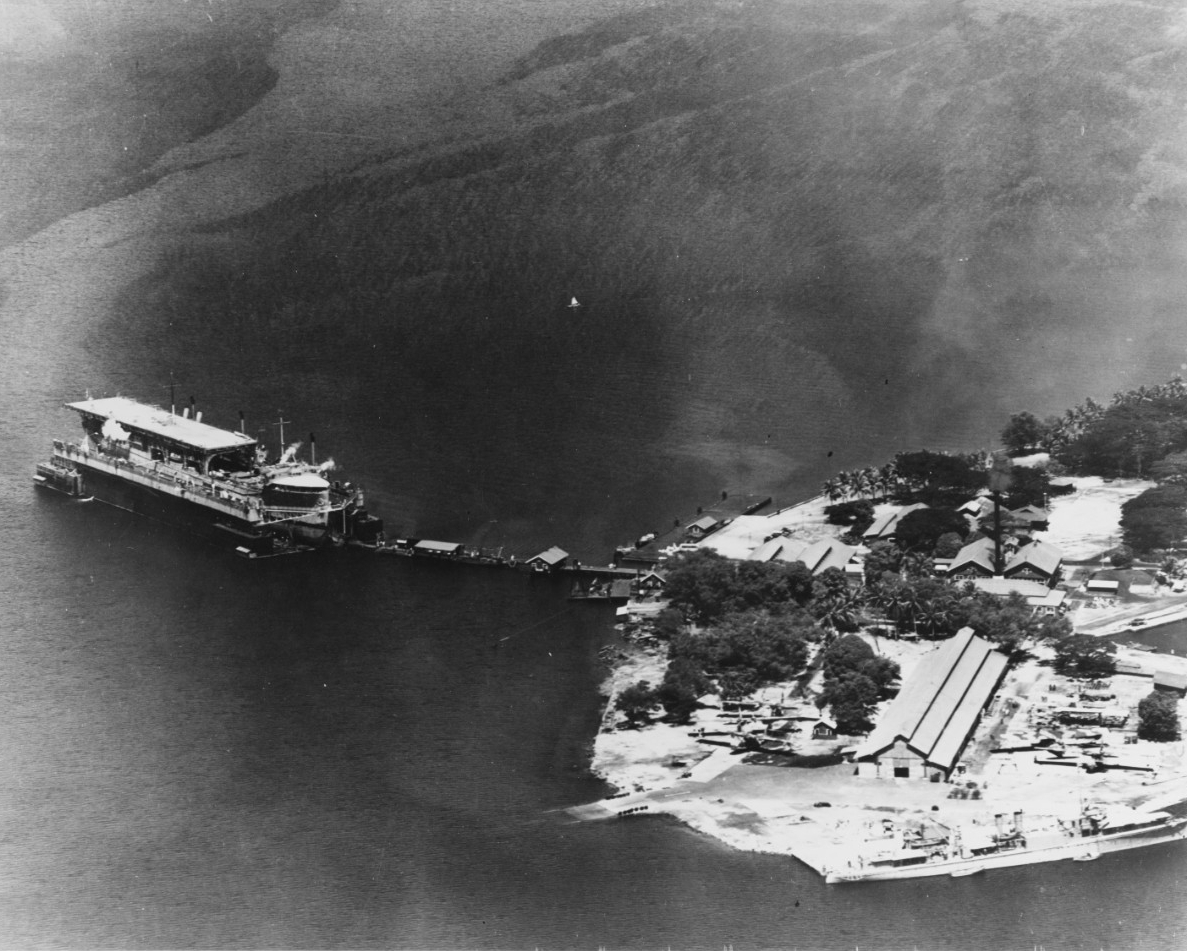
In July 1940, Langley shifted to the Naval Station, Olongapo, Zambales, Luzon, P. I., to be serviced by the floating dry dock Dewey (YFD-1). This was completed on 24 July in preparation for the ship conducting operations at various Philippine locations. On 8 September, Langley steamed to Puerto Princesa, then to the southern island of Mindanao to scout locations that could serve as seaplane bases in the event of war. This included visits to Zamboanga, Polloc Harbor, and Malalag. The tender was back at Sangley Point in October when, on the 17th, the ship was boarded by an unauthorized person who was reported as a spy in the press. Afterward, she got underway on 27 October and continued to scout and survey locations, this time around the island of Luzon, for their suitability as seaplane bases. These locations included Sorsogon Bay, Lopez Bay, and Casiguran Bay. Upon completion of these surveys, Langley returned to Palawan and visited San Vicente. After servicing aircraft of VP-21 in Lingayen Gulf, Luzon, P.I., the ship stood back into her mooring at Sangley Point on 8 November. In mid-December, she shuttled between Sorsogon Bay and Manila. It was also around this time that the Catalina squadrons in the Philippines, VP-21 and VP-26, were re-designated VP-101 and VP-102, respectively. Along with five additional seaplanes, these squadrons were combined to create Patrol Wing 10 on 16 December. Stationed at Cavite, Langley was assigned to support the wing. The ship spent the Christmas and New Year’s holidays, the last before the U.S. entry into World War II, at her Sangley Point mooring.
For the first time in 1941, Langley sortied on 6 January bound for the Philippine islands of Cebu and Panay. She returned to Manila in the middle of the month, then in February, conducted a week of drills including antiaircraft gunnery training. Returning on 20 February, she remained in port into April. Langley was underway with the bulk of the Asiatic Fleet under Adm. Thomas C. Hart on 7 April to conduct tactical training to include antisubmarine work. During the course of the 10-day exercise, Langley spent most of her time anchored at Tutu Bay, Jolo Island, P.I., servicing and supporting the fleet’s aircraft. With the exercise’s end, she departed Jolo and returned to Cavite to prepare for her annual inspections and maintenance availability. She shifted to Olongapo and docked in Dewey on 12 May.
She then returned to Cavite and underwent maintenance alongside Machina Wharf into July 1941. Underway on 7 July, the tender conducted trials in Manila Bay for several days and then underwent degaussing on 11 July. On the 16th, she cleared Manila Bay and steamed for Chongos Bay, Tawi Tawi, P. I., to rendezvous with the heavy cruiser Houston (CA-30), the Asiatic Fleet flagship and other ships of that fleet. She remained there supporting the fleet’s aircraft for two weeks. On 26 July, as most of the fleet relocated to Tutu Bay, Sulu, P.I., to conduct additional tactical exercises, Langley detached and moved to Sugat Bay, Mindanao, to support Catalinas conducting air patrols to monitor Japanese naval activities in the South China Sea amidst increasing tensions between Japan and the U.S.
Afterward, the tender steamed to Tutu Bay and briefly rejoined the fleet before making her return to Manila on 21 August 1941. She was soon underway again on the 26th, when she departed for a return to Tutu Bay in support of air operations based from there. Arriving on 28 August, she remained there for a week before departing on 4 September. Langley spent the next several months visiting various anchorages throughout the Philippine archipelago to assess their suitability as advanced seaplane bases and preposition supplies to support future seaplane operations in the event of the outbreak of war against Japan. On 27 November, the tender was at Malalag Bay, Mindanao, and remained there until departing on 2 December for a return to Manila Bay. She stood in on the 4th and secured to the dock at Cavite.
At the time the Japanese launched their strategic offensive in the Pacific on 8 December 1941 (local), Langley lay off Sangley Point. She sortied that same day and proceeded in company with the oilers Pecos (AO-6) and Trinity (AO-13) to Balikpapan, Borneo, Netherlands East Indies (N.E.I.) [Indonesia] (14-16 December), and Makassar, Sulawesi, N.E.I., (19-22 December); Soerabaja [Surabaya], Java (24-27 December) before finally reaching Darwin, Northern Territory, Australia, on 1 January 1942. While there, Capt. Robert P. McConnell coordinated with the Royal Australian Air Force for the launching of antisubmarine patrols in the waters off northern Australia.
On 10 January 1942, six Catalinas of VP-22, Lt. Cmdr. Frank O’Beirne commanding, landed at Darwin and began to load on board Langley. Squadron executive officer Lt. Doyle G. Donaho led a second group of six aircraft that arrived at Darwin on 11 January. These were the first aviation reinforcements from the Central Pacific to reach the Southwest Pacific. The relentless Japanese advances, however, precluded VP-22’s deployment as a concentrated squadron, and the planes operated in small detachments based at Soerabaja and Ambon, N.E.I. On 20 January, a Grumman OS2U Kingfisher from Langley dropped a bomb that detonated close aboard I-124’s conning tower. The submarine was later sunk by the destroyer Edsall (DD‑219).
Langley departed Darwin on 11 February 1942 and steamed to Fremantle, Western Australia, arriving on the 19th. Three days later, on 22 February, Langley departed Fremantle, along with the merchant vessels, Duntroon, and Katoomba, the U.S. cargo ship (term chartered) Sea Witch and the light cruiser Phoenix (CL-46) [later Argentine ship General Belgrano sunk by HMS Conqueror during the Falklands War, 1982] in convoy MS-5 routed for Colombo, Ceylon [Sri Lanka]. She carried 32 Curtiss P‑40E Warhawks the Far East Air Force’s 13th Pursuit Squadron (Provisional), along with U.S. Army Air Force (USAAF) pilots and ground crews.
While en route, American-British-Dutch-Australian Command (ABDACOM) requested that Langley and Sea Witch, the latter carrying an additional 27 P-40Es, divert and deliver the much needed aircraft for the Dutch colony’s defense to Tjilatjap, Java, N.E.I. Having parted from the convoy, she and Sea Witch were met by the Dutch minelayer HNLMS William van der Zaan which was to escort them into Tjilatjap. On 27 February, Langley and Sea Witch, William van der Zaan having parted, then rendezvoused with the destroyers Whipple (DD-217) and Edsall around 0720. They had sortied from Tjilatjap to serve as Langley’s antisubmarine screen.
At 1140, however, about 74 miles from Tjilatjap, 16 twin-engine Mitsubishi G4M1 Type 1 attack bomber [Betty] based at Denpasar, Bali, N.E.I., from the Takao Kokutai, accompanied by 15 Mitsubishi A6M2 Type 0 carrier fighters [Zero] and a 17th G4M1 Type 1 as an observation plane, attacked Langley and her escorts. These attackers were soon joined by an additional seven more G4M1s. The first and second Japanese strike attempts were unsuccessful; but during a third, around 1212, Langley sustained five hits. The P-40s topside burst into flames on her abbreviated flight deck, her steering was impaired, and she listed 10° to port. The damage rendered her incapable of negotiating the narrow mouth of Tjilatjap Harbor. Soon thereafter, Langley went dead in the water as inrushing water flooded her engine compartments. At 1332 the order to abandon ship was passed. Whipple picked up 308 of Langley’s crew and passengers and Edsall picked up an additional 177. With the survivors rescued, the escorting destroyers fired nine 4‑inch shells and two torpedoes into the “Covered Wagon” at 1429 to ensure her sinking. Langley stubbornly went down about 75 miles south of Tjilatjap.
In order to avoid additional Japanese air attacks, the destroyers cleared the vicinity and rendezvoused with Pecos near Christmas Island the next day. Some of Langley’s survivors transferred to the oiler. Unfortunately, on 1 March, those sailors endured the demise of another ship when Japanese Aichi D3A1 Type 99 carrier bombers [Val], launched from the carriers Akagi, Kaga, Hiryū, and Sōryū, sank Pecos south of Christmas Island. Whipple sped to the scene of this latter sinking and rescued 232 of those that had gone into the water.
According to the Bureau of Naval Personnel a total of 288 officers and crew from Langley were initially classified as missing in action following the loss of Langley and Pecos. Later, in 1945, a total of 319, including the 31 USAAF pilots embarked, were declared killed.
Langley earned two battle stars, the first for the Philippine Islands operations (8 December 1941–6 May 1942 and the other, for the Netherlands East Indies engagements, 23 January–27 February 1942.
Christopher B. Havern Sr. 21 November 2024
Commanding Officers Dates of Command | Cmdr. Kenneth Whiting 20 March 1922 – 16 June 1922 | Capt. Stafford H. R. Doyle 16 June 1922 – 20 June 1924
Commanding Officers Dates of Command | Cmdr. Kenneth Whiting 20 March 1922 – 16 June 1922 | Capt. Stafford H. R. Doyle 16 June 1922 – 20 June 1924
Held by NeuraWeb Global Inc. and kept permanently. Her association may claim this record and maintain it.