USS Indianapolis
Commissioned 15 November 1932 · 10 battle stars
- 31 March 1930 Laid down 31 March 1930 (CA-35: displacement 9,800; length 610'; beam 66'; draft 17'4"; speed 32 knots; complement 1,269; armament 9 8-inch, 8 5-inch; class Portland) The second Indianapolis (CA-35) was laid down on 31 March 1930 at Camden, N.
- 7 November 1931 Launched 7 November 1931 ; launched on 7 November 1931; sponsored by Miss Lucy Taggart, daughter of the late Senator Thomas Taggart, a former mayor of Indianapolis; and commissioned at the Philadelphia Navy Yard on 15 November 1932, Capt.
- 15 November 1932 Commissioned 15 November 1932 ; launched on 7 November 1931; sponsored by Miss Lucy Taggart, daughter of the late Senator Thomas Taggart, a former mayor of Indianapolis; and commissioned at the Philadelphia Navy Yard on 15 November 1932, Capt.
- Her fate sunk by the Japanese submarine I-58 within the first hour of 30 July Indianapolis was en route from Guam to Leyte when she was torpedoed and sunk by the Japanese submarine I-58 within the first hour of 30 July 1945.
- Sponsored by Miss Lucy Taggart ; launched on 7 November 1931; sponsored by Miss Lucy Taggart, daughter of the late Senator Thomas Taggart, a former mayor of Indianapolis; and commissioned at the Philadelphia Navy Yard on 15 November 1932, Capt.
- Class Portland
- Battle stars 10 battle stars for her World War II service in the Pacific, for her participation in Pacific Raids that included the air action off Bougainville (20 Febru Indianapolis received 10 battle stars for her World War II service in the Pacific, for her participation in Pacific Raids that included the air action off Bougainville (20 February 1942) and the Salamaua-Lae raid (10 March 1942); the occupation of Attu, Aleutian Islands (25 May-3 June 1943); the Gilbert Islands operation
- Campaign World War II Indianapolis received 10 battle stars for her World War II service in the Pacific, for her participation in Pacific Raids that included the air action off Bougainville (20 February 1942) and the Salamaua-Lae raid (10 March 1942); the occupation of Attu, Aleutian Islands (25 May-3 June 1943); the Gilbert Islands operation
- Built by Camden, N.J., by the New York Shipbuilding Corp (CA-35: displacement 9,800; length 610'; beam 66'; draft 17'4"; speed 32 knots; complement 1,269; armament 9 8-inch, 8 5-inch; class Portland) The second Indianapolis (CA-35) was laid down on 31 March 1930 at Camden, N.
- Battle stars ten battle stars Frequently the flagship of the 5th Fleet, Indianapolis served with honor from Pearl Harbor through the last campaign of World War II, earning ten battle stars.
- Decoration Navy Unit Commendation return to top Alchiba (AK-23) · Arizona (BB-39) · Expand navigation for Cole (DDG-67) Cole (DDG-67) USS Cole In Memoriam · USS Cole Navy and Marine Corps Medals · USS Cole Legion of Merit · USS Cole Purple Heart Recipients · USS Cole Meritorious Service Medal · USS Cole Navy and Marine Corps Commendation Medal · USS Cole Navy and Marine Corps Achievement Medal · USS Cole Navy Unit Commendation · U…
(CA-35: displacement 9,800; length 610'; beam 66'; draft 17'4"; speed 32 knots; complement 1,269; armament 9 8-inch, 8 5-inch; class Portland)
The second Indianapolis (CA-35) was laid down on 31 March 1930 at Camden, N.J., by the New York Shipbuilding Corp.; launched on 7 November 1931; sponsored by Miss Lucy Taggart, daughter of the late Senator Thomas Taggart, a former mayor of Indianapolis; and commissioned at the Philadelphia Navy Yard on 15 November 1932, Capt. John M. Smeallie in command.
Following shakedown in the Atlantic and Guantanamo Bay until 23 February 1933, Indianapolis trained in the Canal Zone and in Pacific off the Chilean coast. After overhaul at the Philadelphia Navy Yard, the heavy cruiser sailed to Maine to embark President Franklin D. Roosevelt at Campobello Island on 1 July 1933. Getting underway the same day, Indianapolis arrived at Annapolis two days later where she entertained six members of the cabinet. After disembarking the President, she departed Annapolis on 4 July, and returned to the Philadelphia Navy Yard.
On 6 September 1933, Secretary of the Navy Claude A. Swanson broke his flag in Indianapolis for an inspection tour of the Pacific, visiting the Canal Zone, Hawaii, and the fleet in the San Pedro-San Diego area. He debarked at San Diego on 27 October, and Indianapolis became flagship of the Scouting Force on 1 November 1933. Following maneuvers off the West Coast, she departed Long Beach, Calif., on 9 April 1934 and arrived at New York City on 29 May. There she again embarked the President and his party for a review of the Fleet. She arrived Long Beach on 9 November 1934 for tactical war problems with the Scouting Fleet.
Indianapolis acted as flagship for the remainder of her peacetime career, and again welcomed President Roosevelt at Charleston, S.C., on 18 November 1936 for a "Good Neighbor" cruise to South America. After carrying President Roosevelt to Rio de Janeiro, Buenos Aires, and Montevideo for state visits, she returned to Charleston on 15 December where the presidential party left the ship.
As international tension built up during ensuing years and the U.S. girded to meet aggression, the heavy cruiser's intensified training program fused ship and crew into a fighting machine of high efficiency ready to defend the Nation from any enemy who might attack.
When Japanese bombs struck Pearl Harbor, Indianapolis, then making a simulated bombardment of Johnston Island, immediately joined Task Force 12 and searched for Japanese carriers reportedly still in the vicinity. She arrived Pearl Harbor on 13 December 1941 and entered Task Force 11 for operations against the enemy.
Her first action came in the South Pacific deep in enemy-dominated waters about 350 miles south of Rabaul, New Britain. Late in the afternoon of 20 February 1942, the American ships were attacked by 18 twin-engined bombers, flying in two waves. In the battle that followed, 16 of the planes were shot down by accurate antiaircraft fire of the ships and fighter planes from Lexington (CV-2). All ships escaped damage and they splashed two trailing Japanese seaplanes.
On 10 March 1942 the Task Force, reinforced by carrierYorktown (CV-5) attacked enemy ports at Lae and Salamaua, New Guinea, where the enemy was marshalling amphibious forces. Carrier-based planes achieved complete surprise by flying in from the south, crossing the high Owen Stanley mountain range, and swooping in to strike Japanese harbor shipping. As they inflicted heavy damage on Japanese warships and transports, the American flyers knocked down many of the enemy planes which rose to protect the ports. American losses were exceptionally light.
Indianapolis then returned to the United States for overhaul and alterations in the Mare Island Navy Yard. Indianapolis then escorted a convoy to Australia, then headed for the North Pacific where Japanese landings in the Aleutians had created a precarious situation. The weather along this barren chain of islands is noted for continuous coldness; persistent and unpredictable fogs; constant rain, snow, and sleet; and sudden storms with violent winds and heavy seas.
By 7 August 1942, the task force to which Indianapolis was attached finally found an opening in the thick fog which hid the Japanese stronghold at Kiska Island, and imperiled ships in the treacherous and partially uncharted nearby coasts. Indianapolis' 8-inch guns opened up along with those of the other ships. Although fog hindered observation, scout planes flown from the cruisers reported seeing ships sinking in the harbor and fires burning among shore installations. So complete was the tactical surprise that it was 15 minutes before shore batteries began to answer; and some of them fired into the air, believing they were being bombed. Most of them were silenced by accurate gunnery from the ships.
Japanese submarines then appeared but were promptly depth-charged by American destroyers. Japanese seaplanes also made an ineffective bombing attack. The operation was considered a success despite the scanty information on its results. It also demonstrated the necessity of obtaining bases nearer the Japanese-held islands. Consequently, U.S. forces occupied the island of Adak later in the month, providing a base suitable for surface craft and planes further along the island chain from Dutch Harbor. In January 1943, Indianapolis supported the U.S. occupation of Amchitka.
On the night of 19 February 1943, while Indianapolis and two destroyers patrolled southwest of Attu, hoping to intercept enemy ships running reinforcements and supplies into Kiska and Attu, she contacted a Japanese cargo ship, Akagane Maru. When challenged, the enemy tried to feign a reply but was shelled by Indianapolis' 8-inch guns. Since the Maru exploded with great force and left no survivors, she was presumably laden with ammunition.
Throughout the spring and summer of 1943, Indianapolis operated in Aleutian waters escorting American convoys and covering amphibious assaults. In May the Navy took Attu, the first territory stolen by the Japanese to be reconquered by the United States. After Attu was proclaimed secure, the U.S. forces focused their attention on Kiska, the last enemy stronghold in the Aleutians. However, the Japanese managed to evacuate their entire garrison under cover of persistent, thick fog before our landings there 15 August.
After refitting at Mare Island, the ship next moved to Hawaii where she became flagship of Vice Admiral Raymond A. Spruance commanding the Fifth Fleet. She sortied from Pearl Harbor on 10 November 1943 with the main body of the Southern Attack Force of the Assault Force for Operation Galvanic, the invasion of the Gilbert Islands. On 19 November 1943, Indianapolis, in a force of cruisers, bombarded Tarawa and next day pounded Makin. The ship then returned to Tarawa and acted as a fire-support ship for the landings. That day her guns splashed an enemy plane and shelled enemy strong points as valiant landing parties struggled against fanatical Japanese defenders in an extremely bloody and costly battle. She continued this role until the leveled island was declared secure three days later.
The conquest of the Marshall Islands followed hard on victory in the Gilberts. Indianapolis was again Fifth Fleet Flagship. She rendezvoused with other ships of her task force at Tarawa, and on D-Day minus 1, 31 January 1944, she was a unit of the cruiser group which bombarded the islands of Kwajalein Atoll. The shelling continued on D-Day with Indianapolis silencing two enemy shore batteries. Next day she obliterated a blockhouse and other shore installations and supported advancing troops with a creeping barrage. The ship entered Kwajalein Lagoon on 4 February and remained until all resistance disappeared.
During March and April of 1944, Indianapolis, still flagship of the Fifth Fleet, attacked the Western Carolines. Carrier planes struck at the Palau Islands 30-31 March with shipping as their primary target. They sank 3 destroyers, 17 freighters, 5 oilers and damaged 17 other ships. In addition, airfields were bombed and surrounding waters mined to immobilize enemy ships. Yap and Ulithi were struck on the 31st and Woleai on 1 April. During these three days, enemy planes attacked the U.S. fleet but were driven off without damaging the American ships. Indianapolis shot down her second plane, a torpedo bomber, and the enemy lost 160 planes in all, including 46 destroyed on the ground. These attacks successfully prevented enemy forces from the Carolines from interfering with the U.S. landings on New Guinea.
During June 1944, the Fifth Fleet was busy with the Marianas assault, raids on Saipan which began with carrier-based planes on the 11th followed by surface bombardment, in which Indianapolis had a major role, from 13 June. On D-Day, 15 June, Admiral Spruance received reports thata large fleet of battleships, carriers, cruisers, and destroyers was headed south to relieve their threatened garrisons in the Marianas. Since amphibious operations at Saipan had to be protected at all costs, Admiral Spruance could not draw his powerful surface units too far from the scene. Consequently, a fast carrier force was sent to meet this threat while another force attacked Japanese air bases on Iwo Jima and Chichi Jima in the Bonin and Volcano Islands, bases for dangerous potential enemy air attacks.
A combined fleet met the enemy on 19 June 1944 in the Battle of the Philippine Sea. Enemy carrier planes, which hoped to use the airfields of Guam and Tinian to refuel and rearm and attack our off-shore shipping, were met by carrier planes and the guns of the escorting ships. That day the Navy destroyed 402 enemy planes while losing only 17 of her own. Indianapolis, which had operated with the force which struck Iwo Jima and Chichi Jima, shot down one torpedo plane. This famous day's work became known throughout the fleet as the "Marianas Turkey Shoot." With enemy air opposition wiped out, the U.S. carrier planes pursued and sank two enemy carriers, two destroyers, and one tanker and inflicted severe damage on other ships. Indianapolis returned to Saipan on 23 June to resume fire support there and six days later moved to Tinian to smash shore installations. Meanwhile, Guam had been taken; and Indianapolis was the first ship to enter Apra Harbor since that American base had fallen early in the war. The ship operated in the Marianas area for the next few weeks, then moved to the Western Carolines where further landings were planned. From 12 to 29 September she bombarded the Island of Peleliu in the Palau Group, both before and after the landings. She then sailed to Manus in the Admiralty Islands where she operated for ten days before returning to the Mare Island Navy Yard.
Overhauled, Indianapolis joined Vice Adm. Marc A. Mitscher's fast carrier task force on 14 February 1945 two days before it made the first attack on Tokyo since the Halsey-Doolittle Raid of 18 April 1942. The operation covered American landings on Iwo Jima, scheduled for 19 February 1945, by destroying Japanese air facilities and other installations in the "Home Islands". Complete tactical surprise was achieved by approaching the Japanese coast under cover of bad weather, and attacks were pressed home for 2 days. On 16 and 17 February, the American Navy lost 49 carrier planes while shooting down or destroying on the ground 499 enemy planes. Besides this 10-to-l edge in aircraft victories, Mitscher's force sank a carrier, 9 coastal ships, a destroyer, 2 destroyer escorts, and a cargo ship. Moreover, they wrecked hangers, shops, aircraft installations, factories, and other industrial targets. Throughout the action, Indianapolis played her vital role of support ship.
Immediately after the strikes, the Task Force raced to the Bonins to support the landings on Iwo Jima. The ship remained there until 1 March 1945, aiding in the bloody struggle for that little island by protecting the invasion ships and training her guns on any targets spotted on the beach. The ship returned to Admiral Mitscher's Task Force in time to strike Tokyo again on 25 February and Hachijo off the southern coast of Honshu the following day. Although weather proved extremely bad, the Americans destroyed 158 planes and sank 5 small ships while pounding ground installations and demolishing trains.
A large base close to the home islands was needed to press the attack, and Okinawa in the Ryukyus seemed ideal for the part. To capture it with minimum losses, airfields in southern Japan had to be pounded until they were incapable of launching effective airborne opposition to the impending invasion.
Indianapolis, with the fast carrier force, departed on Ulithi 14 March 1945, and proceeded toward the Japanese coast. On 18 March, from a position 100 miles southeast of Kyushu, the flat-tops launched strikes against airfields on the island, ships of the Japanese fleet in the harbors of Kobe and Kure on southern Honshu. After locating the U.S. Task Force on 21 March, Japan sent 48 planes to attack the ships, but 24 planes from the carriers intercepted the enemy aircraft some 60 miles away. At the end of the battle, every one of the enemy planes was in the sea.
Preinvasion bombardment of Okinawa began 24 March 1945 and for 7 days Indianapolis poured 8-inch shells into the beach defenses. Meanwhile, enemy aircraft repeatedly attacked the ships; and Indianapolis shot down six planes and assisted in splashing two others. On 31 March, the day before the invasion, the ship's sky lookouts spotted a Japanese single-engined fighter plane as it emerged from the morning twilight and roared at the bridge in a vertical dive. The ship's 20-millimeter guns opened fire, but less than 15 seconds after it was spotted the plane was over the ship. Tracer shells crashed into the plane, causing it to swerve; but the enemy pilot managed to release his bomb from a height of 25 feet and crash his plane on the port side of the after main deck. The plane toppled into the sea, causing little damage; but the bomb plummeted through the deck armor, the crew's mess hall, the berthing compartment below, and the fuel tanks still lower before crashing through the bottom of the ship and exploding in the water under her. The concussion blew two gaping holes in the ship bottom and flooded compartments in the area, killing nine men. Although Indianapolis settled slightly by the stern and listed to port, there was no progressive flooding; and the plucky cruiser steamed to a salvage ship for emergency repairs. Here, inspection revealed that her propeller shafts were damaged, her fuel tanks ruptured, her water-distilling equipment ruined; nevertheless, the cruiser made the long trip across the Pacific to the Mare Island Navy Yard under her own power.
After repairs and overhaul, Indianapolis received orders to proceed at high speed to Tinian, carrying parts and nuclear material to be used in the atomic bombs which were soon to be dropped on Hiroshima and Nagasaki. Due to the urgency of her mission, Indianapolis departed San Francisco on 16 July 1945, foregoing her post-repair shakedown period. Touching at Pearl Harbor on 19 July, she raced on unescorted and reached Tinian on 26 July, covering some 5,000 miles from San Francisco in only ten days.
After delivering her top-secret cargo at Tinian, Indianapolis was dispatched to Guam where she disembarked men and reported for onward routing to Leyte. From there she was to report to Vice Adm. Jesse B. Oldendorf for further duty off Okinawa. Departing Guam on 28 July 1945, Indianapolis proceeded by a direct route, unescorted. Early in the morning, 15 minutes into the mid watch on 30 July 1945, two heavy explosions occurred against her starboard side forward, and she capsized and sank in 12 minutes. Indianapolis had been hit by two torpedoes from Japanese submarine I-58, Cmdr. Hashimoto Mochitsura in command. The seas had been moderate; the visibility, good; Indianapolis had been steaming at 17 knots. When the ship did not reach Leyte on the 31st, as scheduled, no report was made that she was overdue. This omission was due to a misunderstanding of the Movement Report System. Thus it was not until 1025 on 2 August that the survivors were sighted, mostly held afloat by life jackets, although there were a few rafts which had been cut loose before the ship went down. They were sighted by a plane on routine patrol; the pilot immediately dropped a life raft and a radio transmitter. All air and surface units capable of rescue operations were dispatched to the scene at once, and the surrounding waters were thoroughly searched for survivors.
Upon completion of rescue operations, 8 August 1945, a radius of 100 miles had been combed by day and by night, saving 316 of the crew of 1,195 men.
Capt. Charles B. McVay, III, commanding officer of Indianapolis at the time of her sinking, was vindicated from any blame concerned with the loss of his ship. All personnel involved in the failure to report the ship's absence from Leyte were also exonerated, after all the evidence had been carefully weighed.
Indianapolis received 10 battle stars for her World War II service in the Pacific, for her participation in Pacific Raids that included the air action off Bougainville (20 February 1942) and the Salamaua-Lae raid (10 March 1942); the occupation of Attu, Aleutian Islands (25 May-3 June 1943); the Gilbert Islands operation (20 November-8 December 1943); Marshall Islands operation, including the occupation of Kwajalein and Majuro Atolls (29 January-8 February 1944) and the occupation of Eniwetok Atoll (17 February-2 March 1944); Asiatic-Pacific Raids, involving Palau, Yap, Ulithi, and Woleai (30 March-1 April 1944); the Marianas operation, involving the occupation of Saipan (11 June-10 August 1944), the Battle of the Philippine Sea (19-20 June 1944), and the capture and occupation of Guam (21-23 July 1944); the capture and occupation of Tinian (24-25 July 1944); the capture and occupation of the Southern Palaus (6 September-14 October 1944); the capture and occupation of Iwo Jima (15 February-6 March 1945), Fifth Fleet raids against Honshu and the Nansei Shoto (15-16 February, 25 February, and 1 March 1945); and the Fifth Fleet and Third Fleet raids in support of the Okinawa Gunto operation (17-25 March 1945) and the assault and occupation of Okinawa Gunto (26 March-5 April 1945).
Held by NeuraWeb Global Inc. and kept permanently. Her association may claim this record and maintain it.
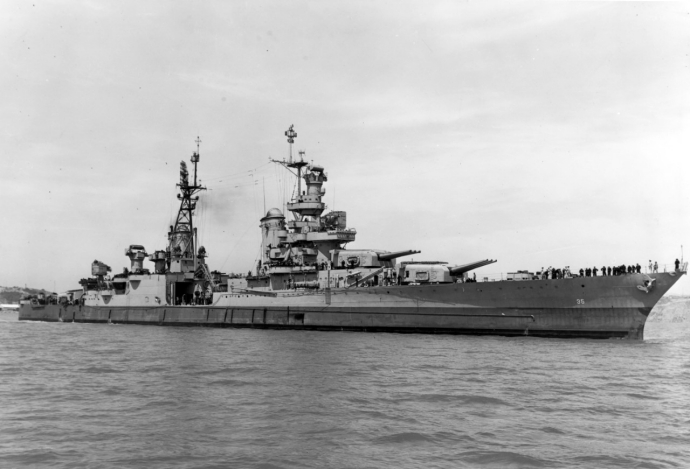
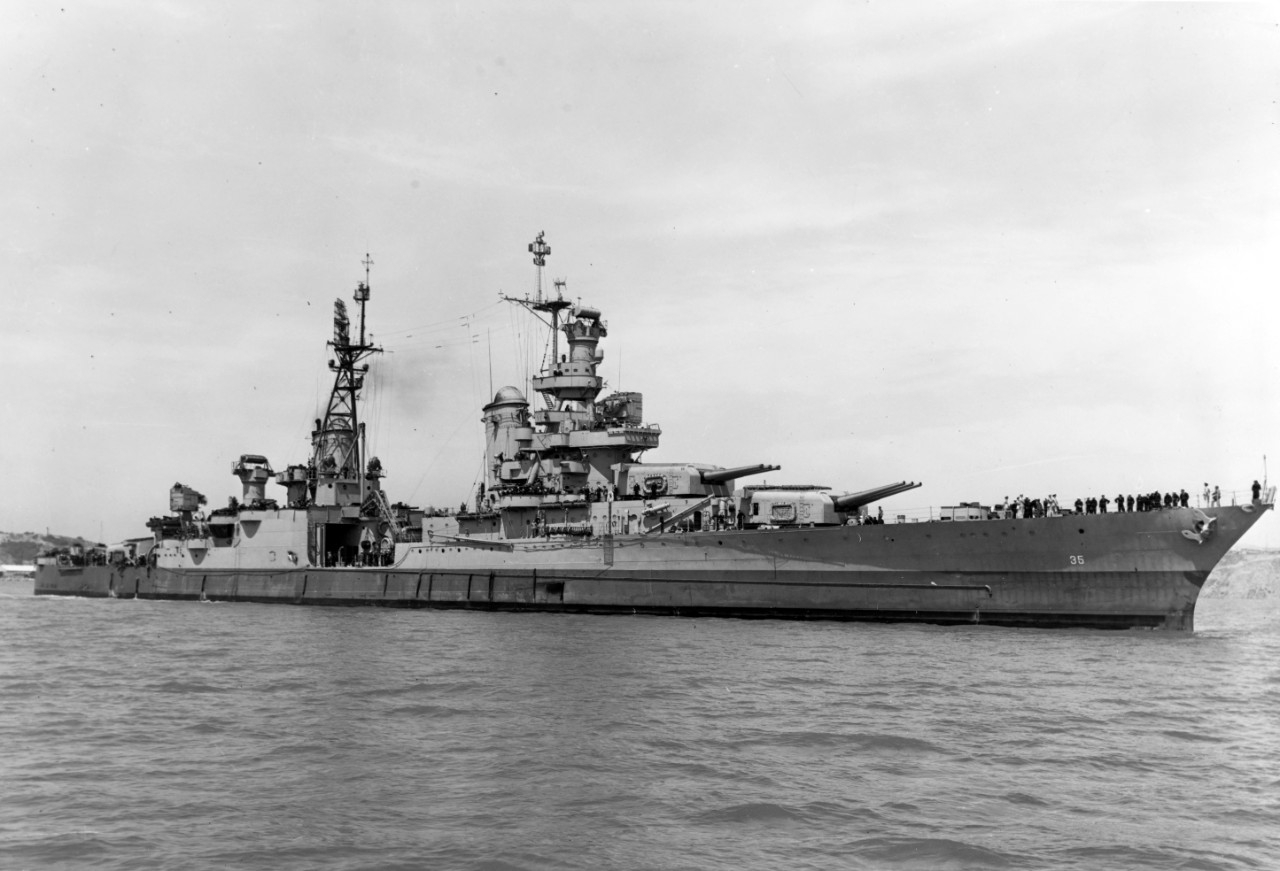
USS Indianapolis (CA-35). Off the Mare Island Navy Yard, California, 10 July 1945, after her final overhaul and repair of combat damage. Photograph from the Bureau of Ships Collection in the U.S. National Archives. (19-N-86911)
Research into the Loss
The Ship and the Sailors
Final Voyage of Indianapolis
Rescue
Aftermath
Indianapolis Wreck Found
The Legacy and Lessons Learned
Remembrance
The loss of USS Indianapolis (CA-35) was a tragic moment following the completion of a secret mission that directly contributed to the end of World War II. After a successful high-speed run to deliver atomic bomb components to Tinian, the decorated Portland-class cruiser continued to Guam. Indianapolis was en route from Guam to Leyte when she was torpedoed and sunk by the Japanese submarine I-58 within the first hour of 30 July 1945. The following resources, available on the NHHC website, document the history of Indianapolis, the sinking, the aftermath of the tragedy, and the discovery of the ship's wreck on 19 August 2017.
Documents Relating to the Loss of Indianapolis Historians at the Naval History and Heritage Command have developed an online collection of primary documents and images. As tragic as the loss was, the Navy learned from its mistakes and implemented changes that improved reporting procedures, requirements for ship escorts, and increased lifesaving equipment. Documents in the collection provide information on the routing and sinking of the ship, the available intelligence, rescue operations, and the investigation and court martial that followed. The online collection also includes photographs of the survivors of Indianapolis in addition to paintings by combat artist Alexander Russo.
Final Contact: USS Indianapolis (CA-35) Passes USS LST-779, 29 July 1945 In this July 2016 paper, an NHHC historian discusses information about the last visual contact of Indianapolis with a U.S. Navy ship and what this indicates about the route of Indianapolis before the sinking.
A Grave Misfortune: The USS Indianapolis Tragedy An e-book that examines the circumstances surrounding the sinking of Indianapolis on 30 July 1945, including primary source documents describing the sinking, rescue efforts, investigations, aftermath, and continuing commemoration efforts.
Frequently the flagship of the 5th Fleet, Indianapolis served with honor from Pearl Harbor through the last campaign of World War II, earning ten battle stars.
Biography of Captain McVay Captain Charles B. McVay III commanded Indianapolis on the final voyage.
USS Indianapolis WWII Battle Stars Extracted from the book, A Grave Misfortune: The USS Indianapolis Tragedy.
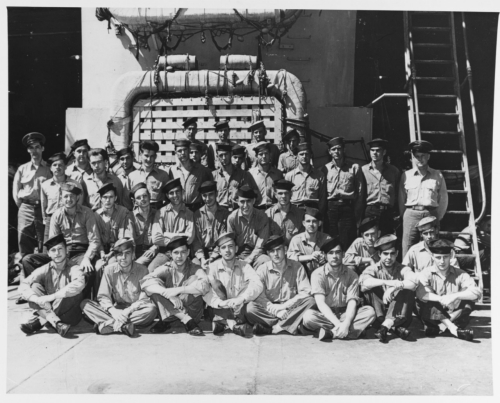
USS Indianapolis (CA-35). Members of the ship's crew pose in the well deck, during World War II. Official U.S. Navy Photograph, now in the collections of the National Archives. (80-G-336932)
USS Indianapolis Photos The NHHC Photo Archives USS Indianapolis collection.
USS LST-779 Ship History The day before the sinking, Indianapolis made visual contact with another U.S. Navy ship, which NHHC historians have identified as USS LST-779.
The Sinking of USS Indianapolis Story Map This story map, created by the NHHC Underwater Archaeology Branch, provides an account of Indianapolis' final voyage.
Lest We Forget: USS Indianapolis and Her Sailors NHHC Director Sam Cox discusses the lessons learned from the story of USS Indianapolis.
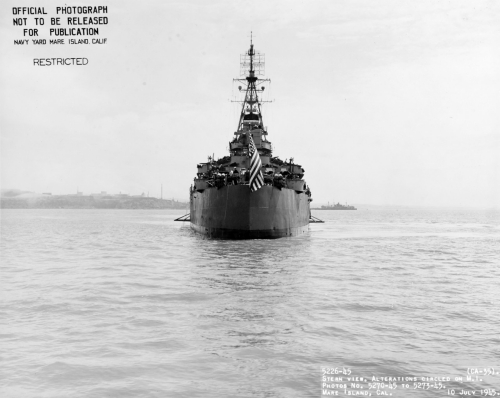
USS Indianapolis (CA-35). View from astern, off the Mare Island Navy Yard, California, 10 July 1945, after her final overhaul. Photograph from the Bureau of Ships Collection in the National Archives. This photo has been released and is available for public use. (19-N-86914)
The following ships were involved in the rescue of survivors from USS Indianapolis:
Honoring the Sacrifice of Those Who Served Navy Shares Final Crew Accounting at USS Indianapolis Survivors Reunion
Setting the Record Straight: The Loss of USS Indianapolis and the Question of Clarence Donnor NHHC Historian Richard Hulver and award-winning documentary filmmaker Sara Vladic set the record straight on the correct number of survivors and the total number of crew members 73 years after the loss of USS Indianapolis.
The Sinking of USS Indianapolis: Press Releases and Related Sources The Navy Department Library Online Reading Room includes Navy Department press releases on the investigation and court martial of Captain Charles B. McVay III. Also available are oral histories from McVay and another survivor, Lieutenant Commander Lewis L. Haynes, and the Allied interrogation of Commander Mochitsura Hashimoto of the Japanese submarine I-58 regarding wartime tactics.
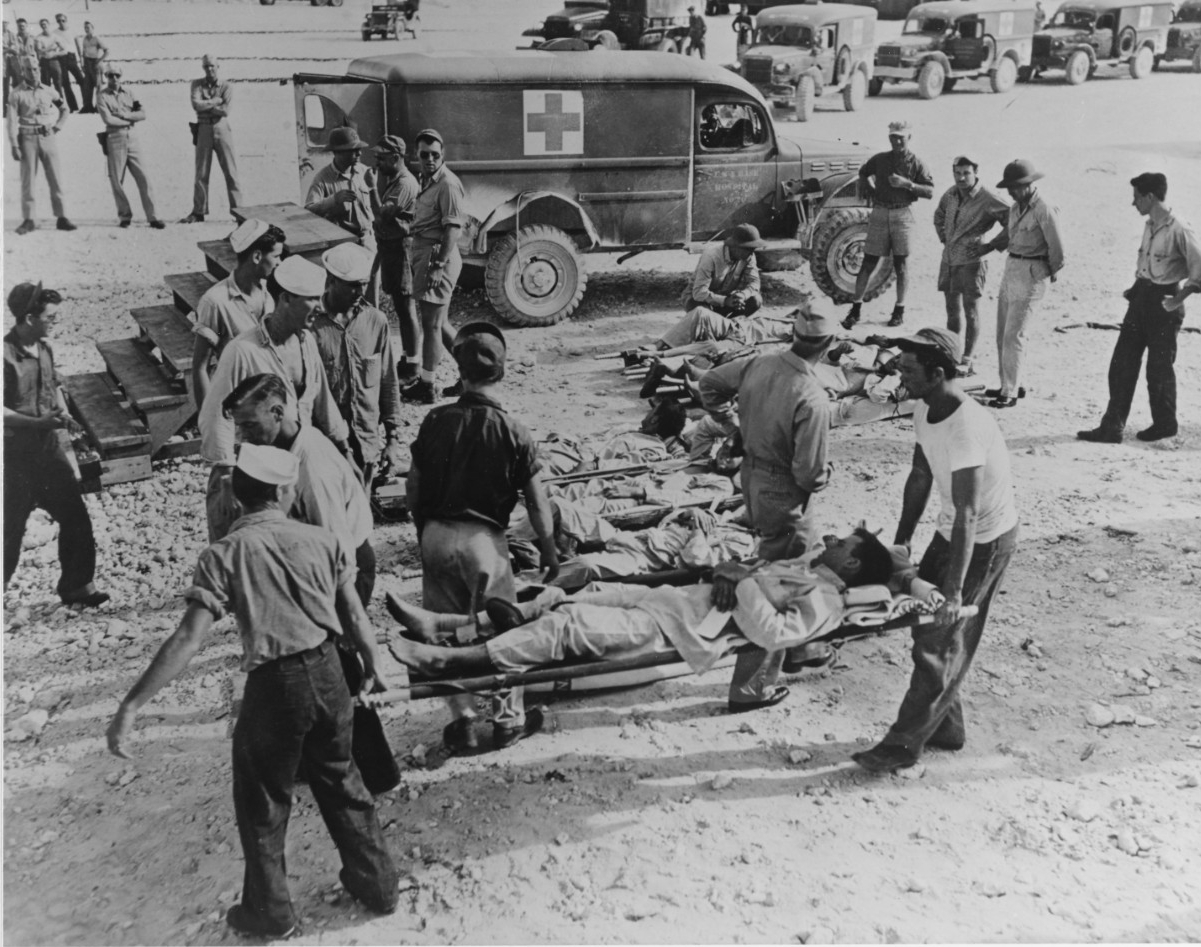
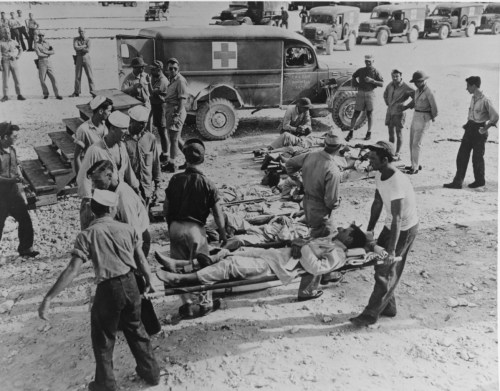
Loss of USS Indianapolis, July 1945. Indianapolis survivors en route to a hospital following their rescue, circa early August 1945. Official U.S. Navy Photograph, now in the collections of the National Archives. 80-G-490322.
Indianapolis Wreck Site Located
On 19 August 2017, the U.S. Navy–supported expedition led by entrepreneur-philanthropist Paul G. Allen announced that it had located the wreck of Indianapolis. This Sextant blog entry recaps the exhilarating culmination of the search.
NHHC Director’s Remarks at USS Indianapolis 71st Anniversary Reunion In July 2016, 71 years after the tragedy, survivors and family members gathered to honor and remember the Indianapolis Sailors and Marines. Indianapolis continues to serve her Navy and her nation by teaching our Sailors today something new about themselves and reminding them that we never forget.
return to top
On 18 August 2017, Paul G. Allen's research vessel Petrel located wreckage from Indianapolis some 5,500 meters below the surface, resting on the floor of the North Pacific.
Visit The Saga of a Ship and Its Crew on NHHC's Disasters and Phenomena page which examines the circumstances surrounding the sinking of Indianapolis.
Commanding Officers Dates Assumed Command Capt. John Morris Smeallie 15 November 1933 Capt. William Stanley McClintic 11 December 1934 Cmdr. Theodore Stark Wilkinson 24 January 1936 Capt. Henry Kent Hewitt 16 March 1936 Capt. Thomas Cassin Kinkaid 7 June 1937 Capt. John Franklin Shafroth Jr. 27 August 1938 Capt. Edward William Hanson 11 August 1940 Capt. Morton Lyndholm Deyo 11 July 1942 Capt. Nicholas Vytlacil 2 December 1942 Capt. Einar Reynolds Johnson 30 July 1943 Cmdr. Charles Arthur Ferriter 19 October 1944 Capt. Einar Reynolds Johnson 6 November 1944 Capt. Charles Butler McVay III 18 November 1944
Commanding Officers Dates Assumed Command | Capt. John Morris Smeallie 15 November 1933 | Capt. William Stanley McClintic 11 December 1934
Commanding Officers Dates Assumed Command | Capt. John Morris Smeallie 15 November 1933 | Capt. William Stanley McClintic 11 December 1934