Navy · CVA-59 · Forrestal class
USS Forrestal
Commissioned 1 October 1955 · 135 honoured here served aboard her
She is named for
They served aboard her
Commissioned 1 October 1955 · 135 honoured here served aboard her
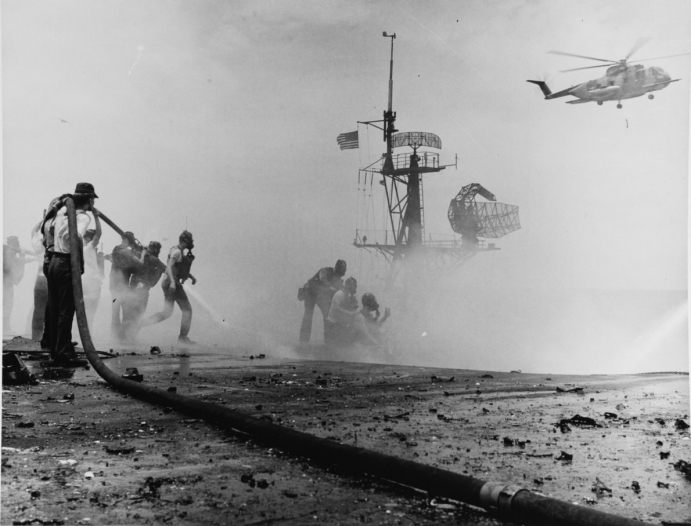
USN 1124786. Forrestal (CVA-59) crewmen are assisted by those from Rupertus (DD-851) in fighting the fires raging aboard Forrestal, while a helicopter ferries firefighting supplies to the burning ship. Download image.
Named for James Vincent Forrestal, born on 15 February 1892, in Matteawan (now Beacon), New York . His father, an Irish immigrant who arrived in the United States in 1857, managed a construction company. After graduating from high school in 1908, Forrestal worked for three years on local newspapers in New York State and then entered Dartmouth College as a freshman in 1911. The following year he transferred to Princeton University in New Jersey , but left in 1915 a few credits short of his degree, apparently due to academic and financial difficulties. During his time at both schools he also participated in boxing, tennis and wrestling. He then worked briefly as a financial reporter, a clerk for a zinc company and as a tobacco salesman. The next year Forrestal joined an investment banking house, William A. Read & Company of New York (which became Dillon, Read & Company in 1923), as a bond salesman. World War I interrupted his career in finance, however, and he enlisted in the U.S. Navy as a seaman second class on 2 June 1917.
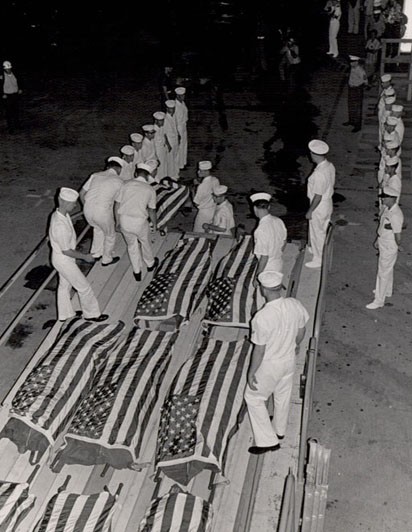
On 29 July 1967, USS Forrestal (CVA/CV-59) suffered a catastrophic fire during flight operations while on Yankee Station off the coast of Vietnam. Wracked by eight high-order explosions of thin-shelled Korean War–vintage bombs and a number of smaller weapons explosions, the world’s first supercarrier was mere minutes away from the bottom of the Gulf of Tonkin. In its wake, the fire claimed 134 Sailors and Airmen, and seriously injured or burned another 161. Of those who died, 50 died where they slept. Many more were wounded but did not report their injuries because of the severity of those of their shipmates.
The young sailor became enthused by naval aviation and he took flight training with British instructors from the Royal Flying Corps at Camp Borden, considered to be the birthplace of the Royal Canadian Air Force, and at Deseronto, both in Ontario, Canada . He commissioned as an ensign, Naval Reserve Flying Corps (NRFC) at Boston, Massachusetts, on 17 November of that year, and he gained his wings of gold as Naval Aviator No. 154 [HTA, heavier-than-air] on 6 December 1917. Soon thereafter, Forrestal served in the office of the Chief of Naval Operations.
Forrestal was the first Atlantic Fleet carrier on Yankee Station, and she had been there only five days. As the ship prepared for its second strike of the day, at 1050, everything changed. The Navy in its definitive report on the event—Manual of the Judge Advocate General Basic Final Investigative Report Concerning the Fire on Board the USS FORRESTAL (CVA-59)—concluded that a stray electrical signal ignited the motor of a Zuni rocket carried by an F-4B Phantom II on the starboard quarter and shot across the deck, striking the external fuel tank of a fully armed A-4E Skyhawk on the port. At least one of the Skyhawk’s M-65 1,000-lb. bombs fell to the deck, cracked open, and was burning with a white-hot ferocity.
Following the Armistice, Forrestal, discharged from the Navy with the rank of lieutenant, NRFC, on 30 December 1919, returned to banking through 1940. He rose rapidly in the company, becoming a partner in 1923, vice president in 1926, and president in 1938. Meanwhile, he met and courted Josephine Ogden, a beautiful 26-year-old chorus girl for the Ziegfeld Follies, and after a tempestuous romance the couple married on 13 October 1926, a union that would produce two sons, Michael V., and Peter. Although Jim Forrestal was the man I wanted the bride afterward confided to an interviewer, and their matrimonial voyage began happily, their marriage eventually grounded on the husband's extra-marital affairs and his wife's descent into alcoholism and mental illness.
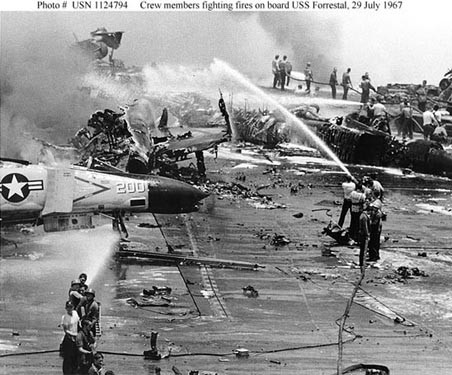
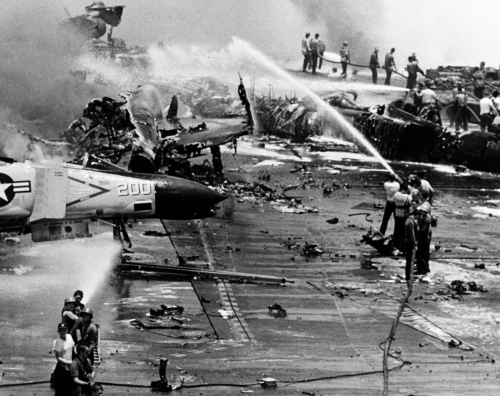
The carrier’s fire crew responded immediately. Fifty-four seconds after the initiation of the fire, Chief Gerald W. Farrier, head of the firefighting team, attacked the cracked and furiously burning bomb with a hand-held extinguisher. Twenty seconds later the hose crew arrived and fought the periphery of the fire. At slightly more than 90 seconds into the fire, the bomb exploded. Nine seconds later a second 1,000-pounder exploded with even more ferocity, hurling debris nearly 1,000 feet away at the bow.
In June 1940, Forrestal accepted a post as a special assistant to President Franklin D. Roosevelt, serving as a liaison for the chief executive in handling the National Defense Program, part of the countrys belated rearmament efforts as it prepared for World War II. In August 1940, the President nominated Forrestal to fill the new position of under secretary of the Navy. Secretary of the Navy William F. Knox [Frank Knox] assigned his under secretary to handle contracts, taxes and legal affairs, and as a liaison with several other government agencies. A highly capable administrator and manager, Forrestal built his office into an efficient organization, and he ran very effectively the Navy's machinery for industrial mobilization and procurement, a vast system that ultimately produced the largest fleet ever to put to sea. The seemingly tireless under secretary made numerous trips across the country and to the far-flung battlefields, coming under fire by the Japanese more than once during inspection and morale-building tours on Kwajalein and Iwo Jima. When a heart attack took Secretary Knox, Forrestal succeeded him on 19 May 1944. He guided the Navy through the last year of the war and into the two difficult years of demobilization after the Japanese surrendered.
The explosions of the large, old weapons blew holes in the armored flight deck above spaces primarily set aside for crew berthing. Flaming and unburned fuel, water, and foam cascaded down into the compartments. Battling the fires below deck was more difficult than that topside with the confined spaces, little light, thick black smoke, and toxic fumes. Although the fire on the flight deck was controlled within an hour, fires below deck raged until 0400 the next morning.
Forrestal visited Joint Task Force 1 at Bikini Lagoon in the Marshall Islands for Test Able of Operation Crossroads to witness the detonation of an atomic bomb and its effects upon over 90 ships, together with weapons and equipment, during late June and early July 1946. The explosion stunned the secretary, who made a number of references during interviews over succeeding days to the tremendous power unleashed by the blast and its effect upon viewers. Complex global problems made more urgent by the Cold War confronted the nation, however, and planners developed a new national security system to begin functioning without delay. Forrestal participated prominently in the development of the National Security Act of 1947, even though he initially opposed unification services. Nonetheless, under pressure from President Harry S. Truman and others, Forrestal made use of the 1945 Eberstadt report and negotiations with Secretary of War Robert P. Patterson to play a primary role in shaping the initial form of the plans. Although the President preferred Patterson as his first choice for secretary of defense, the latter intended to return to private life. The President's subsequent selection of Forrestal, however ironic it might appear given the Secretary's resistance to unification, was deserved and logical considering his long experience in the Defense establishment and dedication to effective administration.
Twenty-one aircraft were destroyed and another 40 damaged of the 73 on board at the start of the fire.
Tensions between the Western Allies and the East Bloc continued to build and intelligence analysts feared that Yugoslav Marshal Josip Broz [Tito] might attempt to seize the Adriatic city of Trieste, still occupied by U.S. and British troops to ensure the orderly transition of power following the Axis collapse. Therefore, when President Harry S Truman selected Forrestal as the first secretary of defense, he also directed that be sworn-in several days earlier than originally scheduled, on 17 September 1947.
Although the investigation report cited errors of safety checks on the Zuni rocket, it concluded that no one on board was directly responsible for the fire and subsequent explosions, and recommended that no disciplinary or administrative action be taken against any persons attached to the ship or its air wing.
Forrestal brought to his new office a deep distrust of the Soviets and a determination to make the new national security structure workable. He recognized the magnitude of the job; he wrote to a friend shortly after announcement of his appointment confiding his serious apprehensions about the future of the new organization. He soon discovered that perhaps the chief obstacle to accomplishing his objectives would be the inherent weakness in the secretary of defenses powers as defined in the National Security Act. Another problem became the existence of virtually autonomous heads for the military departments. These organizational difficulties, combined with a steady escalation of Cold War tensions, ensured 18 months of frustration.
Forrestal received emergency repairs over eight days at Subic Bay, The Philippines, before sailing for complete repair at the Norfolk Naval Shipyard in Portsmouth, Virginia. She went on to serve until 11 September 1993 when she was decommissioned after 21 deployments. She never made another Vietnam cruise.
By February 1948, the Soviets had largely completed their network of satellite nations across eastern Europe, as communists supported by Moscow seized control in Czechoslovakia. That June, the Soviets blockaded land routes from the western zones of Germany to Berlin, forcing the Americans and their allies to initiate an airlift which supplied Berlin until Moscow relaxed the blockade more than 10 months later. In the meantime, war broke out in Palestine between the Arabs and Israelis. As these events occurred, Congress approved the Marshall Plan, providing economic aid for 16 European nations, and in June 1948 the Senate adopted the Vandenberg Resolution, encouraging the administration to enter into collective defense arrangements. The Americans and British led in developing the North Atlantic Treaty Organization (NATO), formally established in April 1949. On the other side of the world, the Chinese communists defeated the Nationalists and drove them from the mainland, leading in 1949 to their emergence as a growing threat to freedom within Asia.
This information was extracted from the Manual of the Judge Advocate General Basic Final Investigative Report Concerning the Fire on Board the USS FORRESTAL (CVA-59), portions of which are available from the U.S. Navy JAG online library.
The national security apparatus played an important role in the development of U.S. policies and programs to meet these Cold War challenges. Forrestal believed strongly in the need for close coordination of defense and foreign policy and saw the National Security Council as a major instrument for accomplishing this coordination. Although President Truman deemed the council a subordinate advisory body he met infrequently with it before the Korean War erupted in June 1950. Forrestal thought it should originate policy proposals and provide firm guidance for strategic planning. He labored hard, for the most part unsuccessfully, to increase its influence. In addition, during these years many Western leaders feared that the Soviets would use their enormous armed forces to conquer Western Europeans, who World War II largely weakened and made destitute. These men sought desperately for aid to brunt the (perceived) Russian steamroller and embraced many former Axis leaders due to the latter-s expertise in and dedication to containing communism.
USN 1124794. USS Forrestal (CVA-59). Crew members fight a series of fires and explosions on the carrier's after flight deck, in the Gulf of Tonkin, 29 July 1967. The conflagration took place as heavily-armed and fueled aircraft were being prepared for combat missions over North Vietnam. Official U.S. Navy Photograph. Download image.
Forrestal became one of these leaders who established a chain of contacts and infrastructure with émigré anti-communists, including the Organization of Ukrainian Nationalists [OUN, better known by their code name of Nactigall, or Nightingale], a group of zealously xenophobic Ukrainians who fought both the Poles and the Russians from World War I onward. Some of these men gained a notorious reputation for supporting Nazi efforts to exterminate Jews, Gypsies and other victims of the Holocaust.
Ship History 1955-1993 Dictionary of American Naval Fighting Ships entry for Forrestal. Includes biographical information on the ship’s namesake, Secretary of Defense James V. Forrestal, and a chronology of the ship’s service.
While the public did not become aware of these classified operations for sometime, the highly publicized War Crimes trials drew attention to the atrocities of the Holocaust, and to those even remotely affiliated with them in whatever manner. Although it is unknown to what extent his association with these men affected Forrestal's mental state, on his final day the Secretary began to copy a Greek poem entitled The Chorus of Ajax by Sophocles; he stopped after writing the first syllable of the final word of one of the lines: Nightingale.
The Forrestal Fire Article from Naval Aviation News, October 1967, compiled and edited by Senior Chief Journalist John D. Burlage. (Download PDF of October 1967 issue [5 MB].)
National security issues plagued the Secretary and the defense budget became a source of tension between Forrestal and Truman. Due to public pressures to limit defense expenditures and his predilection for a balanced budget, Truman would not agree to budget levels proposed by Forrestal or the larger amounts desired by the services. Disagreements between the services over roles and missions complicated the matter. Because the budget limits Truman imposed intensified the competition for scarce funds, the services developed elaborate rationales justifying their views of roles and missions and the funds to support them.
How the 1967 Fire on USS Forrestal Improved Future U.S. Navy Damage Control Readiness A Sextant blog post by Hank Stewart, Commander, USN (Retired), Assistant Professor of Engineering, Maine Maritime Academy.
The Air Force argued that strategic air power as exemplified by long-range bombers carrying nuclear weapons could be key factor in future wars, and that service wanted funds to support 70 combat groups as well as exclusive use of atomic weapons. On the other hand, the Navy wanted to build large flush-deck carriers from which it could launch naval aircraft carrying atomic weapons. These and other differences among the services surfaced especially during annual consideration of the budget.
USS Forrestal—Trial by Fire The Sextant blog post by Chief Damage Controlman (SW/AW) Teddy Yates discussing the tragedy and the impact of the fire.
For all the problems, Forrestal could list 15 solid accomplishments in the process of unification in his first report as secretary of defense in December 1948. These included the formulation of long-range and short-range strategic plans, the development of an integrated defense budget for FY 1950, the definition of service roles and missions, the coordination of service procurement efforts, and the establishment of additional overseas unified commands. Forrestal observed that the mere passage of the National Security Act did not mean the accomplishment of its objectives overnight. The most difficult part of the task of unification is to bring conflicting ideas into harmony How fast we complete the process of resolution will depend on the speed with which we achieve the harmony of thought which is inherent in true unification. I am confident that we shall reach that accord. The 1949 amendments to the National Security Act stand as testimony to Forrestals determination to improve the Defense structure. The 1949 amendments began the legislative process of clarifying and expanding the powers of the secretary of defense. Centralization of authority in the Office of the Secretary of Defense became a constant objective under Forrestal and many of his successors. Unfortunately, Forrestal no longer served in the Pentagon when Congress approved these amendments.
The Impact of the USS Forrestal’'s 1967 Fire (PDF, 305 KB) U.S. Army Command and General Staff College master’s thesis by Lieutenant Commander Henry P. Stewart. The opinions and conclusions expressed therein are those of the student author and do not necessarily represent the view of the U.S. Army Command and General Staff College or any other governmental agency.
Forrestal struggled with recurring bouts of despair, hopelessness and widely erratic mood swings, that the strain of the war exacerbated and that caused the Secretary to resign on 28 March 1949. Psychiatrist Dr. William Menninger of the Menninger Clinic of Topeka, Kansas, diagnosed his patients disorder as reactive depression, a malady then commonly identified among veterans returning from the fronts with combat fatigue. Although Menninger recommended that Forrestal enter his clinic for treatment, Navy officials dispatched Captain George N. Raines, the chief psychiatrist at the U.S. Naval Hospital at Bethesda, Md., a suburb of the nations capital, who counseled that Forrestal should enter that facility instead.
Trial by Fire A motivational film for Navy personnel on the prevention of fire and for learning firefighting damage control measures.
While at Bethesda, however, he continued to experience further attacks of depression and resolved to take his own life by tying off one end of his dressing gown sash to a radiator and falling from the window of his room on the thirteenth floor to the roof of a third story passageway below, on 22 May 1949.
All Hands Update: Remembering the 1967 USS Forrestal Fire Video providing overview of the event that changed how the Navy trains for firefighting and response.
The country acknowledged his services to American security and freedom through two world wars by interning Forrestal with full military honors at Arlington National Cemetery three days later. The Finnish artist Kalervo Kallio sculpted a bronze bust of Forrestal which officials unveiled at the Mall entrance to the Pentagon on 22 September 1950. Some months after he left office, the House Armed Services Committee, with which he worked closely, described his administration as secretary of defense as "able, sensitive, restrained, and far-sighted."
Remembering Forrestal Video from 45th annual commemoration ceremony of the fire. Includes historic imagery and remarks from former Forrestal crew member.
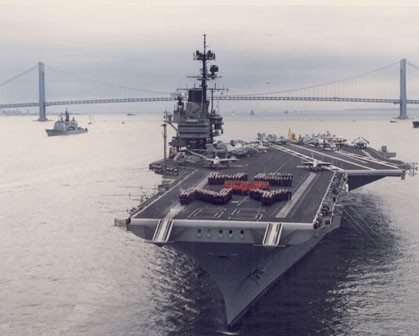
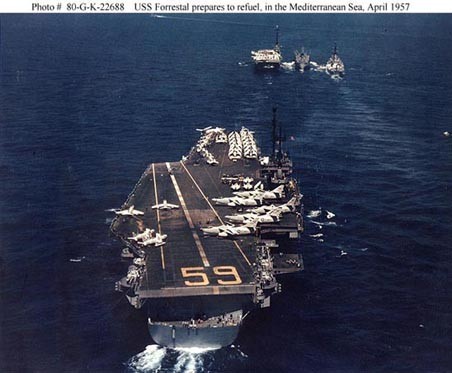
(CVA-59: displacement 56,000; length 1,036; beam 129'4"; extreme width 252'0"; draft 35'9"; speed 33 knots; complement 4,000+ ; armament 8 5-inch; class Forrestal)
National Naval Aviation Museum Ensures USS Forrestal “Trial by Fire” Accident is Forever Remembered The National Naval Aviation Museum collection also includes the Forrestal Fire exhibit and the Forrestal Plan of the Day from 30 July 1967, the day after the fire.
Forrestal (CVA-59) was laid down on 14 July 1952 at Newport News, Virginia, by the Newport News Shipbuilding & Dry Dock Co. ; launched on 11 December 1954; sponsored by Mrs. Josephine Forrestal, widow of Secretary of Defense Forrestal; and commissioned at Norfolk Naval Shipyard, Portsmouth, Virginia, on 1 October 1955, CAPT Roy L. Johnson in command.
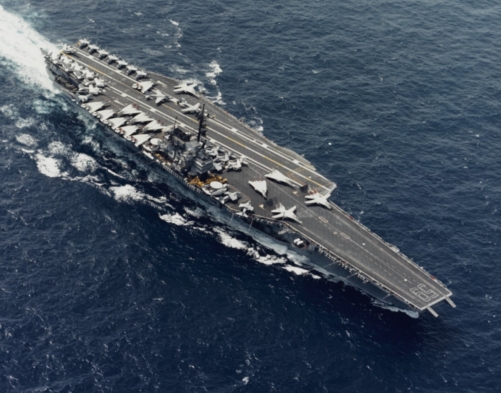
NH 97657-KN. USS Forrestal (CV-59). USS Forrestal (CV-59) Underway in 1987, with three F-14s and an A-6 on her catapults. Official U.S. Navy Photograph, from the collections of the Naval History and Heritage Command. Download image.
1 Oct 1955: Secretary of the Navy Charles S. Thomas, RADM Ingolf N. Kiland, Commandant of the Fifth Naval District, and W.E. Blewett, Jr., President of the Newport News Shipbuilding and Dry Dock Company, attended the ceremony when the ship hoisted aloft her commissioning pennant at 1430 at Norfolk Naval Shipyard at Portsmouth, Virginia; Captain Roy L. Johnson was the first commanding officer. The huge aircraft carriers of the Forrestal class were so large when compared to previous carriers that veterans referred to them as supercarriers. Forrestal commissioned with four steam catapults, two forward and two on her angled flight deck, enabling her to launch aircraft more rapidly. During the post-World War II period several developments prepared naval aviation to provide a credible nuclear deterrent against East Bloc expansion: building Forrestal, reducing the weight and dimensions of nuclear weapons, and developing aircraft capable of dropping them, including Douglas A-3 Skywarriors. From her home port in Norfolk, Va., Forrestal spent the first year of her commissioned service in intensive training operations off the Virginia capes and in the Caribbean. An important assignment became training aviators in the use of her advanced facilities, a duty on which she often operated out of Mayport, Fla.
Dec 1955-Jan 1956: Helicopter Utility Squadron (HU)-2 Detachment 42 operated a pair of Piasecki (Vertol) UH-25B Retrievers on board for search and rescue purposes to winch survivors of downed aircraft out of the water. Meanwhile, a pair of McDonnell Douglas A-4 Skyhawks, one a night attack variant and the other an electronic warfare conversion, together with a couple of Beech TC-45J Kansans, also flew from the ship to qualify their pilots to operate from carriers. Just after the New Year Fighter Squadron (VF)-41 flew 11 McDonnell F-2C Banshees on board for carrier qualifications, joined by 14 Douglas A-1H Skyraiders and one Kansan from Attack Squadron (VA)-42 and 13 Vought F7U-3M Cutlass, from VA-86. These became the first aircraft to operate from the carrier.
3 Jan 1956: CDR Ralph L. Werner, commanding Air Task Group-1, made the first fixed wing aircraft landing on board Forrestal when he made three touch-and-go landings after which he made the first full-stop landing, in his North American FJ-3 Fury during the afternoon watch at about 1440. A few hours later he piloted the same aircraft to make the first catapult launch from the huge carrier. Meanwhile, CDR William M. Harnish, commanding officer of VF-21, made the second landing, also in a Fury, at approximately 1445. LT Vincent Darcey of the air group was the landing signal officer for both traps. Sailors painted both aircraft in the Navy's new white and gray 'atomic' paint scheme. The ship sailed to the east of Norfolk.
24 Jan-28 Mar 1956: Forrestal completed her shakedown cruise in Caribbean waters, operating principally off Guantánamo Bay, Cuba .
23-27 Apr 1956: The ship accomplished her final acceptance trials off the coast of Virginia.
4 May 1956: The carrier entered the yard for repairs which included replacing her original propeller shafts. Forrestal's Command History Report noted that completing this work "greatly improved her performance."
29 Oct-12 Dec 1956: Worsening tensions in the Middle East erupted into Operation Kadesh, Israeli attacks against the Egyptians in the Sinai Peninsula and along the Suez Canal. The next day the British and French issued an ultimatum to the Israelis and Egyptians to pull their forces back 10 miles from either side of the vital waterway to bring about the early cessation of hostilities and to safeguard the free passage of the canal. The Israelis accepted the terms of the ultimatum but the Egyptians angrily refused to comply. ADM Arleigh A. Burke, the Chief of Naval Operations, alerted the Sixth Fleet to standby to evacuate Americans stranded by the crisis in Haifa and Tel Aviv, Israel, Beirut, Lebanon, and Alexandria, Egypt. By 4 November, ships evacuated 1,702 people, naval helos took out 165 more and Air Force crews pulled 310 refugees from harm's way, often during extremely perilous situations from gunfire, errant bombs or navigational hazards. Just as destroyer Strong (DD-758) arrived at Gaza and anchored 3,000 yards off the port to disembark 21 members of a UN truce inspection team, an Egyptian ammunition dump exploded, showering the area with molten fragments and debris. From their vantage point crewmembers also observed mortar and small arms fire as the Israelis and Egyptians fought over the strategic city, culminating in strafing and bombing runs by Israeli aircraft against Egyptian troops who refused to surrender. The Sailors also witnessed the pitiable spectacle as the fighting forced hundreds of people to leave on foot, carrying their few belongings as they drove sheep and goats before them. Meanwhile, the Anglo-French ultimatum expired at 0430 on Halloween, and the two allies dispatched a huge expeditionary force that bombarded Egyptian forces across Egypt. At dawn on 5 November they began Operation Musketeer, landing commandoes, Marines and specialized troops at key points along the strategic canal to prevent the Egyptians from closing it by sinking ships or laying mines. The fighting raged into the next day, when British Prime Minister Sir Anthony Eden announced a cease-fire notice to take effect at midnight of the 6th. Canadian Secretary of State for External Affairs Lester B. Pearson proposed the creation of a UN peacekeeping force to separate the combatants, and a majority of that body's members agreed to support his resolution. Orders directed a vast number of American ships to rendezvous and concentrate in Atlantic waters off east coast ports, including Forrestal, which put to sea from Mayport. Due to concerns over possible Soviet submarine attacks should the crisis escalate, CINCLANTFLT authorized ships proceeding independently to do so at high speed, consistent with weather and sea conditions. Ships set sail from various U.S. ports, arriving at holding areas and mustering ports as type commanders desired by 10 December. By 17 November, RADM Murr E. Arnold, Commander, Carrier Division 4 and Task Force 26, broke his flag from Forrestal in command of a powerful concentration of ships that rendezvoused near 36-30-N, 27-18-17-W, in the eastern Atlantic around the Azores Islands, also including; attack aircraft carrier Franklin D. Roosevelt (CVA-42), heavy cruiser Des Moines (CA-134), radar picket destroyers Charles P. Cecil (DDR-835), Corry (DDR-817), O-Hare (DDR-889) and Stickell (DDR-888), destroyers Douglas H. Fox (DD-779), Healy (DD-672), John Hood (DD-655), Laffey (DD-724), Lowry (DD-770), Robinson (DD-562), Sigourney (DD-643) and Stormes (DD-780), store ship Rigel (AF-58) and oiler Severn (AO-61). Additional ships relieved some of these vessels during the following days to enable the original ships to take on fuel or achieve repairs. The carriers conducted air operations "as practicable" to enhance their readiness, and utilized their aircraft to evaluate experiments determining the maximum air group loading for "executing war missions" as they maintained readiness to enter the Mediterranean should their presence be necessary. CINCLANTFLT tentatively scheduled attack aircraft carrier Lake Champlain (CVA-39) to relieve Franklin D. Roosevelt. Forrestal returned to Norfolk to prepare for her first deployment with the Sixth Fleet in the Mediterranean.
15 Jan-22 Jul 1957: The ship made her first deployment to the Mediterranean. On this, as on her succeeding tours of duty in the Mediterranean, Forrestal visited many ports to allow dignitaries and the general public to come on board and view the tremendous power for peace she represented. For military observers, she staged underway demonstrations to illustrate her capacity to bring air power to and from the sea in military operations on any scale.
2-3 Feb 1957: The ship passed through the Strait of Gibraltar for the first time and entered Mediterranean waters. During this deployment she also conducted underway demonstration cruises for Prince Rainier III and Princess Grace of Monaco, and for Mohammad R. Pahlavi, the Shah of Iran.
29 Mar-3 Apr 1957: Forrestal steamed off the Greek isle of Rhodes.
5-7 Apr 1957: The ship appeared briefly off Beirut, Lebanon.
17 Apr 1957: VADM Charles R. Brown, Commander, Sixth Fleet, escorted Sir Robert Laycock, the British Governor of Malta, and 26 other high ranking British government and military officials including VADM Durnford Slater, RN, RADM Geoffrey Brittian, RN, and RADM Lee Barber, RN, onto the ship to witness flight operations and aircraft demonstrations. The British officials visited as guests of RADM Arnold and CAPT William E. Ellis, the commanding officer of Forrestal, and VADM Brown arrived on board from his flagship, heavy cruiser Salem (CA-139).
24 Apr-5 May 1957: A crisis occurred in the Middle East concerning rising pan-Arab nationalism, the withdrawal of European colonial powers and intrigues between Western and East Bloc factions, which threatened the throne of Jordanian King Hussein bin Talal (also known as King Hussein I). On the evening of the 25th, Admiral Burke directed VADM Brown to deploy his forces to the eastern Mediterranean to ensure that the Jordanians maintained their independence and not be subverted from within or attacked from without. "Once again," VADM Brown explained in a message to all hands of the Sixth Fleet, "we find ourselves dropping everything and rushing to the scene of the fire." By the next day Forrestal, Lake Champlain, heavy cruisers Des Moines and Salem and their destroyers rendezvoused and proceeded eastward at best possible speed into the crisis. Crew members worked at a feverish pace to prepare for action and at 0705 on the 27th, VADM Brown reported that he could launch attack aircraft and fighters at "first light tomorrow" should the emergency escalate. Concerns that they would have to evacuate Americans within the country prompted planning to deploy Marines into the Jordanian capital of Amman as armed escorts while helicopters flying from Forrestal covered the evacuations. Meanwhile, amphibious forces made for Beirut, Lebanon, and upon arriving they stood ready to deploy additional troops and equipment ashore or to evacuate United States civilians. These two groups of ships continued to maintain station in the eastern Mediterranean until diplomats diffused the tension. "In ten short days," VADM Brown told his men as they returned on the 5th, "from the time of our sudden departure for the eastern Mediterranean the striking fleet is back in Italian waters, for a NATO exercise which begins tonight. While everyone must be pleased to be back, I hope no one loses sight of the larger significance of what has happened. In the brief period of time we have successfully carried out an important national mission in the eastern Mediterranean and we have met an important NATO commitment in the central Mediterranean. The distance between the two assignments is about 1,500 miles as the crow flies. This performance has been a dramatic demonstration of the mobility and flexibility of the fleet and one in which all can be proud to have had a part."
13-14 Jul 1957: The ship passed through the Strait of Gibraltar into the Atlantic . Attack aircraft carrier Randolph (CVA-15) relieved Forrestal at the British dockyard and naval station at "The Rock" on 14 July.
22 Jul 1957: Forrestal returned to Norfolk for exercises off the North Carolina coast in preparation for her first NATO exercise in the North Sea , Operation Strikeback.
24 Jul-11 Aug 1957: The carrier completed work at Norfolk Naval Shipyard.
3 Sep-22 Oct 1957: During Strikeback, Forrestal drilled in the highly important task of coordinating United States naval power with that of other NATO nations. Forrestal steamed off the Clyde River Estuary in Scotland (14-16 September) and visited Southampton in England (30 September-11 October). Observers estimated that as many as 65,000 people visited or viewed the ship at the latter port, including U.S. Ambassador to the Court of St. James John H. Whitney.
20 Dec 1957-20 Feb 1958: Forrestal's crew and shipyard workers accomplished repairs and upkeep at the Norfolk Naval Shipyard.
28 Mar-24 May 1958: The ship participated in a series of major fleet exercises off the North Carolina , Georgia and Florida coasts, as well as taking part in experimental flight operations. She also made a brief visit to Miami , Fla. (19-21 May). During LantRaEx 1-58 in May, LTJGs Strang and Woods of VA-85 flew two A-1H Skyraiders from Forrestal as she steamed off the coast of Jacksonville nonstop to NAS North Island in California. They completed their flight normally flying at altitudes below 1,000 feet to demonstrate the low level and long range capabilities of their squadron, and then returned nonstop to the carrier two days later.
11-17 Jul 1958: Rival Lebanese political and religious factions clashed resulting in rioting that threatened that Levantine country. Tensions produced a crisis when Muslims rebelled against the Lebanese government at the same time that Iraqi army officers overthrew the pro-Western Hashemite monarchy in a coup détat in Baghdad on 14 July. Lebanese President Camille Chamoun requested assistance from President Dwight D. Eisenhower and the latter initiated Operation Blue Bat on the following day, which included the Sixth Fleet and supporting Air Force and Army commands landing over 14,000 Marines and soldiers at Beirut to restore order and protect Americans trapped in the fighting. During the crisis Forrestal operated in the eastern Atlantic to back-up naval operations in the Mediterranean, and to be ready to intervene if the crisis escalated. She sailed from Norfolk to embark CVG-10 at Mayport two days later, and then she patrolled the Atlantic until returning to Virginian waters when the crisis subsided and the Americans ultimately withdrew most troops from Lebanon.
2 Sep 1958-12 Mar 1959: Setting sail from Norfolk at 0800 Forrestal began her second tour of duty in the Mediterranean as she combined a program of training, patrol, and participation in major exercises with ceremonial hospitality and public visiting. The A-4Bs of VA-12 became the first Skyhawks to deploy on board the ship.
12 Sep 1958: The ship passed through the Strait of Gibraltar.
16-17 Sep 1958: Forrestal relieved attack aircraft carrier Saratoga (CVA-60) at Augusta Bay, Sicily.
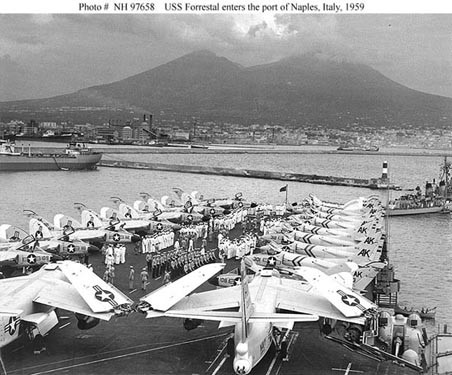
14-27 Oct 1958: The carrier encountered "a major failure" of her No. 1 Catapult, however, and her crew and civilian technicians accomplished the extensive repairs while visiting Naples, Italy, the first time that they attempted such work outside of a shipyard. Secretary of Defense Neil H. McElroy led her guest list during this cruise.
2 Dec 1958: RADM Roy L. Johnson relieved RADM Charles D. Griffin as Commander, Carrier Division 4, during a ceremony on board Forrestal at Barcelona, Spain.
18 Dec 1958-3 Jan 1959: The crew and civilian workers again accomplished extensive repairs to a catapult while visiting Naples, Italy, this time to No. 2. The ship then led Task Force 60 in Operation Big Deal, a joint Second and Sixth Fleet exercise.
1-2 Mar 1959: Franklin D. Roosevelt relieved Forrestal at Pollensa Bay at Palma de Mallorca in the Balearic Islands.
3-4 Mar 1959: Forrestal passed through the Strait of Gibraltar westbound.
12 Mar 1959: Returning to Norfolk, Forrestal continued to train new aircrew, constantly maintaining her readiness for instant reaction to any demand for her services brought on by international events.
28 Mar 1959: King Hussein I of Jordan visited the ship for a luncheon while she moored to Pier 12 at Norfolk.
1 Apr 1959: Forrestal entered Norfolk Naval Shipyard for her first regular overhaul.
30 Sep-1 Oct 1959: Forrestal sortied to evade Hurricane Hannah as the storm swept toward the Virginia area with winds that peaked at 130 mph on 1 October, however, the hurricane turned to eastward and dropped to an extra tropical storm south of Iceland.
Nov 1959: The ship completed a weapons evaluation exercise with USAF pilots.
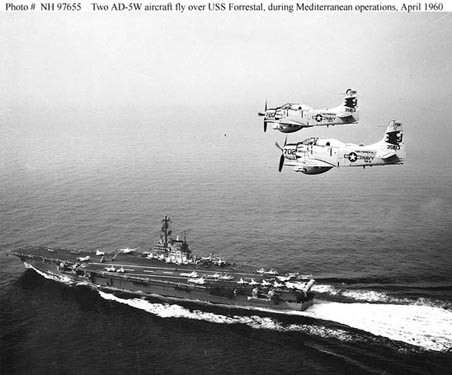
14 Feb 1960: Forrestal relieved Saratoga at Pollensa Bay. Among the ports she subsequently visited usual to a Mediterranean deployment the ship put into Split, Yugoslavia, a port-of-call that generated heated controversy in the media due to the tensions still existing between the communists and the West.
7 Mar 1960: The Bureau of Ships issued a report concerning the endurance of Forrestal and her sister ships, which stated in part that "Conventionally powered Aircraft Carriers should have sufficient range and endurance to allow approach to the target, high-speed run-in, attack, retirement, and a sufficient amount of reserve fuel to replenish Escorts."
9 Sep-22 Oct 1960: The carrier completed repairs and maintenance in drydock at the Norfolk Naval Shipyard.
26 Oct 1960: RADM Forsyth Massey relieved RADM Robert E. Dixon as Commander, Carrier Division 4, during a ceremony on board at Norfolk .
21 Mar 1961: Archbishop Makarios III, President of Cyprus and ethnarch [national leader] of Greek Cypriots, visited the ship as the guest of VADM George W. Anderson, Jr., Commander, Sixth Fleet, and RADM Massey.
9 Aug 1961: Secretary of the Navy John B. Connally visited the ship and spoke to the crew over her closed circuit television system, congratulating the men for achieving their second coveted Battle Efficiency "E" award.
25 Aug 1961: By the time Forrestal returned from her fourth deployment to the Mediterranean, CVG-8 amassed 26,000 flight hours, the equivalent of almost three years flying during less accelerated operations. In addition, the ship herself celebrated her 60,000th arrested landing. USMC LTV F-8 Crusaders from Marine Fighter Squadron (VMF)-333 also qualified for carrier operations on board Forrestal.
Sep 1961-13 Jan 1962: Forrestal completed work at Norfolk Naval Shipyard.
Held by NeuraWeb Global Inc. and kept permanently. Her association may claim this record and maintain it.