Navy · CV-5 · Yorktown class
USS Yorktown
Commissioned 30 September 1937 · 3 battle stars · 3 honoured here served aboard her
They served aboard her
Commissioned 30 September 1937 · 3 battle stars · 3 honoured here served aboard her
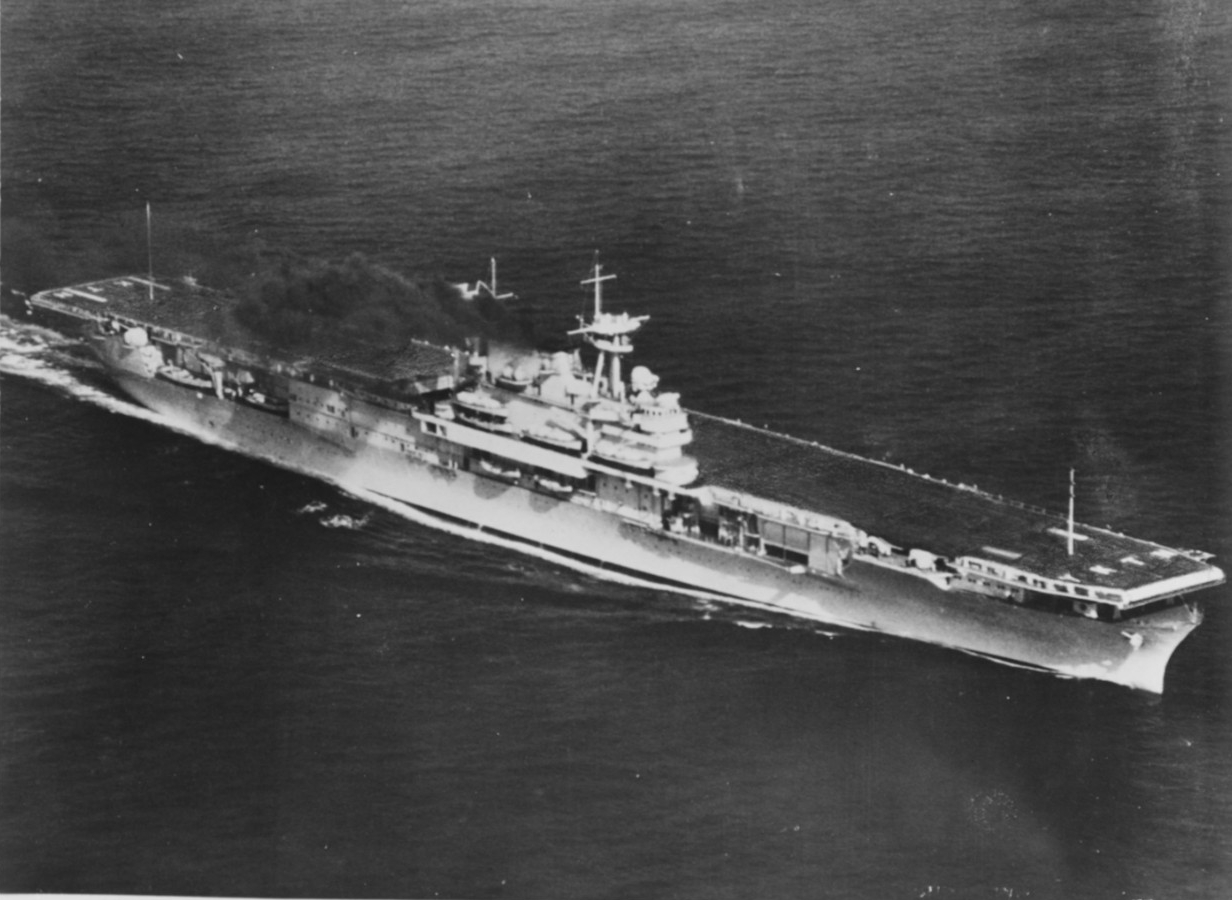
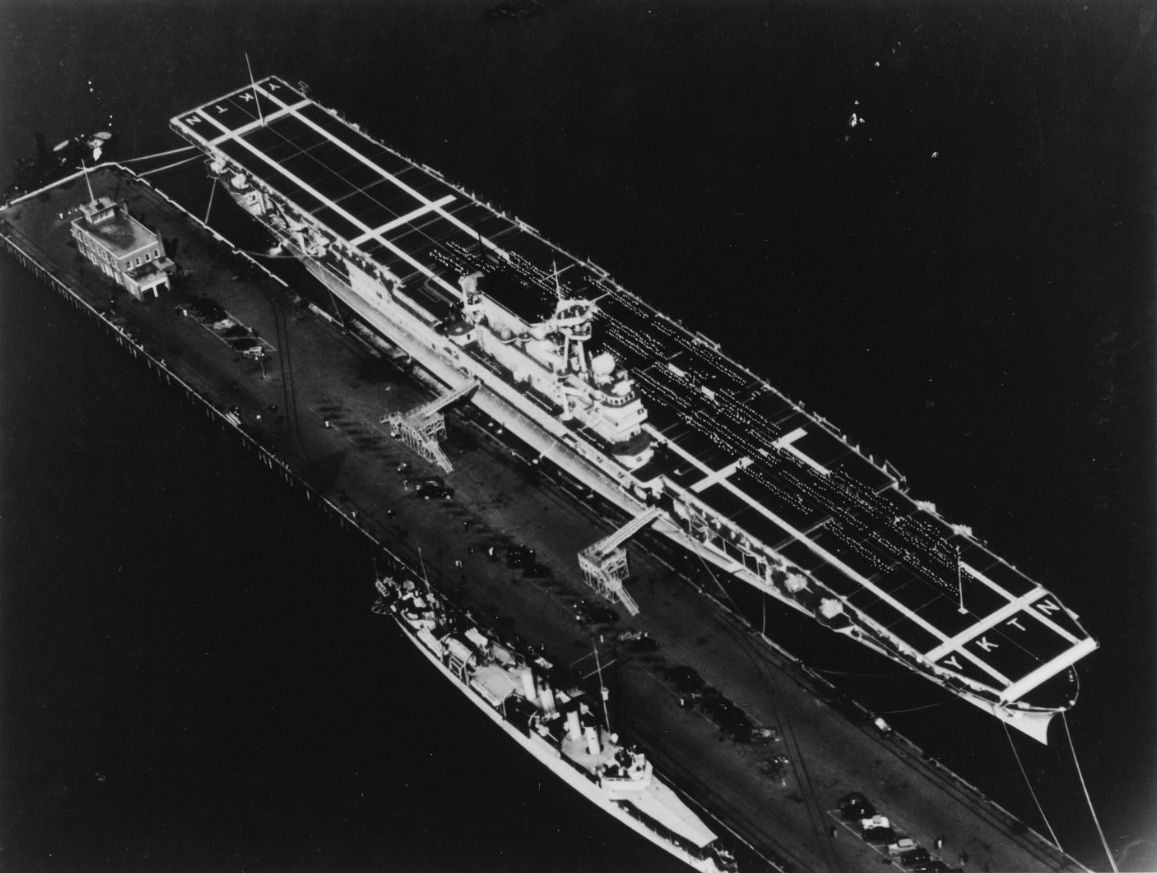
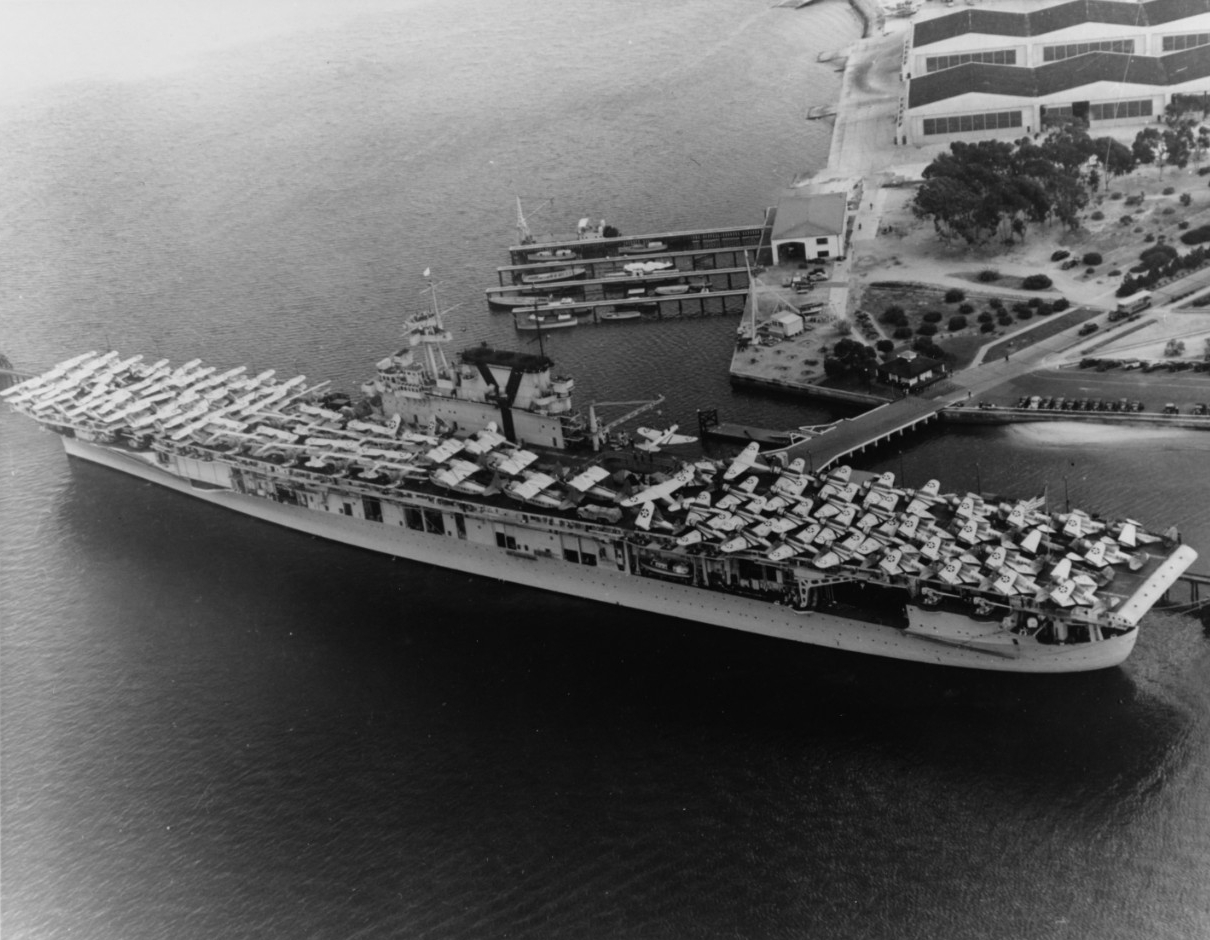
USS Yorktown (CV-5) was commissioned at Naval Operating Base Norfolk, Virginia, on 30 September 1937, with Captain Ernest D. McWhorter in command. After shakedown training that took the aircraft carrier to the Virgin Islands, Haiti, Guantanamo Bay, and Cristobal in the Panama Canal Zone, she returned to Norfolk for subsequent repairs in the fall of 1938. After operating along the eastern seaboard into early 1939, Yorktown participated in her first war game, Fleet Problem XX, which called for one fleet to control the sea lanes in the Caribbean against the incursion of a foreign European power while maintaining sufficient naval strength to protect vital American interests in the Pacific. The maneuvers were conducted with her sistership, USS Enterprise (CV-6), and witnessed by President Franklin D. Roosevelt. The fleet problem revealed—with convoy escort, antisubmarine defense, and various attack measures against surface ships and shore installations—that if war came to American shores, aircraft carriers could make significant contributions to the war fighter. After steaming to the Pacific in late April 1939, she operated out of San Diego, California, into 1940. Yorktown participated in another fleet problem (Fleet Problem XXI) that would ultimately characterize future warfare in the Pacific. The two-part exercise was devoted to screening and scouting, convoy protection, and the seizure of advanced bases. It also pointed out the need to coordinate Army and Navy defense plans for the Hawaiian Island. Yorktown operated in Pacific waters until April 1941 when the success of German U-boats preying upon British shipping in the Atlantic required a shift of American naval strength. Therefore, the Navy transferred a substantial force from the Pacific including Yorktown, a battleship division, and accompanying cruisers and destroyers, to reinforce the Atlantic Fleet. From that time until the United States officially entered World War II, Yorktown conducted multiple patrols in the Atlantic to enforce American neutrality.
In the aftermath of the Japanese attack on Pearl Harbor on 7 December 1941, the Pacific Fleet was reeling. Although there were no American aircraft carriers damaged or sunk during the attack, the fact remained that there were only three carriers in the Pacific—Enterprise, Lexington (CV-2), and Saratoga (CV-3). While Ranger (CV-4), Wasp (CV-7), and the recently commissioned Hornet (CV-8) remained in the Atlantic, Yorktown steamed for the Pacific reaching San Diego on 30 December 1941, where she shortly thereafter became flagship for Rear Admiral Frank J. Fletcher's newly formed Task Force (TF) 17. On 6 January 1942, Yorktown on her first mission in a new theater, successfully escorted a convoy carrying Marine reinforcements to American Samoa. TF-17, in conjunction with TF-8, also conducted similar troop movements to Tutuila and Pago Pago to augment the garrison already in place at those locations. At the end of January, TF-17 and TF-8 parted ways. TF-8, centered on Enterprise, steamed for the Marshall Islands, while TF-17, centered on Yorktown, steamed for the Gilberts.
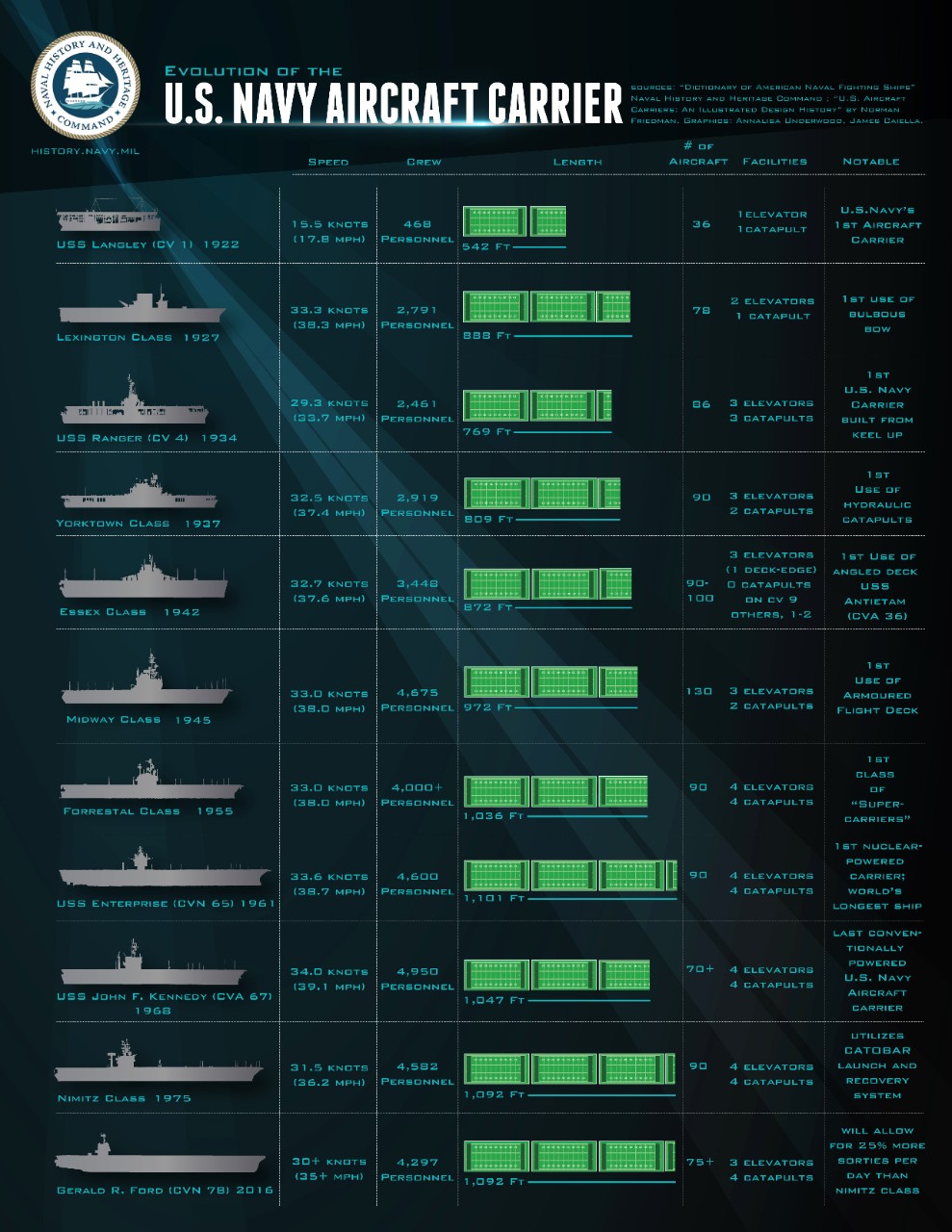
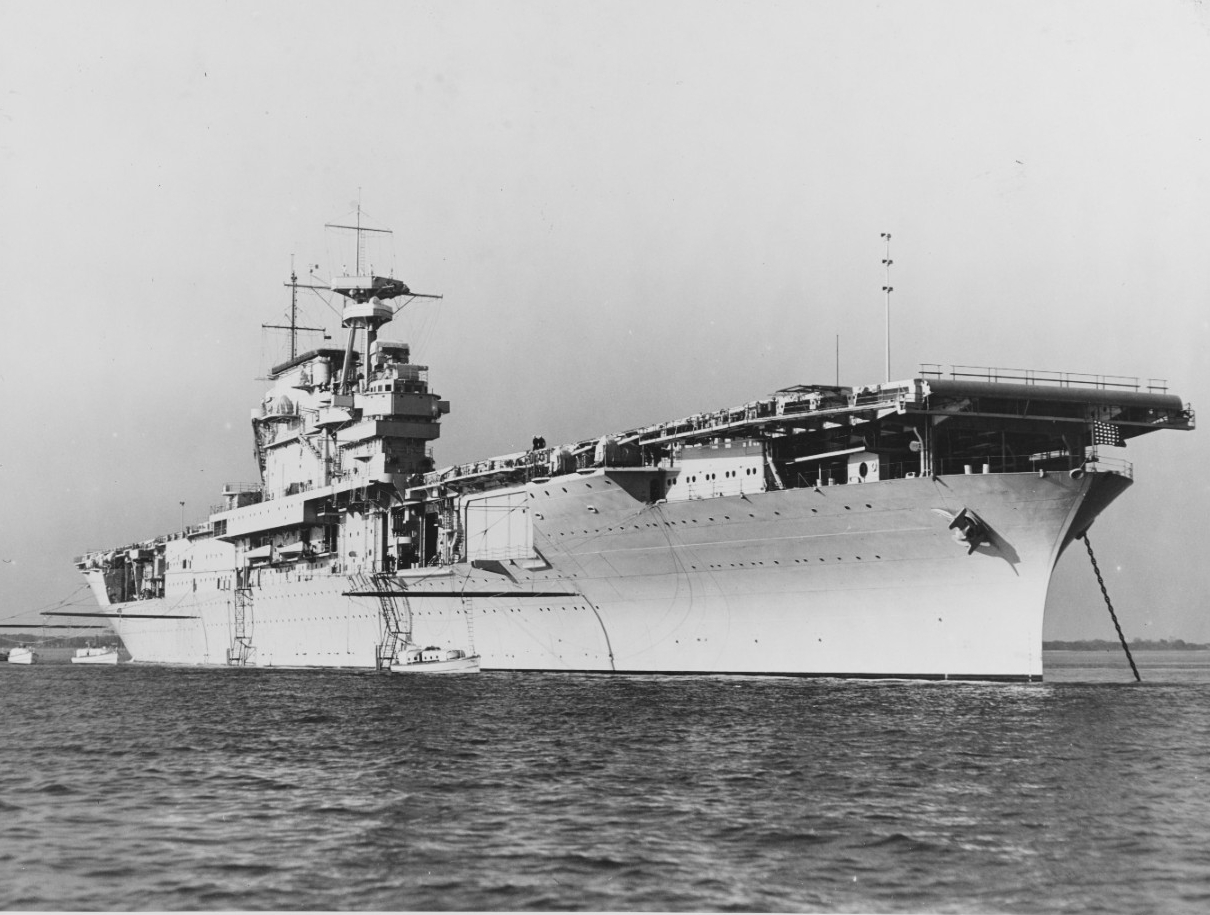
(CV-5: displacement 19,800; length 809'6"; beam 83'1"; draft 28'0"; speed 32.5 knots; complement 2,919; armament. 8 5-inch, 16 1.1-inch, 28 .50 caliber machine guns; aircraft 81-85; class Yorktown)
In the first American offensive of the war, Yorktown, screened by Louisville (CA-28), St. Louis (CL-49), and four destroyers, launched 11 torpedo planes (Devastators) and 17 scout bombers (Dauntlesses) in the early morning of 31 January that hit what Japanese shore installations and shipping they could find at Jaluit, however, adverse weather conditions hampered the mission. Six of Yorktown’s aircraft were lost. Other Yorktown aircraft attacked Japanese installations and ships at Makin and Mill Atolls. A second attack was planned, but was cancelled due to the weather. Yorktown’s force subsequently retired to the sea and later returned to Pearl Harbor for replenishment. On 14 February, Yorktown was underway for the Coral Sea.
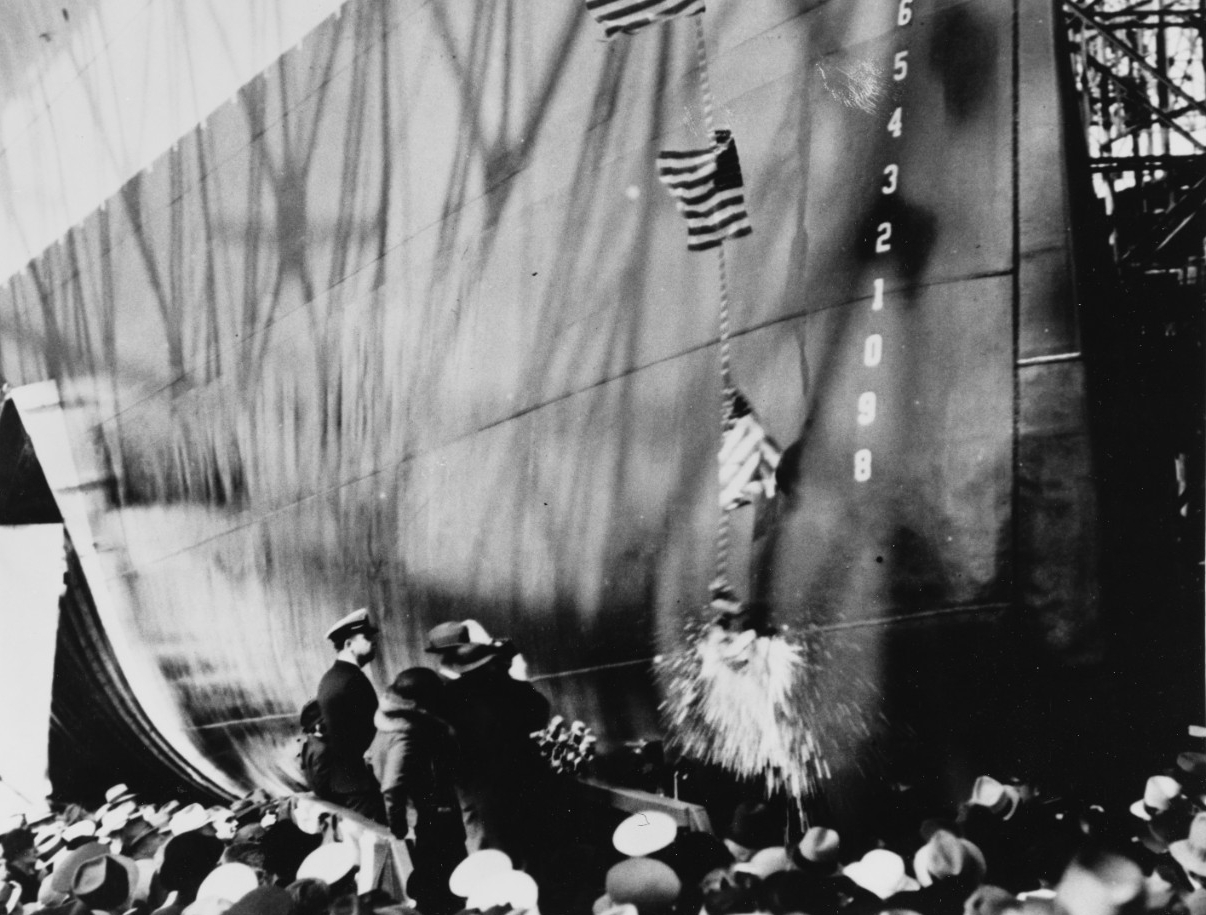
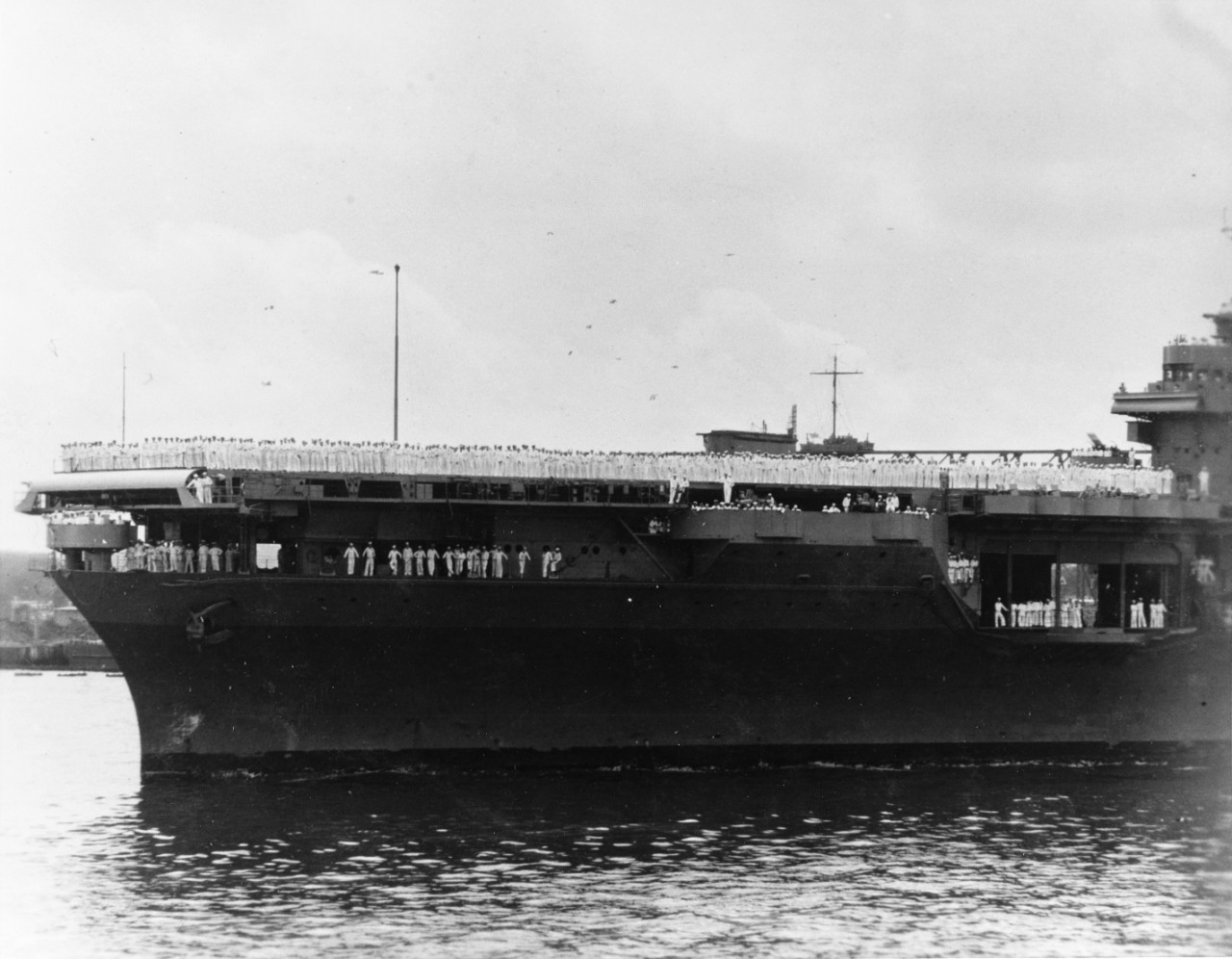
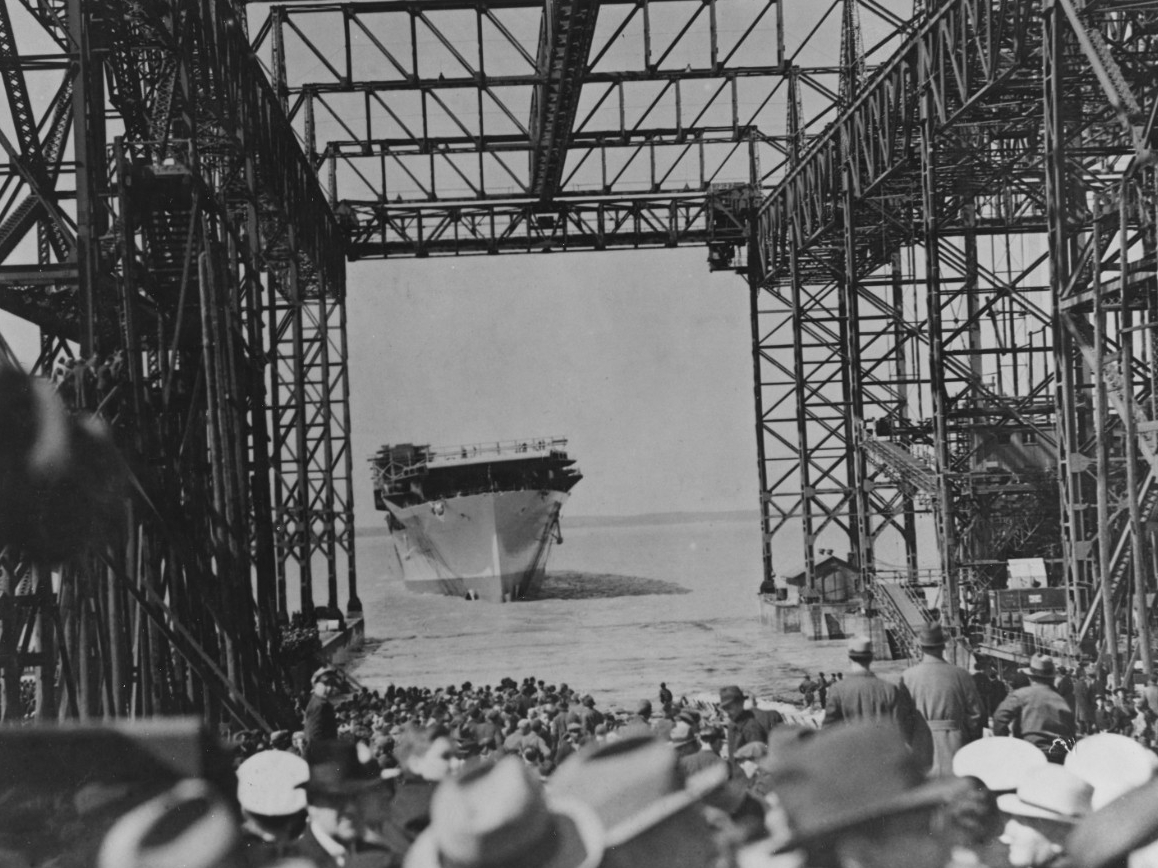
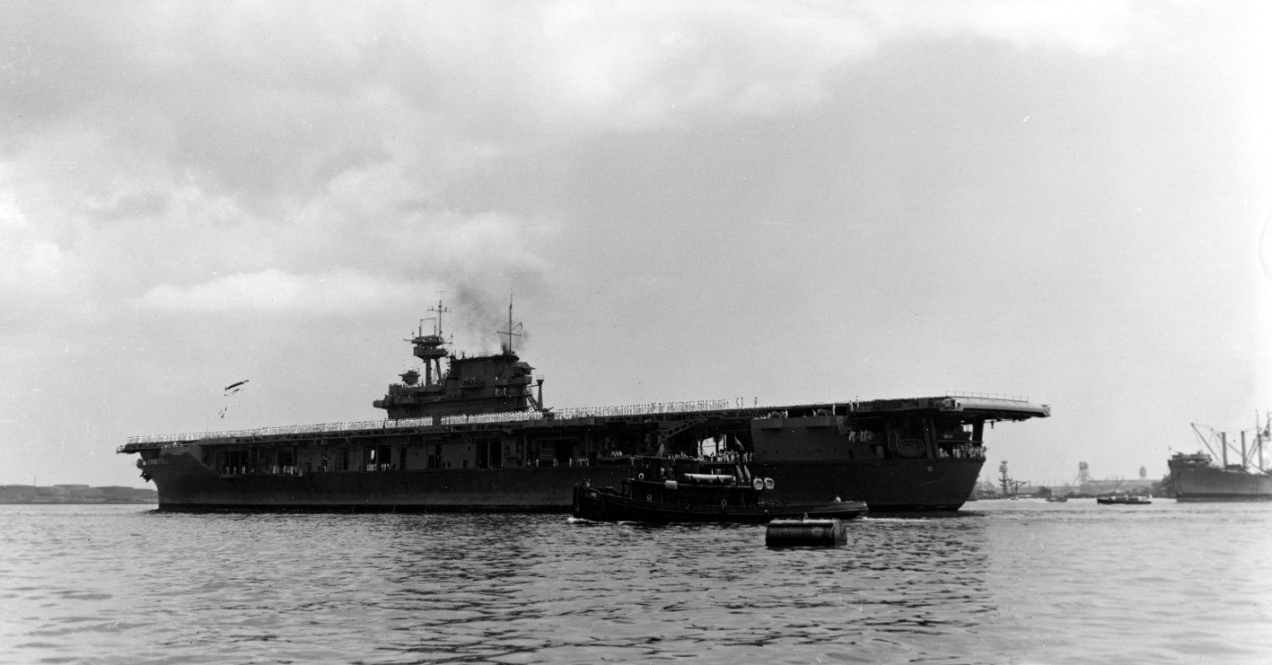
The third Yorktown (CV-5) was laid down on 21 May 1934 at Newport News, Va., by the Newport News Shipbuilding and Drydock Co.; launched on 4 April 1936; sponsored by Mrs. Franklin D. Roosevelt; and commissioned at the Naval Operating Base (NOB), Norfolk, Va., on 30 September 1937, Capt. Ernest D. McWhorter in command.
On 6 March, Yorktown rendezvoused with TF-11, which was centered on Lexington, and steamed towards Rabaul and Gasmata to attack Japanese shipping in an effort to stop the Japanese advance and to cover the landing of Allied troops at Noumea, New Caledonia. However, as the powerful Allied force approached their area of operations, word came the Japanese were advancing towards Australia with a landing at Huon Gulf, in the Salamaua-Lae area on the eastern end of New Guinea. The move prompted the task force commander, Rear Admiral Wilson Brown, to change the objective to the Salamaua-Lae sector. On 10 March, both flattops launched attacks on shipping at Salamaua and auxiliaries moored close in shore at Lae. Of the 104 aircraft launched, only one was lost to antiaircraft fire. For many of the pilots, it was their first combat experience. The task force retired to sea, and then resumed patrols in the Coral Sea. After the raid, the situation in the South Pacific appeared to have stabilized, so the task force steamed for the harbor at Tongatabu, in the Tonga Islands, for needed upkeep. However, the enemy was soon on the move.
After fitting out, the aircraft carrier trained in Hampton Roads and in the Southern Drill Grounds off the Virginia capes into January of 1938, conducting carrier qualifications for her newly embarked air group.
On 27 April, Yorktown was underway once more for the Coral Sea, however, on 3 May, word came from Australian-based aircraft that Japanese transports were disembarking troops and equipment at Tulagi in the Solomon Islands. The Japanese planned to commence construction of a seaplane base there to support their southward thrust. Yorktown accordingly set course and by the following day was within striking distance of the newly established Japanese beachhead. Yorktown launched its first strike at daybreak. Yorktown's air group made three consecutive attacks on enemy ships and shore installations at Tulagi and Gavutu. In the attacks, Yorktown’s aircraft delivered 22 torpedoes and 76 bombs that sank Japanese destroyer Kikuzuki, three minecraft, and four barges. Meanwhile, later that day, a cruiser-destroyer force joined the group completing the composition of the Allied task force on the eve of the crucial Battle of the Coral Sea.
Yorktown sailed for the Caribbean on 8 January 1938 and arrived at Culebra, Puerto Rico, on 13 January. Over the ensuing month, the carrier conducted her shakedown, touching at Charlotte Amalie, St. Thomas, Virgin Islands; Gonaives, Haiti; Guantanamo Bay, Cuba; and Cristobal, Panama Canal Zone. Departing Colon Bay, Cristobal, on 1 March, Yorktown sailed for Hampton Roads and arrived there on the 6th and shifted to the Norfolk Navy Yard the next day for post-shakedown availability.
On the morning of 6 May, Allied forces gathered under the tactical command of Fletcher. At daybreak the following morning, the task force with cruisers and destroyers headed toward the Louisiade archipelago to intercept any enemy attempt to move toward Port Moresby. Meanwhile, while Fletcher moved northward with his two flattops and their screens in search of the enemy, Japanese search planes located oiler Neosho (AO-23) and her escort Sims (DD-409). Two waves of Japanese planes, first high level bombers and then dive bombers, attacked the two ships. Sims took three direct hits and sank quickly with a heavy loss of life. Neosho took seven direct hits, but remained afloat for a few more days until she was sunk by the Allies. Both ships performed a valuable service in that they drew the Japanese away from the carriers. Meanwhile, Yorktown and Lexington's aircraft located Shoho and punished the Japanese light carrier unmercifully, sending her below the waves. The following morning, 8 May, a search plane from Lexington located the carriers Zuikaku and Shokaku. Yorktown’s aircraft scored two hits on Shokaku that heavily damaged her flight deck and thus prevented her from launching aircraft.
After undergoing repairs through the early autumn of 1938, Yorktown shifted from the navy yard to NOB Norfolk on 17 October and soon headed for the Southern Drill Grounds for training.
While the carrier’s aircraft continued to pound the Japanese flattops, intelligence reported the enemy had located the American carriers and were planning a retaliatory strike. Sure enough, shortly before noon, the attack came. Although American Wildcats were able to slash through the Japanese formations, downing 17, some of the enemy aircraft were able to slip through the fighters. Lexington took two torpedoes on her port side and three bomb hits causing her to list. Meanwhile, Yorktown was having problems of her own. Although the carrier was able to dodge eight torpedoes, a bomb penetrated the flight deck and exploded below deck, killing or seriously injuring 66 of her crew. Yorktown’s damage control party managed to get the fires under control, but shortly thereafter, a massive explosion from Lexington rocked the ship. Despite a valiant effort by the crew, Lexington’s commander gave the “abandon ship” order. Once the crew was rescued from the water, a torpedo from a nearby cruiser was deployed into Lexington, which hastened the end of “Lady Lex.” The Battle of the Coral Sea was costly for both sides. The Japanese had won a tactical victory, inflicting comparatively heavy losses on the Allied force, however, the Allies, in stemming the tide of Japan's conquests in the south and southwest Pacific, had achieved a strategic victory. They had stopped the drive toward strategic Port Moresby and had saved the fragile lifeline between America and Australia.
Yorktown operated off the eastern seaboard, ranging from Chesapeake Bay to Guantanamo Bay, into 1939. As flagship for Carrier Division (CarDiv) 2, she participated in her first war game, Fleet Problem XX, along with her sistership Enterprise (CV-6) in February 1939. The scenario for the exercise called for one fleet to control the sea lanes in the Caribbean against the incursion of a foreign European power while maintaining sufficient naval strength to protect vital American interests in the Pacific. The maneuvers were witnessed, in part, by President Roosevelt, embarked in the heavy cruiser Houston (CA-30).
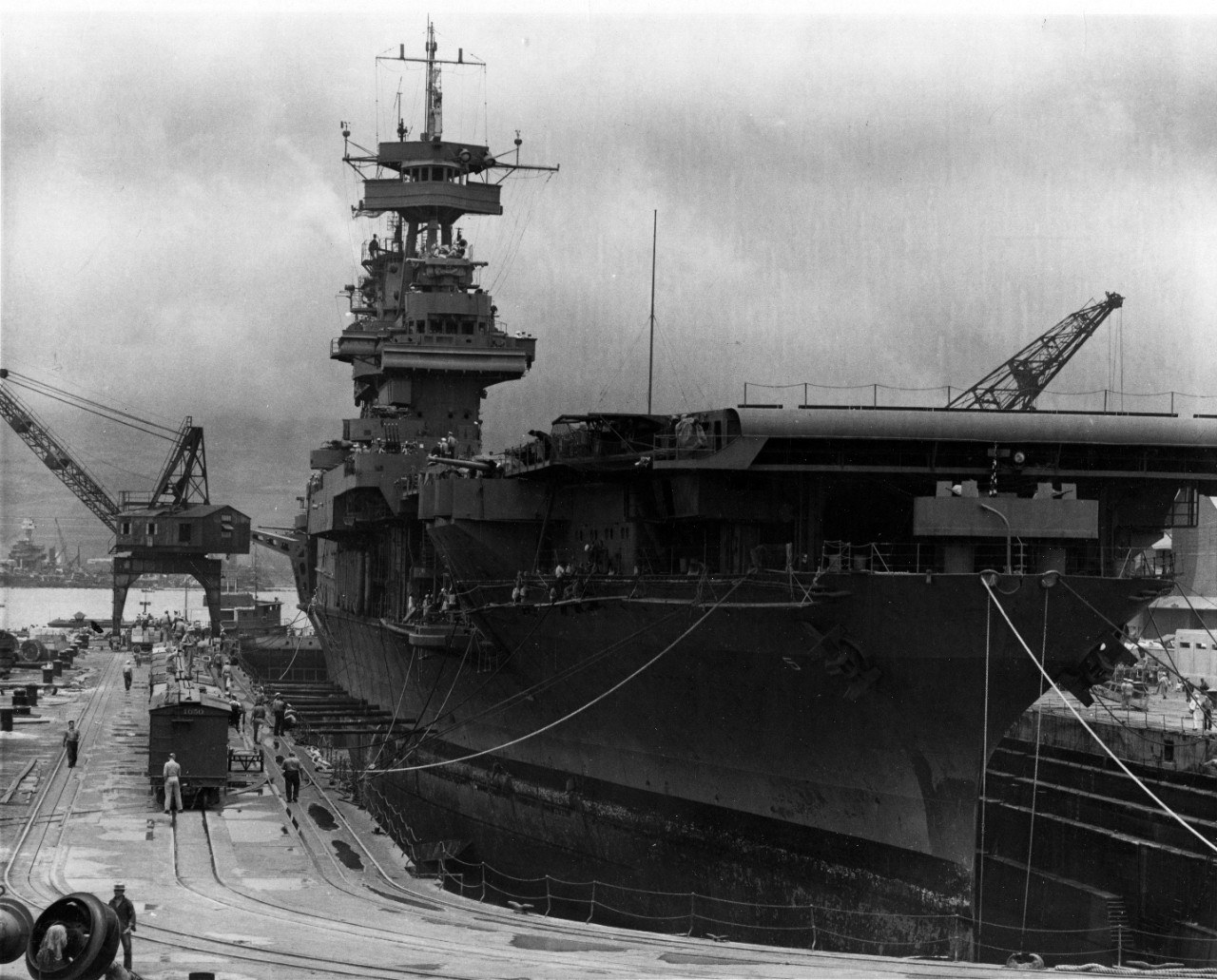
The damage Yorktown suffered during the battle was estimated to take about three months for the overhaul. Unfortunately, there was little time for repairs, because Allied intelligence—notably the cryptographic unit at Pearl Harbor—had gained enough information from decoded Japanese naval messages to estimate that the Japanese were on the threshold of a major operation aimed at two islets in a low coral atoll known as Midway. As Admiral Chester W. Nimitz began to plan for battle, which included Yorktown, yard workers at Pearl Harbor miraculously labored around the clock and made enough repairs to enable the ship to be put to sea. On 30 May, Yorktown steamed to Midway as the central ship of TF-17.
The critique of the operation revealed that carrier operations, a part of the scenarios for the annual exercises since the entry of Langley (CV-1) into the war games in 1925, had achieved a new peak of efficiency. Despite the inexperience of Yorktown and Enterprise (comparative newcomers to the Fleet) both carriers made significant contributions to the success of the problem. The planners had studied the employment of carriers and their embarked air groups in connection with convoy escort, antisubmarine defense, and various attack measures against surface ships and shore installations. In short, they worked to develop the tactics that would be used when war actually came.
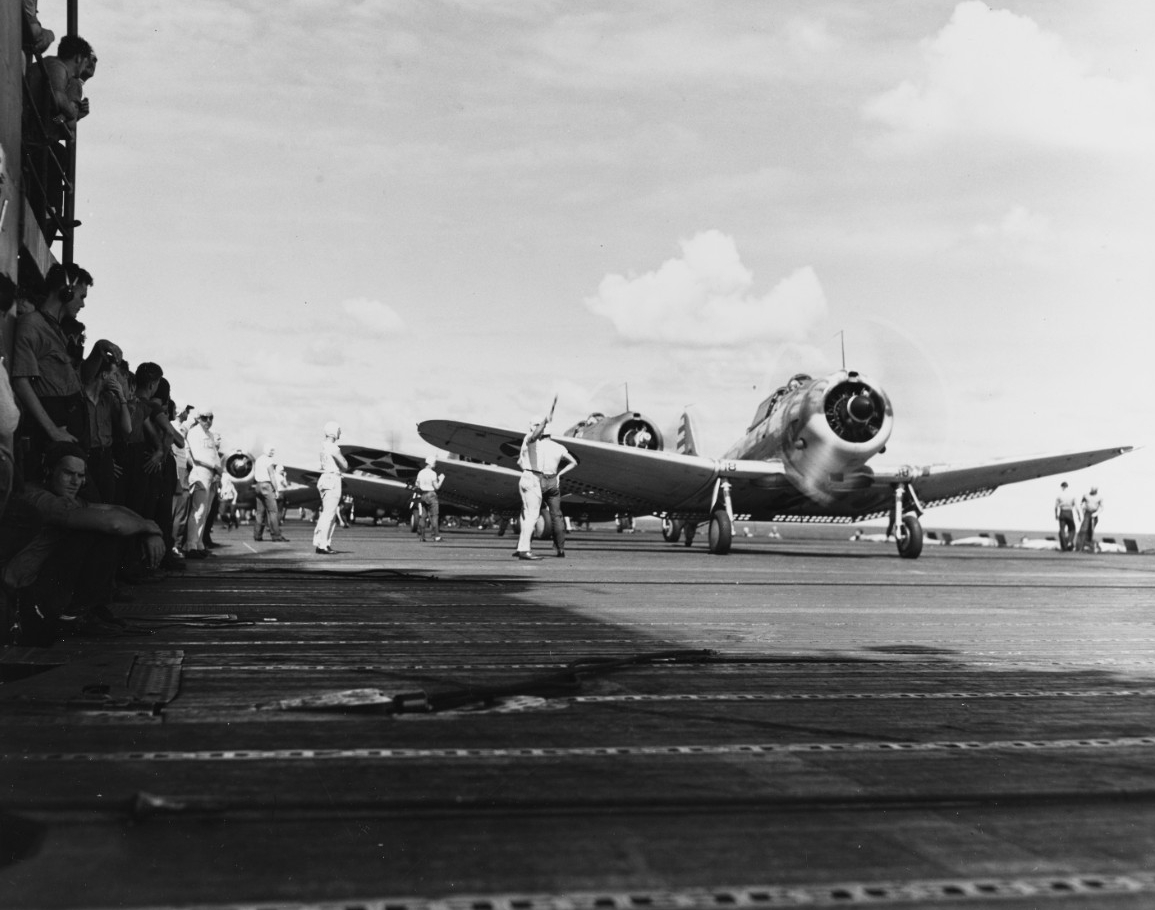
At dawn on 4 June, Yorktown launched a 10-plane group of Dauntlesses, which searched for a distance of about 100 miles out but found nothing. The group returned to the ship at 0830. When the last of the initial attack group had landed, Yorktown launched a second attack group. Meanwhile, Enterprise and Hornet launched their attack groups as well. Torpedo planes from the three flattops located the Japanese carrier striking force, but of the 41 launched only six returned. However, the destruction of the torpedo planes served a purpose. The Japanese had broken off their high-altitude cover to concentrate on the Devastators that were flying low above their ships. This left the skies above wide-open for the Dauntlesses. Yorktown's dive-bombers pummeled Soryu, making three lethal hits with 1,000-pound bombs that turned the ship into a flaming inferno. Meanwhile, Enterprise’s planes struck Akagi and Kaga turning both into fiery wrecks in a very short time. The bombs from the Dauntlesses caught all of the Japanese carriers in the midst of refueling and rearming operations, and the combination of bombs and gasoline was explosive and disastrous to the Japanese.
Following Fleet Problem XX, Yorktown returned briefly to Hampton Roads before sailing for the Pacific on 20 April. Transiting the Panama Canal a week later, Yorktown soon commenced a regular routine of operations with the Pacific Fleet. Operating out of San Diego into 1940, the carrier participated in Fleet Problem XXI that April.
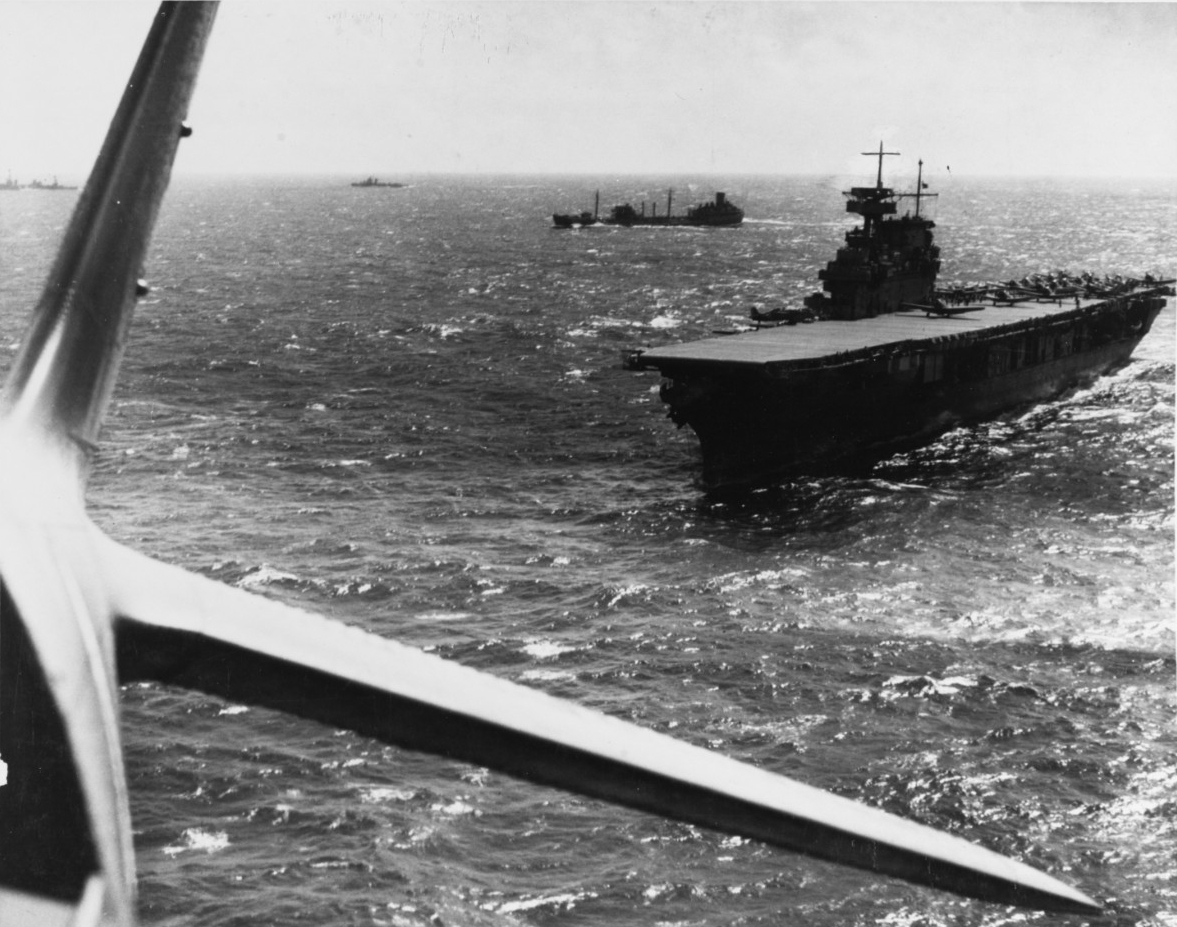
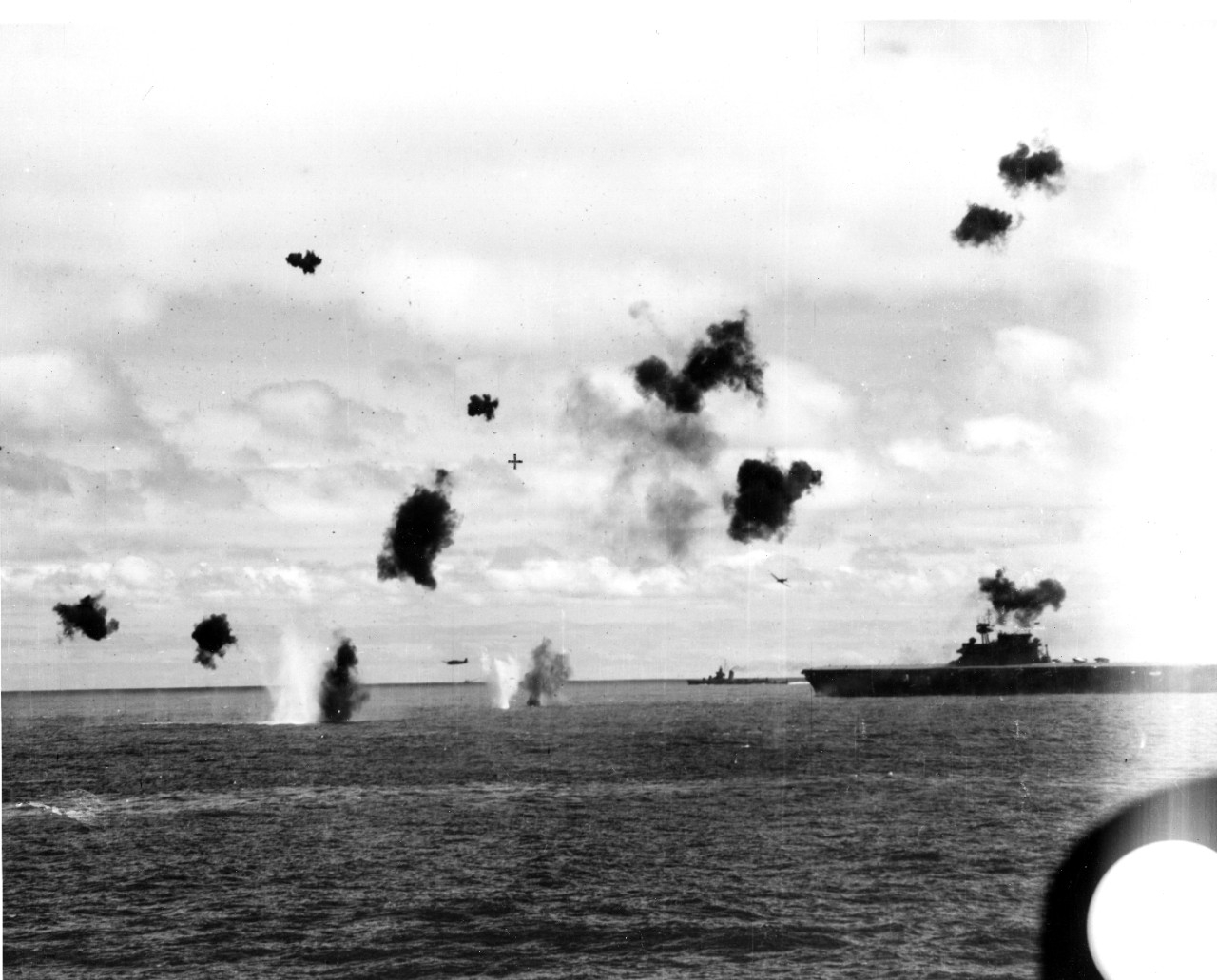
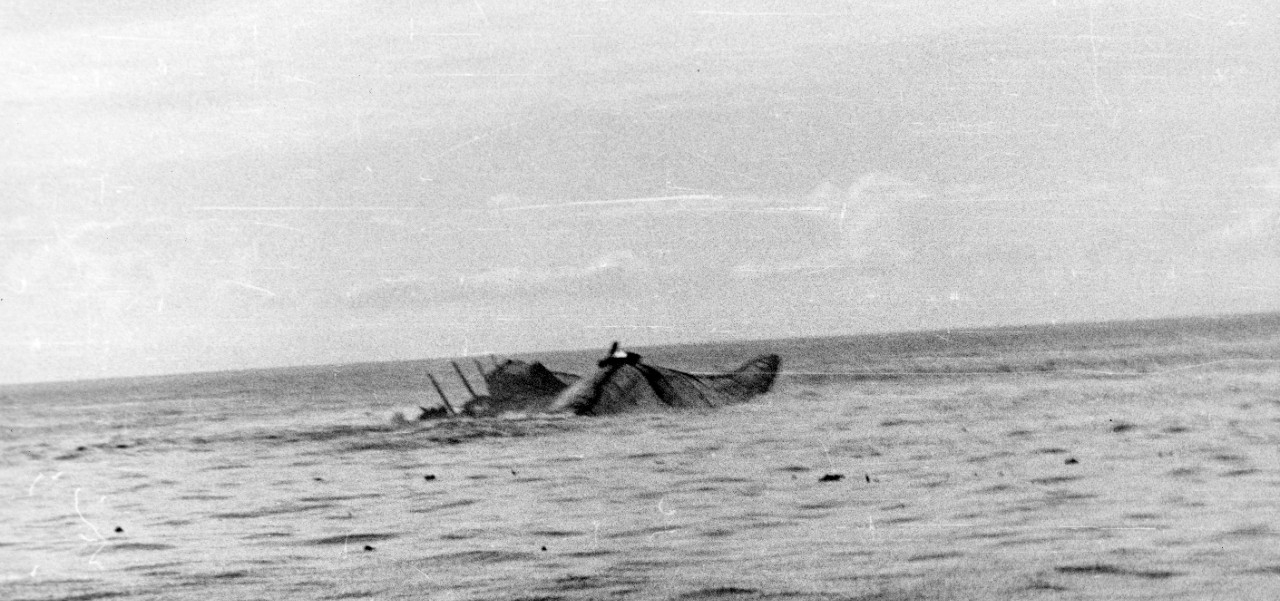
The Japanese had already lost three carriers, however, a fourth, Hiryu, remained at large. Separated from her sister ships, Hiryu launched a strike force of 18 “Vals” that soon located Yorktown. At about 1329, Yorktown’s radar picked up the incoming attack group, and subsequently launched her fighters. About 15 to 20 miles out, the Wildcats intercepted the Japanese and attacked vigorously. Planes were flying in every direction and many were falling from the sky. Despite the valiant effort to keep the enemy attack planes from Yorktown, three scored hits on the ship. Although the attack was devastating to Yorktown, she managed to somewhat recover and began to launch aircraft to fend off the Japanese attack. However, during the fighting, two torpedoes ripped through Yorktown’s port side. The carrier was mortally wounded. She lost power and went dead in the water with a jammed rudder and an increasing list to port. As the list continued to increase and all power lost, the “abandon ship” order was given. Although Yorktown was dead in the water, her aircraft were still fighting in the air, joining those from Enterprise in striking the Japanese carrier Hiryu late that afternoon. After taking four direct hits, the Japanese flattop was soon helpless. She was abandoned by her crew and left to drift. Yorktown had been avenged. Although efforts to save Yorktown were ongoing, the Japanese submarine I-158 managed to move into firing range undetected and fired torpedoes scoring two hits on Yorktown. On 7 June at 0701, the valiant flattop turned over on her port side and sank in 3,000 fathoms of water.
Fleet Problem XXI, a two-part exercise, included some of the operations that would characterize future warfare in the Pacific. The first part of the exercise was devoted to training in making plans and estimates; in screening and scouting; in coordination of combatant units; and in employing fleet and standard dispositions. The second phase included training in convoy protection, the seizure of advanced bases, and, ultimately, the decisive engagement between the opposing fleets. The last pre-war exercise of its type, Fleet Problem XXI, contained two exercises (comparatively minor at the time) where air operations played a major role. Fleet Joint Air Exercise 114A prophetically pointed out the need to coordinate Army and Navy defense plans for the Hawaiian Islands, and Fleet Exercise 114 proved that aircraft could be used for high altitude tracking of surface forces, a significant role for planes that would be fully realized in the war to come.
Yorktown received three battle stars for her World War II service. Although Yorktown’s service to the nation was relatively short, she played a significant role in stopping Japanese expansion and turning the tide of the war during the Battles of the Coral Sea and Midway.
With the retention of the Fleet in Hawaiian waters after the conclusion of Fleet Problem XXI, Yorktown operated in the Pacific off the west coast of the United States and in Hawaiian waters until the following spring, when the success of German U-boats preying upon British shipping in the Atlantic required a shift of American naval strength. Thus, to reinforce the Atlantic Fleet, the Navy transferred a substantial force from the Pacific including Yorktown, a battleship division, and accompanying cruisers and destroyers.
Yorktown departed Pearl Harbor on 20 April 1941 in company with Warrington (DD-383), Somers (DD-381), and Jouett (DD-396); headed southeast; transited the Panama Canal on the night of 6 and 7 May; and arrived at Bermuda on the 12th. From that time to the entry of the United States into the war, Yorktown conducted four patrols in the Atlantic, ranging from Newfoundland to Bermuda and logging 17,642 miles steamed while enforcing American neutrality.
Although Adolph Hitler had forbidden his submarines to attack American ships, the men who manned the American naval vessels were not aware of this policy and operated on a wartime footing in the Atlantic.
Artifacts
On 28 October, while Yorktown, battleship New Mexico (BB-41), and other American warships were screening a convoy, a destroyer picked up a submarine contact and dropped depth charges while the convoy itself made an emergency starboard turn, the first of the convoy's three emergency changes of course. Late that afternoon, engine repairs to one of the ships in the convoy, Empire Pintail, reduced the convoy's speed to 11 knots.
Interviews with USS Yorktown (CV-5) Crewmembers
During the night, the American ships intercepted strong German radio signals, indicating submarines probably in the vicinity reporting the group. Rear Admiral H. Kent Hewitt, commanding the escort force, sent a destroyer to sweep astern of the convoy to destroy the U-boat or at least to drive him under.
The next day, while cruiser scoutplanes patrolled overhead, Yorktown and Savannah (CL-42) fueled their escorting destroyers, finishing the task just at dusk. On the 30th, Yorktown was preparing to fuel three destroyers when other escorts made sound contacts. The convoy subsequently made 10 emergency turns while Morris (DD-417) and Anderson (DD-411) dropped depth charges, and Hughes (DD-410) assisted in developing the contact. Anderson later made two more depth charge attacks, noticing "considerable oil with slick spreading but no wreckage."
The short-of-war period was becoming more like the real thing as each day went on. Elsewhere on 30 October and more than a month before Japanese planes attacked Pearl Harbor, U-562 torpedoed the destroyer Reuben James (DD-245), sinking her with a heavy loss of life-the first loss of an American warship in World War II.
After another Neutrality Patrol stint in November, Yorktown put into Norfolk on 2 December and was there five days later when American fighting men in Hawaii were rudely awakened to find their country at war.
The early news from the Pacific was bleak: the Pacific Fleet had taken a beating. With the battle line crippled, the unhurt American carriers assumed great importance. There were, on 7 December, only three in the Pacific: Enterprise, Lexington (CV-2), and Saratoga (CV-3). While Ranger (CV-4), Wasp (CV-7), and the recently commissioned Hornet (CV-8) remained in the Atlantic, Yorktown departed Norfolk on 16 December 1941 and sailed for the Pacific, her secondary gun galleries studded with new 20-millimeter Oerlikon machine guns. She reached San Diego, Calif., on 30 December 1941 and soon became flagship for Rear Admiral Frank Jack Fletcher's newly formed Task Force (TF) 17.
The carrier's first mission in her new theater was to escort a convoy carrying Marine reinforcements to American Samoa. Departing San Diego on 6 January 1942, Yorktown and her consorts covered the movement of marines to Tutuila and Pago Pago to augment the garrison already there.
Having safely covered that troop movement, Yorktown, in company with sistership Enterprise, departed Samoan waters on 25 January. Six days later, TF 8, built around Enterprise, and TF 17, built around Yorktown, parted company. The former headed for the Marshall Islands, the latter for the Gilberts-each bound to take part in the first American offensive of the war, the Marshalls-Gilberts raids.
At 0517, Yorktown, screened by Louisville (CA-28) and St. Louis (CL-49) and four destroyers, launched 11 torpedo planes (Douglas TBD-1 Devastators) and 17 scout bombers (Douglas SBD-3 Dauntlesses) under the command of Comdr. Curtis W. Smiley. Those planes hit what Japanese shore installations and shipping they could find at Jaluit; but adverse weather conditions hampered the mission in which six planes were lost. Other Yorktown planes attacked Japanese installations and ships at Makin and Mill Atolls.
The attack by TF 17 on the Gilberts had apparently been a complete surprise since the American force encountered no enemy surface ships. A single, four-engined, Kawanishi E7K "Mavis," patrol-bomber seaplane attempted to attack American destroyers that had been sent astern in hope of recovering planes overdue from the Jaluit mission. Antiaircraft fire from the destroyers drove off the intruder before he could cause any damage.
Later, another "Mavis," or possibly the same one that had attacked the destroyers, came out of low clouds 15,000 yards from Yorktown. The carrier withheld her antiaircraft fire in order not to interfere with the combat air patrol (CAP) fighters. Presently, the "Mavis," pursued by two Wildcats, disappeared behind a cloud. Within five minutes, the enemy patrol plane fell out of the clouds and crashed in the water.
Although TF 17 was slated to make a second attack on Jaluit, it was cancelled because of heavy rainstorms and the approach of darkness. Therefore, the Yorktown force retired from the area.
Admiral Chester W. Nimitz later called the Marshalls-Gilberts raids "well conceived, well planned, and brilliantly executed." The results obtained by TF's 8 and 17 were noteworthy, Nimitz continued in his subsequent report, because the task forces had been obliged to make their attacks somewhat blindly, due to lack of hard intelligence data on the Japanese-mandated islands.
Yorktown subsequently returned to Pearl Harbor and replenished there before she put to sea on 14 February, bound for the Coral Sea. On 6 March, she rendezvoused with TF 11, formed around Lexington and under the command of Rear Admiral Wilson Brown, and headed towards Rabaul and Gasmata to attack Japanese shipping there in an effort to check the Japanese advance and to cover the landing of Allied troops at Noumea, New Caledonia. However, as the two flattops, screened by a powerful force of eight heavy cruisers (including the Australian HMAS Australia) and 14 destroyers, steamed toward New Guinea, the Japanese continued their advance toward Australia with a landing on 7 March at the Huon Gulf, in the Salamaua-Lae area on the eastern end of New Guinea.
Word of the Japanese operation prompted Admiral Brown to change the objective of TF ll's strike from Rabaul to the Salamaua-Lae sector. On the morning of 10 March 1942, American carriers launched aircraft from the Gulf of Papua. Lexington flew off her air group commencing at 0749 and, 21 minutes later, Yorktown followed suit. While the choice of the gulf as the launch point for the strike meant that the planes would have to fly some 125 miles across the Owen Stanley mountains, a range not known for the best flying conditions, that approach provided security for the task force and ensured surprise.
In the attacks that followed, Lexington's SBD's from Scouting Squadron (VS) 2 commenced dive-bombing Japanese ships at Lae at 0922. The carrier's Torpedo Squadron (VT) 2 and Bombing Squadron (VB) 2 attacked shipping at Salamaua at 0938. Her fighters from Fighter Squadron (VF) 2 split up into four-plane attack groups: one strafed Lae and the other, Salamaua. Yorktown's planes followed on the heels of those from "Lady Lex." VB-5 and VT-5 at-tacked Japanese ships in the Salamaua area at 0950, while VS-5 went after auxiliaries moored close in shore at Lae. The fighters of VF-42 flew over Salamaua on CAP until they determined that there was no air opposition and then strafed surface objectives and small boats in the harbor.
After carrying out their missions, the American planes returned to their carriers; and 103 planes of the 104 launched were back safely on board by noon. One SB3-2 of VS-2 had been downed by Japanese antiaircraft fire. The raid on Salamaua and Lae was the first attack by many pilots of both carriers; and, while the resultant torpedo and bombing accuracy was inferior to that achieved in later actions, the operation gave the fliers invaluable experience which enabled them to do so well in the Battle of the Coral Sea and the Battle of Midway.
Task Force 11 retired at 20 knots on a southeasterly course until dark, when the ships steered eastward at 15 knots and made rendezvous with Task Group (TG) 11.7 (four heavy cruisers and four destroyers) under Rear Admiral John G. Grace, Royal Navy, the group that had provided cover for the carriers on their approach to New Guinea.
Yorktown resumed her patrols in the Coral Sea area, remaining at sea into April, out of reach of Japanese land-based aircraft and ready to carry out offensive operations whenever the opportunity presented itself. After the Lae-Salamaua raid, the situation in the South Pacific seemed temporarily stabilized, and Yorktown and her consorts in TF 17 put in to the undeveloped harbor at Tongatabu, in the Tonga Islands, for needed upkeep, having been at sea continuously since departing from Pearl Harbor on 14 February.
However, the enemy was soon on the move. To Admiral Nimitz, there seemed to be "excellent indications that the Japanese intended to make a seaborne attack on Port Moresby the first week in May." Yorktown accordingly departed Tongatabu on 27 April, bound once more for the Coral Sea. TF 11, commanded by Rear Admiral Aubrey W. Fitch, who had relieved Brown in Lexington, departed Pearl Harbor to join Fletcher's TF 17 and arrived in the vicinity of Yorktown's group, southwest of the New Hebrides Islands, on 1 May.
At 1517 the next afternoon, two Dauntlesses from VS-5 sighted a Japanese submarine, running on the surface. Three Devastators took off from Yorktown, sped to the scene, and carried out an attack that only succeeded in driving the submarine under.
On the morning of the 3d, TF 11 and TF 17 were some 100 miles apart, engaged in fueline operations. Shortly before midnight, Fletcher received word from Australian-based aircraft that Japanese transports were disembarking troops and equipment at Tulagi in the Solomon Islands. Arriving soon after the Australians had evacuated the place, the Japanese landed to commence construction of a seaplane base there to support their southward thrust.
Yorktown accordingly set course northward at 27 knots. By daybreak on 4 May, she was within striking distance of the newly established Japanese beachhead and launched her first strike at 0701-18 F4F-3's of VF-42, 12 TBD's of VT-5, and 28 SBD's from VS and BV-5. Yorktown's air group made three consecutive attacks on enemy ships and shore installations at Tulagi and Gavutu on the south coast of Florida Island in the Solomons. Expending 22 torpedoes and 76 1,000-pound bombs in the three attacks, Yorktown's planes sank a destroyer (Kikuzuki), three minecraft, and four barges. In addition, Air Group 5 destroyed five enemy seaplanes, all at the cost of two F4F's lost (the pilots were recovered) and one TBD (whose crew was lost).
Meanwhile, that same day, TF 44, a cruiser-destroyer force under Rear Admiral Grace (RN), joined Lexington's TF 11, thus completing the composition of the Allied force on the eve of the crucial Battle of the Coral Sea.
Elsewhere, to the northward, the enemy was on his way. Eleven troop-laden transports, escorted by destroyers and covered by the light carrier Shoho, four heavy cruisers, and a destroyer, steamed toward Port Moresby. In addition, another Japanese task force, formed around the two Pearl Harbor veterans, carriers Shokaku and Zuikaku, and screened by two heavy cruisers and six destroyers, provided additional air cover.
On the morning of the 6th, Fletcher gathered all Allied forces under his tactical command as TF 17. At daybreak on the 7th, he dispatched Grace, with the cruisers and destroyers under his command, toward the Louisiade archipelago to intercept any enemy attempt to move toward Port Moresby.
Meanwhile, while Fletcher moved northward with his two flattops and their screens in search of the enemy, Japanese search planes located the oiler Neosho (AO-23) and her escort, Sims (DD-409) and identified the former as a "carrier." Two waves of Japanese planes, first high level bombers and then dive bombers, attacked the two ships. Sims, her antiaircraft battery crippled by gun failures, took three direct hits and sank quickly with a heavy loss of life. Neosho was more fortunate in that, even after seven direct hits and eight near-misses, she remained afloat until, on the 11th, her survivors were picked up by Henley (DD-391) and her hulk sunk by the rescuing destroyer.
In their tribulation, Neosho and Sims had performed a valuable service, drawing off the planes that might otherwise have hit Fletcher's carriers. Meanwhile, Yorktown and Lexington's planes found Shoho and punished that Japanese light carrier unmercifully, sending her to the bottom. One of Lexington's pilots reported this victory with the radio message, "Scratch one flattop."
That afternoon, Shokaku and Zuikaku, still un-located by Fletcher's forces, launched 27 bombers and torpedo planes to search for the American ships. Their flight proved uneventful until they ran into fighters from Yorktown and Lexington, who proceeded to down nine enemy planes in the ensuing dogfight.
Near twilight, three Japanese planes incredibly mistook Yorktown for their own carrier and attempted to land. The ship's gunfire, though, drove them off; and the enemy planes crossed Yorktown's bow and turned away out of range. Twenty minutes later, when three more enemy pilots made the mistake of trying to get into Yorktown's landing circle, the carrier's gunners splashed one of the trio.
However, the Battle of the Coral Sea was far from over. The next morning, 8 May, a Lexington search plane spotted Admiral Takagi's carrier striking force, including Zuikaku and Shokaku, the flattops that had proved so elusive the day before. Yorktown planes scored two bomb hits on Shokaku, damaging her flght deck and thus preventing her from launching aircraft; in addition, the bombs set off explosions in gasoline storage tanks and destroyed an engine repair workshop. Lexington's Dauntlesses added another hit. Between the two American air groups, the hits scored killed 108 Japanese sailors and wounded 40 more.
While the American planes were bedeviling the Japanese flattops, however, Yorktown and Lexington, alerted by an intercepted message which indicated that the Japanese knew of their whereabouts, were preparing to fight off a retaliatory strike. Sure enough, shortly after 1100, that attack came.
American CAP Wildcats slashed into the Japanese formations, downing 17 planes. Some, though, managed to slip through the fighters; and the "Kates" that did so managed to launch torpedoes from both sides of Lexington's bows. Two "fish tore into "Lady Lex" on the port side; dive bombers, "Vals," added to the destruction with three bomb hits. Lexington developed a list with three partially-flooded engineering spaces. Several fires raged belowdecks, and the carrier's elevators were out of commission.
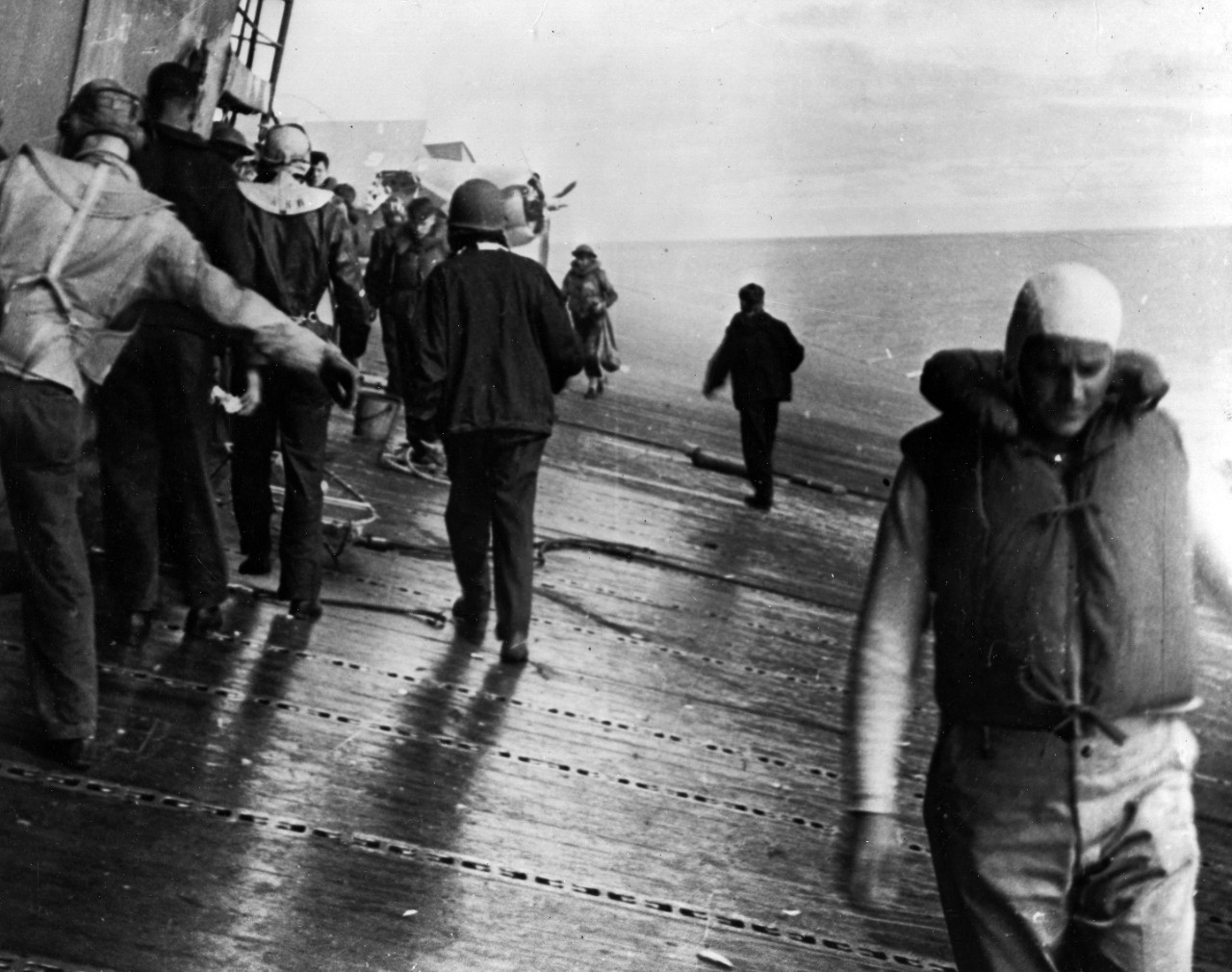
Meanwhile, Yorktown was having problems of her own. Skillfully maneuvered by Capt. Elliott Buckmaster, her commanding officer, the carrier dodged eight torpedoes. Attacked then by "Vals," the ship managed to evade all but one bomb. That one, however, penetrated the flight deck and exploded belowdecks, killing or seriously injuring 66 men.
Yorktown's damage control parties brought the fires under control; and, despite her wounds, the ship was still able to continue her flight operations. The air battle itself ended shortly before noon on the 8th; and, within an hour, "Lady Lex" was on an even keel, although slightly down by the bow. Her damage control parties had already extinguished three out of the four fires below. In addition, she was making 25 knots and was recovering her air group.
At 1247, however, disaster struck Lexington, when a heavy explosion, caused by the ignition of gasoline vapors, rocked the ship. The flames raced through the ship, and further internal explosions tore the ship apart inside. Lexington battled for survival; but, despite the valiant efforts of her crew, she had to be abandoned. Capt. Frederick C. Sherman sadly ordered "abandon ship" at 1707. Her men went over the side in an orderly fashion and were picked up by the cruisers and destroyers of the carrier s screen. Torpedoes fired by Phelps (DD-361) hastened the end of "Lady Lex."
As Yorktown and her consorts retired from Coral Sea to lick their wounds, the situation in the Pacific stood altered. The Japanese had won a tactical victory, inflicting comparatively heavy losses on the Allied force; but the Allies, in stemming the tide of Japan's conquests in the South and Southwest Pacific, had achieved a strategic victory. They had blunted the drive toward strategic Port Moresby and had saved the tenuous lifeline between America and Australia.
Yorktown had not achieved her part in the victory without cost, but had suffered enough damage to cause experts to estimate that at least three months in a yard would be required to put her back in fighting trim. Unfortunately, there was little time for repairs, because Allied intelligence, most notably the cryptographic unit at Pearl Harbor, had gained enough information from decoded Japanese naval messages to estimate that the Japanese were on the threshold of a major operation aimed at the northwestern tip of the Hawaiian chain, two islets in a low coral atoll known as Midway.
Thus armed with this intelligence, Admiral Nimitz began methodically planning Midway's defense, rushing all possible reinforcement in the way of men, planes, and guns to Midway. In addition, he began gathering his naval forces, comparatively meager as they were, to meet the enemy at sea. As part of those preparations, he recalled TF 16, Enterprise and Hornet (CV-8), to Pearl Harbor for a quick replenishment.
Yorktown, too, received orders to return to Hawaii; and she arrived at Pearl Harbor on 27 May. Miraculously, yard workers there, laboring around the clock, made enough repairs to enable the ship to put to sea. Her air group, for the most part experienced but weary, was augmented by planes and flyers from Saratoga (CV-3) which was then headed for Hawaiian waters after her modernization on the west coast. Ready for battle, Yorktown sailed as the central ship of TF 17 on 30 May.
Northeast of Midway, Yorktown, flying Rear Admiral Fletcher's flag, rendezvoused with TF 16 under Rear Admiral Raymond A. Spruance and maintained a position 10 miles to the northward of the latter. Over the days that ensued, as the ships proceeded toward a date with destiny, few men realized that within the next few days the pivotal battle of the war in the Pacific would be fought.
Patrols, both from Midway itself and from the carriers, proceeded apace during those days in early June. On the morning of the 4th, as dawn began to streak the eastern sky, Yorktown launched a 10-plane group of Dauntlesses from VB-5 which searched a northern semicircle for a distance of 100 miles out but found nothing.
Meanwhile, PBY's flying from Midway had sighted the approaching Japanese and broadcast what turned out to be the alarm for the American forces defending the key atoll. Admiral Fletcher, in tactical command, ordered Admiral Spruance, with TF 16, to locate the enemy carrier force and strike them as soon as they were found.
Yorktown's search group returned at 0830, landing soon after the last of the six-plane CAP had left the deck. When the last of the Dauntlesses had landed, a flight deck ballet took place in which the deck was spotted for the launch of the ship's attack group: 17 Dauntlesses from VB-3; 12 Devastators from VT-3, and six Wildcats from "Fighting Three." Enterprise and Hornet, meanwhile, launched their attack groups.
The torpedo planes from the three American flattops located the Japanese carrier striking force but met disaster. Of the 41 planes from VT-8, VT-6, and VT-3, only six returned to Enterprise and Yorktown, collectively. None made it back to Hornet.
The destruction of the torpedo planes, however, had served a purpose. The Japanese CAP had broken off their high-altitude cover for their carriers and had concentrated on the Devastators, flying low "on the deck." The skies above were thus left open for Dauntlesses arriving from Yorktown and Enterprise. Virtually unopposed, the SBD's dove to the attack. The results were spectacular.
Yorktown's dive-bombers pummeled Soryu, making three lethal hits with 1,000-pound bombs that turned the ship into a flaming inferno. Enterprise's planes, meanwhile, hit Akagi and Kaga, turning them, too, into wrecks within a very short time. The bombs from the Dauntlesses caught all of the Japanese carriers in the midst of refueling and rearming operations, and the combination of bombs and gasoline proved explosive and disastrous to the Japanese.
Three Japanese carriers had been lost. A fourth, however, still roamed at large, Hiryu. Separated from her sisters, that ship had launched a striking force of 18 "Vals" that soon located Yorktown.
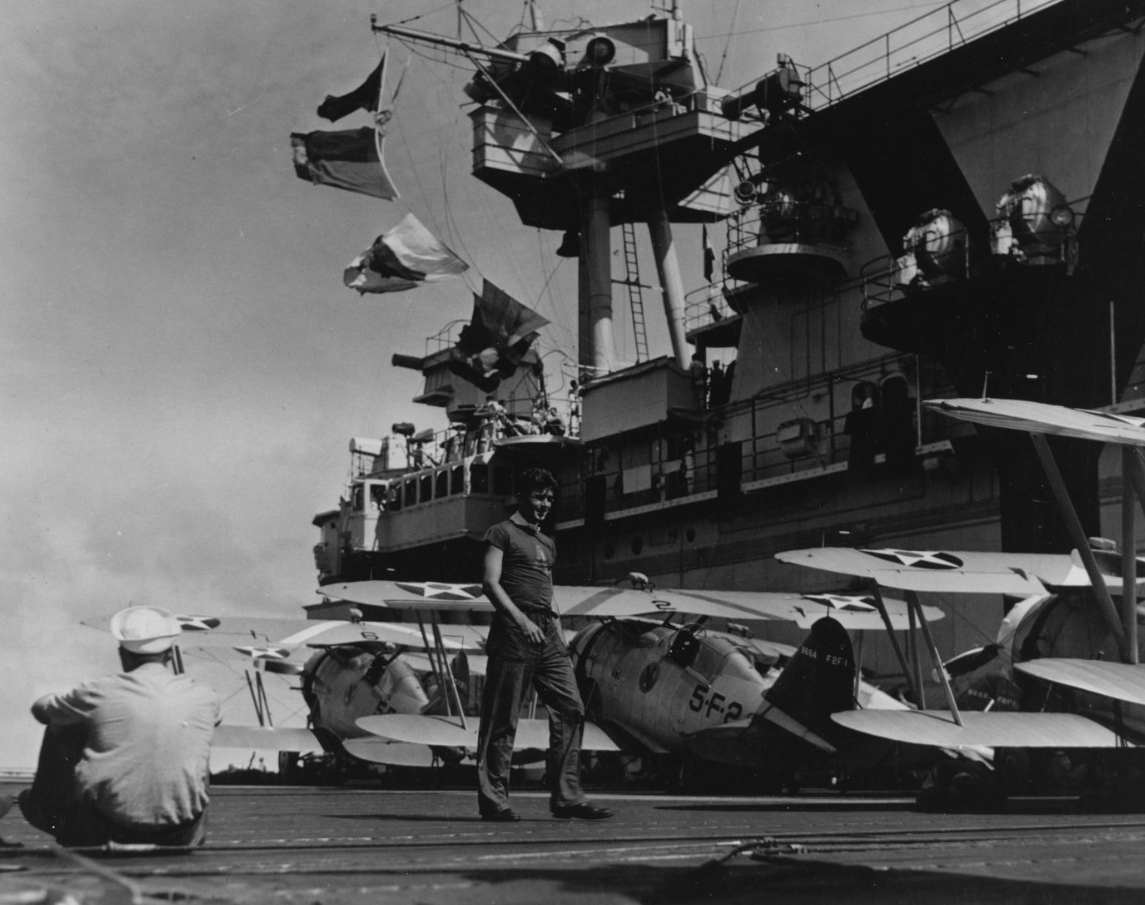
As soon as the attackers had been picked up on Yorktown's radar at about 1329, she discontinued the fueling of her CAP fighters on deck and swiftly cleared for action. Her returning dive bombers were moved from the landing circle to open the area for antiaircraft fire. The Dauntlesses were ordered aloft to form a CAP. An auxiliary gasoline tank, of 800 gallons capacity, was pushed over the carrier's fantail, eliminating one fire hazard. The crew drained fuel lines and closed and secured all compartments.
All of Yorktown's fighters were vectored out to intercept the oncoming Japanese aircraft, and did so some 15 to 20 miles out. The Wildcats attacked vigorously, breaking up what appeared to be an organized attack by some 18 "Vals" and 18 "Zeroes." "Planes were flying in every direction," wrote Capt. Buckmaster after the action, "and many were falling in flames."
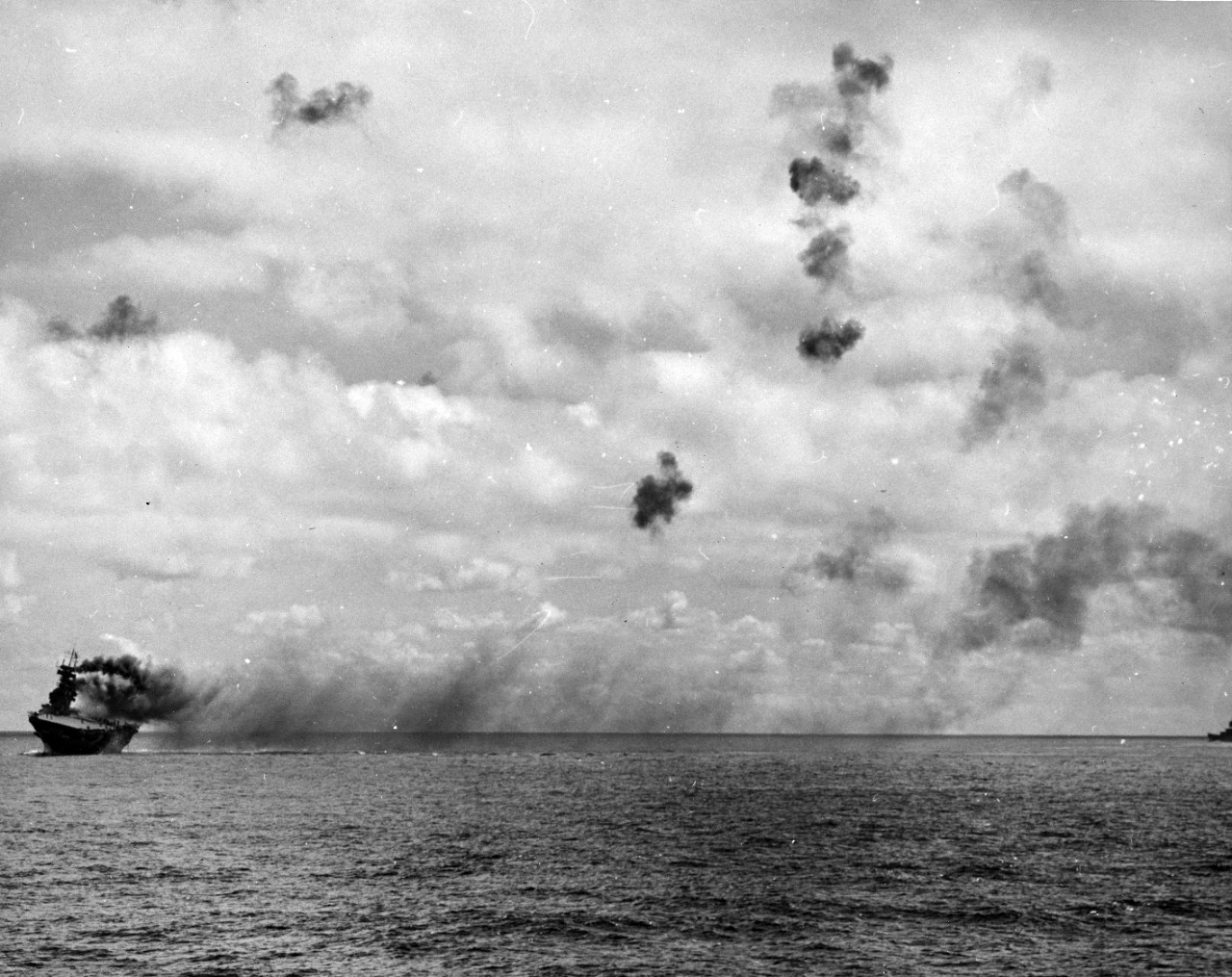
Yorktown and her escorts went to full speed and, as the Japanese raiders attacked, began maneuvering radically. Intense antiaircraft fire greeted the "Vals" and "Kates" as they approached their release points.
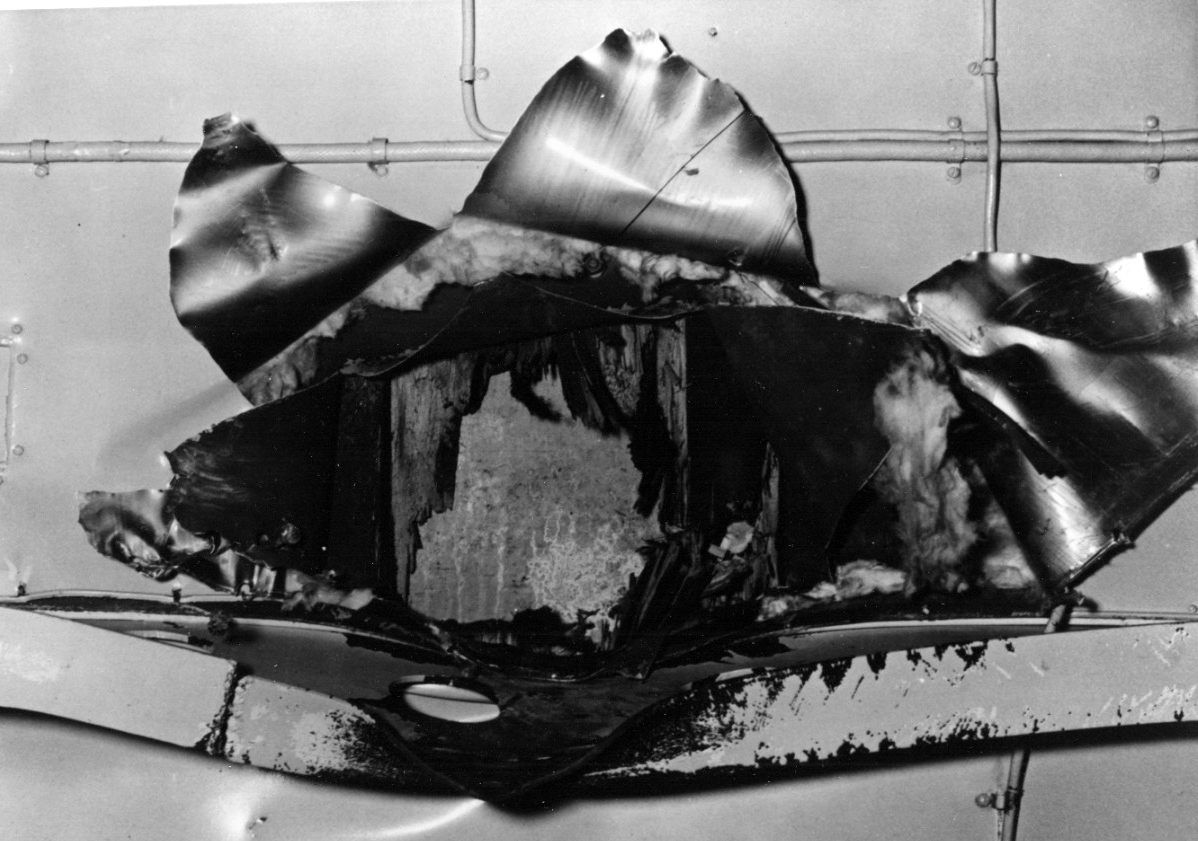
Despite the barrage, though, three "Vals" scored hits. Two of them were shot down soon after releasing their bomb loads; the third went out of control just as his bomb left the rack. It tumbled in flight and hit just abaft number two elevator on the starboard side, exploding on contact and blasting a hole about 10 feet square in the flight deck. Splinters from the exploding bomb decimated the crews of the two 1.1-inch gun mounts aft of the island and on the flight deck below. Fragments piercing the flight deck hit three planes on the hangar deck, starting fires. One of the aircraft, a Yorktown Dauntless, was fully fueled and carrying a 1,000-pound bomb. Prompt action by Lt. A. C. Emerson, the hangar deck officer, prevented a serious conflagration by releasing the sprinkler system and quickly extinguishing the fire.
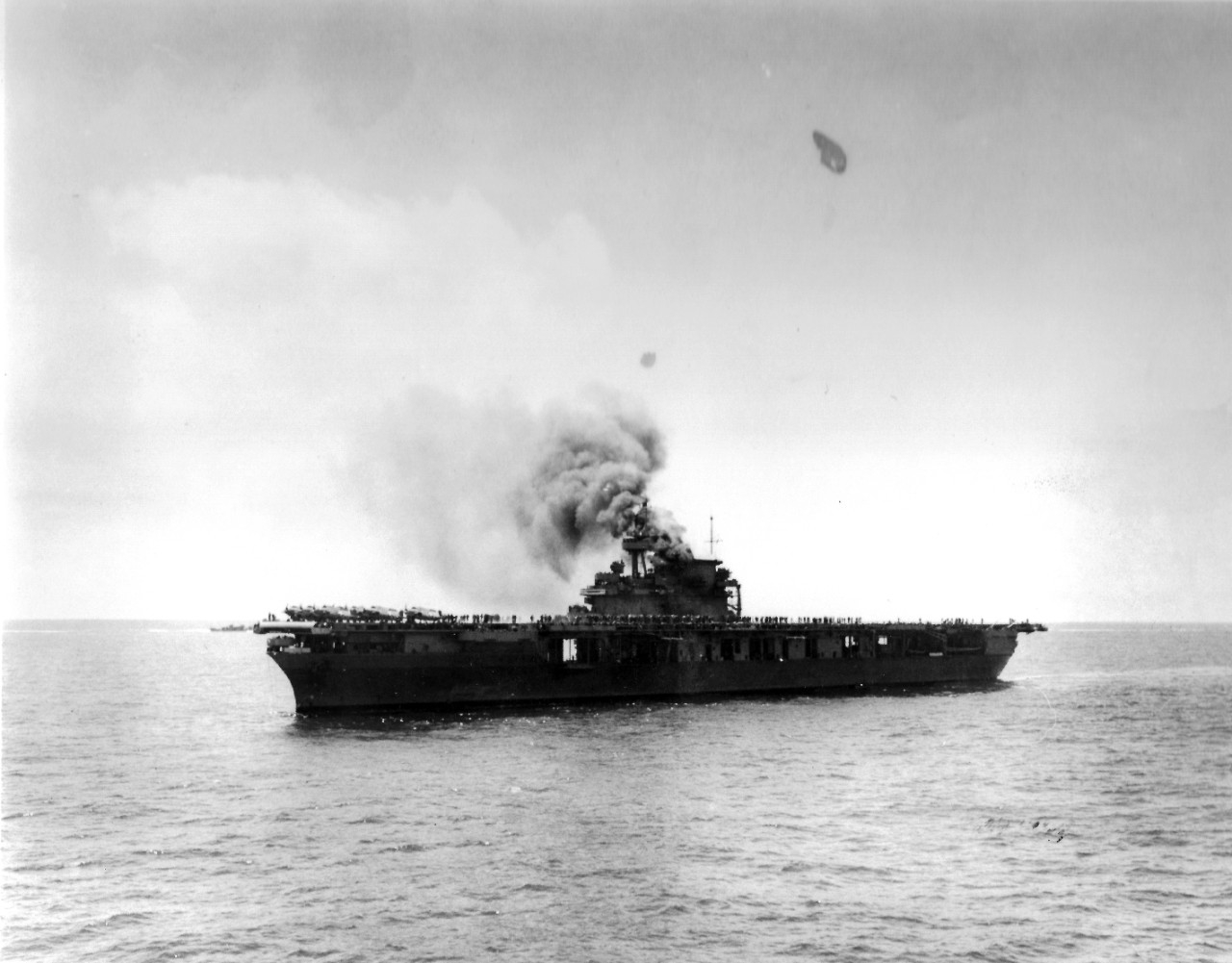
The second bomb to hit the ship came from the port side, pierced the flight deck, and exploded in the lower part of the funnel. It ruptured the uptakes for three boilers, disabled two boilers themselves, and extinguished the fires in five boilers. Smoke and gases began filling the firerooms of six boilers. The men at number one boiler, however, remained at their post despite their danger and discomfort and kept its fire going, maintaining enough steam pressure to allow the auxiliary steam systems to function.
A third bomb hit the carrier from the starboard side, pierced the side of number one elevator and exploded on the fourth deck, starting a persistent fire in the rag storage space, adjacent to the forward gasoline stowage and the magazines. The prior precaution of smothering the gasoline system with CO2 undoubtedly prevented the gasoline's igniting.
While the ship recovered from the damage inflicted by the dive-bombing attack, her speed dropped to six knots; and then, at 1440, about 20 minutes after the bomb hit that had shut down most of the boilers, Yorktown slowed to a stop, dead in the water.
Held by NeuraWeb Global Inc. and kept permanently. Her association may claim this record and maintain it.