U.S. Army · Battalion

13TH SIGNAL BATTALION

15 honoured here served in it

The Heraldry 2
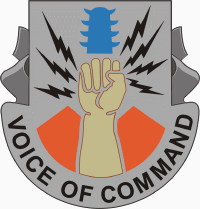
13TH SIGNAL BATTALION — Distinctive unit insignia
Distinctive unit insignia

Authorised 28 October 1953

A silver color metal and enamel device 1 1/8 inches (2.86cm) overall consisting of a shield blazoned: Per fess dancetté abased of two Argent and Tenné, issuant from base overall a cubit arm palewise Proper grasping seven lightning flashes three and four Sable, in chief a Korean temple Azure. Below the shield a motto scroll inscribed "VOICE OF COMMAND" in black letters.

Orange and white are the colors used for the Signal Corps. The two mountains are symbolic of the mountainous area of the Pacific in which the unit provided communications for the 1st Cavalry Division during World War II. They also represent the invasions of the Bismark Archipelago and Leyte. The arm grasping the lighting flashes alludes to the mission of the unit enabling information and orders to be sent and received. The 7 lightning flashes commemorate the seven decorations awarded the unit for services in World War II and Korea. The temple refers to actions in Korea during the Korean War.

The distinctive unit insignia was approved on 28 Oct 1953. Coat of Arms
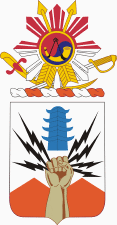
13TH SIGNAL BATTALION — Coat of arms
Coat of arms

Authorised 28 October 1958

Per fess dancetté abased of two Argent and Tenné, issuant from base overall a cubit arm palewise Proper grasping seven lightning flashes three and four Sable, in chief a Korean temple Azure. From a wreath Argent and Tenné a scimitar and an officer's sword points down saltirewise Proper surmounted by a Philippine sun per fess Gules and Argent; overall two arrows saltirewise Or surmounted by a taeguk fimbriated and charged with a bugle horn of the like garnished and stringed Sable. VOICE OF COMMAND

Orange and white are the colors used for the Signal Corps. The two mountains are symbolic of the mountainous areas of the Pacific in which the unit provided communications for the 1st Cavalry Division during World War II. They also represent the invasions of the Bismark Archipelago and Leyte. The arm grasping the lighting flashes alludes to the mission of the unit enabling information and orders to be sent and received. The seven lightning flashes commemorate the seven decorations awarded the unit for services in World War II and Korea. The temple refers to actions in Korea during the Korean War. World War II service represented by the sunburst, adapted from the Philippine flag and divided in scarlet and white, signifying courage and honor. The thirteen scarlet and thirteen white points of the sunburst allude to the unit's designation. The arrows recall assault landings by the unit during World War II. The taeguk symbolizes service in the Korean War and the many decorations awarded for that service, including the Republic of Korea Presidential Unit Citations. The officer's word refers to the awards in recognition of Vietnam service. The horn represents the signal mission and reflects the unit's service in Southwest Asia. Gold signifies excellence.

The coat of arms was originally approved on 28 Oct 1958. It was amended on 4 Mar 1997, to include a crest.

Where It Sits

15 of the men and women on this memorial served in this formation. See them.

In Our Keeping
Country United States
Service U.S. Army
Echelon Battalion
Stewarded by NeuraWeb Global Inc.
Permanent identifier neuraspine_01m1pnpew0c9qq1x2gjx48h89c

Held by NeuraWeb Global Inc. and kept permanently. The formation itself may claim this record and maintain it.