U.S. Army · Regiment

6th Infantry Regiment

Constituted 1812 · 205 honoured here served in it

The Heraldry 2
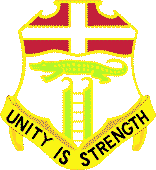
6th Infantry Regiment — Distinctive unit insignia
Distinctive unit insignia

Authorised 11 February 1924

A gold color metal and enamel device 1 1/8 inches (2.86cm) in height overall consisting of a shield blazoned: Argent, a scaling ladder Vert, in fess an alligator statant Proper, on a chief wavy Gules a cross of the field and attached below the shield a gold scroll inscribed "UNITY IS STRENGTH" in black letters.

The alligator symbolizes service in several Indian campaigns, notably the Seminole War, when the regiment bore the brunt of the fighting at the battle of Lake Okeechobee on 25 December 1837 (Report of Colonel Zachary Taylor). Service in the Mexican War with General Scott, especially at Churubusco and at the assault on the citadel of Chapultepec, is commemorated with a scaling ladder (in green, the Mexican color), by means of which the walls of Chapultepec were stormed. The chief, symbolic of the crossing of the Meuse near Dun, is the arms of the ancient Lords of Dun - a silver cross on a red field. The partition line, wavy, represents the river. The shield is white (Argent), the color of the Infantry facings when the regiment was organized.

The distinctive unit insignia was originally approved on 11 Feb 1924. It was amended on 26 Mar 1938. The insignia was redesignated for the 6th Infantry (Armored) on 11 Sep 1940. On 15 May 1942 it was redesignated for the 6th Armored Infantry Regiment. It was redesignated for the 12th Constabulary Squadron on 29 Nov 1946. The distinctive unit insignia was redesignated for the 6th Infantry Regiment on 2 Nov 1950. Coat of Arms
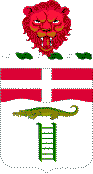
6th Infantry Regiment — Coat of arms
Coat of arms

Authorised 25 January 1921

Argent, a scaling ladder Vert, in fess an alligator statant Proper, on a chief wavy Gules a cross of the field. On a wreath of the colors a lion's face Gules. UNITY IS STRENGTH.

The crest represents service in the Canadian campaigns of 1813 and 1814. The alligator symbolizes service in several Indian campaigns, notably the Seminole War, when the regiment bore the brunt of the fighting at the battle of Lake Okeechobee on 25 December 1837 (Report of Colonel Zachary Taylor). Service in the Mexican War with General Scott, especially at Churubusco and at the assault on the citadel of Chapultepec, is commemorated with a scaling ladder (in green, the Mexican color), by means of which the walls of Chapultepec were stormed. The chief, symbolic of the crossing of the Meuse near Dun, is the arms of the ancient Lords of Dun - a silver cross on a red field. The partition line, wavy, represents the river. The shield is white (Argent), the color of the Infantry facings when the regiment was organized.

The coat of arms was originally approved on 25 Jan 1921 for the 6th Infantry. It was amended on 4 Oct 1922 to correct the description of the shield. On 11 Sep 1940 it was redesignated for the 6th Infantry (Armored). On 16 May 1942 it was redesignated for the 6th Armored Infantry Regiment. It was redesignated for the 6th Armored Infantry Battalion on 13 Nov 1944. It was redesignated for the 12th Constabulary Squadron on 29 Nov 1946. On 2 Nov 1950 the coat of arms was redesignated for the 6th Infantry Regiment. The coat of arms was amended on 4 Jun 1970 to correct the description of the design.

Lineage and Honours
World War I
Where It Sits

205 of the men and women on this memorial served in this formation. See them.

In Our Keeping
Country United States
Service U.S. Army
Echelon Regiment
Status Active
Stewarded by NeuraWeb Global Inc.
Permanent identifier neuraspine_01krc4nv2vsg33gqq0j503q5tb

Held by NeuraWeb Global Inc. and kept permanently. The formation itself may claim this record and maintain it.