U.S. Army · Regiment

7th Cavalry Regiment

Constituted 28 July 1866 · 1,396 honoured here served in it

The Heraldry 2
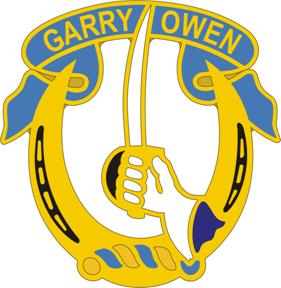
7th Cavalry Regiment — Distinctive unit insignia
Distinctive unit insignia

Authorised 29 June 1924

Within a Gold and enamel horseshoe 1 1/4 inches (3.18 cm) overall, showing seven nail holes, heels upward and the opening between the heels closed with a Blue ribbon bearing the words "GARRY OWEN" in Yellow letters, the crest of the coat of arms of the Regiment (on a wreath Or and Azure a dexter arm embowed vested Azure the hand in a buckskin gauntlet Proper grasping an old style United States Army saber Argent hilted Or).

The color gold, or yellow, is symbolic of the Cavalry service, yellow being the color of the facings on the old blue uniform at the time the Regiment was first organized. The horseshoe is adapted from the Regimental coat of arms, the seven nail holes alluding to the unit's numerical designation. The gauntlet and saber at the "Charge" position are also adapted from the coat of arms and represent the "Cavalry Charge" and the battle heritage of the Regiment. "Gary Owen" is the name of a song which became a favorite of General Custer and once was used as a battle song in the Indian Wars.

The distinctive unit insignia was originally approved for the 7th Cavalry Regiment on 29 June 1924. It was redesignated for the 7th Cavalry Regiment (Infantry) on 16 December 1953. The insignia was redesignated for the 7th Cavalry Regiment and amended effective 4 February 1983, to revise the description and include a symbolism. Coat of Arms
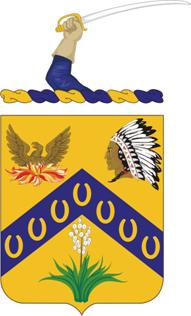
7th Cavalry Regiment — Coat of arms
Coat of arms

Authorised 6 December 1920

Or, on a chevron Azure, between a phoenix rising from its ashes in dexter chief, the head of a North American Indian in war bonnet couped at the neck in sinister chief, all Proper, and a yucca plant Vert in base, seven horseshoes heels upward of the field. On a wreath of the colors (Or and Azure) a dexter arm embowed vested Azure, the hand in a buckskin gauntlet Proper, grasping an old style United States Army saber Argent, hilted Or. THE SEVENTH FIRST.

The field is yellow, the Cavalry color; the principal charge is a chevron whose origin tradition ascribes to the spur, which was formerly of that shape without rowel. The number of the horseshoes corresponds to the numerical designation of the regiment. The phoenix symbolizes the resurgence of the regiment after its heavy losses in the Battle of Little Big Horn. The Indian head and yucca commemorate Indian campaigns and the Punitive Expedition of 1916, respectively. The crest shows the position of "raised saber" taken at the command "Charge" prescribed by General Order 6, Adjutant General Office, 1873, the arm being habited in the uniform of the period.

The coat of arms was originally approved for the 7th Cavalry Regiment on 6 December 1920. It was redesignated for the 7th Cavalry Regiment (Infantry) on 16 December 1953. The insignia was redesignated for the 7th Cavalry Regiment and the symbolism amended effective 4 February 1983 to accurately reflect the losses incurred at the Battle of Little Big Horn.

Lineage and Honours
World War II
Where It Sits

1,396 of the men and women on this memorial served in this formation. See them.

In Our Keeping
Country United States
Service U.S. Army
Echelon Regiment
Status Active
Stewarded by NeuraWeb Global Inc.
Permanent identifier neuraspine_01krc4ntyapvraf2svhs2th5wg

Held by NeuraWeb Global Inc. and kept permanently. The formation itself may claim this record and maintain it.