 U.S. Army Air Forces · United States
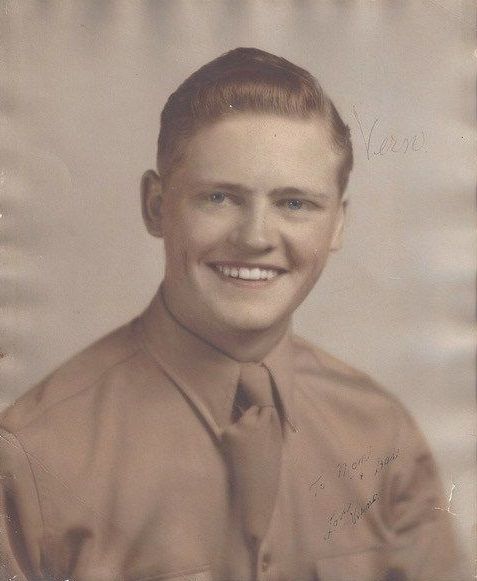
Sergeant Vernon Lance Hamilton served in the U.S. Army Air Forces. Vernon served in World War II. Vernon was 19 years old.
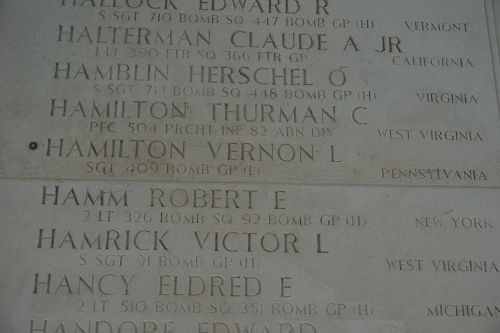
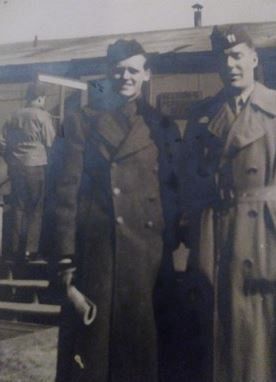
Sgt Vernon L. Hamilton was a salesman. | | He joined the Air Corps of the U.S. Army Reserve in Greensboro, North Carolina on 13 October 1943 at the age of 17. When asked at the induction center if he wanted to leave immediately after his birthday or wait for six months, he replied, "as soon as possible." He was stationed at several camps in the States, including Florence, South Carolina; Charlotte, North Carolina; Keesler Field, Mississippi; Selfridge, Florida.; Greensboro, North Carolina, and at Hunter Field, Savannah, Georgia. | | Statement from F/O Stuart, K. Gibson, T5370, 642nd Bomb Sq, 409th Bomb Gp.: | "On 21 March 1945 I was flying an A-26 aircraft on a combat mission. I was flying in No.5 position, second flight, first box. Lt Hadfield was flying No. 5 position, first flight, first box. Just a few minutes past the initial point, before opening our bomb bay doors, I saw Lt Hadfield's plane peel up to the right. It fell over on its back and headed straight down towards the earth. I was a mile or two behind him at the time. From my position, I didn't see his plane hit by flak. The last I saw of the plane the bomb bay doors were closed and I saw no parachutes leave the plane". | | Crew members were 2nd Lt Lynn W. Hadfield, Sgt Vernon L. Hamilton and Sgt John Kalausich. They all were killed. | | The Defense POW/MIA Accounting Agency (DPAA) announced on 17 January 2019 that Sgt. Hamilton was accounted for on 13 December 2018. | | After the war, the American Graves Registration Command extensively searched the area where the aircraft was believed to have crashed, however no crash sites could be positively matched with Hamilton’s aircraft. | | In June 2016, a German researcher, Adolph Hagedorn, who had previously collaborated with Joint POW/MIA Accounting Command, JPAC (a predecessor to DPAA) contacted DPAA historians regarding a crash site he had found in Hülsten-Reken, Germany, that could possibly be linked to Hamilton’s aircraft. In September 2016, Hagedorn led DPAA to the crash site in a horse paddock, where the aircraft matched the description of Hamilton’s. | | In November and December 2016, under a partnership, History Flight, Inc., a nongovernmental organization, excavated the crash site, recovering aircraft material, life support equipment, personal effects and possible osseous material. | | To identify Hamilton’s remains, scientists from DPAA and the Armed Forces Medical Examiner System used mitochondrial DNA (mtDNA) analysis, dental and anthropological analysis, as well as circumstantial and material evidence. | | A rosette was placed next to his name to indicate he has been accounted for. | | Funeral arrangements are pending (January 2019).
 Awards & Decorations
2
Awards & Decorations
2
 Burial Information
This page is permanent and free. No fee to view it, no advertising, no tracking, and no account required. It will not be taken down.
Are you family? This record can be claimed and maintained by those who knew Vernon Lance. Claim this record.


Be the first to honor Vernon Lance.
Leave a Tribute