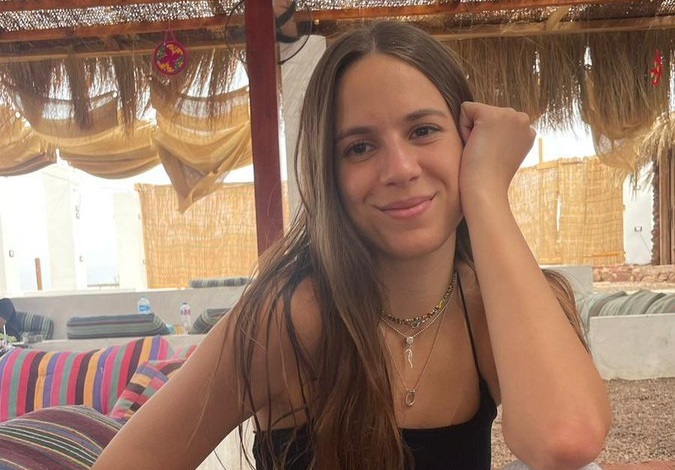
In memory of

Gaya Halifa

Killed at the Nova festival on October 7, 2023, aged 24.

Israel

Her life

A ‘gentle, peaceful’ soul who loved music. Killed trying to escape the Hamas massacre at the Supernova music festival on October 7.

Her story

Gaya Halifa was a month shy of her 25th birthday when she was killed trying to escape the Hamas massacre at the Supernova music festival at Kibbutz Re’im on October 7, 2023.

Her father, Avi, was on the phone with her and believes he heard her last breaths when she and a group of friends came under gunfire as they attempted to flee the area in a vehicle.

The moment was captured on the car’s dashcam as terrorists opened fire at the vehicle, peppering the windshield with bullets. In the footage, the car slows and crashes into another vehicle on the side of the road.

“Then there were two deep breaths, as if she had no oxygen, as if she couldn’t breath, and then a deep, deep silence,” Avi Halifa recounted to the Kan public broadcaster.

Gaya had been in constant touch with her parents that devastating Saturday morning, reassuring them that she was ok when rockets and interceptions started flying overhead. Then she said, “Dad there are gunshots here,” Avi recalled.

Her family was not yet worried. Gaya had served as a combat medic in the Israel Defense Forces’ Duvdevan unit and didn’t lose her cool easily, they said.

Gaia tried to escape from Hamas terrorists in Re'im and was shot to death while on the phone with her father. All he heard were her last two deep breaths, followed by an eerie silence@ifatglick | #KanIsraelstory pic.twitter.com/Jf6K8Mtq68 — כאן חדשות (@kann_news) October 30, 2023

Gaia tried to escape from Hamas terrorists in Re'im and was shot to death while on the phone with her father. All he heard were her last two deep breaths, followed by an eerie silence@ifatglick | #KanIsraelstory pic.twitter.com/Jf6K8Mtq68

— כאן חדשות (@kann_news) October 30, 2023

She hid and updated her family. She even called her mom, Sigal, asking her to tell her brother, Ido, to stop calling her and to reassure him that she was ok.

But she was texting her dad, telling him that they were being fired upon and asking if the police had somehow given instructions on how to escape. “I didn’t know what to tell her, no one knew anything yet,” he said.

She and a few others, including her friend Romi Gonen, who is missing and presumed captive, stayed hidden and waited.

Gaya then contacted Ben Shimoni, another Supernova partygoer whose story of heroism circulated widely in the Hebrew-language media. Shimoni initially made it to safety, saving frantic strangers from terrorists at the music festival by loading them up in his car and driving away. He made multiple such trips, according to witness accounts.

Gaya’s father said that in her text conversation with Shimoni, she told him not to drive back to the party, that it was too dangerous. But he made it back and picked up Gaya, Romi, and a third passenger, Ofir Tzarfati, also presumed captive.

Gaya sent her dad a text saying, “Ben the hero came to get us, he’s driving around” trying to find a way out, and asked him to meet her in Ashdod.

When Avi and Sigal left for Ashdod, it was with a feeling of relief that Gaya had been saved and that she would be home soon.

He thought the next call from Gaya would be with a meet-up location. But the call was of sounds of terror and gunfire.

“Dad, they’re shooting at us!” he said she was yelling, adding that he didn’t have time to say hello and “it was over, in five or six seconds. You don’t realize that it’s the end.”

Her parents drove to all the hospitals, holding onto hope. Everyone knew but there was silence at home, no one dared say it out loud, the family said. Ido said he acted optimistic for his parents until authorities came to notify them that her body was found, days later.

Sigal insisted on identifying Gaya’s body, despite the family’s protests.

“She lay there as she was, gentle and peaceful, there was nothing on her face. I hugged her, I held onto every bit of her body I could. I told her that I was letting her go and that we will love her. And I think she heard me,” said her mom.

Friends and family members described a sweet, smiling, bright young woman. who has been set to start studying for an academic degree in economics.

“Gaya, our angel, cousin, and in general the most perfect, smiling, pure and kind-hearted woman,” wrote her cousin on Facebook. “You will be missed by so many people.”

At her family home in Kiryat Ono, Gaya’s bedroom remains as it was the night she left for the massive party. She loved music and had been excited to go to the festival.

Gaya’s belongings were returned to her parents and lay on the bed: a pair of grey sweatpants, a package of lollipops she bought for herself and her friends, and her cellphone.

The phone was found strewn on the ground in the vicinity of the shattered car.

Gaya’s parents were able to retrieve a short clip of her and Romi from the party, and a photo she took while hiding from Hamas terrorists. They were also able to see the text exchange with Shimoni, who insisted on coming back to get her and friends in what would be his last heroic attempted rescue.

His body was found five days after October 7.

After the funeral, Gaya’s whole family — Avi, Sigal, Ido, and her sister Noga — each got a tattoo identical to Gaya’s: of a gramophone with a heart built in so she could “stay close.”

Her parents added the date 7.10.2023.

The Nova festival

October 7, 2023

On the morning of 7 October 2023, during the Jewish holiday of Shemini Atzeret and Simchat Torah, Hamas's military wing, the al-Qassam Brigades, attacked the Supernova Sukkot Gathering, the Nova festival, an open-air trance music festival near kibbutz Re'im in the Eshkol Regional Council, about five kilometres from the Gaza border. It was one part of the wider assault on southern Israel that day. 378 people were killed at the festival or close to it, 344 civilians and 34 security personnel, and 44 were taken hostage. It was the deadliest single site of the 7 October attacks and the deadliest attack on a concert ever recorded.

The festival had begun the evening before, 6 October, as a weekend gathering at the end of Sukkot. The organisers had moved it to this site only two days earlier. There were several stages, camping, food and bars, and about 3,500 people, most of them young Israelis in their twenties and thirties from across the country. Police and security were present. It was billed as a celebration of friends, love and infinite freedom. Investigations later concluded that the attackers most likely did not know the festival was there; they appear to have turned toward it after seeing the crowd on the way to other targets.

At about 6:30 a.m. a rocket barrage began, covering the infiltration, and the sirens sounded. Around 6:35 the senior police commander on duty, Deputy Superintendent Nivi Ohana, ordered the event shut down and the crowd sent out along Route 232, a decision that let most of those there begin to leave. By about 7:00 people were being directed out. Many who fled north or south along the highway ran into fire from gunmen who had taken the junctions and set ambushes. Police opened a dirt track east through the fields, and thousands escaped toward Patish on foot or by car. Dozens of cars were left behind along Route 232 and on the grounds.

The main attacking force, more than a hundred men of the 1st and 3rd companies of Hamas's Nuseirat Battalion in pickup trucks and on motorcycles, had been heading for Netivot. Seeing the festival, they turned. By about 8:00 to 8:20 they were fighting police at a roadblock near the site with rifles and rocket-propelled grenades. An Israeli tank that arrived under heavy fire, most of its crew already killed or wounded, slowed them for a time before it was forced to pull back south. As the perimeter collapsed, the gunmen entered the grounds at around 9:00 to 9:15. They set up a command post, shot people who had stayed or come back, and hunted those hiding in bushes, orchards, portable toilets, dumpsters and under structures. An ambulance where about twenty people had taken shelter was hit by a rocket-propelled grenade, and most inside were killed. Hostages were seized on the highway and on the grounds. Rape and mutilation are documented in survivor testimony, by emergency responders and by later investigations, and the attackers spread video of the killings and abductions.

At about 9:50 the main force withdrew toward Be'eri to join other units. A second wave of armed and unarmed men from Gaza reached the site around 10:20 and looted the dead. The first large Israeli reinforcements, from the Givati Brigade among others, arrived after 11:30, fought the remaining attackers and had cleared the area by about 3:00 p.m. Around twenty of the attackers were killed in the fighting at the festival.

Of the 378 killed, 171 died on the festival grounds or the stretch of Route 232 beside them; the rest were killed or taken farther away across the Gaza envelope as they fled. The 34 security personnel included off-duty soldiers who had come to dance, police officers, many of them killed fighting, and two Shin Bet agents. Among the dead were the festival's organisers Osher and Michael Vaknin, journalists, and people of many nationalities. The 44 hostages were Israelis and dual nationals; releases, rescues and the recovery of remains went on over the months and years that followed, until the last living hostage of the war came home in October 2025 and the last remains were recovered soon after.

The Nova festival was the largest killing of civilians at any single site on 7 October, carried out while the nearby kibbutzim, among them Be'eri, Kfar Aza, Nir Oz and Holit, were under attack at the same time. Early counts varied, from at least 260 bodies recovered from the grounds to 364 in November 2023, before the final toll of 378 was established. What happened there has been recorded in survivor testimony, military inquiries, criminal investigations, films and memorial exhibitions.
Everyone taken by The Nova festival →

October 7, 2023

October 7, 2023

It began at twenty past six in the morning with rocket fire and a coordinated crossing of the perimeter at some thirty points.

At the Nova music festival near Re'im, three hundred and sixty-four people were killed. Most were in their twenties. They had been dancing since before dawn and had nowhere to go across open ground.

In the kibbutzim and villages along the fence - Be'eri, Kfar Aza, Nir Oz, Nahal Oz, Holit and others - families were killed in their houses and their shelters. Be'eri lost about a tenth of its people.

About twelve hundred were killed in all, the large majority of them civilians, and two hundred and fifty-one people were taken into Gaza.

Among the dead were the volunteers and off-duty people who drove toward it without orders. Rachel Edri of Ofakim kept the men who held her and her husband talking for twenty hours, feeding them biscuits and coffee, until a rescue reached the house.

It was the deadliest day for Jews since the Holocaust, and Israel stopped.

Everyone taken by October 7, 2023 →

The ground

The Nova festival

October 7, 2023 · 404 named here

  • Gaya Halifa
  • 213 others whose spot is known · point at one to see who
  • The other grounds that morning
Gaya Halifa

Media

Gaya Halifa, was killed at the Supernova music festival on October 7, 2023. (Courtesy)
Gaya Halifa, was killed at the Supernova music festival on October 7, 2023. (Courtesy) 0 Views JPG 113 KB

No monument carrying this name is recorded yet.

Who was beside her is still being drawn.

No family is recorded with her yet.

What people have said

Nobody has said anything for Gaya Halifa yet.

↑