In memory of

James Zadroga

Detective · New York City Police Department

Died of it afterward on January 5, 2006, aged 34.

United States of America

His life

Detective James Zadroga died of a respiratory disease he contracted during rescue and recovery operations at the site of the September 11, 2001, terrorist attack on the World Trade Center.

Detective Zadroga had responded to the World Trade Center immediately following the attack and began providing assistance. He was inside 7 World Trade Center as it began to collapse, but was able to escape.

In the weeks following the attack, Detective Zadroga spent over 470 hours digging through debris and inhaling the noxious gases and fumes present around the Ground Zero area.

Shortly after finishing his rescue and recovery work at the World Trade Center, Detective Zadroga developed a chronic cough, shortness of breath, acid reflux, and was plagued by headaches. Within months he required oxygen tanks to breathe as well as other medicines to slow the deterioration of his health. His condition continued to worsen and Detective Zadroga was granted a 75% pay disability pension on November 1, 2004.

Detective Zadroga died on January 6, 2006, as a result of respiratory disease, black lung disease, and mercury on the brain. His death was directly linked to his work at Ground Zero.

Detective Zadroga had served with the New York City Police Department for 13 years, and was assigned to the Manhattan South Homicide Task Force.
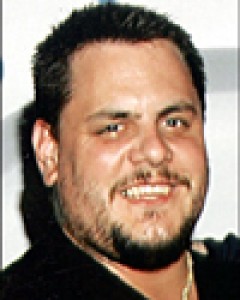
Detective Zadroga had served with the New York City Police Department for 13 years, and was assigned to the Manhattan South Homicide Task Force.

His story

James Zadroga grew up in North Arlington, New Jersey, where his father served as police chief. After studying at Bergen Community College, he was appointed to the New York City Police Department on 13 January 1992 and was first assigned to the 6th Precinct in Manhattan. In early 1997 he moved to the Street Crime Unit in Queens, and he was promoted to detective there on 4 June 1999.

After the attacks of 11 September 2001, Detective Zadroga was assigned to the rescue, recovery and clean-up effort and spent about 500 hours working in the rubble of the World Trade Center. When he went back to his new command, the 25 Squad, in late December 2001, he began to have trouble breathing. He transferred to Manhattan South Homicide in June 2002, but his health kept getting worse, and he retired on disability on 1 November 2004. His wife, Ronda, died during his illness. As his condition advanced he needed a wheelchair and oxygen at all times, and he moved in with his parents in New Jersey so they could help care for his young daughter.

Detective Zadroga died on 5 January 2006 of respiratory and digestive diseases caused by his exposure at the World Trade Center site. He was 34 years old. He was the first member of the department whose death after 9/11 was directly tied by a medical examiner to the rescue and recovery work, and later legislation to protect the health of the responders who worked at Ground Zero and related sites was named in his honor. He was survived by his daughter, Tyler Ann, and his parents, Linda and Joseph.

Survived by

He is survived by his 4-year-old daughter and his parents.

The Years After

September 11, 2001

For eight months after the towers came down, men and women worked the site. Firefighters, police, paramedics, iron workers, truck drivers, cleaners, volunteers. They breathed what was in that air, and many of them have died of it since - cancers, lung disease, illnesses that took ten years or twenty to arrive.

More people have now died of September 11th than were killed on September 11th. They are not a footnote to the day. They are the day, arriving late.

A man who walked down eighty flights and out into the street, and who died of a cancer in 2031, was killed by the same attack as the man who never got out. This gate holds them together, because the same morning took them both.

Everyone taken by The Years After →

September 11, 2001

September 11, 2001

On a clear Tuesday morning, four airliners were taken. Two were flown into the towers of the World Trade Center in New York, one into the western face of the Pentagon, and one came down in a field near Shanksville, Pennsylvania, after the passengers and crew went forward at the cockpit door.

Two thousand nine hundred and seventy-seven people were killed. Three hundred and forty-three were firefighters of the New York City Fire Department. Seventy-one were law enforcement officers. Eight were paramedics and emergency medical technicians. One hundred and twenty-five died at the Pentagon, military and civilian together. The rest - some two thousand four hundred of them - had gone to work, or boarded a plane, and belonged to no service at all.

None of them began that morning as heroes. A great many of them ended it as heroes: men and women who carried strangers down stairwells, who stayed with people who could not walk, who held a door, who went back up. Four men on a flight over Pennsylvania, who had thirty minutes of telephone calls and knew what had already happened, decided where their aircraft would come down.

At Arlington, the nation set aside its own rules of eligibility and buried the Pentagon's civilian dead in national ground. It had decided that on this day the distinction did not apply.

Everyone taken by September 11, 2001 →

Media

James Zadroga
James Zadroga 0 Views JPG 19 KB

No monument carrying this name is recorded yet.

Everything James Zadroga is tied to in the record. Scroll to zoom, drag to move, click a face or a label to open it.

No family is recorded with him yet.

What people have said

Nobody else has said anything for James Zadroga yet.

↑