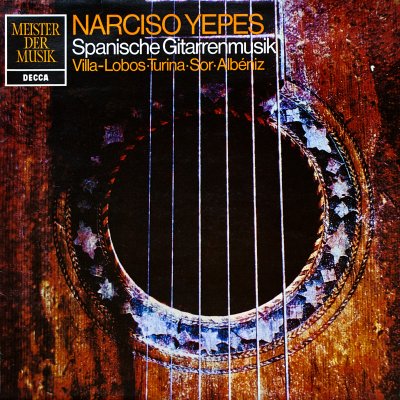
Narciso Yepes
Narciso Yepes (14 November 1927 – 3 May 1997) was a Spanish guitarist. He is considered one of the finest virtuoso classical guitarists of the twentieth century. Yepes was born into a family of humble origin in Lorca, Region of Murcia. His father gave him his first guitar when he was four years old, and took the boy five miles on a donkey to and from lessons three days a week. Yepes took his first lessons from Jesus Guevara, in Lorca. Later his family moved to Valencia when the Spanish Civil War started in 1936. When he was 13, he was accepted to study at the Conservatorio de Valencia with the pianist and composer Vicente Asencio. Here he followed courses in harmony, composition, and performance. Yepes is credited by many with developing the A-M-I technique of playing notes with the ring (Anular), middle (Medio), and index (Indice) fingers of the right hand. Guitar teachers traditionally taught their students to play by alternating the index and middle fingers, or I-M. However, since Yepes studied under teachers who were not guitarists, they pushed him to expand on the traditional technique. According to Yepes, Asencio "was a pianist who loathed the guitar because a guitarist couldn't play scales very fast and very legato, as on a piano or a violin. 'If you can't play like that,' he told me, 'you must take up another instrument.'" Through practice and improvement in his technique, Yepes could match Asencio's piano scales on the guitar. "'So,' he said, 'it's possible on the guitar. Now play that fast in thirds, then in chromatic thirds.'" Allan Kozinn observed that, "Thanks to Mr. Asencio's goading, Mr. Yepes learned "to play music the way I want, not the way the guitar wants." Similarly, the composer, violinist, and pianist George Enescu would also push Yepes to improve his technique, which also allowed him to play with greater speed. On 16 December 1947 he made his Madrid début, performing Joaquín Rodrigo's Concierto de Aranjuez with Ataúlfo Argenta conducting the Spanish National Orchestra. The overwhelming success of this performance brought him renown from critics and public alike. Soon afterwards, he began to tour with Argenta, visiting Switzerland, Italy, Germany, and France. During this time he was largely responsible for the growing popularity of the Concierto de Aranjuez, and made two early recordings, both with Argenta – one in mono with the Madrid Chamber Orchestra (released between 1953 and 1955), and the second in stereo with the Orquesta Nacional de España (recorded in 1957 and released in 1959). In 1950, after performing in Paris, he spent a year studying interpretation under the violinist George Enescu, and the pianist Walter Gieseking. He also studied informally with Nadia Boulanger. This was followed by a long period in Italy where he profited from contact with artists of every kind. On 18 May 1951, as he leant on the parapet of a bridge in Paris and watched the Seine flow by, Yepes unexpectedly heard a voice inside him ask, "What are you doing?" He had been a nonbeliever for 25 years, perfectly content that there was no God or transcendence or afterlife. But that existential question, which he understood as God's call, changed everything for him. He became a devout Catholic, which he remained for the rest of his life. In 1952 a work ("Romance"), Yepes claims to have written when he was a young boy, became the theme to the film Forbidden Games (Jeux interdits) by René Clément. Despite Yepes's claims of composing it, the piece ("Romance") has often been attributed to other authors; indeed published versions exist from before Yepes was even born, and the earliest known recording of the work dates from a cylinder from around 1900. In the credits of the film Jeux Interdits, however, "Romance" is credited as "Traditional: arranged – Narciso Yepes." Yepes also performed other pieces for the Forbidden Games soundtrack. His later credits as film composer include the soundtracks to La Fille aux yeux d'or (1961) and La viuda del capitán Estrada (1991). He also starred as a musician in the 1967 film version of El amor brujo. In Paris he met Maria Szumlakowska, a young Polish philosophy student, the daughter of Marian Szumlakowski, the Ambassador of Poland in Spain from 1935 to 1944. They married in 1958 and had two sons, Juan de la Cruz (deceased), Ignacio Yepes, an orchestral conductor and flautist, and one daughter, Ana Yepes, a dancer and choreographer. In 1964, Yepes performed the Concierto de Aranjuez with the Berlin Philharmonic Orchestra, premièring the ten-string guitar, which he invented in collaboration with the renowned guitar maker José Ramírez III.
Discography
Credits