Mountain
The breakup of Cream in late 1968 had consequences that rippled across the rock music world -- in its wake were formed directly such bands as Blind Faith (whose tragedy was they never had a chance to actually become a band) and Ginger Baker's Air Force, as well as the rich solo careers of members Eric Clapton and Jack Bruce. And it yielded -- by way of Cream associate and producer Felix Pappalardi -- something of a successor band in 1969, in the form of Mountain. Disraeli Gears The band's history all started with a Long Island-based psychedelic/garage band called the Vagrants, who'd acquired a serious local following and always seemed poised to break out, without ever actually doing so. Their lead guitarist, Leslie West, was a physically outsized figure as well as a musician extraordinaire whose playing had been completely transformed by his experience of hearing Clapton's playing in Cream. the Vagrants and West first crossed paths with Pappalardi in 1968, when he saw their potential and got them signed to Atlantic Records, where he was working as a producer.
He had already made a name for himself producing Cream's Disraeli Gears album, and had played numerous background instruments on their follow-up, Wheels of Fire (and on the studio tracks that would form their Goodbye album). He did produce some of the best work that the Vagrants ever released, but none of it sold; and when West left the band in late 1968 to do a solo album, titled Mountain, Pappalardi produced it for him, as well as played keyboards and bass on the record. The results were the most impressive of West's career up to that time, a solid, blues-based hard rock workout, showing off just how profoundly he incorporated Clapton's playing into his own style -- Mountain sounded a great deal like the now-disbanded Cream, and was satisfying enough for the two to form a partnership, also called Mountain. Their first lineup was built around the one used on the album, with N.D.
Smart on drums, and Steve Knight added on keyboards, while Pappalardi concentrated on playing the bass. Following a debut performance at the Fillmore West in July 1969, the group played its fourth live performance ever at Woodstock, in front of an audience of several hundred thousand, on a bill with the likes of Jimi Hendrix, the Who, the Jefferson Airplane, Janis Joplin, Creedence Clearwater Revival, and -- also getting their first national exposure at the same festival -- Crosby, Stills, Nash & Young. The event was an auspicious one, even though it was followed by a personnel shift, as Smart was replaced by Corky Laing, West's oldest friend. Climbing!
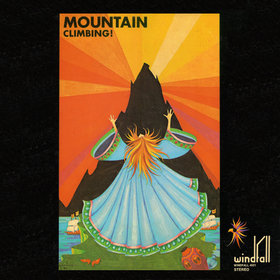
The group was signed to the Windfall label and released their debut LP, Mountain Climbing!, in the spring of 1970, accompanied by their debut single, "Mississippi Queen, " which reached number 21 in June of 1970. That chart placement doesn't begin to delineate the impact of that single, a hard rock boogie that was a killer showcase for West's guitar and an unlikely piece of Southern-fried rock & roll, coming from the pens of the Queens- and Brooklyn-born West and Pappalardi, and the Canadian-born Laing -- it was as improbable as the California-born John Fogerty authoring "Born on the Bayou" or "Green River, " and almost as enduring in popular culture. The single may not have reached the Top 20, but the album it was on peaked at number 17, driven by listeners drawn to the single but wanting more from the band behind it, and the high-energy mix of hard rock and blues they generated. And the debut album offered some surprises, such as the quartet's successful digression into progressive rock with "Theme from an Imaginary Western" (co-authored by Cream's Jack Bruce, which only further emphasized the indirect connections and musical debt owed the other band).
The latter got lots of play on FM radio, as did "Never in My Life. " Nantucket Sleighride Equally important to the band's fortunes, they were able to deliver on-stage what they promised on their records -- indeed, their records were a surprisingly accurate representation of their actual sound, except that Mountain was even louder live than they were in the studio. The group scored another hit at the Atlanta International Pop Festival in 1970, alongside the Allman Brothers, Cactus. and others. Mountain's second album, Nantucket Sleighride, was equally successful commercially and unveiled the title track, which would take on epic proportions in concert.
Flowers of Evil followed in November of 1971, just ten months after its predecessor, and it began to clearly show the strain of the pace the band had been keeping up since July of 1969 -- half of it consisted of lackluster studio originals, while the other half was a live medley and a concert version of "Mississippi Queen. " Lackluster sales and reviews were inevitable, and the impression of a band running on empty was reinforced by their next release, Mountain Live (The Road Goes Ever On) (1972), which had only four cuts on it, all of them characterized by extended solos. Hardcore fans appreciated the record as an extension of their recordings, but many listeners and most critics found it lacking musical cohesion. The Best Of Mountain The group broke up soon after the release of that album, due in part to Pappalardi's concerns about his hearing, which been damaged by the high volume the band generated in concert.
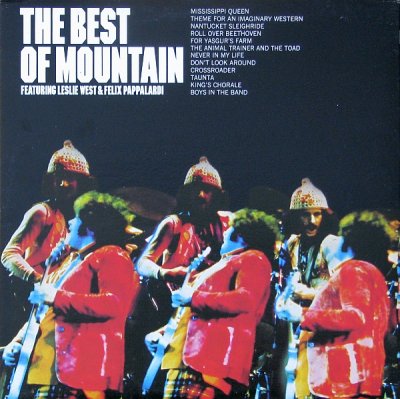
He returned to production, while West and Laing -- staying close to their hard rock roots, as well as the orbit whence Pappalardi had come -- teamed up with ex-Cream bassist Jack Bruce as West, Bruce & Laing, a hard rock power trio that cut a brief but memorable swathe of their own across the musical landscape in the early/mid-'70s. Meanwhile, a Best of Mountain LP released in the wake of the breakup helped to sustain interest in the group. And later in 1973, Mountain was back together, West and Pappalardi reactivating the band with Bob Mann on keyboards and guitar and Allan Schwartzberg on drums for a tour of Japan. This resulted in the live double LP Twin Peaks (1974), a much better representation of the group's concert sound, including a 32-minute version of "Nantucket Sleighride.
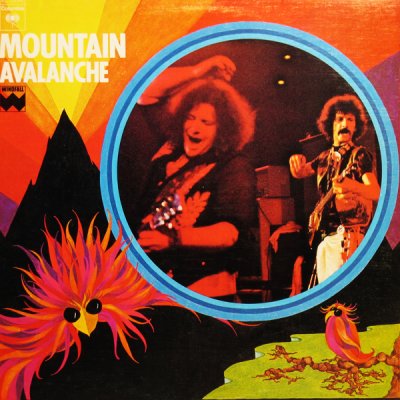
" During 1974, in the wake of the second live album, West, Laing, and Pappalardi revived Mountain again to record a studio LP, Avalanche. In subsequent years, West and Laing revived the group for live shows, sometimes joined by Pappalardi; West also performed with his own Leslie West Band. Sadly, Pappalardi was shot and killed by his wife in 1983. Two years later, West and Laing regrouped with Mark Clarke on bass and recorded an album before once again calling it quits.
Laing served as PolyGram's A&R vice president in Canada between 1989 and 1995. In 1996, he reunited with West and Clarke for a new Mountain album, Man's World. West and Laing teamed up again in 2002 for another album as Mountain, Mystic Fire.
Discography