music.nwby NeuraWeb Global Inc.
~13.0M artists · ~39.4M recordings indexed
Narrow to
KP
Person · Polish composer

Krzysztof Penderecki

Albums
192
Members
0
Active
1933–2020
Origin
Poland
Biography

Krzysztof Penderecki (born November 23, 1933 in Dębica) is a Polish composer and conductor. His 1960 avant-garde Threnody to the Victims of Hiroshima for string orchestra brought him to international attention, and this success was followed by acclaim for his choral St. Luke Passion. Both these works exhibit novel compositional techniques. Since the 1970s Penderecki's style has changed to encompass a post-Romantic idiom. He has won prestigious awards including Grammy Awards in 1987 and 1998 and 2001, and the Grawemeyer Award for Music Composition in 1992. As well as the works already mentioned, his compositions include four operas, eight symphonies and other orchestral pieces, a variety of instrumental concertos, choral settings of mainly religious texts, as well as chamber and instrumental works. After taking private composition lessons with Franciszek Skolyszewski, Penderecki studied music at Jagiellonian University and the Academy of Music in Kraków under Artur Malawski and Stanislaw Wiechowicz. Having graduated in 1958, he took up a teaching post at the Academy. Penderecki's early works show the influence of Anton Webern and Pierre Boulez (he has also been influenced by Igor Stravinsky). Penderecki's international recognition began in 1959 at the Warsaw Autumn with the premieres of the works Strophen, Psalms of David, and Emanations, but the piece that truly brought him to international attention was Threnody to the Victims of Hiroshima (see threnody and atomic bombing of Hiroshima), written for 52 string instruments. In it, Penderecki makes use of extended instrumental techniques (for example, playing on the "wrong" side of the bridge, bowing on the tailpiece). There are many novel textures in the work, which makes great use of tone clusters. He originally titled the work 8' 37", but decided to dedicate it to the victims of Hiroshima. Fluorescences followed a year later; it increases the orchestral density with more wind and brass, and an enormous percussion section of 32 instruments for six players including a Mexican güiro, typewriters, gongs and other unusual instruments. The piece was composed for the Donaueschingen Festival of contemporary music of 1962, and its performance was regarded as provocative and controversial. Penderecki's intentions at this stage were quite Cagean: 'All I'm interested in is liberating sound beyond all tradition'. This preoccupation with sound culminated in De Natura Sonoris I, which frequently calls upon the orchestra to use non-standard playing techniques to produce original sounds and colours. A sequel, De Natura Sonoris II, was composed in 1971: with its more limited orchestra, it incorporates more elements of post-Romanticism than its predecessor. This foreshadowed Penderecki's renunciation of the avant-garde in the mid-1970s, although both pieces feature dramatic glissandos, dense clusters, and a use of harmonics, and unusual instruments (the musical saw features in the second piece). Around the mid-1970s, while he was a professor at the Yale School of Music Penderecki's style began to change. The Violin Concerto No. 1 largely leaves behind the dense tone clusters with which he had been associated, and instead focuses on two melodic intervals: the semitone and the tritone. Some commentators compared this new direction to Anton Bruckner. This direction continued with the Symphony No. 2, Christmas (1980), which is harmonically and melodically quite straightforward. It makes frequent use of the tune of the Christmas carol Silent Night. Penderecki explained this shift by stating that he had come to feel that the experimentation of the avant-garde had gone too far from the expressive, non-formal qualities of Western music: 'The avant-garde gave one an illusion of universalism. The musical world of Stockhausen, Nono, Boulez and Cage was for us, the young - hemmed in by the aesthetics of socialist realism, then the official canon in our country - a liberation...I was quick to realise however, that this novelty, this experimentation and formal speculation, is more destructive than constructive; I realised the Utopian quality of its Promethean tone'. Penderecki concluded that he was 'saved from the avant-garde snare of formalism by a return to tradition'. In 1980, Penderecki was commissioned by Solidarity to compose a piece to accompany the unveiling of a statue at the Gdańsk shipyards to commemorate those killed in anti-government riots there in 1970. Penderecki responded with Lacrimosa, which he later expanded into one of the best known works of his later period, the Polish Requiem (1980-84, 1993, 2005). Again the harmonies are rich, although there are moments which recall his work in the 1960s. In recent years, he has tended towards more traditionally conceived tonal constructs, as heard in works like the Cello Concerto No. 2 and the Credo. He conducted Credo on the occasion of the 70th birthday of Helmuth Rilling, 29 May 2003. In celebration of his 75th birthday he conducted three of his works at the Rheingau Musik Festival in 2008, among them Ciaccona from the Polish Requiem. In 2001, Penderecki's Credo received the Grammy Award for best choral performance for the world-premiere recording made by the Oregon Bach Festival, which commissioned the piece. The same year, Penderecki was awarded with the Prince of Asturias Prize in Spain, one of the highest honours given in Spain to individuals, entities, organizations or others from around the world who make notable achievements in the sciences, arts, humanities, or public affairs. Invited by Walter Fink, he was the eleventh composer featured in the annual Komponistenporträt of the Rheingau Musik Festival in 2001. Penderecki received an honorary doctorate from the Seoul National University, Korea in 2005, as well as from the University of Münster, Germany in 2006. His notable students include Chester Biscardi and Walter Mays. Penderecki has three children, a daughter from his first marriage, and a son and daughter with his current wife, Ezbieta Solecka, whom he married in 1965. Some of Penderecki's music has been adapted for film soundtracks. The Shining (1980) features six pieces of Penderecki's music: Utrenja II: Ewangelia, Utrenja II: Kanon Paschy, The Awakening of Jacob, De Natura Sonoris No. 1, De Natura Sonoris No. 2 and Polymorphia. The Exorcist (1973) features Polymorphia as well as his String Quartet and Kanon For Orchestra and Tape; fragments of the Cello Concerto and The Devils of Loudun are also used in the film. Writing about The Exorcist, the film critic for The New Republic wrote "even the music is faultless, most of it by Krzysztof Penderecki, who at last is where he belongs."David Lynch has used Penderecki's music in the soundtracks of the movies Wild at Heart (1990) and Inland Empire (2006). Penderecki's piece, Threnody for the Victims of Hiroshima, was also used during one of the final sequences in the film Children of Men. Penderecki composed music for Andrzej Wajda's 2007 film Katyń, while Martin Scorsese's Shutter Island featured his Symphony No. 3 and Fluorescences.

Discography
Te Deum
Krzysztof Penderecki · 2007
Te Deum / Hymne an den Heiligen Daniel / Polymorphia
Krzysztof Penderecki · 2007
Seven Gates of Jerusalem
Krzysztof Penderecki · 2008
Symphony no. 2 "Christmas" / Sacred Works
Krzysztof Penderecki · 2008
Symphony no. 8 / Dies irae / Aus den Psalmen Davids
Krzysztof Penderecki · 2008
Symphony No. 8 • Dies Irae • Aus Den Psalmen Davids
Krzysztof Penderecki · 2008
Works For Cellos And Orchestra
Krzysztof Penderecki · 2008
Album cover
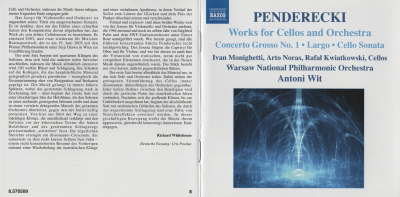
Works for Cellos and Orchestra: Concerto Grosso no. 1 / Largo / Cello Sonata
Krzysztof Penderecki · 2008
Complete Choral Works
Krzysztof Penderecki · 2009
Music for Chamber Orchestra
Krzysztof Penderecki · 2009
Rękopis znaleziony w Saragossie
Krzysztof Penderecki · 2009
Utrenja
Krzysztof Penderecki · 2009
Credo
Krzysztof Penderecki · 2010
Credo
Krzysztof Penderecki · 2010
Album cover
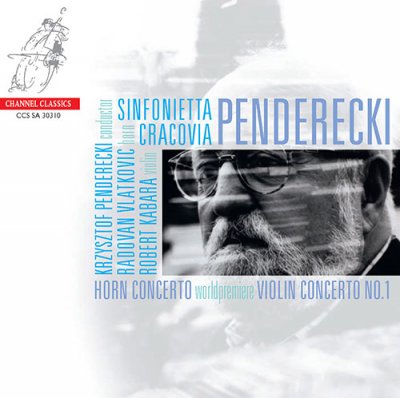
Horn Concerto / Violin Concerto
Krzysztof Penderecki · 2010
Viola Concerto / Cello Concerto no. 2
Krzysztof Penderecki · 2011
Album cover
A Portrait of Krzysztof Penderecki
Krzysztof Penderecki · 2012
Canticum Canticorum Salomonis / Kosmogonia / Hymne an den heiligen Adalbert / Song of the Cherubim / Strophen
Krzysztof Penderecki · 2012
Changing Colors
Krzysztof Penderecki · 2012
Fonogrammi / Horn Concerto / Partita / The Awakening of Jacob / Anaklasis / De natura sonoris
Krzysztof Penderecki · 2012
Sinfoniettas / Oboe Capriccio / Three Pieces in Old Style / Serenade / Intermezzo
Krzysztof Penderecki · 2012
The Symphonies And Other Orchestral Works
Krzysztof Penderecki · 2012
The Symphonies And Other Orchestral Works
Krzysztof Penderecki · 2012
Album cover
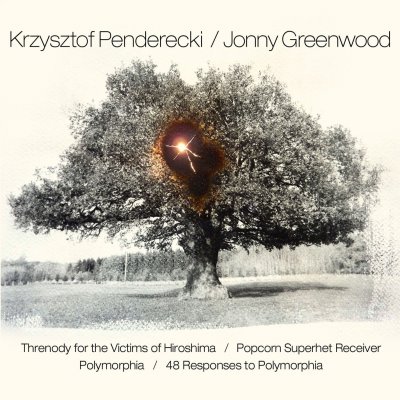
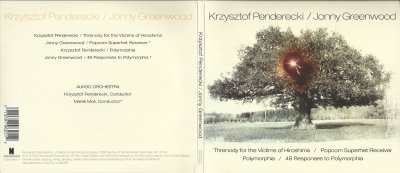
Threnody for the Victims of Hiroshima / Popcorn Superhet Receiver / Polymorphia / 48 Responses to Polymorphia
Krzysztof Penderecki · 2012
Complete Works for Cello Solo
Krzysztof Penderecki · 2013
Orchestral Works, Vol. 1
Krzysztof Penderecki · 2013
Piano Concerto »Resurrection«
Krzysztof Penderecki · 2013
Piano Concerto 'Resurrection', Flute Concerto
Krzysztof Penderecki · 2013
Album cover
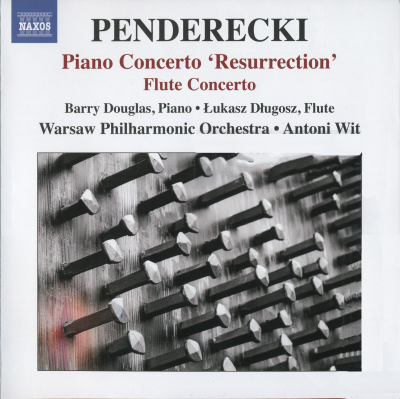
Piano Concerto "Resurrection" / Flute Concerto
Krzysztof Penderecki · 2013
String Quartets
Krzysztof Penderecki · 2013
The Complete Symphonies
Krzysztof Penderecki · 2013
A Sea of Dreams Did Breathe on Me…
Krzysztof Penderecki · 2015
Clarinet Concerto / Flute Concerto / Concerto Grosso no. 1
Krzysztof Penderecki · 2015
Homo ludens
Krzysztof Penderecki · 2015
Magnificat / Kadisz
Krzysztof Penderecki · 2015
Polska
Krzysztof Penderecki · 2015
Soli
Krzysztof Penderecki · 2015
Concertos for Wind Instruments and Orchestra
Krzysztof Penderecki · 2016
Oriental Trumpet Concertos
Krzysztof Penderecki · 2016
Penderecki Conducts Penderecki, Vol. 1
Krzysztof Penderecki · 2016
Piano Concertos
Krzysztof Penderecki · 2016
Kosmogonia
Krzysztof Penderecki · 2017
Penderecki Conducts Penderecki, Vol. 2: Choral Music
Krzysztof Penderecki · 2017
Penderecki / Dvořák
Krzysztof Penderecki · 2017
Cello Concertos
Krzysztof Penderecki · 2018
Hommage à Penderecki
Krzysztof Penderecki · 2018
Concerto per violoncello ed orchestra no. 2 / Sonata per violoncello ed orchestra
Krzysztof Penderecki · 2019
Penderecki
Krzysztof Penderecki · 2019
Sonoristic Penderecki by Penderecki
Krzysztof Penderecki · 2019
Symphony no. 3, op. 36 "Symphony of Sorrowful Songs"
Krzysztof Penderecki · 2019
Symphony no. 6 "Chinese Songs" / Concerto per clarinetto
Krzysztof Penderecki · 2019
Weinberg, Penderecki, Schnittke: String Trios
Krzysztof Penderecki · 2019
Horn Concerto / Adagio for Strings / Violin Concerto no. 1 / Threnody for the Victims of Hiroshima
Krzysztof Penderecki · 2020
Penderecki’s Sinfonietta(s)
Krzysztof Penderecki · 2020
Quatuors nos 1-3 / Unterbrochen Gedanke / Quatuor avec clarinette / Trio à cordes
Krzysztof Penderecki · 2020
St. Luke Passion
Krzysztof Penderecki · 2020
Complete Music For String Quartet
Krzysztof Penderecki · 2021
Complete Music For String Quartet / String Trio
Krzysztof Penderecki · 2021
Complete Quartets
Krzysztof Penderecki · 2021
Muzyka teatralna i filmowa
Krzysztof Penderecki · 2022

Credits

Symphony no. 3, op. 36 "Symphony of Sorrowful Songs"
Conductor · 2019
Album cover
A Portrait of Krzysztof Penderecki
Conductor · 2012
Album cover
Threnody for the Victims of Hiroshima / Popcorn Superhet Receiver / Polymorphia / 48 Responses to Polymorphia
Conductor · 2012
Rękopis znaleziony w Saragossie
Composer · 2009
Utrenja
Composer · 2009
Album cover
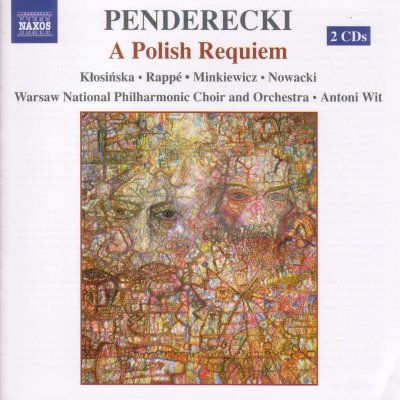
A Polish Requiem
Composer · 2004
Album cover
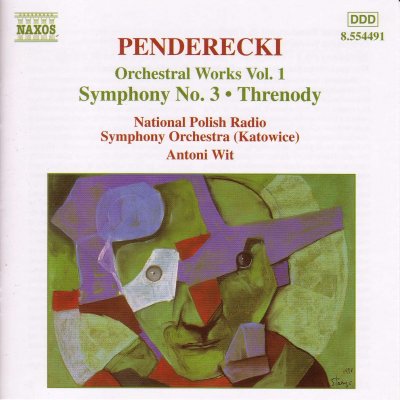
Orchestral Works, Vol. 1: Symphony no. 3 / Threnody
Composer · 2000
Violin Concerto No. 2 "Metamorphosen"
Liner Notes · 1997
Carmina Burana
Conductor · 1994
The Shining
Conductor · 1980
The Exorcist
Composer · 1974
Jutrznia/Utrenja
Composer · 1972
Album cover
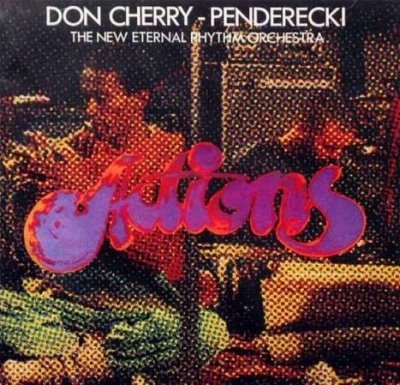
Actions
Conductor · 1971
Album cover
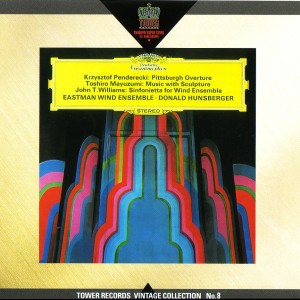
Williams: Sinfonietta for Wind Ensemble / Penderecki: Pittsburgh Overture / Mayuzumi: Music with Sculpture
Composer · 1970
Dies irae (Auschwitz Oratorio) / Polymorphia / De natura sonoris
Composer · 1967
20th Century Masterpieces - 100 Years Of Classical Music
Conductor · —
Actions
Composer · —
Akrata, Pithoprakta / Capriccio For Violin & Orchestra, De Natura Sonoris
Composer · —
A Portrait
Composer · —
Canticum Canticorum Salomonis / Als Jacob Erwachte / Threnos / De Natura Sonoris Nr. 1
Conductor · —
Canticum Canticorum Salomonis / Strophes / Cantata
Composer · —
Capriccio Für Violine Und Orchester / Capriccio Für Oboe Und Elf Streichinstrumente / Als Jakob Erwachte / Threnos
Composer · —
Caribbean Rhapsody
Art Direction · —
Complete Cello Concertos
Conductor · —
Complete Music For String Quartet
Composer · —
Concerto N° 2 Pour Violoncelle · Partita
Conductor · —
Concerto Per Viola Ed Orchestra · Capriccio · Strophen · Intermezzo · Drei Stücke Im Alten Stil
Composer · —
Contemporary Polish Music
Composer · —
Credo
Composer · —
Credo
Conductor · —
Credo
Composer · —
Debut
Composer · —
Die Neue Domäne Für Oboe
Composer · —
Doppelganger
Writer · —
Fonogrammi / De Natura Sonoris Nr. 2 / Emanationen Für Zwei Streichorchester / Partita Für Cembalo Und Orchester
Conductor · —
Fragments Of A Prayer (From The Motion Picture Children Of Men)
Composer · —
Hommage À Penderecki
Composer · —
Kammarkören
Composer · —
Koncert Skrzypcowy • Violin Concerto
Composer · —
Kosmogonia
Composer · —
Kosmogonia / Dimensions Of Time And Silence / De Natura Sonoris II
Composer · —
Lasalle String Quartet
Composer · —
Les Diables De Loudun
Composer · —
Magnificat
Conductor · —
Mendelssohn, Lidholm, Crusell, Sjtjedrin, Stravinskij, Penderecki, Denisov, Rautavaara
Composer · —
Messa Da Requiem
Conductor · —
Musica Da Camera
Composer · —
Music Around The Baltic Sea Vol.II
Composer · —
New York Counterpoint
Composer · —
Orchestral & Choral Works
Composer · —
Orchestral Works
Conductor · —
Orchestral Works Vol. 2 - Symphonies Nos. 1 & 5
Composer · —
Orchestral Works Vol. 3 - Symphonies Nos. 2 And 4
Composer · —
Orchestral Works Volume 4 - Violin Concertos Nos. 1 And 2
Composer · —
Passio Et Mors Domini Nostri Jesu Christi Secundum Lucam
Composer · —
Passio Et Mors Domini Nostri Jesu Christi Secundum Lucam
Composer · —
Penderecki: Concerto Per Violino / Violin Concerto, Shostakovich: Sinfonia N.6 / Symphony No. 6
Conductor · —
Penderecki Conducts Penderecki Album 1
Conductor · —
Penderecki Conducts Penderecki Album 2
Conductor · —
Penderecki Dirigiert Penderecki
Composer · —