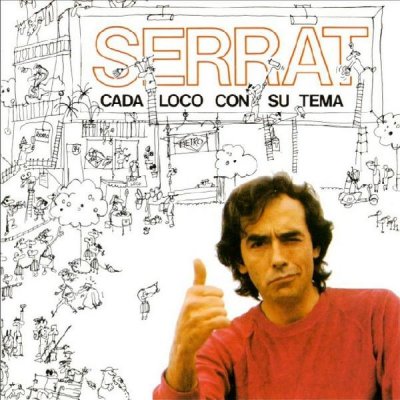
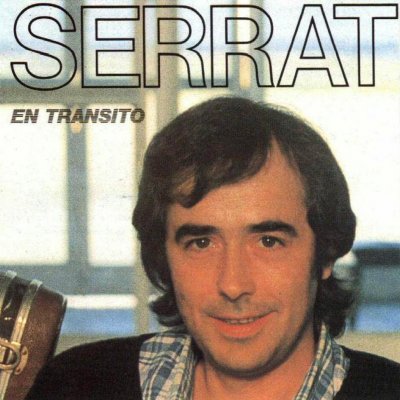
Joan Manuel Serrat
Joan Manuel Serrat i Teresa (Catalan pronunciation: [ʒuˈam mənuˈɛɫ səˈrat]) (27 December 1943) is a Spanish musician, singer-songwriter, recording artist, and performer. He is considered one of the most important figures of modern, popular music in both the Spanish and Catalan languages. Serrat's lyrical style has been influenced by other poets such as Mario Benedetti, Antonio Machado, Miguel Hernández, Rafael Alberti, Federico García Lorca, Pablo Neruda, and León Felipe. He has also recorded songs by Violeta Parra and Víctor Jara. Serrat was one of the pioneers of what is known in Catalan as "Nova Cançó". Joan Manuel Serrat is also known by the names "El noi del Poble-sec" and "El Nano".
Biography
Childhood Joan Manuel Serrat i Teresa was born the 27 of December 1943 in the Poble-sec neighbourhood of Barcelona, to members of a working family.. His father, Josep Serrat, was a Spanish anarchist affiliated with the CNT and his mother, Ángeles Teresa, the woman of the home was from Belchite, Zaragoza. His childhood and environment in his neighbourhood greatly impacted him, as a great number of his songs described Catalonia after the Spanish Civil War (examples are "La Carmeta", "La tieta" y "El drapaire" as stereotypical characters from his neighbourhood).
Early career Serrat became involved with music at the age of 17 when he obtained his first guitar to which he dedicates one of his earliest songs, "Una guitarra". In the early 1960s, the young artist participated in a pop band, playing along with classmates at Barcelona's Agronomy School and performing mainly Beatles songs and Italian 'pop-of-the-era' songs translated to Spanish. In 1965, while singing in a radio show called Radioscope, host Salvador Escamilla helped him secure a record deal with local label Edigsa, from there joining the group Els Setze Jutges which defended the Catalan language during the Franco dictatorship. In that same year, he recorded his first EP Una guitarra with the songs Una guitarra, Ella em deixa, La mort de l'avi and El mocador. In 1966 appeared his second EP Ara que tinc vint anys with the songs Ara que tinc vint anys, Quan arriba el fred, El drapaire and Sota un cirerer florit. In 1967 his first LP was released Ara que tinc vint anys which included some songs from previous EP recordings, as well as Balada per a un trobador, Els vells amants and Els titelles. Joan Manuel Serrat's first live stage performance in 1967 at the Palau de la Música Catalana, served to establish him as one of the most important artists inside the Nova cançó movement in Catalonia. The following year, Spain entered Serrat in the Eurovision Song Contest 1968 to sing "La, la, la", but he asked to sing it in Catalan, to which the Spanish authorities would not agree. This would be the first time he would come into conflict with the language politics of Francoist Spain, because of his decision to sing in his native Catalan language, repressed by dictator Francisco Franco. Defiantly, Serrat refused to sing the Spanish-language version, and was hurriedly replaced by Massiel, who went on to win the contest with her Spanish-language interpretation. As a result, Serrat's songs were banned and his records burned in the streets.
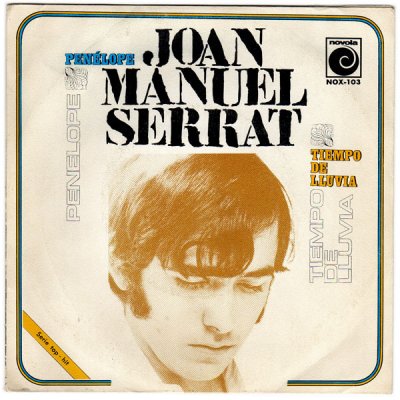
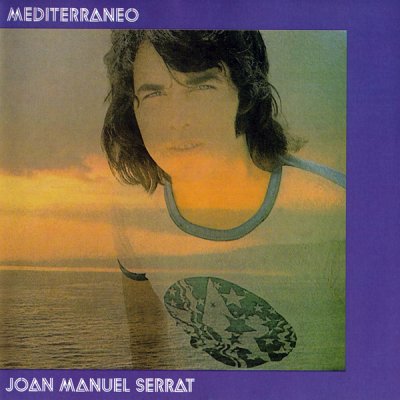
1969-1974 Serrat's first son Queco is born in 1969, and in that same year he made his first tour to South America. He released an album containing songs with texts of Antonio Machado, a well-known Spanish poet of late 19th-early 20th century. This album brought him immediate fame in all Spain and Latin America though, in spite of this, his decision to sing in Spanish was criticized in some Catalan nationalist circles. Regarding this and other times when his choice of language (sometimes Spanish, sometimes Catalan) raised controversy on either side of the political sphere, he once explained: "I sing better in the language they forbid me." He participated and won the song festival of Rio de Janeiro in 1970 with his single Penélope. The release of the Mediterráneo LP in 1971 consolidated the artist's reputation worldwide. During that year, Serrat sang a seminal concert at the theater of the University of Puerto Rico, Río Piedras Campus, which was highly influential in the Puerto Rican music community of the time, and which had repercussions as late as 2006. In late 1974, Serrat was exiled in Mexico due to his condemnation of arbitrary executions under Franco's regime. It wasn't until Franco's death on November 20, 1975 that Serrat was able to return to his homeland. In 1976, Joan Manuel Serrat was acclaimed for the first time in the U.S.A., while performing in Los Angeles, San Francisco, and New York. In January 1995, the Spanish government awarded him a medal for his contribution to Hispanic culture. That same year, a tribute album called Serrat, eres único was made to honour his career, featuring artists such as Diego Torres, Ketama, Rosario Flores, Joaquín Sabina, and Antonio Flores. On 28 November 1998, Serrat performed the Cant del Barça during the FC Barcelona Centenary festival at the Camp Nou. In 2000, the Spanish Association of Authors and Editors (SGAE) awarded him with one of ten Medals of the Century. Serrat revealed in October 2004 that he had been undergoing treatment for cancer of the urinary bladder and in November that year he had to cancel a tour of Latin America and the U.S. in order to undergo surgery in Barcelona, where he still lives. His signature song "Mediterráneo" was selected as the most important song of the 20th century in Spain. His recovery was satisfactory, and in 2005 he went on tour again ("Serrat 100×100") around Spain and Latin America with his lifelong producer and arranger, Ricard Miralles. During the tour Serrat played symphonic versions of his songs with local symphony orchestras. A second volume of Serrat, eres único was also released this year, featuring Alejandro Sanz, Estopa, and Pasión Vega. Around the same time, Cuban artists such as Silvio Rodríguez, Pablo Milanés, Chucho Valdez, and Ibrahim Ferrer came together to make another tribute CD, Cuba le canta a Serrat. By 2006, the theater of the University of Puerto Rico in Río Piedras where Serrat sang in 1970 had undergone a multi-million dollar renovation, after being closed for ten years. The university planned to reopen the theater with Serrat as its first popular culture act, thus recalling his first performance there. However, student protests over the university conceding private entities control over some theater administration functions ended up in a physical confrontation between some student leaders and patrons attending the theater's inaugural gala, the day before Serrat's first scheduled performance. As a result, the concerts had to be postponed and changed to another venue. Serrat felt particularly uneasy about the whole situation; when he was pressed to take sides in the controversy he opted to remain neutral. In 2006, Serrat also released Mô, his first album completely in Catalan in 17 years. The album title refers to the city of Mahón, capital of the Spanish island of Menorca, where he likes to get away from it all during long touring seasons. Serrat is a part owner of the Mas Perinet winery producing both DO Montsant and DOC Priorat wines in La Morera de Montsant.
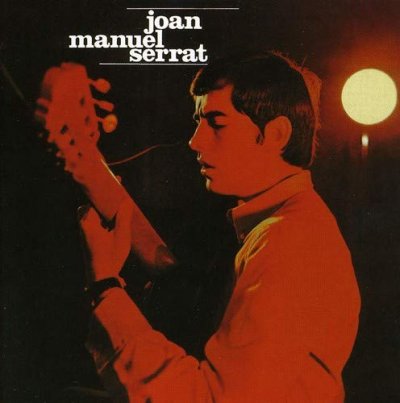
Discography
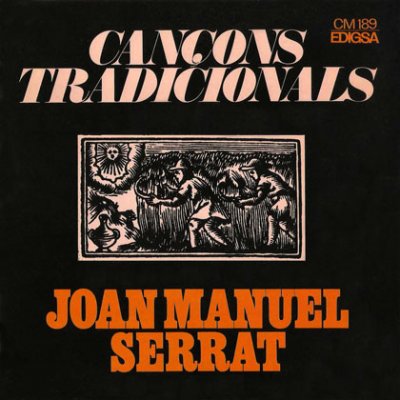
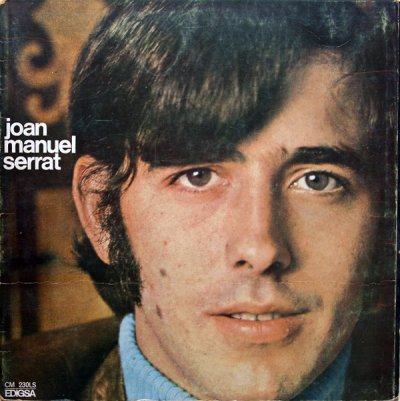
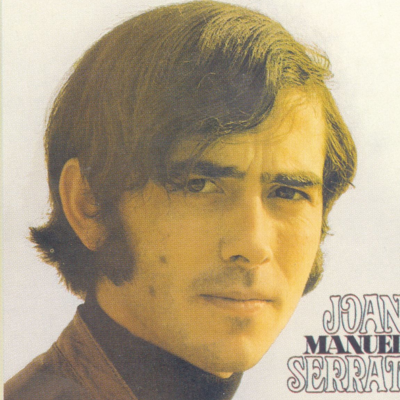

Credits